

Leadership During Trade Disruption: Executive Playbook
The 2026 trade landscape reveals a harsh truth: most executives still treat disruption as a temporary shock rather than the operating environment. Between escalating tariffs, reshored manufacturing mandates, and geopolitical supply chain fractures, leadership during trade disruption has shifted from crisis management to strategic competency. Organizations that succeed aren’t just weathering storms. They’re fundamentally restructuring decision-making processes, abandoning outdated playbooks, and building capabilities that turn volatility into competitive advantage.
The Strategic Failures Most Leaders Miss
Three critical errors separate struggling organizations from resilient ones during trade shocks. First, leaders confuse speed with strategic clarity. When tariffs hit in early 2026, we observed executives rushing to alternative suppliers without assessing total landed costs, regulatory compliance gaps, or quality control implications. The result: supply chain pivots that created more problems than they solved.
Second, leadership teams operate in functional silos precisely when cross-functional integration matters most. Finance evaluates tariff impact. Operations scrambles for new suppliers. Legal reviews contract implications. Nobody owns the holistic view. Research on decision-making frameworks during supply chain disruptions confirms that structured, integrated approaches deliver superior outcomes compared to fragmented responses.
Third, organizations fail to distinguish between immediate tactical responses and long-term strategic repositioning. A client example: a mid-market manufacturer responded to 15% tariffs by absorbing costs to maintain customer relationships. Six months later, margins collapsed, and competitors who had repositioned their supply chains owned the pricing conversation.
What Diagnostic Assessments Reveal
Advanced leadership diagnostics consistently identify specific capability gaps during trade turbulence:
- Scenario planning weakness: 73% of executives lack robust frameworks for modeling multiple disruption scenarios simultaneously
- Cross-functional communication breakdowns: Siloed decision-making delays response time by an average of 3-4 weeks
- Risk tolerance misalignment: Leadership teams frequently operate with conflicting assumptions about acceptable exposure levels
- Stakeholder communication failures: External messaging lags internal decisions, creating trust deficits with customers and investors
The gap between knowing disruption is coming and preparing systematically remains enormous. When we audit executive teams facing trade challenges, the pattern repeats: smart leaders with inadequate frameworks making reactive decisions under pressure.

The Cross-Functional Integration Imperative
Leadership during trade disruption demands a fundamental shift in how executive teams collaborate. Traditional hierarchical decision flows break down when disruptions cascade across functions simultaneously. Consider the tariff announcement scenario: procurement needs immediate supplier alternatives, finance requires cost impact models, legal must review contract force majeure clauses, operations needs production timeline adjustments, and sales requires customer communication strategies.
All within 48 hours.
Organizations that navigate this effectively establish integrated response teams with clear decision rights and real-time information sharing. One Fortune 500 client implemented what they called “disruption sprints”: 72-hour intensive sessions where cross-functional leaders worked a single problem collaboratively, breaking down silos and building shared mental models.
The alternative is chaos. We’ve observed leadership teams scheduling sequential meetings across departments, each reviewing the same disruption with different lenses, reaching conflicting conclusions, and escalating decisions up organizational hierarchies that can’t move fast enough.
| Traditional Approach | Integrated Approach | Outcome Difference |
|---|---|---|
| Sequential functional review | Concurrent cross-functional analysis | 60% faster decision cycles |
| Siloed information gathering | Shared real-time data platforms | 45% reduction in blind spots |
| Hierarchy-dependent escalation | Empowered team decision rights | 70% improvement in response quality |
| Individual functional metrics | Shared outcome accountability | 3x better execution alignment |
The insights from women leaders in trade ecosystems emphasize this collaborative imperative. When leaders pause to integrate perspectives rather than rushing to individual functional solutions, organizations identify opportunities competitors miss.
Strategic Repositioning vs. Tactical Firefighting
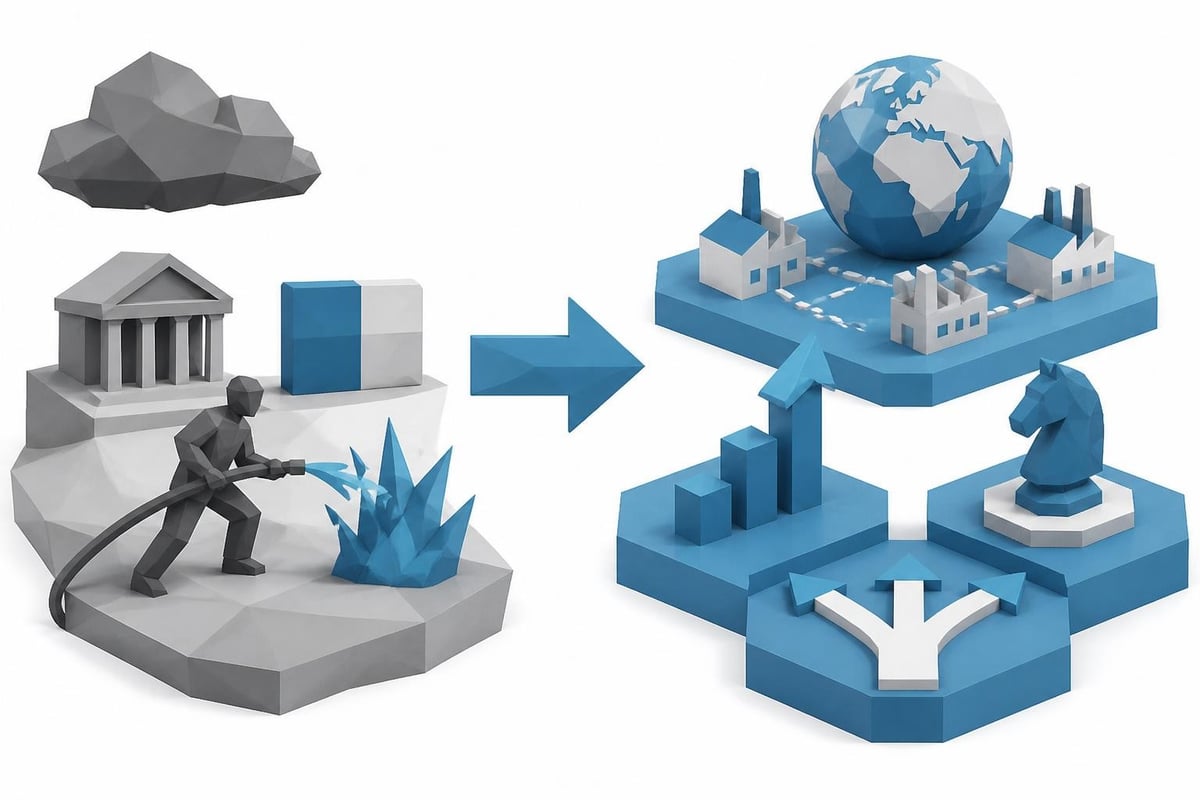
The most consequential leadership failure during trade disruption is conflating short-term tactics with long-term strategy. Absorbing tariff costs, switching suppliers, or adjusting pricing are tactical moves. Strategic repositioning means fundamentally rethinking supply chain architecture, market positioning, and competitive advantage.
We worked with a government contractor facing simultaneous challenges: new Buy American requirements, supplier consolidation mandates, and budget constraints. Initial leadership response focused on compliance tactics: documenting domestic content, auditing supplier locations, and adjusting procurement processes.
The strategic question was different: How should sourcing strategy evolve to turn regulatory requirements into competitive moats that smaller competitors couldn’t match?
This reframing led to a complete supply chain redesign that consolidated domestic suppliers, built deeper partnerships with fewer vendors, and created cost advantages through volume commitments that tactical compliance efforts would never achieve.
The Repositioning Framework
- Map current state vulnerabilities: Identify which disruption types create existential risk vs. manageable challenges
- Define strategic objectives: Determine whether goals prioritize resilience, cost leadership, speed to market, or innovation capacity
- Evaluate structural options: Assess nearshoring, diversification, vertical integration, or strategic partnership alternatives
- Model total economic impact: Calculate not just direct costs but strategic option value and competitive positioning shifts
- Build implementation roadmap: Sequence changes to maintain operational continuity while executing transformation
The framework addresses what resilient leaders understand about trade turbulence: disruption creates market share opportunities when competitors remain stuck in reactive mode.
The Situational Control Paradox
Research on SME exporters during supply chain disruptions reveals a counterintuitive finding: leaders who accept limited situational control often make better strategic choices than those pursuing total control.
The paradox plays out repeatedly. Executives facing tariff uncertainty demand perfect information before deciding. They wait for policy clarity that never comes, competitor moves that remain opaque, and market conditions that continue shifting. Meanwhile, leaders who acknowledge uncertainty’s permanence establish decision frameworks that work despite incomplete information.
One manufacturing client faced this directly when 2026 tariff policies created a decision tree with sixteen possible scenarios. Traditional planning would map all sixteen, build contingencies for each, and update continuously as conditions changed. Paralysis disguised as thoroughness.
The alternative: identify the two or three factors that matter most, establish clear decision triggers for each, and build flexible capacity to pivot when triggers activate. This isn’t ignoring complexity. It’s recognizing that detailed planning for low-probability scenarios wastes resources better invested in adaptive capacity.
Decision Triggers That Matter
- Cost threshold breaches: Define specific landed cost increases that trigger supplier changes or market exits
- Supply continuity risks: Establish lead time extensions or quality metrics that mandate backup sourcing activation
- Competitive pricing shifts: Monitor competitor pricing moves that signal market repositioning requirements
- Policy implementation milestones: Track regulatory timelines that compress decision windows
This approach borrows from how leaders turn policy disruptions into strategic advantages. Organizations that build trigger-based decision frameworks move faster and more confidently than those pursuing comprehensive scenario analysis.
Building Organizational Muscle for Continuous Disruption
Leadership during trade disruption in 2026 requires accepting that volatility isn’t temporary. The question shifts from “how do we weather this storm” to “how do we build permanent capabilities for operating in continuous turbulence.”
This means different investments:
Traditional crisis response: Hire consultants to map current disruption. Build point solutions. Return to normal operations when crisis passes.
Permanent capability building: Develop internal expertise in scenario planning. Establish standing cross-functional teams with disruption response mandates. Integrate resilience metrics into standard performance management. Create dedicated coaching programs that build leadership capabilities for navigating uncertainty.
We’ve observed that organizations investing in leadership development specifically focused on disruption management outperform peers by meaningful margins. One Fortune 500 client implemented quarterly “red team” exercises where senior leaders simulate different disruption scenarios and pressure-test response plans. The goal isn’t perfect predictions. It’s building the cognitive flexibility and collaborative muscle memory that enables rapid, coordinated responses when real disruptions hit.
The evolution of supply chain leadership thinking confirms this shift. Leaders who treat disruption as an ongoing strategic variable rather than an exceptional event build fundamentally different organizational capabilities.
The Communication Dimension Leaders Underestimate
Trade disruption creates cascading stakeholder communication challenges that most leadership teams handle poorly. Customers need reassurance about supply continuity and pricing stability. Employees require context for operational changes and workload shifts. Investors demand clarity on financial impacts and strategic responses. Suppliers need partnership signals amid uncertainty.
The failure pattern: leaders focus on internal decision-making and treat communication as a secondary implementation task. The result is information vacuums that stakeholders fill with worst-case assumptions.
A client example illustrates the cost. When tariffs disrupted their supply chain, leadership spent three weeks developing a supplier diversification strategy before communicating with customers. In the interim, their largest customer, hearing nothing, initiated conversations with competitors about backup sourcing. By the time our client communicated their plan, they were defending existing relationships rather than strengthening them.
The alternative approach: parallel communication streams that provide transparency about the decision process even before final decisions emerge.
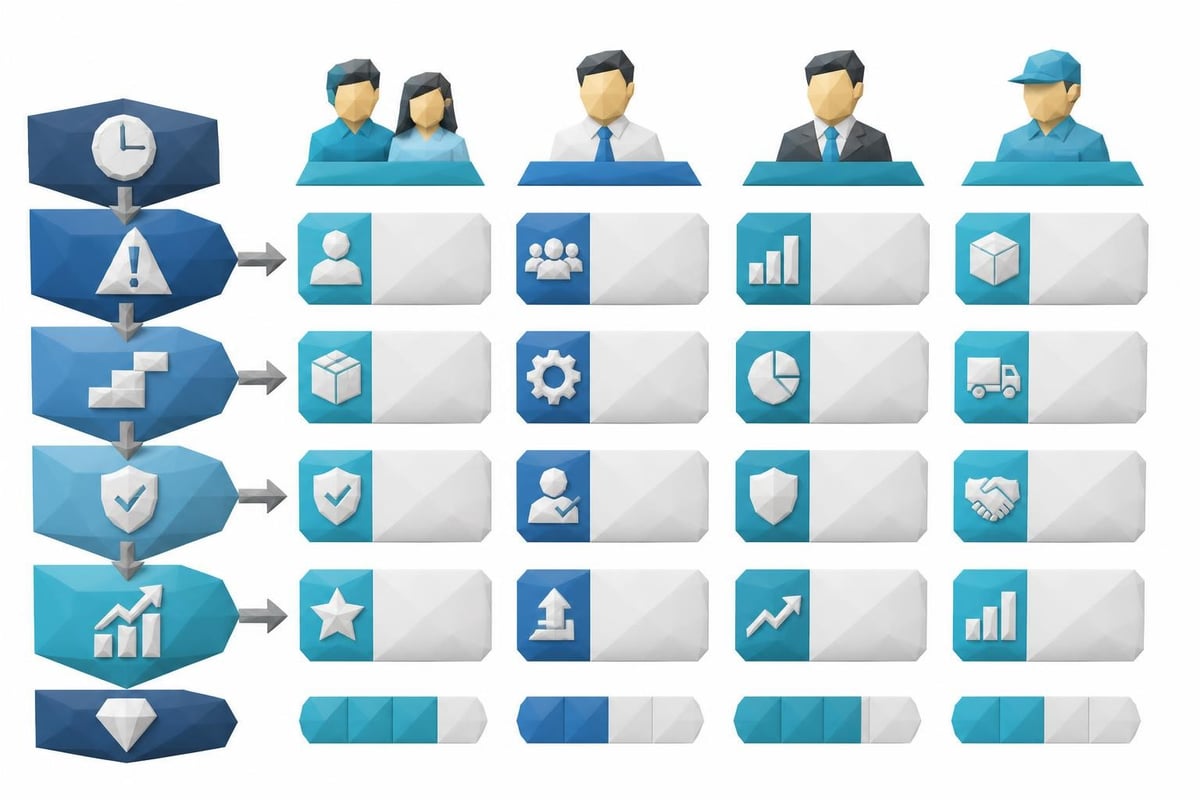
Communication Architecture for Disruption
| Stakeholder | Timing | Message Focus | Channel |
|---|---|---|---|
| Executive Team | Immediate | Strategic options, decision framework, role clarity | Daily standups, shared workspace |
| Board | Within 48 hours | Risk assessment, response plan, resource requirements | Formal briefing, written updates |
| Employees | Within 72 hours | Operational changes, job security, expectations | All-hands meeting, manager cascade |
| Customers | Within one week | Supply continuity, pricing approach, partnership commitment | Direct outreach, account teams |
| Suppliers | Concurrent | Partnership signals, volume commitments, collaboration needs | Executive-to-executive contact |
| Investors | Quarterly cycle | Financial impact, strategic positioning, competitive response | Earnings calls, investor relations |
The discipline here isn’t just message content but cadence and consistency. Strategies for navigating tariff uncertainty emphasize that leaders who communicate proactively and frequently reduce organizational anxiety and maintain stakeholder confidence even when delivering difficult messages.
The Role of Executive Coaching in Disruption Response
Organizations rarely acknowledge how leadership during trade disruption exposes individual executive limitations. The capabilities required operating in stable environments and those needed navigating volatility overlap partially but not completely.
Stable environment leadership rewards planning rigor, process optimization, incremental improvement, and predictable execution. Disruption leadership demands comfort with ambiguity, rapid decision-making despite incomplete information, cross-functional orchestration, and strategic flexibility.
Most executives weren’t hired or developed for the latter. They’re smart, experienced leaders suddenly operating outside their capability sweet spots. The typical response: work harder, push through, rely on existing strengths. The better response: acknowledge the gap and build new capabilities systematically.
This is where targeted executive coaching creates measurable impact. We’ve seen executives transform their disruption response effectiveness through focused coaching interventions that address:
- Decision-making under uncertainty: Building frameworks for choosing amid incomplete information rather than waiting for clarity that won’t come
- Cross-functional influence: Developing the collaborative leadership skills required to orchestrate rapid responses across silos
- Strategic communication: Learning to message complex, evolving situations to diverse stakeholders with appropriate transparency and confidence
- Stress resilience: Managing the cognitive and emotional load of sustained high-stakes decision-making without burnout
The organizations that navigate disruption most effectively aren’t just those with better strategies. They’re those that invest in developing leaders who can execute those strategies under pressure. Understanding the human skills AI cannot replace becomes critical as executives face increasingly complex judgment calls.
Case Study: Regional Manufacturer’s Tariff Response
A regional automotive parts manufacturer faced 25% tariffs on imported components representing 40% of their cost structure. Initial executive response followed predictable patterns: finance modeled price increases, operations contacted alternative suppliers, and leadership debated whether to absorb costs temporarily.
The diagnosis: Leadership team lacked shared mental model of the strategic choice architecture. Each functional leader saw a different primary problem requiring different solutions. No integration mechanism existed to evaluate tradeoffs systematically.
The intervention: We facilitated a two-day intensive session using a structured decision framework that required collaborative analysis of four strategic options:
- Price passthrough: Maintain margins, accept volume risk
- Cost absorption: Maintain volume, accept margin compression
- Supply chain restructuring: Nearshore production, invest in domestic suppliers
- Market repositioning: Exit price-sensitive segments, focus on premium products with better margins
Each option carried different financial profiles, execution timelines, competitive implications, and risk exposures. The exercise forced leadership alignment on strategic priorities before choosing tactics.
The result: Leadership selected a hybrid approach combining partial price increases in premium segments with accelerated nearshoring for high-volume components. They communicated the strategy transparently to customers with 90-day transition timelines, offered extended contracts at adjusted pricing to secure commitments, and partnered with two domestic suppliers willing to co-invest in capacity expansion.
Eighteen months later, the company gained market share as less-prepared competitors either absorbed unsustainable costs or lost customers through reactive price increases. The leadership team credited their improved cross-functional collaboration and strategic decision framework as permanent capability gains beyond that single disruption.
The lesson: Leadership during trade disruption requires frameworks that integrate functional expertise into coherent strategic choices rather than optimizing individual functional objectives independently.
FAQ Schema
What is the most common leadership failure during trade disruption?
The most common failure is treating disruption as a temporary crisis requiring tactical firefighting rather than a strategic inflection point demanding fundamental repositioning. Leaders focus on immediate cost mitigation or supplier switches without assessing whether disruption creates opportunities to restructure supply chains, competitive positioning, or market strategy for long-term advantage.
How should executives balance speed and thoroughness when trade policies change?
Effective executives establish decision triggers and clear frameworks before disruptions occur, enabling rapid responses without sacrificing strategic thinking. Rather than pursuing perfect information, they identify the two or three factors that matter most, define threshold metrics that require action, and build flexible capacity to adjust as conditions evolve. Speed comes from preparation, not from skipping analysis.
What cross-functional capabilities matter most during supply chain shocks?
The critical capabilities are integrated scenario planning that brings finance, operations, legal, and commercial teams together from the start; shared real-time information platforms that eliminate information asymmetry; empowered decision rights that allow cross-functional teams to act without constant escalation; and joint accountability for outcomes rather than individual functional metrics. Organizations with these capabilities respond 60% faster and execute with 70% better quality.
How do leaders maintain stakeholder confidence during trade uncertainty?
Leaders maintain confidence through proactive, frequent communication that provides transparency about decision processes even before final decisions emerge. The discipline involves parallel communication streams to different stakeholder groups with appropriate timing, message focus, and channels. Leaders who communicate early about what they’re evaluating and why outperform those who wait until they have perfect answers.
What role does executive coaching play in navigating disruption?
Executive coaching builds capabilities that stable-environment experience doesn’t develop: decision-making under uncertainty, cross-functional influence without authority, strategic communication of evolving situations, and cognitive resilience under sustained pressure. Organizations that invest in targeted coaching for executives facing disruption see measurable improvements in response quality, team collaboration, and strategic outcomes compared to those relying solely on existing leadership strengths.
Trade disruption isn’t temporary in 2026, and leadership approaches built for stability won’t work in permanent volatility. The executives and organizations that thrive are those building systematic capabilities in cross-functional integration, strategic repositioning, and adaptive decision-making rather than optimizing for crisis response. If your leadership team needs to develop these capabilities with precision and measurable results, Noomii Leadership Coaching delivers evidence-based diagnostics, expert coach matching, and targeted interventions that transform how executives navigate complexity and drive organizational resilience.



Leave a Reply
Want to join the discussion?Feel free to contribute!