

When Coaching Is the Better Choice for Business Leaders
Most organizations waste money on the wrong interventions. They send managers to mentoring programs when those managers need specific performance improvement. They invest in training when execution gaps demand accountability. They offer therapy benefits when leaders need goal-driven skill development. Understanding when coaching is the better choice saves time, budget, and prevents mediocre outcomes that damage credibility with boards and investors.
The Core Distinction That Most Leaders Miss
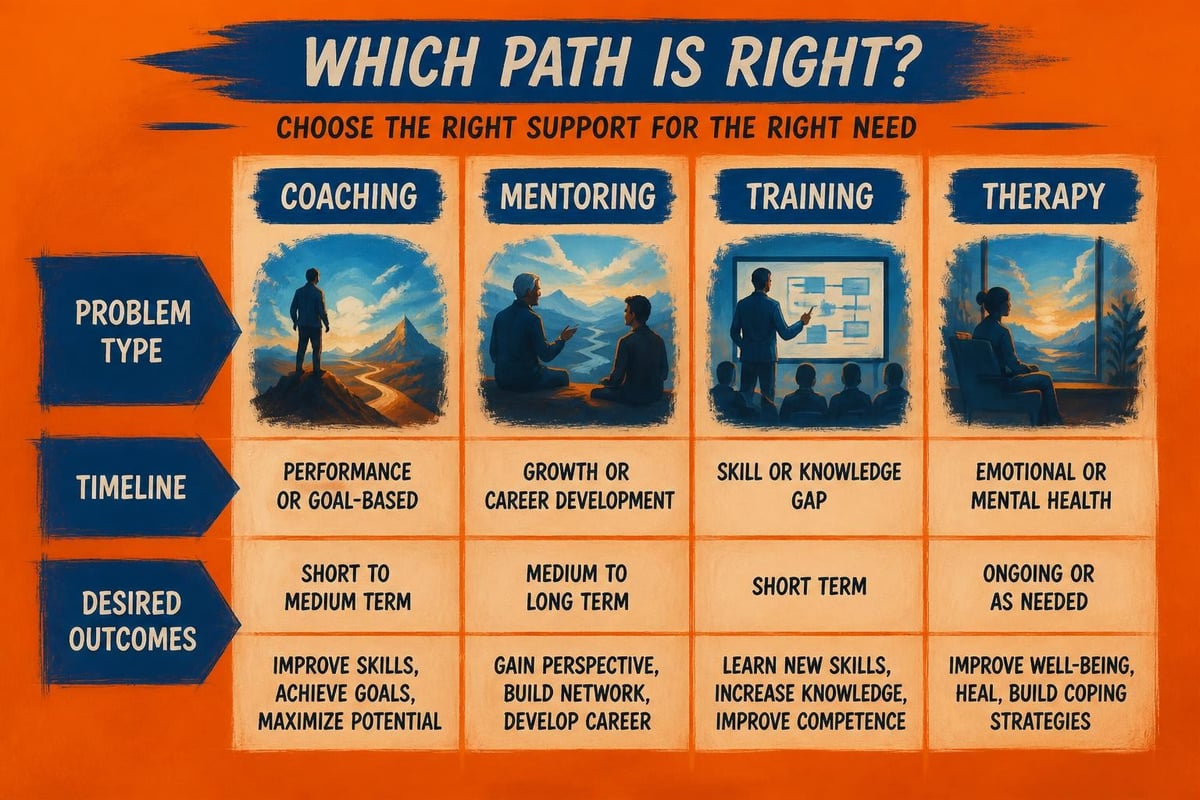
The confusion stems from overlapping terminology. Coaching focuses on performance improvement, behavior change, and achieving measurable goals within defined timeframes. It's structured, objective-driven, and tied to business outcomes. Coaching versus mentoring reveals a fundamental difference: coaching addresses specific skill gaps and performance targets, while mentoring provides broad career guidance through relationship building.
When coaching is the better choice becomes clear when you identify what problem you're actually solving:
- Performance gaps between current state and required competency
- Behavioral patterns blocking execution (micromanagement, conflict avoidance, poor prioritization)
- Skill deficits preventing role advancement or team effectiveness
- Accountability failures where strategies stall in implementation
A 2026 mid-market CFO we coached illustrates this. Strong technical skills, promoted to leadership, couldn't delegate. His team missed deadlines while he worked 70-hour weeks. Mentoring wouldn't fix this. He didn't need career advice from a senior executive. He needed coaching on delegation frameworks, communication patterns, and accountability structures. Within eight weeks, his team velocity increased 40% and his hours dropped to 50.

Five Scenarios Where Coaching Outperforms Alternatives
New Leaders Struggling With Transition
First-time managers promoted for technical excellence hit a wall. They manage tasks well but can't coach their teams, delegate effectively, or navigate conflict. Training modules don't solve this because the problem isn't knowledge. It's application under pressure with real team dynamics.
When coaching is the better choice here: the leader needs someone watching their actual performance, providing feedback on real situations, and holding them accountable to new behaviors. Leadership coaching addresses the execution gap that training and mentoring cannot.
Teams Missing Targets Despite Clear Strategy
We've seen this pattern across industries. Strategy is solid, resources are adequate, but results lag. The issue sits in execution discipline, meeting effectiveness, and accountability rhythms. At Noomii, we coach live in client meetings, observing decision-making, communication breakdowns, and follow-through failures in real time.
| Intervention | Best For | Typical Timeline | Outcome Focus |
|---|---|---|---|
| Coaching | Performance gaps, behavior change | 3-6 months | Measurable KPIs, skill application |
| Mentoring | Career guidance, industry insight | 1-2 years | Relationship, wisdom transfer |
| Training | Knowledge transfer, compliance | Days to weeks | Information retention |
| Therapy | Mental health, trauma, clinical issues | Ongoing | Emotional wellbeing, past healing |
This comparison matters because misdiagnosis wastes budget. A sales team missing quota doesn't need product training if they already know the features. They need sales coaching on objection handling, pipeline discipline, and closing conversations.
High-Potential Employees Ready for Advancement
Organizations identify future leaders but struggle to develop them fast enough. When coaching is the better choice over mentoring becomes evident when timing matters. A high-potential individual contributor needs specific skills (strategic thinking, executive presence, team leadership) within 6-12 months to fill an upcoming role.
Mentoring provides valuable perspective but lacks the structured skill development and accountability that coaching delivers. Understanding coaching versus mentoring differences shows that coaching accelerates targeted competency growth while mentoring builds networks and wisdom over years.

Behavioral Issues Blocking Team Performance
A director with brilliant ideas alienates peers through aggressive communication. An otherwise effective VP avoids difficult conversations, letting performance issues fester. Training on "communication skills" won't change ingrained patterns developed over decades.
Behavioral change requires:
- Awareness through feedback (360 assessments, direct observation)
- Alternative approaches practiced in real situations
- Accountability for trying new behaviors
- Reflection on what works and what doesn't
- Reinforcement until new patterns become natural
This is coaching territory. We've worked with executives who knew their communication style caused problems but couldn't shift without someone calling out the pattern in the moment and holding them to different choices. The difference between coaching and therapy matters here: coaching addresses performance and future goals, while therapy explores past trauma and mental health. If someone needs emotional healing or clinical support, resources like Théla Psychotherapy Clinic provide trauma-informed care that coaching cannot replace.
Organizations Implementing New Operating Rhythms
When companies adopt new meeting cadences, KPI scorecards, or decision-making frameworks, the failure point is rarely understanding the system. It's maintaining discipline when pressure hits. Leaders revert to old habits: skipping one-on-ones, avoiding metrics reviews, making decisions in hallways instead of proper forums.
We coach executives and their teams through these transitions, attending their actual meetings and providing immediate feedback. This isn't theoretical. It's pattern interruption at the moment behavior occurs, which creates lasting change far faster than workshop content delivered in conference rooms.
When Other Interventions Make More Sense
Coaching isn't always the answer, and claiming otherwise erodes credibility. When knowledge gaps exist, training delivers faster results. When someone needs industry connections and career perspective, mentoring provides value coaching cannot. When clinical mental health challenges interfere with work, therapy or clinical support becomes essential.
The decision framework is straightforward:
Choose coaching when:
- The gap is performance, behavior, or skill application
- Timeframe is 3-12 months for measurable improvement
- You can define clear outcomes and track progress
- The individual has capacity and willingness to change
Choose alternatives when:
- Pure knowledge transfer is needed (training)
- Long-term relationship and wisdom matter more than immediate performance (mentoring)
- Clinical mental health support is required (therapy, clinical services)
Many professionals benefit from multiple interventions. A rising leader might work with a coach on delegation skills while maintaining a mentor relationship for career guidance and accessing support from platforms like Soluna Connect for meaningful professional connections. The key is matching the intervention to the actual problem.
Evidence from Mid-Market Companies
We've coached leaders across manufacturing, technology, professional services, and healthcare since well before most coaching directories existed. The pattern is consistent: when coaching is the better choice, results show up in weeks, not quarters.
A 2025 engagement with a 180-person software company illustrates this. Their engineering managers couldn't give feedback or run effective one-on-ones. Employee engagement scores dropped, turnover increased, and product velocity slowed. Training them on "feedback models" failed twice.
Problem: Managers avoided difficult conversations and didn't know how to coach performance
Diagnosis: Knowledge wasn't the issue; behavioral patterns and accountability were
Solution: Six-month coaching engagement with live observation, feedback, and weekly accountability
Result: Engagement scores up 28%, turnover down 35%, and sprint velocity improved 22%
Lesson: Behavioral change requires observation and accountability, not more training content
This aligns with broader research on coaching’s role in skill enhancement and targeted development. When objectives are specific and measurable, coaching delivers superior ROI compared to generalized development approaches.
The Credential Trap and What Actually Matters
The coaching industry loves credentials. ICF certifications, university programs, and various acronyms dominate marketing. But when coaching is the better choice for your business, credentials predict outcomes poorly. What matters:
- Pattern recognition from coaching similar roles, industries, and challenges
- Business acumen to understand your metrics, market pressures, and constraints
- Direct observation skills to identify gaps between stated and actual behavior
- Accountability structures that ensure follow-through between sessions
- Results focus with clear KPIs tied to your business outcomes
We've seen certified coaches fail because they lacked business context. We've seen experienced practitioners without credentials deliver exceptional results because they understood the actual work. The focus on certification over competence misleads buyers and creates mediocre outcomes. For more on navigating these decisions, explore how much business coaching costs and what drives real value beyond credentials.
FAQ
What's the main difference between coaching and mentoring?
Coaching focuses on specific performance goals and skill development within defined timeframes, typically 3-12 months, with structured accountability and measurable outcomes. Mentoring provides broader career guidance, industry wisdom, and relationship-based support over longer periods, often years, without specific performance targets.
How long should a coaching engagement last?
Most effective business coaching engagements run 3-6 months for specific skill development or behavioral change, with some extending to 12 months for complex leadership transitions. Month-to-month terms allow flexibility and ensure coaching continues only while delivering visible results.
When should I choose therapy instead of coaching?
Choose therapy when someone faces clinical mental health challenges, past trauma, anxiety, depression, or other conditions requiring licensed clinical expertise. Coaching addresses future performance, goal achievement, and skill application in work or life contexts, not emotional healing or mental health treatment.
Can coaching help teams, not just individuals?
Yes, team coaching addresses collective performance challenges including meeting effectiveness, decision-making patterns, accountability gaps, and communication breakdowns. Effective team coaching involves live observation during actual meetings, not just facilitated sessions in isolation.
How do I measure coaching ROI?
Define clear KPIs before coaching begins: team velocity, engagement scores, turnover rates, sales metrics, decision cycle time, or meeting effectiveness. Track baseline metrics, measure progress monthly, and calculate impact on business outcomes. Coaching without measurable outcomes is expensive consulting theater.
What makes coaching better than training for managers?
Training transfers knowledge, which matters when information gaps exist. Coaching changes behavior and builds skills through practice, feedback, and accountability in real work situations. Most manager failures stem from application problems, not knowledge deficits, making coaching more effective for leadership development.
Should executives use internal or external coaches?
External coaches provide objectivity, confidentiality, and freedom from organizational politics. Internal coaches understand company culture and context better. The choice depends on what the executive needs: if political navigation and cultural insight matter most, internal works; if candid feedback and outside perspective are priorities, external is better.
How do I know if my organization needs coaching?
Look for performance gaps despite adequate resources and knowledge: strategies that stall in execution, managers who can't develop their teams, high performers struggling after promotion, or persistent communication and accountability issues. If training and process changes haven't solved these problems, coaching likely will.
What's the difference between coaching and consulting?
Consulting typically involves experts analyzing problems and recommending solutions. Coaching develops the client's capability to solve problems themselves through questioning, feedback, observation, and accountability. Consultants do the thinking; coaches build the client's thinking capacity. Many engagements benefit from both.
When coaching is the better choice depends on the specific problem you're solving: performance gaps, behavioral patterns, skill deficits, or accountability failures that training and mentoring cannot address. Noomii delivers practical corporate coaching for mid-market companies through live meeting observation, clear KPI tracking, and month-to-month terms that tie results to your business outcomes. If you need coaching that builds accountable leaders, strengthens team execution, and delivers measurable results without long contracts or credential worship, explore what working together looks like.



Leave a Reply
Want to join the discussion?Feel free to contribute!