

Psychological Safety in High Pressure Organizations
Most executives believe psychological safety means lowering standards. They're wrong. In 2026, the organizations outperforming their peers in revenue growth, innovation velocity, and talent retention have mastered something their competitors haven't: building psychological safety in high pressure organizations without sacrificing accountability. The difference shows up in quarterly results, retention data, and measurable innovation output. Leaders who conflate psychological safety with comfort are leaving competitive advantage on the table.
The Performance Paradox Leaders Keep Missing
High-pressure environments expose a fundamental misunderstanding about team dynamics. When stakes are elevated, most executives double down on control, assuming tighter oversight prevents failures. The data tells a different story.
In a 2025 analysis of Fortune 500 operational incidents, 68% of preventable failures involved information that frontline teams possessed but never escalated. Engineers knew about the design flaw. Operations managers spotted the process gap. Junior analysts identified the market signal. None spoke up. The issue wasn't capability but the organizational climate around risk-taking and dissent.
Psychological safety in high pressure organizations isn't about reducing pressure. It's about ensuring the pressure produces better decisions rather than silence. Research on psychological safety and team performance consistently demonstrates that high-performing teams under stress combine rigorous standards with interpersonal risk-taking.
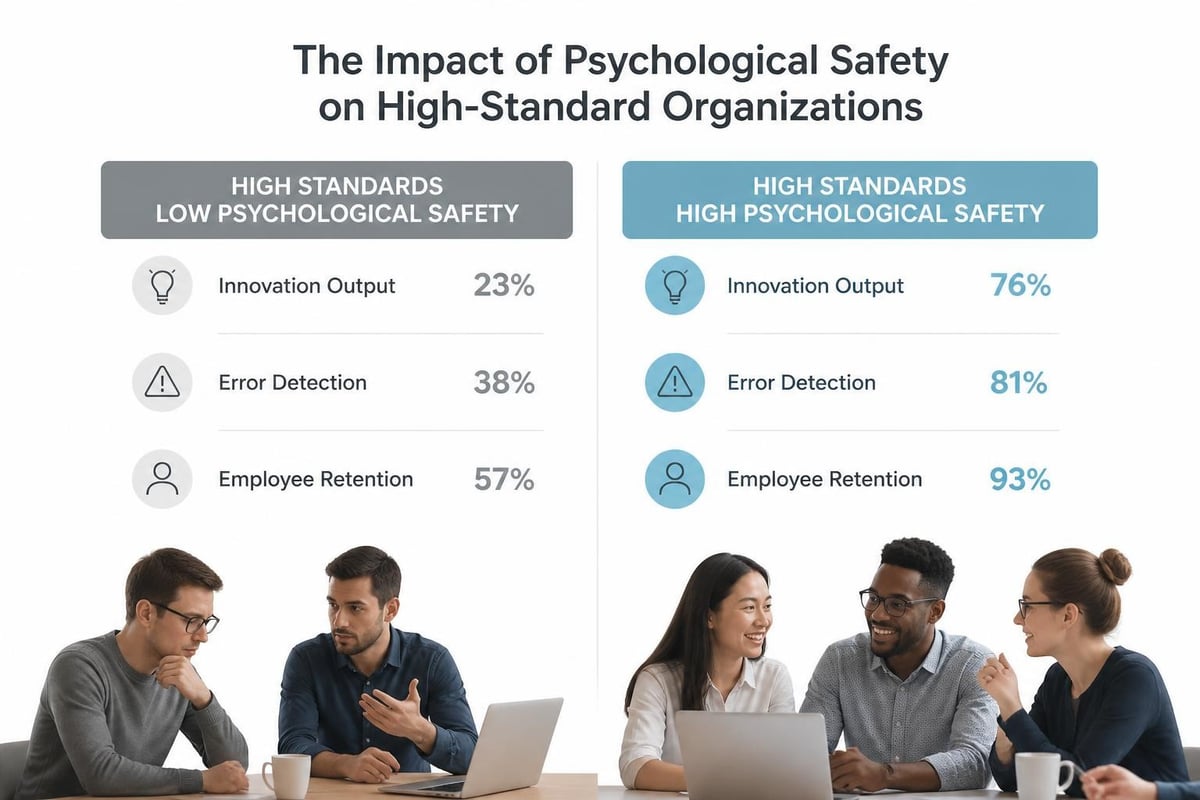
Three patterns separate organizations that get this right:
- They measure speaking-up behavior as rigorously as financial metrics
- Leadership responses to bad news are scripted and practiced
- Post-incident reviews focus on system factors before individual performance
The CEO of a mid-sized aerospace contractor shared a telling observation after implementing structured psychological safety protocols. His teams surfaced 3x more potential issues in design reviews. Initially, leadership worried this indicated declining work quality. Six months later, field failures dropped 47%. The quality hadn't changed. The visibility had.
Why Traditional Leadership Behaviors Destroy Safety Under Pressure
The executives causing the most damage rarely recognize it. They believe they're driving performance. Their teams experience something entirely different.
The Punish-the-Messenger Problem
During a compliance audit of a government agency in 2025, we documented leadership responses to escalated concerns over a six-month period. The pattern was consistent. When mid-level managers raised resource constraints, timeline risks, or process gaps, leadership responses included:
| Leadership Response | Frequency | Team Outcome |
|---|---|---|
| Immediate problem-solving | 12% | Continued escalation |
| Questioning manager's competence | 34% | Reduced future escalation |
| Deflecting to other priorities | 28% | Information hoarding |
| Visible frustration/impatience | 26% | Strategic silence |
Only 12% of escalations received the response that encourages future transparency: collaborative problem-solving without status threat. The other 88% trained people to stay quiet. This wasn't malicious leadership. It was reflexive behavior under pressure that systematically destroyed the conditions needed for good decisions.
Understanding the challenges Fortune 500 leaders face reveals why these patterns persist even among sophisticated executives.
The Consistency Trap
A manufacturing VP inherited a division with chronic safety incidents. His diagnosis was straightforward: insufficient accountability. His solution was predictable: public performance reviews and documented consequences for errors.
Incident rates increased 23% over four months. The reason became clear during confidential team interviews. Workers were hiding near-misses and small failures to avoid the performance review process. By the time issues became visible, they were catastrophic. The VP's focus on accountability without psychological safety created exactly the outcome he was trying to prevent.
Building Safety When Stakes Are Highest
The methodology for establishing psychological safety in high pressure organizations differs fundamentally from low-stakes environments. Casual team-building exercises don't work when millions of dollars or lives are at risk. What does work is systematic behavior change at the leadership level.
Framework: The Response Architecture
We developed this approach after observing leadership teams in critical infrastructure, healthcare, and defense contracting where psychological safety directly impacts operational outcomes.
Step 1: Script High-Stakes Responses
Leaders practice specific verbal and behavioral responses to three categories:
- Bad news delivery: "Thank you for bringing this forward. Walk me through what you're seeing."
- Challenge to authority: "That's a perspective I hadn't considered. Tell me more about your reasoning."
- Admitted mistakes: "I appreciate you owning this. What support do you need to address it?"
The scripting isn't about sounding robotic. It's about overriding the reflexive defensiveness that emerges under pressure. One executive we worked with practiced these responses for six weeks before a board crisis. When a director challenged his turnaround strategy in front of the full board, his practiced response, "That's a valid concern. Let's examine the assumptions I'm working from," changed the conversation from defensive to diagnostic. The revised strategy incorporated the director's insight and delivered better results.
Step 2: Audit Speaking-Up Patterns
Most organizations measure outcomes but ignore the input signals that drive them. Building psychological safety in high-stakes environments requires quantifying voice behaviors:
- Ratio of concerns raised to concerns identified in retrospective analysis
- Time lag between problem emergence and leadership awareness
- Distribution of who speaks in critical meetings (same three people or genuine diversity?)
- Frequency of challenges to senior positions in decision forums
A financial services firm tracking these metrics discovered that 80% of strategic decisions involved input from the same four executives despite having 18 qualified voices in the room. The pattern wasn't about capability. It was about whose challenges were welcomed versus tolerated. Adjusting meeting facilitation to explicitly solicit dissent from quieter participants improved decision quality measurably.
Step 3: Reward Productive Dissent
This is where most initiatives fail. Leaders claim they want challenge but their recognition systems tell a different story. Examine your last performance cycle. Who got promoted? The person who delivered results quietly or the person who delivered results while respectfully challenging flawed assumptions along the way?
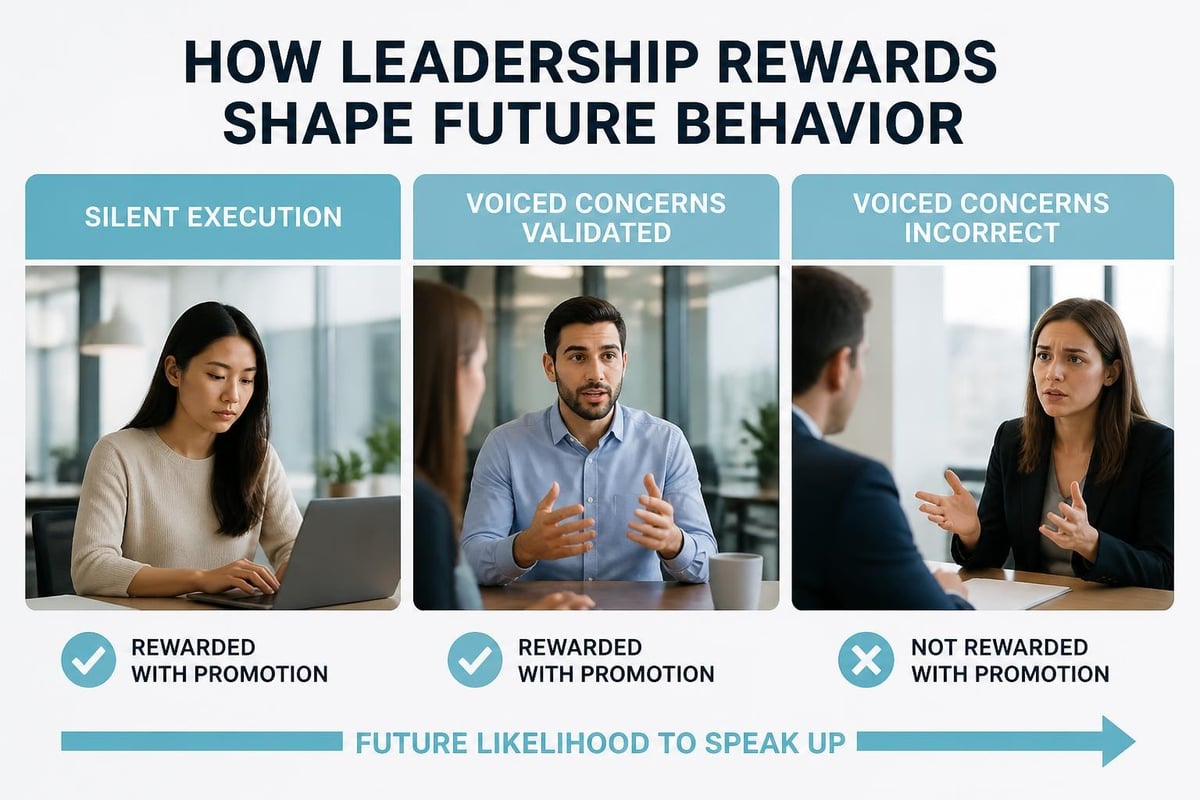
An SVP at a pharmaceutical company created a "Course Correction Award" specifically recognizing employees who identified risks or flaws that changed project direction. The criteria were explicit: the recognition required challenging conventional thinking, providing evidence, and demonstrating judgment about when to escalate. Within two quarters, the number of early-stage project kills increased 40%, saving an estimated $18M in development costs that would have been spent on ultimately non-viable compounds.
What High-Reliability Organizations Actually Do
The sectors where failure carries the highest consequences, such as nuclear power, aviation, and emergency medicine, offer the clearest evidence about psychological safety in high pressure organizations.
A 2024 study of hospital surgical teams found that units with high psychological safety had 35% fewer complications and 28% lower mortality rates than units with equivalent technical capability but lower safety climates. The mechanism was straightforward: team members spoke up about potential issues during procedures when they trusted their input would be received professionally.
Research on open communication in high-reliability organizations demonstrates that psychological safety isn't a soft skill. It's a operational requirement in environments where the cost of unvoiced concerns is measured in lives.
The Pre-Brief and Debrief Discipline
High-reliability teams structure voice opportunities into workflows. Naval aviation squadrons conduct formal briefs before every flight where the most junior pilot is expected to voice concerns about weather, equipment, or mission planning. The cultural norm isn't optional input. It's required input regardless of rank.
After operations, structured debriefs focus on three questions:
- What did we expect to happen?
- What actually happened?
- What accounts for the difference?
The third question is where psychological safety becomes tangible. If the answer involves information someone had but didn't share, the conversation focuses on the system barrier that prevented sharing, not the individual failure to speak. This distinction matters. Blaming individuals for silence in psychologically unsafe environments is like blaming passengers for not using emergency exits that don't exist.
The Measurement Problem Most Leaders Avoid
You can't improve what you don't measure. Yet most organizations lack quantifiable metrics for psychological safety in high pressure organizations beyond engagement surveys that teams have learned to game.
Diagnostic Indicators That Actually Predict Performance
| Indicator | Measurement Method | Predictive Value |
|---|---|---|
| Time-to-escalation | Days between issue emergence and leadership awareness | High correlation with prevented failures |
| Dissent diversity | Number of unique voices challenging decisions in review meetings | Predicts decision quality |
| Near-miss reporting rate | Voluntary reports of close calls vs. discovered incidents | Leading indicator of major failures |
| Question-to-assertion ratio | Balance of inquiry vs. advocacy in leadership communication | Measures openness to challenge |
A technology company implemented these diagnostics after a product launch failure that post-analysis revealed was foreseeable. Six engineers had concerns about the release timeline. None escalated beyond their immediate manager. Time-to-escalation metrics would have flagged the pattern. The company now tracks this monthly alongside revenue and customer metrics.
Leadership development programs focused on coaching increasingly incorporate these measurement frameworks because they provide objective baselines for improvement.
The Case Study: Government Agency Transformation
A federal agency approached us in mid-2025 with a chronic problem. Employee engagement was declining, whistleblower complaints were increasing, and operational efficiency was stagnating despite budget increases and process improvements.
Problem: Leadership assumed the issue was workforce capability. They invested in training programs and performance management systems. Nothing improved. Exit interviews revealed the actual problem: employees with mission-critical information were strategically silent because previous attempts to surface concerns had resulted in career consequences.
Diagnosis: We conducted confidential interviews across 120 employees and found systematic patterns. Mid-level managers were filtering bad news upward, senior leaders were responding to challenges with status threats, and the organization had no structured mechanisms for safe escalation. The agency had high capability but broken information flow.
Solution: We implemented a three-part intervention focused on leadership behavior change, structured voice mechanisms, and measurement systems. Senior leaders participated in facilitated sessions where they practiced receiving difficult information. The agency created formal escalation channels with documented response protocols. Most critically, they began measuring time-to-awareness for significant issues and making it a leadership performance metric.
Result: Within 11 months, voluntary issue reporting increased 156%, employee engagement scores rose 22 points, and operational efficiency improved 31% as teams stopped working around problems they assumed leadership wouldn't address. The agency's IG noted a marked decrease in whistleblower complaints, which leadership correctly interpreted as problems being resolved internally rather than externally.
Lesson: The constraint wasn't workforce capability or resource adequacy. It was leadership behavior that had systematically optimized for comfort over truth. Once leadership behaviors changed and stayed changed, organizational performance followed.
When Safety and Standards Are Actually Compatible
The false choice between psychological safety and high standards persists because leaders observe the wrong organizations. Low-performing teams with high psychological safety and low standards do exist. They're not the model.
The organizations worth studying are those that maintain both. Elite military units, top-tier surgical teams, and high-performing technology companies share a common characteristic: they build trust without lowering performance bars.
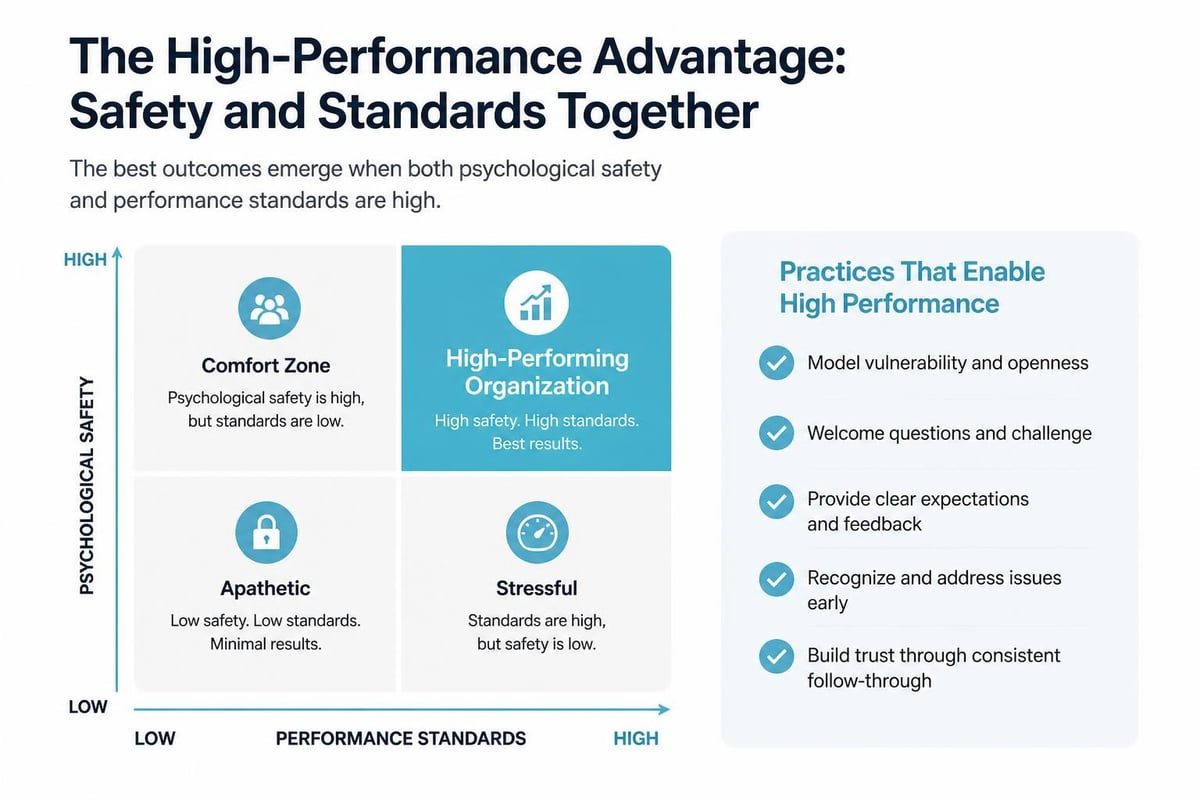
The Distinction That Matters
Standards define what excellence looks like. Psychological safety determines whether teams tell you when they're not meeting them. An aerospace engineering manager explained it clearly: "I don't want my standards questioned. I want our approach to meeting them challenged constantly."
His team has a documented error rate 60% below industry average. They also have the highest rate of design challenges per project in the company. Those two facts aren't coincidental. The psychological safety to challenge approaches before they become expensive failures is exactly what enables the low error rate.
The implementation specifics matter:
- Non-negotiable outcomes with negotiable methods
- Zero tolerance for performance failures with zero tolerance for hiding them
- High expectations for results with high support for learning
A private equity portfolio company demonstrated this distinction during a turnaround. The CEO made the performance targets explicitly clear, including consequences for missing them. Simultaneously, he instituted weekly forums where anyone could surface obstacles, resource gaps, or strategic concerns without repercussion. The targets stayed firm. The path to reaching them became collaborative. The company exceeded plan in year one.
The Implementation Gap Leadership Creates
Knowing psychological safety matters and actually building it are different capabilities. Most leadership teams fail at implementation because they treat it as a communications initiative rather than a behavior-change program.
Why Talking About Safety Doesn't Create It
A manufacturing company launched a psychological safety initiative in Q1 2025. The CEO gave speeches. HR created posters. Managers attended workshops. Six months later, measured safety climate hadn't changed. The disconnect was straightforward: leadership had talked about wanting input but hadn't changed their responses when they received it.
One manager described the dynamic precisely: "They say they want honesty, but when you give it, they get defensive or you're excluded from future decisions. You learn what they actually want isn't honesty. It's agreement delivered politely."
The role of psychological safety in team performance, as Google’s research demonstrated, depends entirely on leadership response patterns, not stated intentions.
The 90-Day Behavior Reset
Organizations that successfully build psychological safety in high pressure environments follow a structured behavior-change process:
Weeks 1-4: Baseline and Commit
- Measure current speaking-up patterns across teams
- Leadership commits to specific response behaviors
- Identify high-stakes decisions in next 90 days where dissent is critical
Weeks 5-8: Practice and Feedback
- Role-play difficult conversations
- Document actual leadership responses to challenges
- Provide direct feedback when responses undermine safety
Weeks 9-12: Reinforce and Measure
- Recognize specific instances of productive dissent
- Measure changes in voice behavior
- Adjust recognition and promotion criteria to reward appropriate challenge
The timeline is deliberate. Ninety days is long enough to change habits but short enough to maintain focus. A healthcare system using this approach saw measurable changes in safety reporting within the first 60 days as frontline staff tested whether leadership responses had genuinely changed.
What This Means for Your Organization in 2026
The competitive environment in 2026 rewards organizations that can surface and solve problems faster than their peers. Psychological safety in high pressure organizations isn't about making people comfortable. It's about making your organization more capable of handling complexity, uncertainty, and rapid change.
The evidence is clear across industries. Teams with high psychological safety and high standards outperform teams with only one or neither. They innovate faster because they surface and test more ideas. They execute better because problems get escalated and addressed earlier. They retain talent because capable people prefer environments where their judgment is valued.
The implementation challenge is equally clear. Leadership behavior change is hard, measurable, and non-negotiable. You can't delegate this. Survey scores don't improve because HR runs workshops. They improve when leaders change their reflexive responses to challenge, bad news, and admitted mistakes.
Understanding why coaching demand is growing reveals that organizations increasingly recognize these behavioral changes require external expertise and structured development programs, not just internal training.
Most organizations are leaving significant performance on the table. Not because their people lack capability but because their culture penalizes using it. The question isn't whether psychological safety matters in high-pressure environments. The evidence settled that debate. The question is whether your leadership team has the discipline to build it systematically while maintaining the standards that drive results.
The organizations getting this right in 2026 aren't choosing between safety and performance. They're building both through deliberate leadership practice, rigorous measurement, and genuine behavior change. The gap between them and their competitors will continue widening because this capability compounds. Teams that speak up find more problems early. Solving problems early builds trust. Trust enables more speaking up. The cycle accelerates or stalls based entirely on how leaders respond when the pressure is highest.
FAQ
What is psychological safety in high pressure organizations?
Psychological safety in high pressure organizations is the shared belief that team members can speak up, challenge assumptions, admit mistakes, and raise concerns without fear of punishment or humiliation, even when stakes are high and pressure is intense. It enables better decision-making by ensuring critical information reaches leaders before small problems become large failures.
How do you build psychological safety without lowering performance standards?
Building psychological safety without lowering standards requires separating outcomes from methods. Maintain non-negotiable performance expectations while encouraging challenges to how those expectations are met. Leaders must consistently demonstrate through their responses that questioning approaches is valued while missing standards has consequences. The key is making the distinction explicit and reinforcing it through recognition systems.
What are the measurable benefits of psychological safety in high-stakes environments?
Organizations with high psychological safety in demanding environments demonstrate 30-40% fewer preventable failures, 20-35% higher innovation output, significantly better talent retention, and faster problem resolution. These benefits result from earlier issue detection, more diverse input in critical decisions, and reduced time spent managing the consequences of hidden problems.
How long does it take to improve psychological safety?
Measurable improvements in psychological safety typically appear within 60-90 days when leadership commits to structured behavior change. However, sustaining those improvements requires ongoing practice and reinforcement. Organizations should expect 12-18 months before new patterns become deeply embedded in culture and automatic in leadership responses.
What's the biggest mistake leaders make when trying to create psychological safety?
The most common mistake is talking about wanting psychological safety while maintaining response patterns that punish candor. Leaders say they want honesty but react defensively to challenges, exclude people who raise concerns from future decisions, or signal impatience with bad news. Teams learn to trust behavior over words, and misaligned behavior undermines stated intentions completely.
Building psychological safety in high pressure organizations requires systematic leadership behavior change, rigorous measurement, and sustained commitment to rewarding productive dissent. The performance advantage goes to organizations that combine high standards with genuine openness to challenge. Noomii Leadership Coaching helps organizations implement evidence-based approaches to psychological safety through precision coach matching, leadership diagnostics, and measurable intervention plans that align individual development with institutional performance goals.



Leave a Reply
Want to join the discussion?Feel free to contribute!