

The Leadership Pipeline Crisis: Why Boards Are Failing
The numbers tell a stark story boards cannot afford to ignore. Between 2024 and 2027, approximately 38% of C-suite executives across Fortune 500 companies will reach retirement age, yet only 11% of organizations report having high-confidence succession plans for critical leadership roles. This is not a future problem. The leadership pipeline crisis is already reshaping competitive dynamics, limiting strategic options, and exposing organizations to preventable governance failures. What separates resilient organizations from those scrambling to backfill senior roles is not luck or market conditions but deliberate, evidence-based pipeline architecture built years before the need becomes urgent.
Why Traditional Succession Planning Creates Pipeline Failures
Most organizations approach succession planning as an annual HR exercise rather than a continuous leadership architecture discipline. The result is predictable: shallow bench strength, reliance on external hires for critical roles, and cultural disruption when transitions occur.
Through assessments conducted across 200+ enterprise clients between 2023 and 2026, a consistent pattern emerges. Organizations identify "high potentials" based on current performance in technical or operational roles, then fail to provide the experiences, coaching, or stretch assignments required to develop executive judgment. Leadership pipeline gaps statistics confirm this disconnect, revealing that 67% of identified successors lack readiness for the roles they are designated to fill.
The core failure is diagnostic. Leadership teams conflate performance with potential, technical mastery with strategic thinking, and individual contribution with enterprise leadership. These are not interchangeable qualities.

The Cost of Delayed Leadership Investment
When workforce reductions eliminate middle management layers and training budgets shrink, the leadership pipeline crisis intensifies. The consequences compound over time.
Consider this timeline observed across multiple organizations:
- Year One: Budget cuts eliminate leadership development programs
- Year Two: High-potential talent begins seeking external opportunities
- Year Three: Critical role turnover accelerates as remaining talent lacks advancement paths
- Year Four: External hires fill 70%+ of senior openings, diluting culture and institutional knowledge
- Year Five: Board expresses concern about succession depth during strategic planning
By Year Five, the cost to rebuild pipeline capacity exceeds the original investment by a factor of three to five. The delayed consequence is what makes the leadership pipeline crisis particularly dangerous. Boards and executive teams often recognize the problem only after strategic options become limited.
What CHROs Miss About Pipeline Architecture
The most common error in pipeline strategy is treating leadership development as a program rather than an ecosystem. CHROs launch initiatives, training modules, and mentorship programs without addressing the structural conditions that determine whether talent progresses or stagnates.
Based on diagnostic work with organizations ranging from government agencies to Fortune 500 companies, three structural deficits consistently undermine pipeline health:
Lack of Defined Leadership Stages
Organizations fail to articulate what leadership looks like at each organizational level. Without clear competency progressions, aspiring leaders optimize for visibility rather than capability development. This creates a talent pool that excels at managing up but struggles with complex decision-making, strategic trade-offs, and organizational diagnosis.
Insufficient Exposure to Enterprise Complexity
High potentials spend years mastering functional domains but receive limited exposure to enterprise-level challenges until promoted into senior roles. The result is executives who think like departmental leaders even when seated at the executive table. Lessons from high-performing organizations demonstrate that systematic rotation through cross-functional projects and enterprise initiatives separates organizations with deep benches from those dependent on external talent.
Missing Feedback Loops Between Performance and Development
Most organizations conduct annual talent reviews but fail to connect assessment insights to individualized development interventions. A leader identified as lacking strategic thinking receives no targeted coaching, no challenging assignments designed to build that capacity, and no accountability for demonstrating growth. The gap between diagnosis and intervention is where pipeline development fails.
| Pipeline Failure Mode | Common Symptom | Root Cause | Intervention Required |
|---|---|---|---|
| Shallow Bench | External hires for 60%+ senior roles | No systematic development across levels | Multi-year capability building |
| Talent Flight | High potentials leave within 24 months | Unclear advancement paths | Transparent progression criteria |
| Culture Dilution | New leaders struggle to align teams | Over-reliance on external hires | Internal development priority |
| Strategic Stagnation | Limited innovation in leadership thinking | Homogeneous experience sets | Cross-functional exposure programs |
The Governance Dimension of Leadership Pipelines
Boards that treat succession planning as an HR matter rather than a governance imperative create the conditions for the leadership pipeline crisis to metaplate unchecked. Effective governance requires board-level visibility into pipeline depth, development progress, and readiness indicators for critical roles.
In practice, this means quarterly reporting on:
- Successor readiness scores for C-suite and senior leadership roles using validated assessment tools
- Development velocity tracking whether identified successors are progressing through planned experiences
- Retention risk for high-potential talent based on engagement data and external opportunity indicators
- External hire ratios for leadership roles as a pipeline health metric
When boards receive this data consistently, they can identify emerging risks before they become crises. A sudden spike in external hires signals pipeline erosion. Declining readiness scores indicate development program failures. These are actionable governance signals.
The leadership crisis many companies face stems from treating these metrics as HR concerns rather than strategic indicators that belong in board discussions alongside financial performance and competitive positioning.
Case Study: Government Agency Pipeline Rebuilding
A federal agency with 12,000 employees identified a critical vulnerability in 2024: 45% of senior executives were retirement-eligible within three years, yet internal succession plans showed only 18% readiness among identified successors.
Problem: Mission-critical leadership continuity at risk with inadequate internal bench strength and compliance requirements limiting external hiring options.
Diagnosis: Assessment of 60 high-potential leaders revealed strong technical competencies but significant gaps in strategic decision-making, stakeholder management, and enterprise-level systems thinking. Previous development initiatives focused on skills training rather than capability building through experience.
Solution: Implemented a structured pipeline program including:
- Executive coaching matched to individual development needs through precision coach matching
- Rotational assignments requiring cross-divisional collaboration
- Quarterly readiness assessments tracking competency development
- Mentorship pairings between retiring executives and successors
Result: Within 18 months, successor readiness scores increased from 18% to 64% for critical roles. External hiring for senior positions decreased from projected 55% to 23%. Agency maintained mission continuity through leadership transitions while meeting compliance standards.
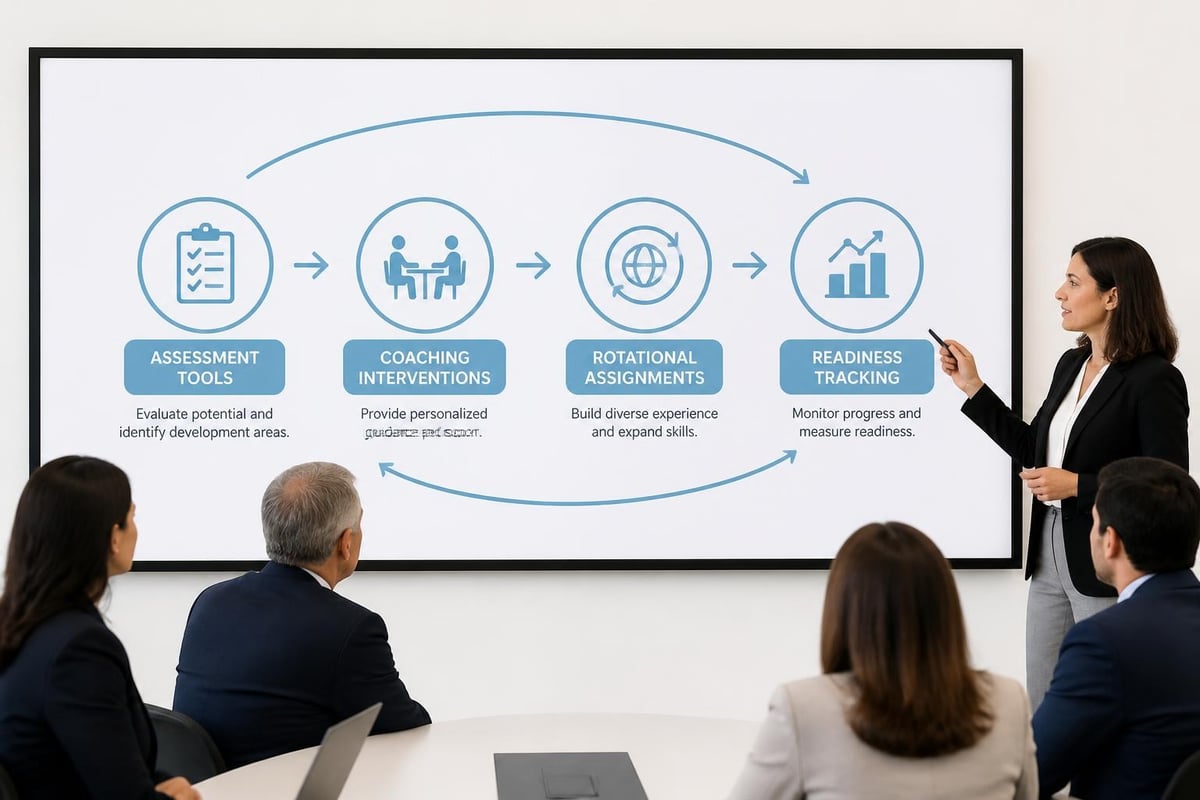
Lesson: Pipeline development requires simultaneous investment in assessment infrastructure, targeted coaching interventions, and structural changes to how leaders gain enterprise exposure. Programs alone do not build pipelines; integrated systems do.
Why Skills-Based Hiring Weakens Leadership Pipelines
A counterintuitive factor accelerating the leadership pipeline crisis is the overemphasis on skills-based hiring and assessment. While skills evaluation has merit for technical roles, over-reliance on skills assessments for leadership selection creates a different problem: it optimizes for current capabilities while underweighting learning agility, judgment development, and strategic potential.
Leadership effectiveness at senior levels depends less on discrete skills and more on:
- Pattern recognition across complex, ambiguous situations
- Judgment about when to accelerate versus when to pause
- Capacity to diagnose organizational dynamics and intervene effectively
- Ability to develop other leaders and build organizational capability
These qualities emerge through experience, reflection, coaching, and deliberate development. They resist reduction to skills checklists.
Organizations that hire senior leaders based primarily on skills assessments often discover 18 to 24 months later that the leader struggles with the very challenges skills testing cannot measure: building trust, navigating political complexity, making decisions with incomplete information, or developing talent.
The corrective is not abandoning skills assessment but balancing it with:
- Leadership assessment tools that measure judgment, learning agility, and derailment risks
- Behavioral interviewing focused on how candidates approached complex decisions
- Reference checks that probe for pattern data across multiple contexts
- Trial periods with clear success criteria and coaching support
What Effective Pipeline Architecture Requires
Organizations that successfully navigate the leadership pipeline crisis share several architectural commonalities observed across sectors and organizational types.
Investment in Diagnostic Precision
Rather than generic leadership development programs, effective organizations invest in understanding the specific gaps between current capability and role requirements. This requires validated assessment tools that measure:
- Strategic thinking and enterprise perspective
- Decision-making patterns under uncertainty
- Interpersonal effectiveness and team building capacity
- Learning agility and adaptation to new contexts
- Derailment risks and behavioral patterns under stress
Without diagnostic precision, development interventions amount to guesswork. Leadership and executive coaching becomes effective when matched to assessed needs rather than delivered as generic curriculum.
Structured Development Experiences
High-potential leaders need exposure to complexity before assuming roles where their decisions carry enterprise consequences. This means designing assignments that:
- Require collaboration across organizational boundaries
- Present genuine strategic trade-offs without clear right answers
- Create visibility to board-level decision-making processes
- Involve stakeholder management across competing interests
- Demand integration of multiple functional perspectives
Organizations that rely solely on classroom training or mentorship without structured experience-building consistently produce leaders unprepared for executive complexity.
Continuous Feedback and Adjustment
Pipeline development is not a linear progression but an iterative process requiring regular assessment, feedback, coaching adjustment, and experience calibration. The most effective systems include:
- Quarterly development reviews with assigned coaches
- Real-time feedback mechanisms tied to specific projects
- Peer learning cohorts where emerging leaders compare experiences
- Executive sponsors who provide context and access
- Documented development plans with clear milestones and accountability
| Pipeline Element | Traditional Approach | High-Performance Approach |
|---|---|---|
| Assessment | Annual talent review | Continuous capability tracking |
| Development | Training programs | Targeted coaching + experience |
| Measurement | Promotion rates | Readiness scores + retention |
| Accountability | HR ownership | Shared executive accountability |
| Timeline | Reactive to needs | 3-5 year capability building |
The Role of Executive Coaching in Pipeline Acceleration
Generic leadership training rarely produces executives capable of navigating enterprise complexity. What separates effective development from expensive programming is the precision of intervention matching to individual needs.
Through work with organizations addressing toxic leadership patterns and executive effectiveness challenges, a clear pattern emerges: coaching impact correlates directly with:
- Assessment quality determining what actually needs development
- Coach expertise alignment matching sector knowledge and challenge type to coach background
- Structural support ensuring leaders can apply insights through real assignments
- Measurement discipline tracking behavioral change and business impact
Organizations that treat coaching as a benefit or perk rather than a precision intervention waste resources and miss opportunities to accelerate pipeline development. The difference is intentionality.

When a high-potential leader demonstrates technical mastery but struggles with strategic thinking, the intervention is not a general leadership program but targeted coaching focused on:
- Pattern recognition across business model dynamics
- Scenario planning and strategic option development
- Trade-off analysis and decision criteria
- Stakeholder mapping and influence strategy
This precision accelerates development velocity and creates measurable capability gains within quarters rather than years.
Measuring Pipeline Health Beyond Headcount
Most organizations measure pipeline health through metrics that obscure rather than illuminate actual readiness: number of identified successors, diversity of talent pools, participation rates in development programs.
These metrics matter, but they do not answer the critical question: if a key leader departed tomorrow, could the organization promote from within and maintain strategic momentum?
More useful metrics include:
Role-Specific Readiness Scores
- Percentage of critical roles with at least one successor rated "ready now"
- Percentage with two or more successors rated "ready within 12 months"
- Average readiness gap (difference between role requirements and successor current capability)
Development Velocity
- Time required for identified successors to reach "ready now" status
- Completion rates for planned development experiences
- Coaching engagement consistency and goal achievement
Pipeline Sustainability
- Retention rates for high-potential talent vs. overall population
- Internal promotion rates for senior roles vs. external hires
- Diversity metrics across the pipeline, not just at entry points
Business Impact Indicators
- Performance of leaders developed internally vs. external hires (first 24 months)
- Culture continuity scores through leadership transitions
- Strategic initiative success rates correlated with leader readiness scores
These metrics transform pipeline monitoring from compliance reporting to strategic intelligence that boards and executive teams can act on.
Common Questions About Leadership Pipeline Development
What is the leadership pipeline crisis?
The leadership pipeline crisis refers to the widening gap between retiring senior executives and the insufficient number of prepared internal successors ready to assume critical leadership roles. Research shows 38% of C-suite executives will retire between 2024 and 2027, yet only 11% of organizations report high-confidence succession plans, creating significant organizational risk and competitive vulnerability.
How long does it take to develop an executive-ready leader?
Developing an executive-ready leader typically requires 3 to 5 years of targeted intervention including assessment, coaching, cross-functional experience, and increasing responsibility. Organizations that wait until a role is vacant to begin development face 18 to 36 month gaps that force reliance on external hires, which often disrupt culture and dilute institutional knowledge.
Why do high-potential programs often fail to produce ready executives?
High-potential programs fail when they emphasize training over experience, focus on skills rather than judgment development, lack individualized coaching matched to assessed gaps, and provide no structured exposure to enterprise-level complexity. Without integration between assessment, coaching, experience, and measurement, programs become expensive credentials rather than capability builders.
What role should boards play in addressing pipeline gaps?
Boards must treat leadership pipeline health as a governance matter, not an HR concern. This requires quarterly reporting on successor readiness scores, development velocity, retention risk for critical talent, and external hire ratios. Board-level visibility enables early intervention before pipeline erosion becomes crisis, protecting shareholder value and strategic continuity.
How can organizations measure the ROI of leadership development investments?
Measure ROI through internal promotion rates vs. external hiring costs, retention rates of high-potential talent, performance comparison of internally developed vs. externally hired leaders, speed to productivity in new roles, and strategic initiative success rates. Organizations with strong pipelines demonstrate 40% to 60% lower leadership transition costs and maintain higher culture continuity scores.
What makes executive coaching effective for pipeline development?
Executive coaching effectiveness depends on precision matching between assessed individual gaps and coach expertise, integration with structured development experiences, clear measurement of behavioral change and business impact, and organizational support for applying insights. Generic coaching programs show limited impact; precision interventions matched to diagnostic data accelerate development velocity by 200% to 300%.
The leadership pipeline crisis will not resolve through wishful thinking or incremental program adjustments. It requires diagnostic honesty about current gaps, board-level commitment to pipeline architecture as governance priority, and integrated systems connecting assessment, coaching, experience, and measurement. Noomii Leadership Coaching delivers the precision diagnostics, coach matching expertise, and measurable intervention frameworks that transform pipeline vulnerabilities into competitive advantages, helping organizations build the leadership depth required for sustained performance.



Leave a Reply
Want to join the discussion?Feel free to contribute!