

The Leadership Crisis Behind Boeing’s Fall
The leadership crisis behind Boeing represents one of the most consequential corporate failures in modern business history. What unfolded at this iconic aerospace manufacturer wasn't a single catastrophic decision but a systematic degradation of leadership judgment, cultural erosion, and misaligned priorities that began decades ago. Boeing's trajectory from engineering excellence to boardroom crisis provides definitive evidence of what happens when leaders prioritize quarterly earnings over operational integrity and substitute financial engineering for technical competence.
The Merger That Changed Everything
The 1997 merger between Boeing and McDonnell Douglas marked the beginning of the leadership crisis behind Boeing. This wasn't a merger of equals. McDonnell Douglas brought a financially driven culture that directly conflicted with Boeing's engineering heritage. What followed was predictable: the McDonnell Douglas leadership philosophy consumed Boeing's identity.
The shift was immediate and measurable. Executives who rose through finance departments replaced engineers in key decision-making roles. Performance metrics changed from technical achievement and safety margins to stock price movement and cost reduction. Boeing moved its headquarters from Seattle, where planes were actually built, to Chicago in 2001, physically distancing leadership from production reality.
This cultural transformation created a feedback loop of declining judgment. Forbes documented how this leadership shift fundamentally altered Boeing's decision-making processes, prioritizing financial returns over the engineering rigor that had defined the company's success.

The Cost Reduction Imperative
Senior leaders implemented aggressive cost-cutting measures that undermined safety and quality systems. Supplier relationships deteriorated as Boeing pressured vendors for lower prices while demanding faster delivery. Internal quality control processes were streamlined, which executives framed as efficiency but workers recognized as corner-cutting.
The 737 Max development exemplified this approach. Rather than designing a new aircraft to compete with Airbus's A320neo, Boeing modified an existing airframe to save development costs and accelerate time to market. This decision cascaded into the MCAS (Maneuvering Characteristics Augmentation System) design, which engineers developed under intense schedule and budget pressure.
Academic analysis of the MCAS software revealed systematic process failures that leadership enabled through resource constraints and timeline demands. The technical decisions that led to 346 deaths weren't engineering mistakes; they were leadership failures.
When Financial Engineering Replaces Technical Competence
The leadership crisis behind Boeing intensified as executives focused on stock buybacks and dividend increases rather than research and development investment. Between 2013 and 2019, Boeing spent approximately $43 billion on share buybacks. This capital allocation decision reveals leadership priorities with surgical precision.
Compare Boeing's capital allocation in this period:
| Category | Amount | Percentage of Operating Cash Flow |
|---|---|---|
| Share Buybacks | $43 billion | 76% |
| R&D Investment | $16 billion | 28% |
| Safety System Upgrades | $3 billion | 5% |
These numbers tell a story executives would prefer to hide. Leadership chose financial engineering over technical innovation. They optimized for analyst calls, not aircraft safety. The consequences were catastrophic and predictable.
The Warning Signs Leadership Ignored
Employees warned management about production shortcuts and safety concerns repeatedly. Whistleblowers documented quality control failures. Engineers raised technical objections to design decisions. Suppliers flagged timeline impossibilities. Leadership ignored all of it.
This wasn't ignorance; it was willful blindness. Senior executives created incentive structures that rewarded hitting financial targets and punished raising concerns. Middle managers learned to suppress bad news or face career consequences. The organizational culture became one where admitting problems was more dangerous than hiding them.
The Crisis Accelerates
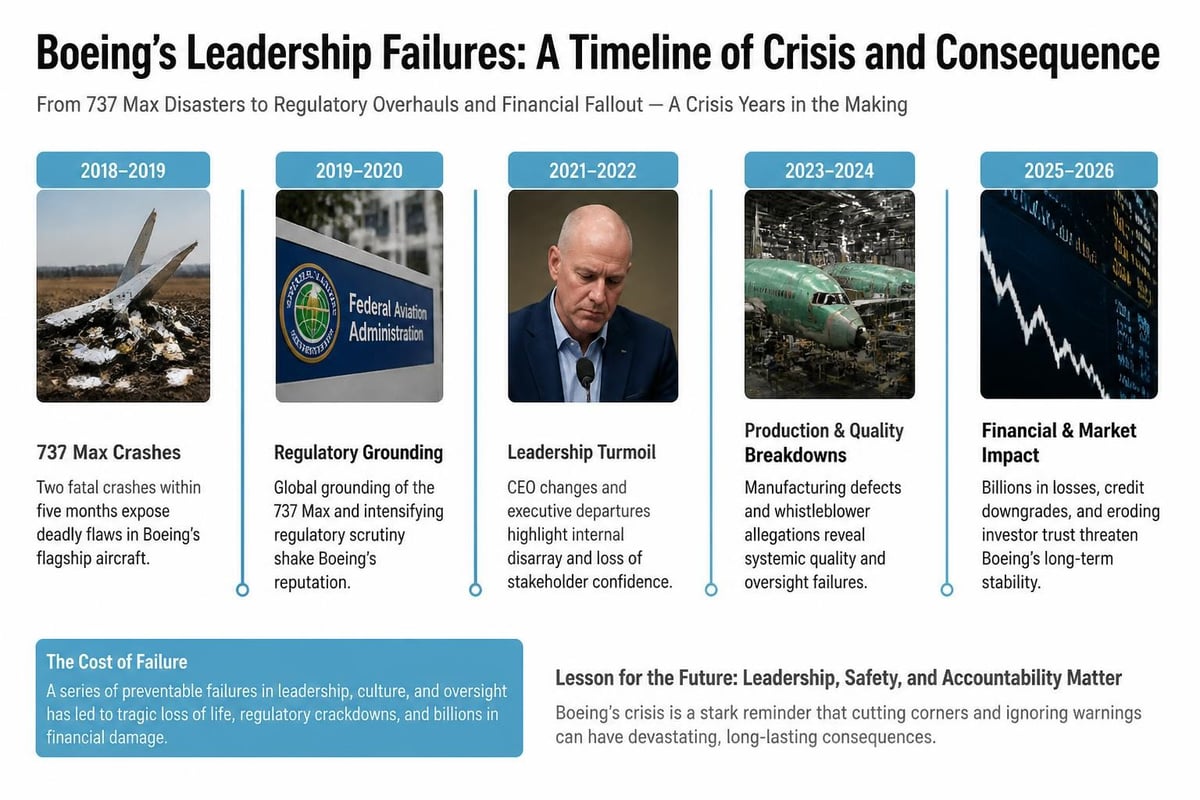
The two 737 Max crashes in 2018 and 2019 exposed the leadership crisis behind Boeing to global scrutiny. The grounding of the entire Max fleet, investigations revealing leadership knew about MCAS flaws before certification, and internal communications showing contempt for regulators destroyed Boeing's reputation.
PBS Frontline’s investigation documented the systematic failures that followed the crashes, including continued safety incidents and production problems that revealed deeper organizational dysfunction.
Leadership's response compounded the crisis. Initial denials, defensive positioning, and attempts to blame pilots demonstrated executive judgment failures. Boeing's CEO at the time, Dennis Muilenburg, defended the aircraft's design even as evidence mounted. The board waited months before removing him, and his exit package exceeded $60 million.
Repeating Failures Under New Leadership
Dave Calhoun replaced Muilenburg in January 2020, promising cultural change and renewed focus on safety. Three years later, a door plug blew out of an Alaska Airlines 737 Max 9 mid-flight, revealing that production quality problems persisted despite leadership's assurances.
The January 2024 incident proved that the leadership crisis behind Boeing was structural, not individual. Changing CEOs addressed symptoms, not root causes. The cultural rot, incentive misalignment, and quality system degradation continued because the board never demanded fundamental transformation.
Major airline customers forced leadership changes after the door plug incident, demonstrating that external stakeholders had lost confidence in Boeing's ability to self-correct. When your customers demand you fire your CEO, leadership has failed completely.
What Organizations Miss About Leadership Crises
The leadership crisis behind Boeing demonstrates patterns that most organizations fail to recognize until damage is irreversible. These aren't unique to aerospace or manufacturing. They appear across industries whenever executive judgment deteriorates and governance fails.
Key indicators of developing leadership crisis:
- Financial metrics dominate strategic discussions while operational metrics decline
- Executives distance themselves physically and organizationally from core operations
- Internal dissent is treated as disloyalty rather than valuable feedback
- Incentive structures reward short-term financial performance over long-term sustainability
- Quality systems are "streamlined" in ways that reduce actual quality
- Board oversight focuses on stock price rather than operational health
- External stakeholders (customers, regulators, suppliers) express increasing concern
These patterns are visible before crises explode publicly. Boards see them and rationalize them. HR leaders recognize them and lack authority to address them. Middle managers experience them daily and feel powerless to change them.
The Governance Failure
Boeing's board composition and oversight represent a textbook case of governance failure. Directors lacked aerospace engineering expertise. Committee structures didn't identify emerging risks. The board approved massive stock buybacks while safety systems deteriorated. They granted executives compensation packages that incentivized exactly the behavior that destroyed the company.
When Boeing announced 17,000 job cuts and massive financial losses, the board still hadn't implemented fundamental governance reforms. The same directorial mindset that enabled the crisis remained in place, making genuine transformation impossible.

The Ripple Effects Beyond Boeing
The leadership crisis behind Boeing damaged the entire aerospace industry. Suppliers lost contracts and capability. Airlines suffered financial losses and schedule disruptions. Regulatory agencies faced credibility questions. The FAA's certification relationship with Boeing revealed regulatory capture that compromised public safety.
NASA Administrator criticism of Boeing’s Starliner program extended the crisis beyond commercial aviation into space exploration. Leadership failures metastasized across Boeing's entire portfolio, suggesting systemic problems that leadership changes alone cannot fix.
Government agencies and Fortune 500 companies face similar leadership challenges that require systematic intervention before they cascade into crisis. The warning signs are often visible years before public failure.
The Human Cost
Behind Boeing's leadership failures are 346 people who died in preventable crashes. Thousands more lost jobs as the crisis deepened. Engineers who raised concerns faced retaliation. Families of victims continue seeking accountability. Shareholders lost billions. Communities dependent on Boeing manufacturing faced economic disruption.
Leadership decisions have human consequences. Boeing's executives optimized for metrics that made them wealthy while creating conditions that killed people. This isn't abstract corporate governance theory. It's evidence of what happens when leadership judgment fails completely.
What Actually Fixes Leadership Crises
Superficial interventions don't resolve the leadership crisis behind Boeing or similar organizational failures. CEO changes, press releases about renewed commitment to safety, and consultant reports gather dust while underlying problems persist.
Interventions that actually work require:
- Complete leadership replacement across executive and board levels, not just the CEO
- Cultural transformation that changes incentive structures, decision rights, and performance metrics
- Operational integration where executives spend substantial time in production environments
- Independent oversight with technical expertise to challenge management assumptions
- Transparent accountability including consequences for executives who enabled failures
- Long-term incentive alignment that makes executives accountable for problems years after their decisions
The leadership crisis behind Boeing demands this level of intervention. Anything less perpetuates the conditions that created the crisis. Most organizations lack the courage to implement genuine transformation, choosing instead to manage optics and hope problems resolve themselves.
Organizations serious about preventing or resolving leadership crises need structured coaching interventions that address root causes systematically. This requires precision matching between leadership challenges and coach expertise, not generic executive development programs.
The Role of Targeted Leadership Development
Boeing needed executives who could balance financial performance with engineering excellence. Instead, they promoted leaders who couldn't distinguish between cost reduction and value destruction. The leadership development failure started decades before the crashes.
Effective leadership development must be diagnostically driven and evidence based. Generic programs waste resources and time. Organizations need to identify specific capability gaps, behavioral patterns causing damage, and decision-making weaknesses before designing interventions.
The Noomii approach to toxic leader transformation demonstrates how targeted coaching addresses specific leadership failures rather than applying one-size-fits-all solutions. Boeing needed this precision intervention years before the crisis became public.
Lessons for Boards and CHROs
The leadership crisis behind Boeing offers definitive lessons for boards and CHROs who want to prevent similar failures:
For Boards:
| Focus Area | What Works | What Fails |
|---|---|---|
| Expertise | Directors with operational knowledge in core business | Financial experts without industry experience |
| Oversight | Regular engagement with operations and employees | Quarterly board meetings reviewing sanitized reports |
| Metrics | Balanced scorecards including safety, quality, culture | Exclusive focus on financial performance |
| Executive Accountability | Long-term incentives tied to operational outcomes | Short-term compensation based on stock price |
For CHROs and HR Leaders:
The leadership crisis behind Boeing demonstrates that HR must escalate cultural and leadership concerns even when executives don't want to hear them. Boeing's HR function either didn't recognize the deteriorating culture or lacked authority to address it. Both represent failures.
CHROs need diagnostic tools that identify toxic leadership patterns, cultural degradation, and misaligned incentives before they cascade into crisis. This requires independence, analytical rigor, and courage to challenge executive assumptions.
The Path Forward Remains Unclear
As of late 2026, the leadership crisis behind Boeing continues. New CEO Kelly Ortberg faces challenges his predecessors created and failed to resolve. Production quality problems persist. Regulatory scrutiny intensifies. Customer confidence remains fragile. Financial performance deteriorates.
Whether Boeing can recover depends on whether leadership makes fundamentally different choices than those that created the crisis. Early evidence suggests incremental improvement rather than transformation. The same board that enabled previous failures still provides oversight. The same incentive structures largely remain. The same cultural patterns persist.
Organizations watching Boeing should recognize that this could happen to them. The leadership failures aren't unique to aerospace. They appear wherever executives prioritize financial engineering over operational excellence, where boards lack courage to demand accountability, and where governance becomes performative rather than substantive.
The leadership crisis behind Boeing will be studied in business schools for decades. The question is whether other organizations learn the lessons before experiencing their own versions of the crisis. Most won't. Leadership judgment failures are remarkably consistent across industries and geographies because the underlying patterns-misaligned incentives, weak governance, cultural degradation-are universal.
The difference between organizations that prevent leadership crises and those that experience them isn't luck. It's systematic attention to the early warning signs, courage to intervene before problems become catastrophic, and commitment to building leadership capability that balances multiple stakeholder interests rather than optimizing narrowly for financial metrics.
Frequently Asked Questions
What caused the leadership crisis behind Boeing?
The crisis stemmed from the 1997 merger with McDonnell Douglas, which introduced a financially driven culture that prioritized cost reduction and stock performance over Boeing's traditional engineering excellence. This cultural shift led to systematic quality degradation, safety compromises, and leadership judgment failures that culminated in the 737 Max crashes and ongoing production problems.
How did Boeing's leadership respond to the 737 Max crashes?
Boeing's initial leadership response was defensive and inadequate, with executives initially defending the aircraft design and attempting to attribute crashes to pilot error. Leadership changes came slowly, and even after CEO replacements, underlying cultural and systemic problems persisted, as evidenced by continued safety incidents through 2026.
What governance failures enabled Boeing's crisis?
Boeing's board lacked aerospace engineering expertise, approved massive stock buybacks while safety systems deteriorated, created executive compensation structures that incentivized short-term financial performance over long-term operational health, and failed to provide independent oversight capable of challenging management assumptions.
Can Boeing recover from this leadership crisis?
Recovery requires complete leadership and cultural transformation, not just CEO changes. Boeing must fundamentally realign incentives, rebuild quality systems, restore engineering primacy in decision-making, and implement board-level governance reforms. As of 2026, evidence suggests incremental improvement rather than the fundamental transformation needed for genuine recovery.
What lessons should other organizations learn from Boeing?
Organizations must recognize that financial metrics cannot substitute for operational excellence, that physical and cultural distance between leadership and core operations breeds dysfunction, that incentive structures drive behavior more than mission statements, and that boards need relevant expertise and courage to challenge executive assumptions before crises develop.
The leadership crisis behind Boeing proves that executive judgment failures, cultural degradation, and governance weaknesses compound into catastrophic organizational failure when left unaddressed. The patterns are visible years before public crisis, but most organizations lack diagnostic precision and intervention courage to act preventatively. If your organization faces similar leadership challenges, misaligned priorities, or cultural dysfunction, Noomii Leadership Coaching delivers evidence-based diagnostics, precision coach matching, and targeted interventions that address root causes before they cascade into crisis.



Leave a Reply
Want to join the discussion?Feel free to contribute!