

The Coaching Industry Oversells Certification
Walk into any corporate learning department, and you'll hear the same refrain: "Are they certified?" The coaching industry has trained buyers to ask the wrong question. Certification has become the default proxy for coaching quality, yet the evidence tells a different story. The coaching industry oversells certification while systematically underdelivering on the outcomes that matter to businesses paying the bills.
The Credential Trap Creates More Problems Than It Solves
Over the past fifteen years, I've watched certification bodies multiply like franchises. Each promises to separate "real" coaches from pretenders. The result? A marketplace drowning in credentials that signal compliance, not competence.
The math alone reveals the problem:
- ICF reports over 50,000 credentialed coaches globally
- Hundreds of certification programs launch annually
- Average certification cost ranges from $3,000 to $15,000
- Yet buyer confusion has never been higher
The coaching industry credibility crisis stems directly from oversupply. When everyone holds a credential, the credential loses meaning. Businesses seeking leadership coaching face thousands of certified options, most indistinguishable by resume alone.
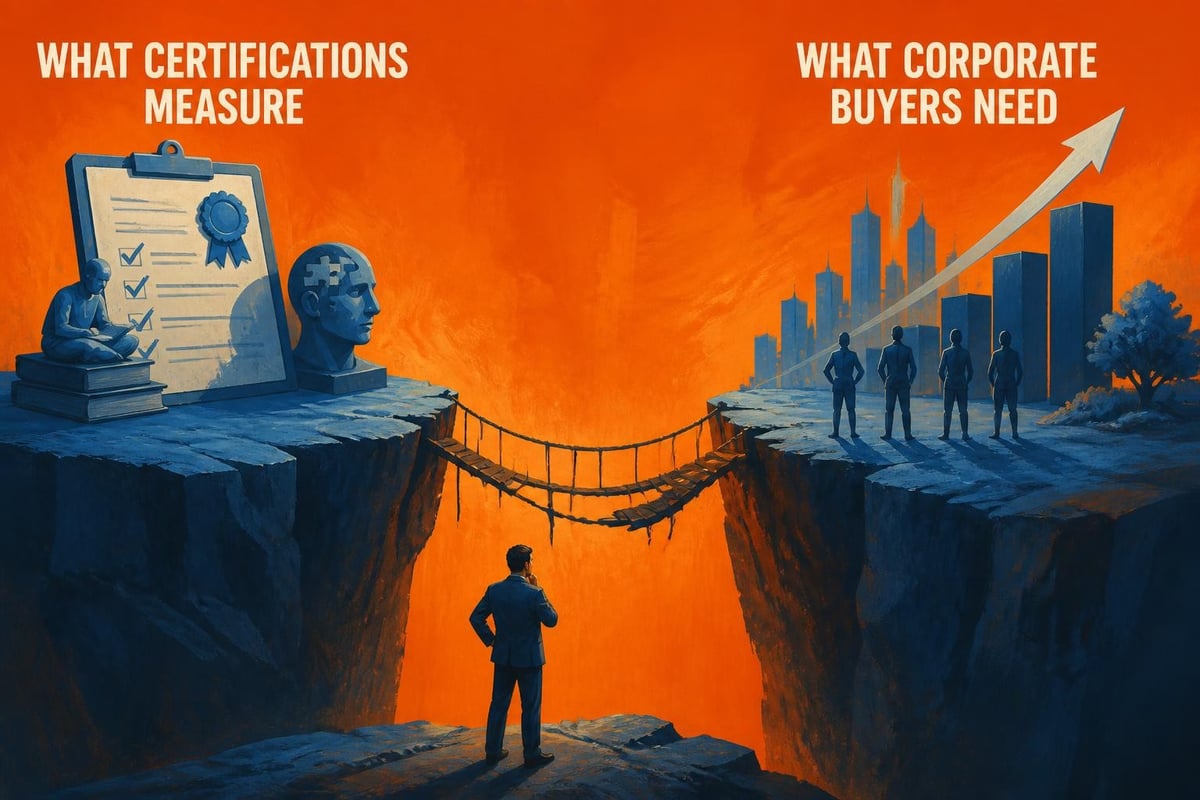
What Certification Programs Actually Measure
Certification programs assess three things with reasonable consistency:
- Process adherence – following a coaching model
- Knowledge retention – understanding coaching theory
- Supervised hours – logging practice time
None of these predict client results. ICF certification doesn’t guarantee coaching success because it measures inputs, not outcomes. A coach can follow perfect GROW model protocol while failing to move business metrics an inch.
The industry knows this. Certification bodies rarely publish outcome data linking credentials to client performance. They can't, because the correlation is weak to nonexistent.
The Financial Incentive Behind Certification Obsession
The coaching industry oversells certification for straightforward economic reasons. Certification represents a $500 million annual market. Organizations profit from:
- Initial certification fees ($2,000-$8,000)
- Continuing education requirements ($500-$2,000 annually)
- Re-certification cycles ($300-$1,000 every three years)
- Mentor coaching mandates ($1,500-$5,000)
This creates a perpetual revenue stream disconnected from coaching effectiveness. As research on why coaching certifications can be misleading demonstrates, the industry lacks regulation while certification bodies self-validate their own standards.
Consider the typical certification journey:
| Stage | Cost | Time Investment | Business Value |
|---|---|---|---|
| Training Program | $5,000-$12,000 | 60-125 hours | Theoretical |
| Mentor Coaching | $1,500-$3,000 | 10-30 hours | Variable |
| Practice Hours | Time cost | 100+ hours | Depends on clients |
| Certification Exam | $300-$750 | 20-40 hours prep | Credential only |
| Annual Renewal | $200-$500 | 30+ CCE hours | Compliance |
Total first-year investment: $7,000-$16,000 and 200+ hours. Yet corporate buyers report no meaningful quality difference between certified and experienced practitioners who skip the credential path entirely.
The Evidence Question Nobody Asks
If certification drove superior outcomes, certification bodies would publish comparative data. They don't because the illusion of credibility collapses under scrutiny.
I've reviewed hundreds of coaching engagements across mid-market companies. The coaches who delivered measurable results shared common traits:
- Industry experience in the client's domain
- Business acumen beyond coaching theory
- Results accountability tied to KPIs
- Practical frameworks adapted to context
- Live facilitation skills in real meetings
Certification appeared nowhere on this list. The correlation between credentials and performance remained statistically insignificant.

What Buyers Should Evaluate Instead
The coaching industry oversells certification because it's easier than measuring what matters. Credentials provide a convenient sorting mechanism. They're also deeply misleading.
Smart buyers evaluate coaches using different criteria:
Relevant Experience
- Industry background matching your challenges
- Leadership roles beyond coaching
- P&L responsibility or operational experience
- Track record in similar organizational contexts
Outcome Accountability
- Willingness to tie coaching to business metrics
- Examples of KPI improvement from past clients
- Case studies showing problem-diagnosis-solution-result
- Month-to-month terms instead of long contracts
Practical Methodology
- Frameworks designed for corporate application
- Live coaching in actual meetings, not just 1-on-1
- Integration with existing operating cadence
- Tools like 360 assessments tied to development plans
This shift threatens certification economics. When Forbes questions whether coaching certifications are a waste of money, the industry responds with more credentials, not better outcomes.
The Real Cost of Certification Worship
Organizations fixated on credentials make predictable mistakes:
- Overlooking experienced practitioners who never pursued certification
- Paying premium rates for letters after names instead of results
- Tolerating poor performance because "they're certified"
- Missing specialists with deep domain expertise but no coaching credential
The low barriers and lack of standards create a paradox. Anyone can call themselves a coach, yet buyers treat certification as meaningful validation. Neither extreme serves organizational interests.
I've watched companies hire certified coaches who've never run a business, managed a team, or understood P&L dynamics. These coaches deliver textbook frameworks while missing the nuances that drive real change. Meanwhile, former operators with decades of leadership experience get overlooked for lacking ACC or PCC designations.
The Alternative Framework
Replace credential screening with outcome-focused evaluation:
| Traditional Approach | Results-Focused Approach |
|---|---|
| Certification level | Industry experience |
| Training hours | Leadership background |
| ICF membership | Accountability terms |
| Coaching model | Business metrics improved |
| Theory knowledge | Live facilitation proof |
This framework reveals coaching competence far more accurately than any certification. Understanding when coaching is the better choice requires looking beyond credentials to actual capability.

Moving Beyond the Certification Myth
The coaching industry oversells certification because the alternative requires uncomfortable honesty. Measuring coaching outcomes demands:
- Clear baseline metrics before engagement
- Defined success criteria tied to business goals
- Regular progress reviews against KPIs
- Accountability for results, not just activity
Most certification programs avoid this rigor entirely. They certify process compliance while ignoring performance outcomes. For businesses serious about leadership development, manager training, or team performance, this creates a dangerous mismatch between promised value and delivered results.
The market is slowly correcting. Sophisticated buyers now seek coaches who offer shared-risk models, tie compensation to outcomes, and bring operational credibility alongside coaching skills. They're discovering that business coaches with relevant experience often outperform certified generalists by wide margins.
Certification has its place for new coaches building foundational skills. But the industry's relentless promotion of credentials over competence has created a marketplace where buyers can't distinguish quality from marketing. Until certification bodies publish outcome data and tie credentials to client results, the overselling continues at everyone's expense except the certifying organizations.
FAQ
Does coaching certification guarantee better results?
No. Certification measures adherence to coaching processes and theoretical knowledge, not the ability to drive business outcomes. Research shows no significant correlation between certification and client results.
What should I look for instead of coaching certification?
Prioritize relevant industry experience, leadership background, accountability to business metrics, practical frameworks, and willingness to tie engagement to measurable outcomes. Month-to-month terms signal confidence in results.
Why do so many coaches pursue certification if it doesn't improve outcomes?
Certification programs generate significant revenue for certifying bodies through initial fees, continuing education, and re-certification cycles. Marketing creates perceived necessity, though evidence doesn't support the claims.
Are all coaching certifications equally valuable?
No. Quality varies dramatically across programs. Many certifications are self-issued with minimal external validation, creating an illusion of credibility without meaningful standards or oversight.
How much does coaching certification typically cost?
Initial certification ranges from $3,000 to $15,000, with ongoing costs of $500-$2,000 annually for continuing education, plus re-certification fees every three years. Total investment often exceeds $20,000 over five years.
Can uncertified coaches be effective?
Yes. Many highly effective coaches bring deep industry experience, operational leadership backgrounds, and proven track records without formal certification. Competence stems from experience and results, not credentials alone.
What metrics should I use to evaluate coaching effectiveness?
Track business outcomes like decision velocity, manager coaching adoption, employee engagement scores, retention rates, and execution clarity. Avoid relying solely on participant satisfaction surveys.
Do Fortune 500 companies require coaching certification?
Requirements vary. Some procurement departments default to certification, while others prioritize relevant experience and outcome accountability. The trend is shifting toward results-based evaluation.
Is the coaching industry addressing the certification overselling problem?
Slowly. Market pressure from sophisticated buyers and growing skepticism about credential value are forcing some organizations to focus more on outcomes, though certification economics still dominate industry messaging.
The coaching industry oversells certification because credentials are easier to market than outcomes. Smart buyers look past the letters after names to evaluate experience, accountability, and proven results. If you're ready to work with coaches who tie their success to yours through measurable business outcomes, month-to-month terms, and live facilitation in your actual meetings, Noomii connects you with practitioners focused on performance over paperwork.



Leave a Reply
Want to join the discussion?Feel free to contribute!