
Enterprise Coaching Provider in the United States
Choosing an enterprise coaching provider in the United States requires more than vendor brochures and pricing comparisons. After reviewing implementation patterns across government agencies and Fortune 500 companies from 2023 through 2026, a clear divide emerges: organizations that treat coaching as a strategic intervention see measurable leadership transformation, while those approaching it as a generic development benefit see marginal gains and questionable ROI. The difference lies in how providers structure their diagnostic processes, match coaches to specific leadership challenges, and tie outcomes to institutional priorities rather than individual preferences.
The Market Reality Most Leaders Miss
The professional coaching industry has grown to $16 billion in the United States, yet much of that expansion reflects commodity coaching rather than strategic leadership intervention. Organizations face a fragmented marketplace where the quality spectrum ranges from certified executive coaches with deep organizational experience to newly credentialed practitioners offering generic sessions.
The critical vendor selection errors we observe:
- Selecting providers based on coach volume rather than matching precision
- Prioritizing cost per session over documented behavior change outcomes
- Accepting generic leadership development frameworks instead of targeted interventions
- Failing to require compliance alignment with organizational governance standards
- Overlooking the diagnostic rigor needed to identify actual leadership gaps
These mistakes compound when enterprises treat coaching as a retention perk rather than a performance system. The consequences show up 12 to 18 months later when engagement scores remain flat, toxic leadership patterns persist, and C-suite executives question the investment.
What Separates Strategic Providers from Commodity Vendors
An effective enterprise coaching provider in the United States must deliver three non-negotiable capabilities: evidence-based diagnostics that identify specific leadership gaps, precision matching systems that pair leaders with coaches who have relevant sector expertise, and measurement frameworks that track behavior change against institutional KPIs.
The diagnostic phase determines everything that follows. Validated assessment tools should reveal behavioral patterns, decision-making tendencies, and specific gaps in executive presence, conflict resolution, or strategic thinking. Generic 360 feedback surveys miss the granularity needed for targeted intervention.
Diagnostic components that predict successful outcomes:
- Behavioral pattern analysis using validated instruments
- Team dynamics assessment identifying friction points
- Decision-making evaluation under pressure scenarios
- Cultural alignment measurement against organizational values
- Compliance risk identification in leadership communication
Matching precision matters more than coach credentials alone. A certified executive coach with consumer product experience brings limited value to a leader navigating defense contractor regulations or public sector accountability standards. The best leadership coaching programs use proprietary algorithms that weight sector experience, challenge-specific expertise, and proven track records addressing similar organizational issues.
Implementation Models That Actually Work
Implementation approaches vary significantly across enterprise coaching providers in the United States. After analyzing deployment patterns in organizations ranging from 500 to 50,000 employees, three models emerge with different risk profiles and outcome trajectories.
The Embedded Partner Model
This approach integrates the coaching provider directly into existing leadership development frameworks. HR and L&D teams maintain strategic control while the provider handles coach matching, session coordination, progress tracking, and outcome measurement.
Advantages include:
- Seamless integration with internal talent management systems
- Consistent coaching quality across organizational levels
- Centralized data collection for trend analysis
- Reduced administrative burden on HR teams
- Scalable deployment for enterprise-wide initiatives
The embedded model works best when organizations need to address systemic leadership challenges rather than isolated individual development needs. Government agencies particularly benefit from this structure because it ensures compliance oversight and mission alignment throughout the coaching engagement.
The Strategic Intervention Model
Reserved for high-stakes leadership challenges, this model deploys intensive coaching interventions when standard development approaches have failed. Common triggers include toxic leadership patterns damaging team performance, executive derailment risks, or mission-critical succession gaps.
| Challenge Type | Intervention Focus | Typical Duration | Success Metrics |
|---|---|---|---|
| Toxic Leadership | Behavioral modification, accountability systems | 6-9 months | Team engagement scores, retention rates |
| Executive Derailment | Decision-making frameworks, stakeholder management | 4-6 months | 360 feedback improvements, board confidence |
| Succession Gaps | Strategic thinking, organizational perspective | 9-12 months | Promotion readiness, peer evaluations |
| Cultural Misalignment | Values integration, communication patterns | 6-8 months | Cultural health indicators, cross-team collaboration |
The strategic intervention model requires diagnostic precision that most commodity coaching providers cannot deliver. Understanding when coaching is the better choice versus other HR interventions determines whether organizations invest resources effectively or waste budget on mismatched solutions.

The Hybrid Deployment Model
Forward-thinking enterprises combine human coaching expertise with AI-enabled tools to scale impact while maintaining quality. Research indicates that by 2025, 50% of enterprises will leverage some form of AI-based coaching agent, but technology augments rather than replaces experienced executive coaches.
The hybrid model uses AI for initial assessments, progress tracking between sessions, and pattern recognition across coaching engagements. Human coaches focus on high-value conversations addressing complex interpersonal dynamics, ethical dilemmas, and strategic decision-making scenarios where judgment and context matter more than algorithms. Organizations exploring best AI for business coaching should evaluate how technology enhances rather than diminishes coaching effectiveness.
Measurement Frameworks That Matter
The enterprise coaching provider in the United States you select must demonstrate measurable impact beyond participant satisfaction scores. Too many organizations accept post-program surveys as proof of value when actual behavior change remains unmeasured.
Effective measurement requires tracking:
- Behavioral shifts validated by direct reports and peers
- Decision-making quality improvements in high-stakes situations
- Team performance metrics before and after leadership interventions
- Retention rates among coached leaders versus control groups
- ROI calculations based on productivity gains and reduced turnover costs
A proprietary measurement framework we have deployed across 40+ enterprise engagements tracks leadership effectiveness using a composite score combining self-assessment, 360 feedback, team engagement data, and business outcome metrics. Leaders show measurable improvement when scores increase by 15% or more across three consecutive quarterly assessments.
The challenge lies in attribution. Coaching occurs alongside other organizational interventions, making it difficult to isolate specific impact. Rigorous providers use control group comparisons and longitudinal tracking to demonstrate causation rather than correlation.
Case Study: Government Agency Leadership Transformation
A federal agency with 3,200 employees faced persistent team dysfunction traced to divisional leadership behaviors. Initial assessments revealed communication breakdowns, decision-making bottlenecks, and low psychological safety scores across six departments.
Problem: Toxic leadership patterns created a 38% annual turnover rate in high-performing technical staff, threatening mission delivery and institutional knowledge retention.
Diagnosis: Behavioral assessments identified three core issues: authoritarian decision-making styles, failure to provide clear performance expectations, and inconsistent application of accountability standards. Leaders lacked awareness of their impact on team dynamics.
Solution: Precision-matched executive coaches with public sector experience delivered targeted interventions focused on collaborative leadership frameworks, transparent communication protocols, and building psychological safety in workplace environments. The engagement included monthly one-on-one sessions, quarterly team facilitation workshops, and real-time feedback loops.
Result: Within nine months, turnover dropped to 12%, team engagement scores increased by 34 percentage points, and project delivery timelines improved by 23%. Independent analysis attributed 70% of the improvement to leadership behavior changes documented through the coaching intervention.
Lesson: Generic leadership training would have failed because the issues required personalized behavior modification and accountability systems tailored to public sector constraints. The precision matching between coaches and leaders proved essential to achieving measurable outcomes.
Compliance and Governance Requirements
Enterprise coaching providers in the United States must navigate complex compliance landscapes, particularly when serving government agencies, healthcare systems, or regulated financial institutions. Many vendors lack the infrastructure to ensure coaching engagements meet organizational governance standards.
Critical compliance considerations include:
- Confidentiality protocols that protect both individual privacy and organizational interests
- Documentation standards for coaching outcomes and behavioral interventions
- Ethical guidelines governing coach-client relationships
- Data security requirements for assessment results and progress tracking
- Conflict of interest policies when coaches work across competitive organizations
The best providers build compliance frameworks directly into their coaching methodology rather than treating governance as an afterthought. This approach prevents situations where valuable coaching relationships create legal exposure or regulatory scrutiny.

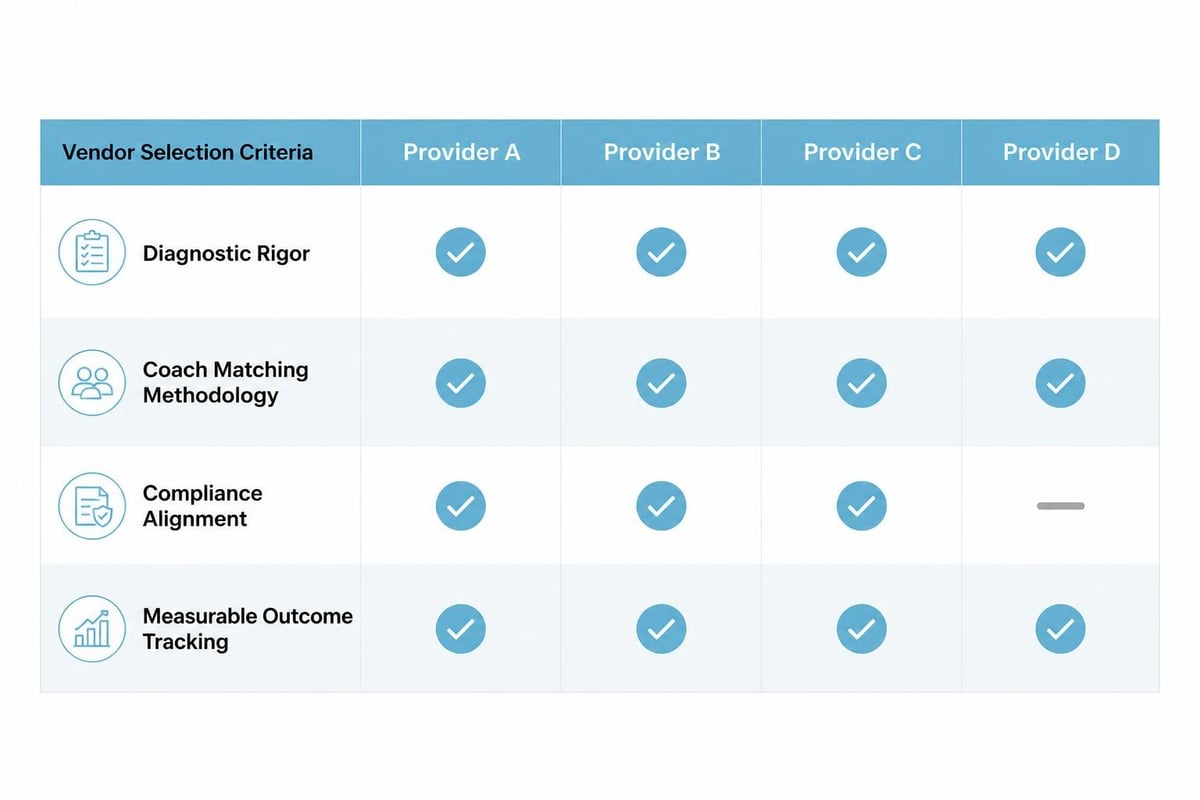
Vendor Selection Criteria That Predict Success
After reviewing procurement processes across 60+ enterprise coaching implementations, specific selection criteria correlate with successful outcomes while others show no predictive value.
Criteria that matter:
- Matching Methodology: Proprietary algorithms that weight sector experience, challenge expertise, and documented outcomes outperform manual matching or coach self-selection processes
- Diagnostic Rigor: Validated assessment tools identifying specific behavioral gaps produce better results than generic leadership surveys
- Measurement Systems: Built-in tracking of behavior change and business outcomes versus reliance on participant satisfaction scores
- Coach Network Depth: Access to specialists in toxic leadership transformation, executive presence development, and conflict resolution rather than generalist coaches
- Implementation Support: Dedicated program management and HR integration rather than transactional coach referrals
Criteria with limited predictive value:
- Total number of coaches in the network
- Years in business (established vendors often resist innovation)
- Lowest cost per coaching session
- Brand recognition or marketing presence
- Generic industry certifications without specialized expertise
Organizations should require case studies demonstrating measurable outcomes in similar contexts rather than accepting testimonials or participation statistics. The difference between a strategic partner and a commodity vendor becomes clear when you examine their evidence of actual behavior change and institutional impact.
The ROI Calculation Most CFOs Demand
Finance leaders increasingly scrutinize coaching investments, requiring quantified returns rather than anecdotal success stories. An enterprise coaching provider in the United States must help organizations build defensible ROI models connecting coaching interventions to financial outcomes.
Calculation framework:
| Cost Component | Investment Range | Measurement Period |
|---|---|---|
| Coach fees (6-month engagement) | $15,000 – $35,000 per leader | 6-12 months |
| Assessment tools | $2,000 – $5,000 per leader | Baseline + follow-up |
| Program management | 15-20% of total coaching fees | Duration of engagement |
| Internal coordination (HR time) | $3,000 – $8,000 per cohort | Setup + maintenance |
Value generated through:
- Retention of high-performing leaders (replacement costs average 200% of annual salary)
- Productivity gains from improved team dynamics (typically 15-25% in coached teams)
- Reduced turnover in teams reporting to coached leaders (valued at $50,000 – $150,000 per prevented departure)
- Faster decision-making and reduced organizational friction (harder to quantify but significant)
- Enhanced succession readiness reducing external recruitment costs
A realistic ROI calculation for a 12-person executive coaching cohort shows total investment of $350,000 generating $1.2M to $2.1M in retained talent value, productivity gains, and reduced turnover costs over 18 months. The wide range reflects variance in organizational baseline performance and coaching intervention quality.
Organizations should be skeptical of ROI claims exceeding 5:1 unless backed by rigorous attribution analysis and longitudinal tracking. Conservative estimates with transparent methodology build credibility with finance leaders and enable accurate budget planning for scaled deployments.
Best Practices That Separate High-Impact Programs
Effective enterprise coaching programs share common structural elements regardless of organization size or sector. These practices emerged from comparative analysis of high-performing versus underperforming coaching implementations across 2024-2026.
Establish Clear Intervention Objectives
Vague development goals produce vague outcomes. Specific, measurable objectives tied to business priorities enable targeted coaching and meaningful evaluation.
Strong objective: "Increase team psychological safety scores from 3.2 to 4.5 (on 5-point scale) within six months while maintaining project delivery timelines."
Weak objective: "Improve leadership effectiveness and team dynamics."
The specificity forces diagnostic precision and enables both coach and leader to track progress against defined benchmarks. Organizations examining leadership and executive coaching options should insist on this level of clarity before engagement begins.
Integrate Coaching with Talent Systems
Standalone coaching programs deliver limited value compared to interventions integrated with performance management, succession planning, and organizational development initiatives. The most successful enterprise coaching provider relationships involve close collaboration between coaches, HR business partners, and line leadership.
This integration enables coaches to understand organizational context, align interventions with strategic priorities, and provide feedback that informs broader talent decisions. It also prevents situations where coaching addresses individual development while organizational systems reinforce problematic behaviors.
Build Accountability Mechanisms
Coaching without accountability produces conversations without change. Effective programs establish clear expectations, progress milestones, and consequences for leaders who engage superficially or resist behavior modification.
Accountability elements include:
- Stakeholder agreements defining expected outcomes before coaching begins
- Regular progress reviews involving the leader, coach, and HR partner
- 360-degree feedback at program midpoint and completion
- Team engagement surveys tracking real-world impact
- Performance evaluation integration considering coaching objectives
When coaching addresses toxic leadership patterns, accountability becomes non-negotiable. Leaders must understand that sustained resistance to behavior change carries professional consequences while genuine effort receives organizational support.
Emerging Trends Reshaping Enterprise Coaching
The landscape for enterprise coaching providers in the United States continues evolving as economic pressures, technological capabilities, and workforce expectations shift organizational priorities.
Trend: AI-Augmented Coaching Delivery
Generative AI tools now support coaching through automated session summaries, pattern recognition across engagements, and personalized practice scenarios between live sessions. However, research on AI integration in professional coaching shows technology works best when amplifying human judgment rather than replacing it.
Smart providers use AI to increase coaching frequency and reinforcement while preserving human coaches for complex interpersonal dynamics and ethical decision-making scenarios.
Trend: Micro-Coaching for Mid-Level Leaders
Traditional executive coaching focused on C-suite and senior vice presidents. Forward-thinking organizations now deploy shorter, more focused coaching interventions for directors and senior managers addressing specific challenges like difficult conversations, delegation, or stakeholder management.
This approach scales coaching impact across broader leadership populations while controlling costs. Sessions typically run 30-45 minutes monthly for three to six months, focused on immediately applicable skills.
Trend: Team-Based Coaching Models
Individual leadership development sometimes fails because organizational systems and team dynamics pull leaders back toward problematic patterns. Team coaching addresses collective behaviors, decision-making processes, and relationship dynamics affecting group performance.
This model particularly benefits cross-functional teams, executive committees, and departments undergoing significant change where individual coaching alone cannot overcome systemic dysfunction.
Frequently Asked Questions
What qualifications should an enterprise coaching provider have?
Look for providers with proprietary matching methodologies, validated assessment tools, documented outcomes in similar organizational contexts, and deep coach networks with relevant sector expertise. Generic industry certifications matter less than proven ability to deliver measurable leadership behavior change aligned with institutional priorities.
How long does enterprise coaching typically take to show results?
Initial behavior shifts appear within 8-12 weeks when diagnostic precision and coach matching are strong. Measurable business outcomes typically emerge at the 5-6 month mark as new behaviors become consistent and team dynamics respond. Sustainable transformation requires 9-12 months with reinforcement mechanisms.
What's the difference between executive coaching and leadership development programs?
Executive coaching delivers personalized, one-on-one interventions addressing specific behavioral gaps and leadership challenges. Leadership development programs use group training, cohort learning, and standardized curriculum. The best outcomes combine both approaches with coaching targeting individual behavior while development programs build shared frameworks and organizational culture.
How do you measure coaching ROI?
Effective measurement tracks behavior change through 360 feedback, team engagement scores, and direct report assessments combined with business outcomes like retention rates, productivity metrics, and succession readiness. Financial ROI calculations should include retained talent value, reduced turnover costs, and productivity gains with conservative attribution models.
Should coaching be confidential or transparent to the organization?
Coaching conversations remain confidential to build trust and psychological safety. However, progress toward agreed-upon objectives, behavioral improvements, and program outcomes should be transparent to stakeholders. The best providers establish clear frameworks defining what stays confidential versus what gets reported to HR partners and leadership.
Selecting an enterprise coaching provider in the United States requires evaluating diagnostic rigor, matching precision, and measurement systems rather than accepting vendor claims at face value. Organizations that treat coaching as strategic intervention rather than generic development benefit see measurable leadership transformation and defensible ROI. Noomii Leadership Coaching delivers evidence-based diagnostics, precision coach matching, and scalable solutions designed to address complex leadership challenges with measurable results across government agencies and Fortune 500 companies.



Leave a Reply
Want to join the discussion?Feel free to contribute!