

Psychological Safety at Work: What It Means for Leaders
Psychological safety is the shared belief that you can ask a question, admit a mistake, or challenge an idea at work without being punished or humiliated for it. In a psychologically safe team, people say the uncomfortable thing early, while it is still cheap to fix.
Leaders usually treat this as a culture topic. It is a performance topic. Teams that hide bad news make slower decisions, repeat avoidable errors, and lose good people quietly.
How Does Psychological Safety Work in a Team?
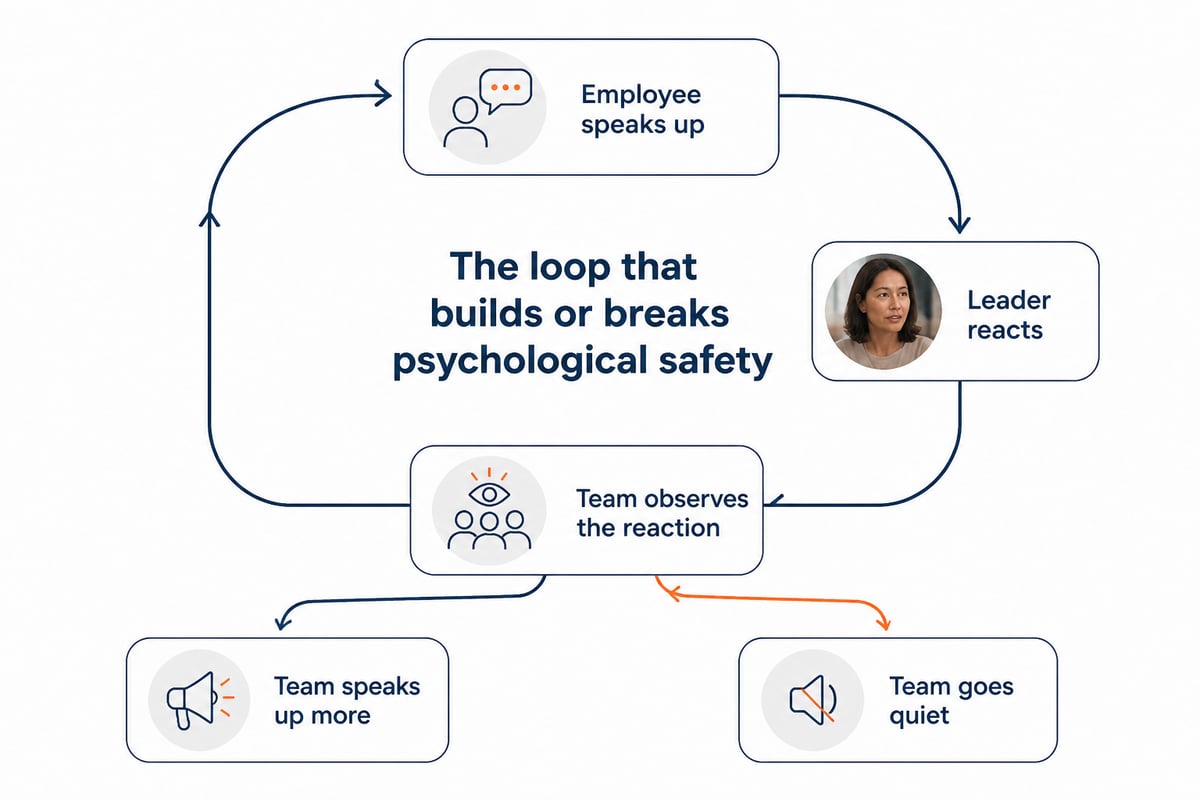
Psychological safety works through a simple loop: a person takes a small risk by speaking up, the leader's response tells everyone whether that risk was safe, and the team adjusts its behavior accordingly. One dismissive reaction in a meeting can silence a department for months.
That is why the leader's reaction matters more than any policy. Employees do not read the values poster. They watch what happens to the last person who disagreed with the boss.
The American Psychological Association surveyed more than 2,000 employed adults in 2024. Among workers who called their workplace toxic, most also reported lower psychological safety, and only a minority of workers overall described their workplace as toxic. Fear and dysfunction travel together.
What Psychological Safety Is Not
Psychological safety is not comfort, agreement, or low standards. A safe team can argue hard, hold people to demanding targets, and still be safe, because the risk being removed is personal punishment, not accountability.
The most common myth is that safety means being nice. In practice, the nicest-seeming teams are often the least safe, because conflict is avoided and problems fester. Real safety makes direct feedback possible.
Other myths worth dropping:
- It means no consequences. Missed commitments still get addressed. The difference is that people report problems early instead of hiding them.
- It is an HR program. A workshop cannot fix what a manager undoes in the next meeting.
- It is the same as engagement. Engaged people can still be afraid to say what they think.
- It is a mental health intervention. It is a team condition shaped by leadership behavior. Anyone needing treatment for a mental health condition should seek a licensed therapist, not a workplace initiative.
What Does Psychological Safety Look Like in Practice?
In practice, psychological safety shows up as observable behaviors: people flag problems before deadlines, junior staff disagree with senior ones, and mistakes get discussed as information instead of hidden as liabilities.
Hypothetical example: a sales manager notices that pipeline forecasts are always optimistic and always wrong. The diagnosis is not poor math. Reps have learned that reporting a stalled deal triggers an interrogation, so they delay bad news until it is unavoidable. The fix is a change in the manager's response to bad news, not a new forecasting template.
Compare two reactions to the same disclosure:
| Rep says | Unsafe response | Safe response |
|---|---|---|
| "This deal is stalling." | "Why didn't you close it?" | "What have you learned, and what do you need from me?" |
| "I missed the target." | Public criticism | Private debrief, then a team lesson |
Hybrid and remote teams need this even more deliberately. Silence on a video call is ambiguous, so leaders have to invite input by name rather than wait for it.
How Leaders Build Psychological Safety
Leaders build psychological safety by changing their own responses first, then making speaking up a routine part of how work gets done. The APA’s guidance recommends modeling constructive, nonjudgmental discussion of difficult issues, inviting team members to raise concerns, and building lessons-learned debriefs into projects.
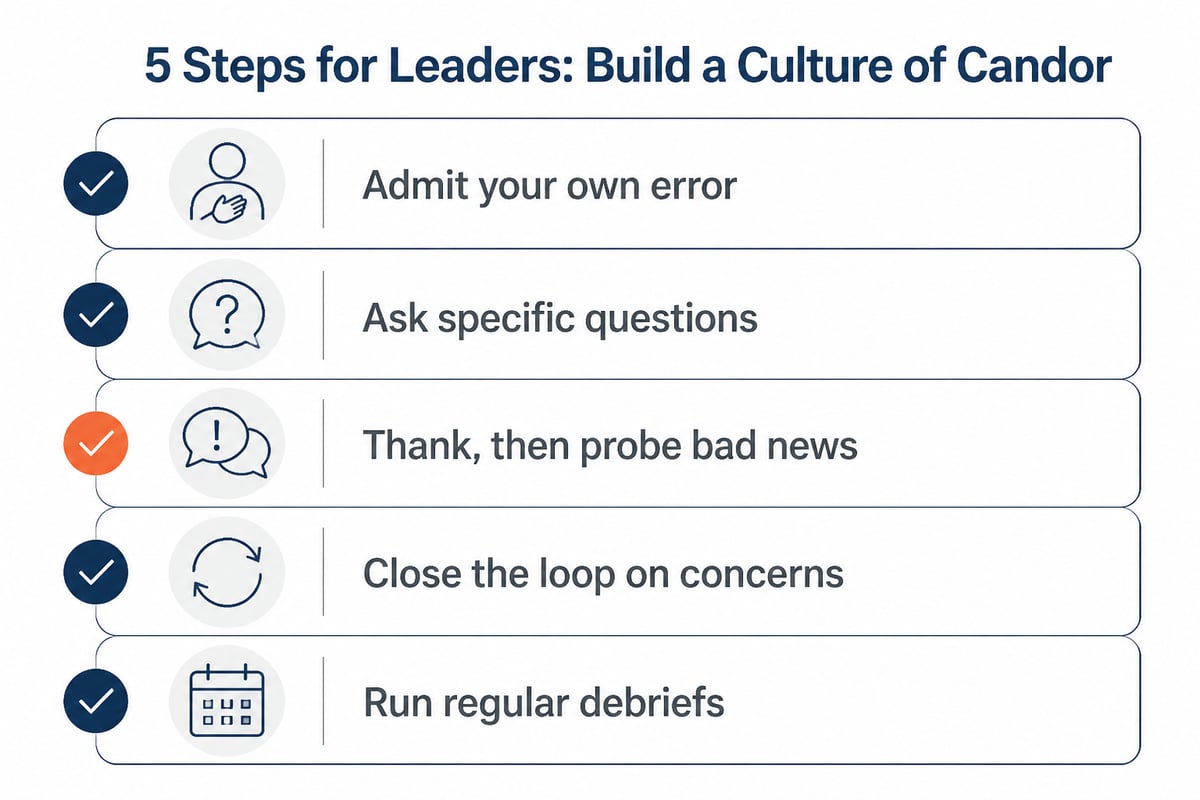
A practical sequence:
- Admit your own error first. Say what you got wrong in the last decision. This lowers the cost of honesty for everyone else.
- Ask specific questions. "What risk are we not discussing?" gets better answers than "Any questions?"
- Respond to bad news with thanks, then curiosity. Anger or sighing ends the flow of information.
- Close the loop. When someone raises a concern, report back on what happened. Silence after a concern teaches people not to bother.
- Run debriefs on wins and losses. Treat them as scheduled learning, not blame sessions.
Many managers know these steps and still fail at them under pressure. That is where live coaching beats a one-time course. Leadership coaching, often starting from a 360 assessment, shows a leader how their reactions actually land, which is rarely how they think they land.
Why Psychological Safety Matters for Retention and Inclusion
Psychological safety matters because it drives whether people share information, stay in their jobs, and feel included. Research on workplace inclusion links it to belonging and retention, and employees from diverse and disadvantaged groups often face higher personal risk when speaking up.
The gap between intent and experience is wide. In Mental Health America’s 2024 survey, fewer than half of employees agreed their employer encourages clear, transparent communication or invests in developing fair and supportive people managers. Many leaders believe they run open teams; the data suggests many employees disagree.

How to Measure Psychological Safety
Measure psychological safety with a short anonymous pulse survey plus behavioral signals, because leaders consistently overrate their own teams. A credential or a workshop completion tells you nothing about whether people speak up on Tuesday.
Track a small set of indicators:
- Share of team members who raised a concern or disagreement in the last month
- Time between a problem occurring and the leader hearing about it
- Whether retrospectives produce changes, not just notes
- Voluntary turnover and exit-interview themes by manager
Tie these to business KPIs such as decision speed and execution cleanliness. For a public-sector view of practices and resources, the CalHR psychological safety guide offers a useful reference.
Related Terms
- Trust: confidence in a person or leader; safety is the team-level result of repeated trust-building.
- Candor: direct, honest communication, which safety makes possible.
- Blameless postmortem: a debrief that examines systems and decisions rather than assigning fault.
- Inclusion: the sense of belonging that safety supports.
- Accountability: ownership of outcomes, which works better with safety, not against it.
Frequently Asked Questions
What is psychological safety in simple terms?
It is the confidence that you will not be punished or embarrassed for speaking up with a question, concern, idea, or mistake.
Who coined the term?
Harvard professor Amy Edmondson popularized the concept in her research on team learning.
Is psychological safety the same as being nice?
No. Safe teams can debate hard and hold high standards. Safety removes the fear of personal punishment, not the pressure to perform.
Can a leader build it alone?
A leader sets the tone, but safety is shared. Peers also shape it through how they respond to each other.
How long does it take to build?
It can erode in one bad meeting and rebuild only through consistent behavior over months. There is no fixed timeline.
How do remote teams build it?
Invite input by name, use written channels for quiet contributors, and run regular debriefs so speaking up is routine.
Does it lower performance standards?
No. It improves performance by surfacing problems earlier. Pair it with clear goals and KPIs.
Can AI tools or a certification create it?
No. Safety comes from observed leader behavior. Tools and credentials can inform, but they cannot replace practiced habits.
When is coaching the right choice?
When managers know what to do but fall back on old reactions under pressure, live coaching in real meetings helps change the behavior.
Start this week by asking your team one specific question, such as "What risk are we not discussing?", then thank the first person who answers honestly. If you want help turning that habit into consistent manager behavior, Noomii Corporate Coaching works live inside your meetings and ties progress to clear KPIs, starting with leadership coaching for the managers who set the tone. Noomii's coaches are real, independent professionals, and most offer a free consultation, so you can get my free match with a coach who fits your goals, personality, and budget.



Leave a Reply
Want to join the discussion?Feel free to contribute!