Leadership Development Providers in Colombia: A Guide
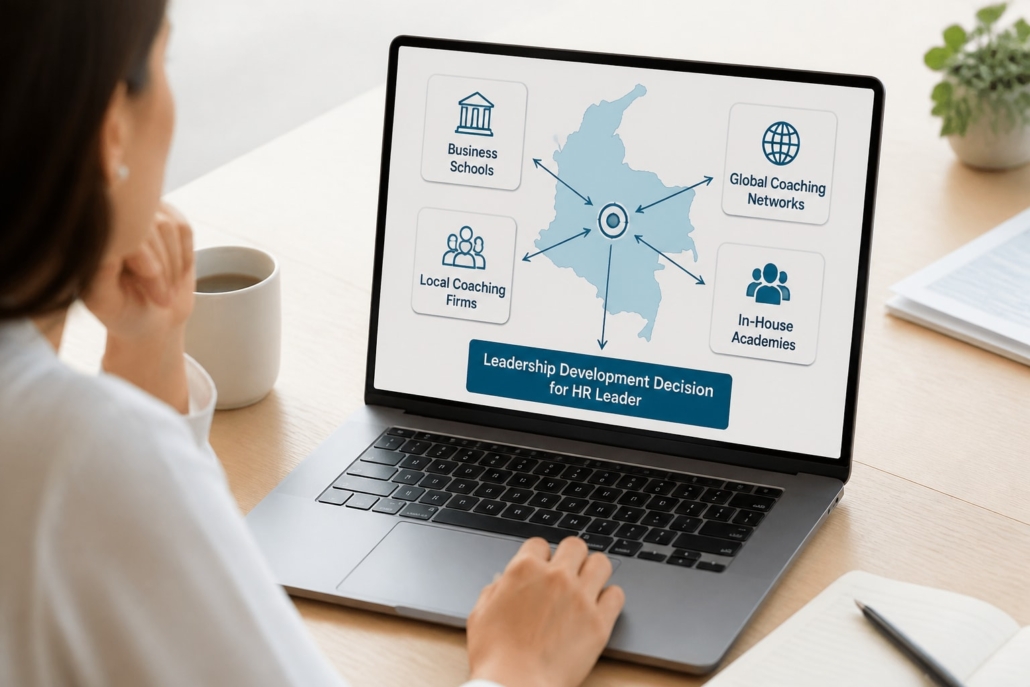
Leadership development providers in Colombia fall into four groups: universities and business schools, regional consultancies and coaching firms, global coaching networks, and in-house corporate academies. The right choice depends less on brand than on whether a provider can change how your leaders behave and prove it with data your CFO will accept.
For HR, L&D and People leaders at mid-market and large companies, the market is crowded but uneven. Many provider websites list partners, team bios and service categories, yet say little about outcomes. This guide gives you a way to sort the field, a scorecard to compare vendors, and the questions that separate programs that change behavior from programs that fill calendars.
What types of leadership development providers operate in Colombia?
Colombia's provider market breaks into four types, each with a different strength and a different weakness.
Universities and business schools. Executive education programs carry academic credibility and strong networks, especially in Bogotá, Medellín and Cali. They work well for cohort-based learning and for building a shared vocabulary across a management layer. Their weakness is individualization. A classroom program rarely addresses the specific behavior that is hurting one director's team.
Regional consultancies and coaching schools. Local firms offer Spanish-language delivery, cultural fluency and relationships with chambers of commerce and trade associations. Many combine talent development with adjacent services such as strategy, commercial management or executive search. That breadth helps smaller engagements, but it can mean leadership development is one line item among several rather than a core discipline.
Global coaching networks. These providers source certified coaches across countries and match them to leaders by function, level and industry. They suit multinational operations where a Colombian country manager needs the same quality of support as a regional vice president in another market. Noomii Leadership Coaching sits in this category.
In-house academies. Large employers increasingly build their own programs. Jerónimo Martins, the Portuguese retail group with a large Colombian operation, reported 101 training hours per employee in Colombia in 2024, up from 84 in 2023. Its total in Colombia reached 1,614,310 training hours in 2024 against 1,156,347 the year before. Scale like that shows how seriously employers there now treat capability building.
How do these four provider types compare?
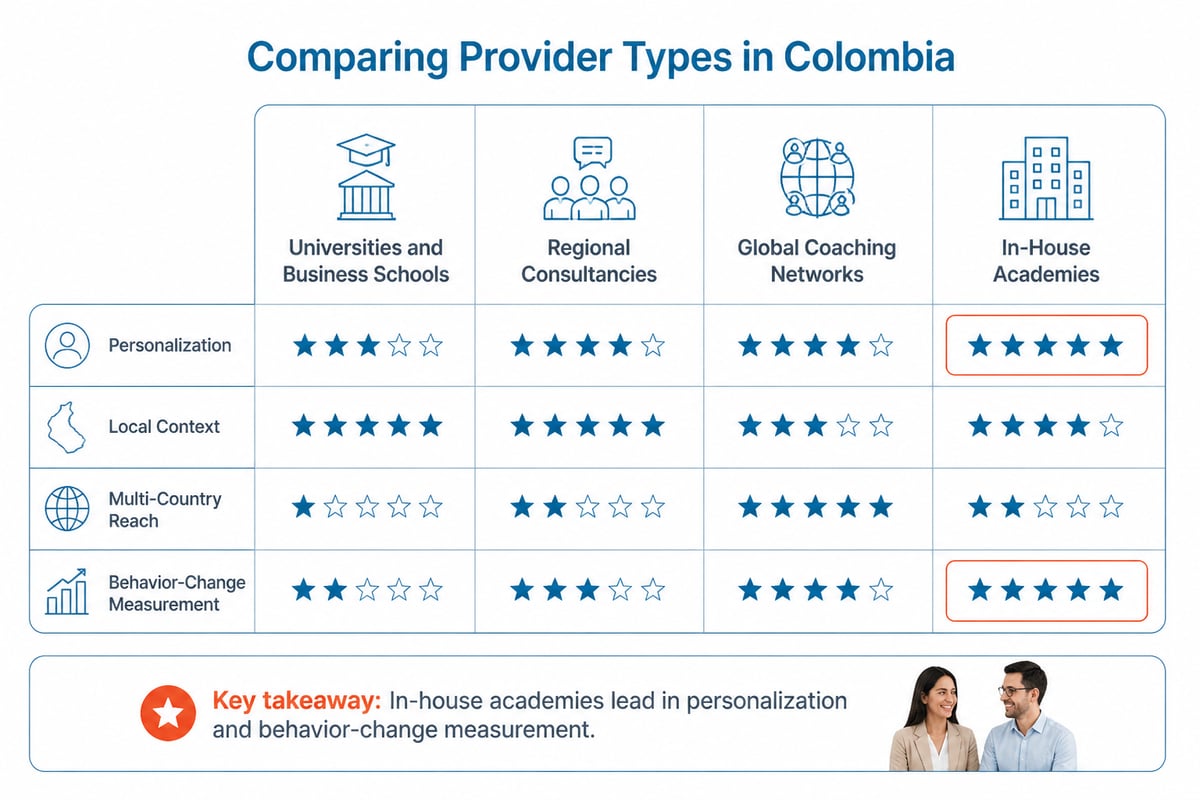
The comparison below uses the attributes HR leaders most often weigh when building a shortlist. Treat it as a screening aid, not a verdict, since individual providers vary widely within each type.
| Attribute | University / business school | Regional consultancy | Global coaching network | In-house academy |
|---|---|---|---|---|
| Personalization | Low to moderate | Moderate | High | Moderate |
| Local language and context | Strong | Strong | Depends on coach match | Strong |
| Multi-country coordination | Limited | Limited | Strong | Depends on footprint |
| Behavior-change measurement | Often limited | Varies | Varies by provider | Varies |
| Speed to launch | Slow (academic calendar) | Moderate | Moderate | Slow to build |
| Best use | Cohort learning, credentials | Local workshops, culture programs | Executive and manager coaching at scale | Core competency frameworks |
The pattern is clear. No single type wins every row, which is why mature organizations usually blend two or three.
Why most leadership programs in Colombia fail to change behavior
Most programs fail because they measure attendance and satisfaction instead of behavior. A leader can rate a workshop five stars and return to the same habits on Monday.
The conventional view holds that more training hours produce better leaders. The evidence from large employers suggests volume alone is not the lever. Jerónimo Martins' Be a Leader program, which had trained 1,437 employees at strategic and managerial levels by the end of 2024, combines classroom training, individual coaching and collaborative learning groups, with separate pathways for leading self, others and teams. The design choice matters more than the headline number: it pairs group learning with one-to-one work. The company also invested more than €1.2 million in the program in 2024, with 265 participants that year, which shows the program is funded seriously.
The lesson for a mid-market HR team with a fraction of that budget is to copy the architecture, not the spend. Learning that happens only in a room decays. Learning tied to real decisions, reinforced by a coach, and checked against observable behavior sticks. If you want to see where programs break down, leadership development without behavior change covers the common failure patterns in detail.
A five-part scorecard for evaluating any provider
Use this scorecard to rate each shortlisted provider from 1 to 5 on each dimension. It is a framework to apply in your own procurement process, and it works regardless of which provider type you are assessing.
- Diagnostic rigor. Does the provider start with a validated assessment, such as a 360 survey, or with a generic needs conversation? Without a baseline, you cannot prove change later.
- Match quality. How are coaches or facilitators selected for each leader? Look for matching on function, level, industry and goals rather than assignment from whoever is available.
- Intervention design. Is there a written development plan tied to a business objective, approved by you before work begins?
- Measurement. What gets reported, how often, and against which KPIs? Retention, performance and leadership indicators beat satisfaction scores.
- Governance and risk. Can the provider handle confidentiality, ethical standards and sensitive situations such as toxic leadership patterns without creating legal exposure?
Providers that score below 3 on diagnostics or measurement should be treated as training vendors, not development partners. That is a legitimate purchase, but it should be priced and expected accordingly.
What does a measurable engagement look like in practice?
A measurable engagement starts with a baseline, assigns a matched coach, and reports against business KPIs on a fixed rhythm. Two documented cases from Noomii's client work show the shape of the outcomes you should expect to see described.
Hypothetical example: a global manufacturer with leaders across several regions would need consistent development, but a single delivery model would not fit different functions and countries. The need would be coordinated, individualized support across geographies, not another standard curriculum, which could be delivered through coordinated multi-coach support with coaches matched to each leader. Repeat purchase is the cleanest proof of value when a client re-commissions without being pushed.
Hypothetical example: leaders operating at the level of task execution rather than owning problems would show a behavioral gap, a mindset about accountability rather than a knowledge gap. One-to-one leadership coaching focused on ownership and decision-making could target that single observable shift, since programs that try to fix everything usually fix nothing measurable.
Any provider you evaluate should be willing to describe its own results with comparable specificity, including ratings for coaching effectiveness and coach professionalism and the share of leaders showing observable behavior change.
How should Colombian HR leaders handle language, culture and distribution?
Handle them by deciding up front which parts of the program must be delivered locally and which can be matched globally. This is the decision that most often goes unplanned.
For a Colombian operation inside a multinational, the first question is whether leaders will coach in Spanish, English or both. The second is whether the coach needs lived experience in Latin American organizations, or whether sector and functional expertise matter more. For a country manager navigating headquarters pressure, a coach who has worked inside matrixed global companies may add more than one who knows the local market but not the matrix.
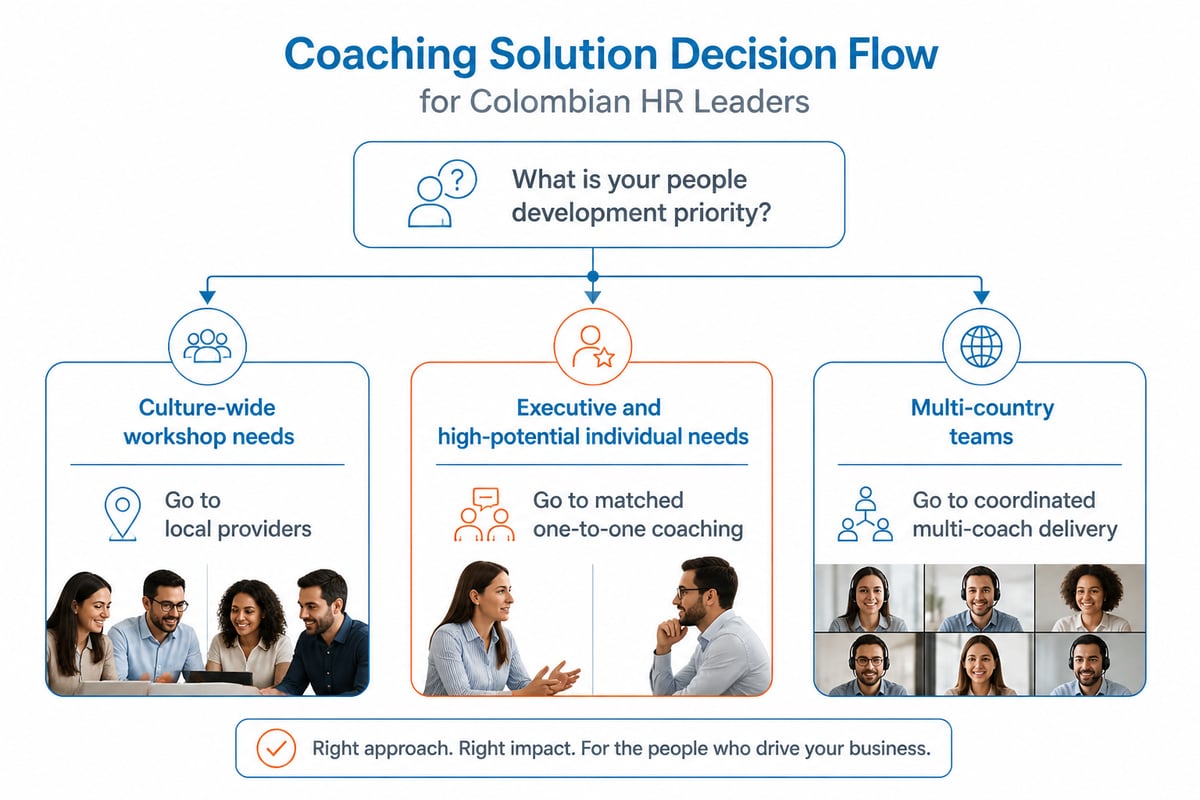
Distribution matters too. Companies with plants, stores or offices spread across Bogotá, Medellín, Barranquilla and smaller cities struggle to run in-person programs consistently. Virtual one-to-one coaching removes that constraint, and it makes coordinated delivery across several countries feasible without a separate vendor in each. The trade-off is that virtual delivery requires disciplined scheduling and manager sponsorship, or sessions slip.
A practical rule: use local providers for culture-wide programs and team workshops where shared context carries the load, and use matched individual coaching for executives and high-potential managers where the problem is specific to the person.
Where individual coaching fits into a leadership development program
Individual coaching fits where group programs stop: at the personal behavior that determines whether a leader's team trusts them. Workshops build shared language, but they rarely reach the specific conflict, blind spot or avoidance pattern that is costing an organization engagement or talent.
Matching is the lever. Noomii's approach hand-matches human coaches to leaders by function, level, industry and goals, and coaches are sourced and interviewed for each leader's needs. There is no payment until the coach selection and development plan are approved, which lowers the risk of committing budget before you see the fit. Every participant also receives a free 360 leadership survey, which gives HR the baseline discussed in the scorecard above. Quarterly ROI reports tie results to retention, performance and leadership KPIs, so the people function can report upward with numbers rather than anecdotes.
For HR leaders designing a full pathway, Noomii's Leadership Development Programs are customized, measurable plans for each leader, built with your HR, L&D or People team and aligned to business strategy, with pilot programs available. A pilot is a sensible way to test a provider before scaling, whichever provider you choose. If your question is how coaching differs from training, this overview of leadership training sets out the distinction.
Questions to ask every provider before you sign
These questions expose the difference between a polished brochure and a provider that can be held accountable.
- What assessment do you use at the start, and will I own the baseline data?
- How do you select and match the specific person who will work with each leader?
- What does the development plan look like, and who approves it before work starts?
- Which KPIs do you report, how often, and can you show a redacted example of a report?
- How do you handle a leader whose behavior is harmful to the team? What is your escalation path?
- Can you coordinate delivery across the countries where my leaders sit?
- What happens if the match is not working at session three?
Weak answers to the first and fourth questions are the most predictive of a weak engagement. If a provider cannot show you how it measures change, it will not be able to show you later.
For organizations with a recurring toxic-leadership problem, it is worth listening to practitioners discuss it directly. Noomii’s fireside chat on how organizations handle toxic leadership with its VP of Development is a useful briefing before you write requirements, and the broader corporate leadership development resource helps frame program scope.
A practical sequence for launching in the next quarter
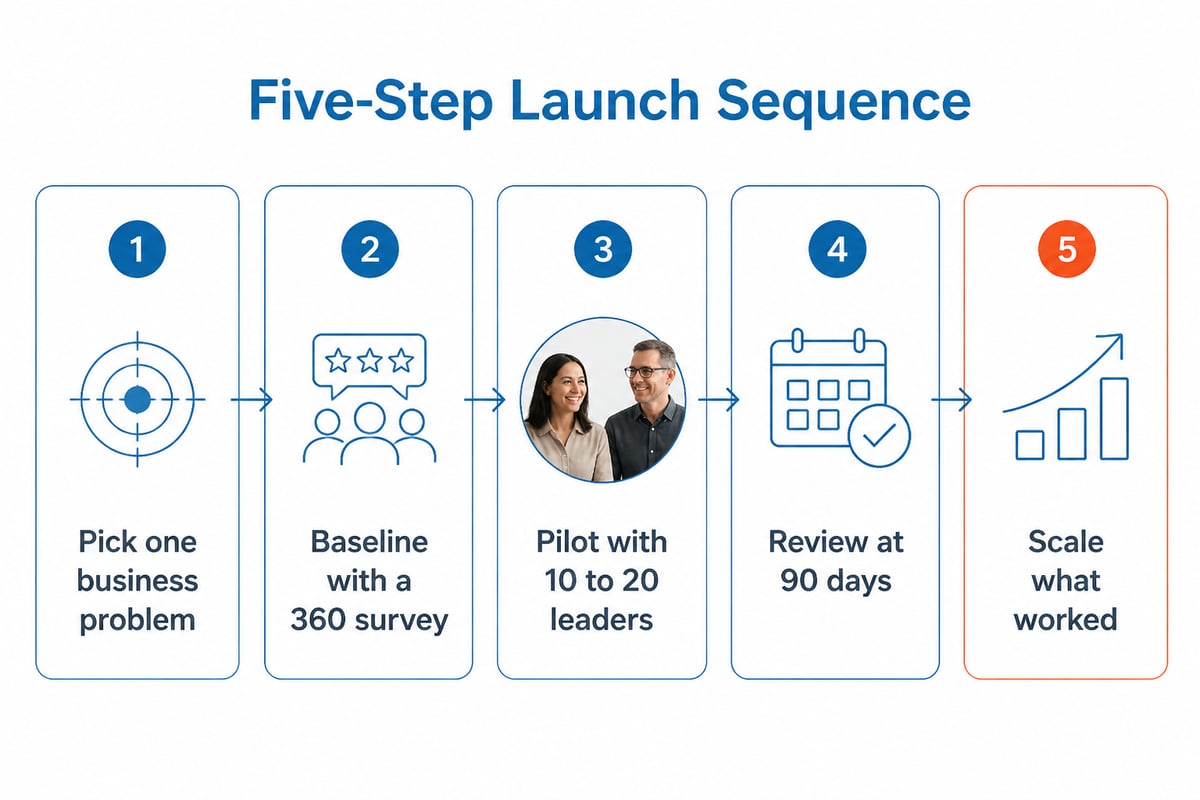
A launch in the next quarter is realistic if you sequence it in five steps and resist the urge to start with the full population.
- Pick one business problem. Choose a retention hotspot, a stalled succession pipeline or a team with falling engagement scores.
- Baseline the population. Run a 360 survey on the target leaders before any intervention.
- Pilot with a small cohort. Select 10 to 20 leaders and agree the KPIs in writing.
- Review at 90 days. Compare behavior and business indicators to the baseline, and decide whether to extend, adjust or stop.
- Scale what worked. Expand only to groups where the pilot showed observable change.
The sequence is deliberately conservative. A narrow pilot with clean measurement builds the internal case for budget far faster than a broad launch with fuzzy results. Teams that follow this path also avoid the common trap of buying a large package from one provider before they know whether the fit is right.
Frequently asked questions
What are the main leadership development providers in Colombia?
The market includes universities and business schools offering executive education, regional consultancies and coaching schools, global coaching networks, and in-house corporate academies. Most mid-market and large employers combine two or more types rather than relying on one.
How do I choose between a local provider and a global coaching network?
Use local providers when shared language and cultural context drive the outcome, such as company-wide workshops. Choose a global network when you need matched individual coaching for executives, or coordinated delivery across several countries.
How should I measure the success of leadership development?
Start with a baseline such as a 360 survey, then track behavior change and business KPIs such as retention and performance at fixed intervals. Satisfaction scores alone do not show whether leaders changed.
Is individual coaching better than group training?
They solve different problems. Group training builds shared frameworks. Individual coaching addresses the specific behaviors of one leader. The strongest programs combine both, as large employers' blended designs show.
How long before a leadership program shows results?
A 90-day review against a baseline is a practical checkpoint for early behavior signals. Business outcomes such as retention typically take longer, so agree reporting rhythms before you start.
Does Noomii work with organizations in Colombia?
Noomii delivers coordinated multi-coach engagements across multiple countries for global organizations. To discuss your Colombian operations specifically, contact Noomii through its website.
This week, pick one leadership group with a visible business problem and write down the single behavior you want to see change, then use the scorecard above to shortlist two or three providers against it. If you want matched coaches, a free 360 baseline and quarterly ROI reporting in place before you commit budget, Book a Free Strategy Call with Noomii Leadership Coaching and scope a pilot around your own KPIs.


Leave a Reply
Want to join the discussion?Feel free to contribute!