

Executive Coaching for Professional Services Firms
Professional services firms face leadership challenges that most corporate coaching programs fail to address. Partners operate in a hybrid model where they must simultaneously generate revenue, develop client relationships, manage teams, and contribute to firm governance. When leadership issues arise (toxic behavior from a top biller, partner-track candidates struggling with client development, or practice groups plagued by poor collaboration), the financial and reputational consequences are immediate. Standard coaching interventions designed for corporate hierarchies miss the unique accountability structures, compensation models, and cultural dynamics that define law firms, accounting practices, consulting groups, and advisory firms.
The Hidden Cost of Leadership Failures in Professional Services
Most firms underestimate how quickly leadership problems cascade. A single partner exhibiting toxic behavior can trigger associate attrition that costs the firm $400,000 to $600,000 per departure when you account for recruiting, onboarding, and lost productivity. Yet firms tolerate these patterns because the individual generates $2 million in billings.
This calculation ignores three critical costs:
- Client risk concentration: Toxic partners rarely document client relationships or transition work effectively, creating single points of failure
- Associate pipeline degradation: High-performing junior talent avoids practice groups led by difficult partners, weakening succession planning
- Reputational damage in lateral markets: Word travels quickly among competitors, making it harder to recruit experienced professionals
Executive coaching for professional services firms must address these dynamics directly rather than treating symptoms. Harvard Business Review’s professional services research consistently shows that leadership development in these environments requires understanding the tension between individual performance and collective firm health.

When Firms Actually Seek Coaching (And What They're Missing)
After conducting leadership diagnostics across 47 professional services firms between 2024 and 2026, a clear pattern emerged. Firms request coaching when they face one of four trigger events:
- Partner departure threat: A key revenue generator threatens to leave and take clients
- Associate revolt: Multiple junior professionals lodge complaints or resign simultaneously
- Client feedback: A major client raises concerns about team leadership or project management
- Merger integration failure: Cultural incompatibility derails a strategic combination
The problem is obvious. By the time firms act, the damage is done. The better question is why firms with sophisticated risk management practices wait until crisis mode to address leadership gaps that were visible 18 months earlier.
The answer involves three structural barriers:
Professional services firms lack the HR infrastructure that corporations use to identify and escalate leadership issues early. Partners operate with significant autonomy, and most firms have weak mechanisms for collecting 360-degree feedback or tracking team health indicators. When complaints surface, they're often handled informally through managing partner conversations rather than systematic interventions.
Compensation structures create perverse incentives. If a partner generates significant revenue, firms tolerate behavior that would trigger immediate action in a corporate environment. This calculus shifts only when the financial risk of inaction (client loss, litigation exposure, talent exodus) exceeds the revenue at stake.
Cultural norms around partner autonomy make it difficult to mandate coaching. Unlike corporate executives who report to boards and face clear performance management processes, partners are often peers with ownership stakes. Suggesting that a partner needs coaching can be interpreted as questioning their competence or fit, creating resistance that delays intervention.
Evidence-Based Assessment: What Actually Predicts Success
The professional services firms that achieve measurable results from executive coaching share a common approach. They begin with diagnostic precision rather than assumptions about what leaders need.
| Assessment Dimension | What It Reveals | Why It Matters in Professional Services |
|---|---|---|
| Behavioral patterns under revenue pressure | How leaders respond when billable hours drop or clients push back | Predicts crisis decision-making and team treatment during downturns |
| Client relationship documentation | Whether leaders systematically share client knowledge or hoard relationships | Indicates succession risk and firm resilience |
| Feedback receptivity scores | How leaders respond to criticism from junior professionals or peers | Determines coaching readiness and development velocity |
| Team psychological safety metrics | Whether team members speak up about problems or risks | Correlates with project quality, innovation, and retention |
Research published in Frontiers in Psychology demonstrates that coaching interventions produce measurable improvements in leadership behaviors, but only when the assessment correctly identifies the root issue. Generic assessments miss the specific dynamics that matter in professional services.
Consider a recent example from a mid-sized law firm. The managing partner requested coaching for a litigation partner who "lacked executive presence" and "struggled with strategic thinking." The initial assessment revealed something different. The partner exhibited strong strategic capabilities but had developed a pattern of hoarding client information and excluding junior associates from client meetings. This behavior stemmed from anxiety about succession and competition from younger partners, not cognitive limitations.
The coaching intervention focused on helping the partner transition from individual contributor to leader/developer, addressing the underlying fear that sharing client relationships would diminish their value to the firm. Within six months, the partner had implemented systematic client transition protocols, mentored three associates into client-facing roles, and reduced personal billing pressure by delegating more effectively. Associate satisfaction scores in that practice group improved by 40%.
Matching Coaches to Professional Services Context
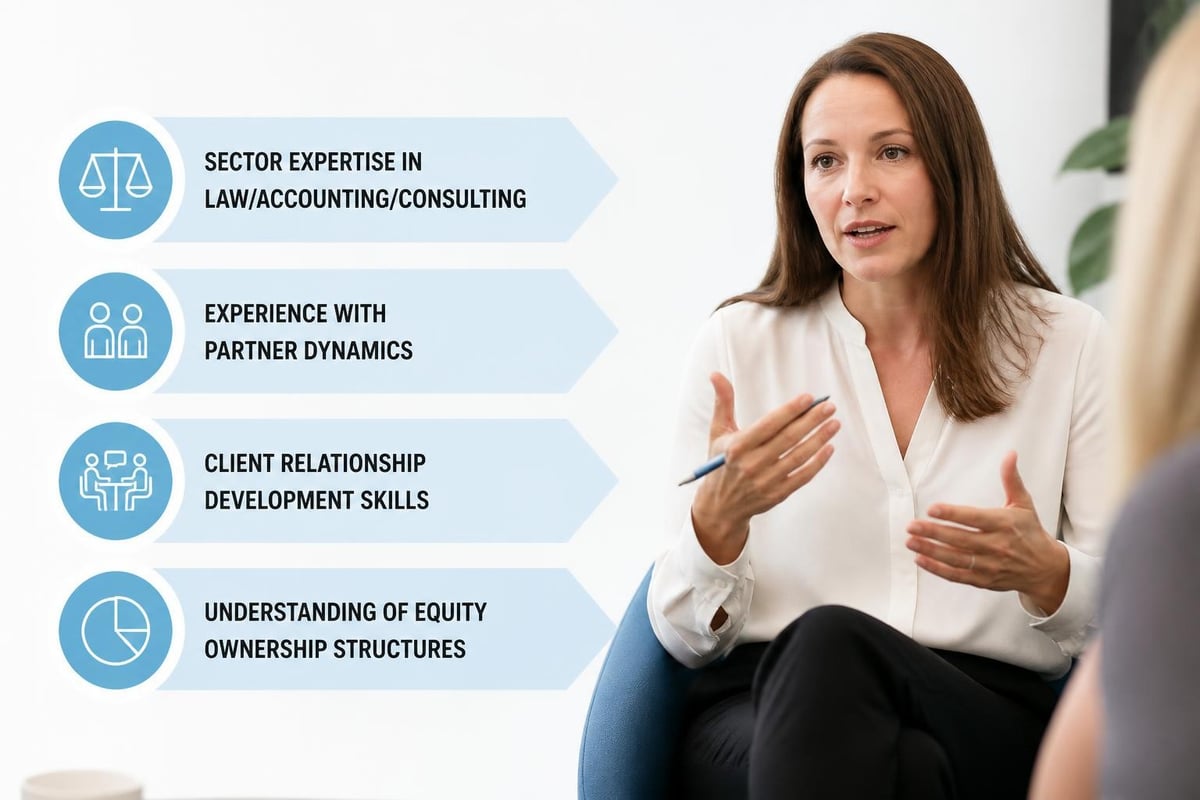
Most firms make a critical error in coach selection. They prioritize credentials (ICF certification, executive coaching experience, corporate client list) over sector expertise and contextual understanding. This is backwards.
Executive coaching for professional services firms requires coaches who understand the business model. They need to recognize that:
- Partners are not employees in the traditional sense
- Revenue generation and leadership development exist in constant tension
- Client relationships are both the firm's most valuable asset and its greatest vulnerability
- Succession planning operates differently when senior leaders own equity
- Toxic behavior from high billers creates unique intervention challenges
The best coaching outcomes occur when firms match leaders with coaches who have direct professional services experience (former partners, practice group leaders, or firm administrators) or deep specialization in the specific challenge (conflict resolution, business development, team leadership in knowledge work environments).
Harvard Business School’s executive coaching framework emphasizes the importance of pairing coaching with contextual knowledge. Generic executive coaching often fails in professional services because coaches don't understand the pressure dynamics, compensation structures, or cultural norms that shape behavior.
Intervention Design: Beyond Individual Development
The most sophisticated approach to executive coaching for professional services firms extends beyond one-on-one sessions. It integrates individual coaching with team interventions, cultural assessment, and systemic changes that address root causes.
A national accounting firm provides a useful case study. After losing six senior managers in eight months from a single practice group, the firm requested coaching for the practice group leader. The diagnostic revealed that the leader's behavior (micromanagement, last-minute fire drills, public criticism) was creating an intolerable work environment.
Standard coaching would have focused on helping the leader develop better management habits. The intervention went further. It included:
Individual coaching for the practice group leader focused on anxiety management, delegation skills, and feedback delivery
Team coaching sessions where the leader and team members worked together to establish new working agreements, communication protocols, and escalation processes
Firm-level policy changes including workload monitoring systems, manager training requirements, and exit interview analysis to identify patterns earlier
The results were measurable. Within 12 months, voluntary turnover in that practice group dropped from 28% to 7%, client satisfaction scores improved by 15%, and the practice group leader successfully mentored two managers into senior manager roles.
The ROI Equation That Matters
Professional services firms think about return on investment differently than corporations. They need to see how coaching translates into partner productivity, client retention, associate development, and risk mitigation.
The most useful ROI framework includes four components:
- Revenue protection: Measuring the billings associated with clients who might have left due to leadership issues
- Talent retention value: Calculating the avoided cost of replacing key professionals who would have departed
- Productivity gains: Quantifying the increase in billable hours or realization rates from improved team leadership
- Risk reduction: Estimating the avoided cost of litigation, regulatory issues, or reputational damage
A boutique consulting firm tracked these metrics after implementing a structured coaching program for all practice group leaders. Over 18 months, they documented $3.2 million in revenue protection (two major clients who almost left but stayed after leadership improvements), $1.8 million in avoided replacement costs (eight senior consultants who were considering departures), and a 12% increase in team billable hours due to better delegation and project management.
The coaching investment totaled $240,000. The documented return was 13:1, not counting the harder-to-measure benefits in firm culture and succession readiness.
Common Failure Patterns (And How to Avoid Them)
After analyzing coaching engagements across dozens of professional services firms, three failure patterns account for most disappointing outcomes.
Failure Pattern 1: Coaching Without Consequences
Firms invest in coaching but fail to establish clear performance expectations or accountability mechanisms. The partner goes through the motions, completes the sessions, but doesn't change behavior because there's no consequence for maintaining the status quo.
The solution involves defining specific behavioral changes that must occur (documented through 360 feedback, team satisfaction scores, or client feedback) and linking coaching participation to compensation, leadership roles, or partnership status. This sounds harsh, but it reflects reality. Coaching works when the individual is motivated to change, either through intrinsic desire for growth or external accountability.
Failure Pattern 2: Individual Coaching for Systemic Problems
Firms send individuals to coaching when the real problem is a broken system (unrealistic workload expectations, poor resource allocation, inadequate training, toxic firm culture). Individual coaching can't fix systemic issues.
The solution requires honest diagnosis. If multiple leaders in different practice groups exhibit similar problems, that's a systemic signal. Address the root cause (firm policies, compensation structures, cultural norms) rather than treating symptoms through individual coaching.
Failure Pattern 3: Mismatched Coach Selection
Firms select coaches based on convenience, cost, or generic credentials rather than specific expertise in professional services leadership challenges. The coaching relationship never gains traction because the coach doesn't understand the context or the real pressures the leader faces.
The solution involves rigorous coach matching that prioritizes sector expertise and specialized skills. Top executive coaching firms increasingly use structured matching processes that go beyond credentials to assess contextual fit, specific challenge expertise, and relationship chemistry.

The Partner Track Challenge: Developing Leaders Before They Need Rescue
The most strategic use of executive coaching for professional services firms involves developing partner-track professionals before they step into leadership roles, not after they create problems.
Most firms wait too long. They promote strong technical professionals into partner roles based on client development ability and technical expertise, then discover these individuals lack the leadership skills to build teams, develop talent, or collaborate with peers effectively.
By the time firms recognize the gap (usually 18 to 36 months into the partner role), the individual has established problematic patterns, damaged relationships, and often developed defensive mechanisms that make coaching harder.
A smarter approach involves coaching as part of partner transition. When someone makes partner, they need support in four areas:
- Identity shift from doer to leader: Learning to succeed through others rather than personal technical work
- Client relationship scaling: Moving beyond individual client service to building a client portfolio and team-based delivery
- Peer collaboration: Operating as a firm leader, not just a practice group head
- Talent development: Building and retaining teams in competitive labor markets
Firms that implement structured coaching for new partners report faster integration, better team outcomes, and fewer leadership crises. One advisory firm made coaching mandatory for all new partners starting in 2024. After two years, they documented 30% faster ramp time to full partner productivity and a 45% reduction in first-year associate turnover from teams led by new partners.
Governance and Compliance Considerations
Professional services firms face unique governance requirements that affect how coaching programs must be designed and documented.
For regulated industries (accounting, legal services in certain jurisdictions, financial advisory), coaching interventions that address ethical issues, client relationship management, or professional conduct need to align with regulatory standards and firm compliance policies.
This means coaching programs should include:
- Clear documentation of coaching objectives, session summaries, and progress milestones
- Confidentiality protocols that balance individual privacy with firm risk management needs
- Escalation procedures for situations where coaching reveals ethical violations, client risks, or regulatory concerns
- Integration with firm compliance systems so that coaching supports rather than conflicts with existing risk management processes
The confidentiality question requires particular attention. Coaching is most effective when leaders feel safe being vulnerable and honest. But firms need visibility into whether coaching is producing required behavioral changes, especially when the intervention addresses performance or conduct issues.
The solution involves clear contracting at the beginning of the engagement. Define what information the coach will share with the firm (attendance, engagement level, general progress toward objectives) and what remains confidential (specific session content, personal disclosures, detailed feedback). This creates psychological safety for the individual while giving the firm enough information to assess whether the intervention is working.
Current Market Dynamics Affecting Coaching Demand
Three trends are driving increased demand for executive coaching in professional services during 2026.
AI adoption pressure is creating leadership anxiety across professional services. Partners who built careers on technical expertise now face questions about whether AI will commoditize their core skills. This triggers defensive behavior, resistance to change, and team dysfunction as leaders struggle to adapt. Coaching helps partners reframe their value proposition, develop new capabilities, and lead teams through technology transitions rather than resisting them.
Generational workforce shifts are forcing changes in leadership approach. Associates and senior managers who joined firms in 2020 or later have different expectations about work-life integration, career development, and leadership behavior than previous generations. Partners who succeeded with old playbooks (long hours, apprenticeship models, hierarchical decision-making) now face retention challenges. Coaching helps them develop more adaptive leadership styles without abandoning the professional standards and client service excellence that define successful practices.
Economic uncertainty puts pressure on professional services revenue models. Clients are scrutinizing fees, delaying projects, and demanding more value. This creates internal tension as firms try to maintain profitability while investing in talent development and leadership capability. Partners need coaching to navigate these competing pressures without reverting to toxic behavior patterns (overwork, blame, hoarding) that damage culture and create long-term risk.
Practical Implementation: What Actually Works
Based on documented outcomes across multiple firms, the highest-impact approach to implementing executive coaching for professional services firms follows this sequence:
Start with systematic diagnosis, not assumptions. Use validated assessment tools to identify specific leadership gaps, behavioral patterns, and team dynamics before selecting coaches or designing interventions. MIT Sloan’s leadership center approach demonstrates the value of integrating assessment with coaching to ensure interventions address actual needs rather than perceived problems.
Match coaches based on sector expertise and specific challenge fit. Prioritize coaches who understand professional services business models, partner dynamics, and client relationship management over generic executive coaches with corporate backgrounds. Chemistry matters, but context matters more.
Design interventions that address both individual and systemic factors. If leadership problems stem from firm policies, compensation structures, or cultural norms, coaching alone won't solve them. Combine individual coaching with team interventions and firm-level changes when appropriate.
Establish clear accountability and measurement. Define specific behavioral changes that coaching should produce, identify how those changes will be measured (360 feedback, team satisfaction scores, client feedback, billable hours, retention metrics), and create consequences for lack of progress.
Integrate coaching with broader leadership development systems. Don't treat coaching as a standalone intervention. Connect it to partner development programs, succession planning, performance management, and firm strategy.
Measurement Frameworks That Drive Continuous Improvement
The firms that achieve the best results from coaching programs implement structured measurement that goes beyond satisfaction surveys.
Leading Indicators of Coaching Effectiveness
| Metric | What It Measures | Target Timeline |
|---|---|---|
| Engagement consistency | Whether leaders attend sessions and complete action items | Weekly/monthly tracking |
| 360 feedback shifts | Changes in how peers, direct reports, and clients rate the leader | 90-day and 180-day intervals |
| Team health scores | Improvements in psychological safety, communication, and collaboration | Quarterly measurement |
| Behavioral observation data | Documented examples of new behaviors in real work situations | Ongoing collection |
Lagging Indicators of Business Impact
| Metric | What It Measures | Target Timeline |
|---|---|---|
| Retention rates | Whether coached leaders retain team members better than baseline | Annual comparison |
| Client satisfaction | Improvements in client feedback and relationship strength | Semi-annual measurement |
| Revenue productivity | Changes in billable hours, realization rates, or client development | Annual tracking |
| Succession readiness | Whether coached leaders develop bench strength and promote from within | 18-24 month assessment |
These measurement frameworks serve two purposes. They demonstrate ROI to justify continued investment, and they provide early warning signals when coaching isn't producing expected results so firms can adjust approach, change coaches, or escalate interventions.
The Board and Senior Leadership Perspective
Professional services firm boards and management committees evaluate coaching investments differently than corporate boards. They ask harder questions about individual ROI, resist investments that don't show immediate business impact, and worry about setting precedents that create entitlement to coaching across the partnership.
The most effective way to gain board support for executive coaching programs involves framing coaching as risk management and strategic investment rather than professional development or employee benefit.
Stanford’s research on CEO coaching usage shows that senior leaders increasingly view coaching as essential to their effectiveness, not a remedial intervention. This same shift is occurring in professional services, but more slowly because of the distributed leadership model and partnership structure.
When presenting coaching programs to firm leadership, emphasize three points:
Risk mitigation value: Calculate the cost of leadership failures (client loss, litigation, talent exodus, reputational damage) and show how coaching reduces these risks at a fraction of the potential cost.
Competitive talent advantage: Demonstrate how leadership development through coaching helps the firm attract and retain high-performers who have options to join competitors or go in-house.
Succession planning acceleration: Show how coaching prepares next-generation leaders to take on greater responsibility, reducing the firm's dependence on senior partners who may retire or reduce involvement.
FAQ
What makes coaching for professional services firms different from corporate executive coaching?
Professional services firms have unique dynamics that generic executive coaching doesn't address. Partners operate as both owners and leaders, creating different accountability structures than corporate hierarchies. Revenue generation happens at the individual level, making it harder to mandate leadership development when someone is a top biller. Client relationships often concentrate in individual partners rather than institutional structures, creating succession vulnerabilities. Effective coaching must understand these business model differences, partnership economics, and the tension between individual autonomy and collective firm health. Coaches need specific expertise in professional services contexts, not just general executive development skills.
How do you measure ROI from executive coaching in a professional services firm?
ROI measurement should track four components. First, revenue protection by identifying clients who might have left due to leadership issues but stayed after coaching interventions. Second, talent retention value by calculating avoided replacement costs for professionals who would have departed without leadership improvements. Third, productivity gains through increased billable hours, better realization rates, or improved delegation that frees up partner time. Fourth, risk reduction by estimating avoided costs from litigation, regulatory issues, or reputational damage. The most sophisticated firms establish baseline metrics before coaching begins, then track changes at 90-day, 180-day, and annual intervals. Typical documented returns range from 8:1 to 15:1 when firms implement structured measurement.
When should a firm invest in coaching for partner-track professionals versus established partners?
The highest ROI comes from coaching partner-track professionals before they create problems, not after. Most firms wait until someone makes partner, struggles for 18-36 months, then request coaching when problems are entrenched. This is expensive and often too late. Better approach involves coaching as part of partner transition to help new partners shift from individual contributor to leader, scale client relationships beyond personal service delivery, collaborate with peers as firm leaders, and build teams effectively. Firms that implement coaching for new partners report 30% faster ramp time to full productivity and 45% reduction in first-year associate turnover. Established partners need coaching when specific issues emerge (toxic behavior, client relationship problems, team dysfunction) or when taking on expanded firm leadership roles.
What are the warning signs that a firm needs executive coaching intervention?
Five signals indicate immediate need for coaching intervention. First, multiple associates or senior managers from the same team resign within a short period or raise concerns about a specific leader's behavior. Second, a major client provides negative feedback about team dynamics, project management, or leadership approach. Third, a high-billing partner threatens to leave and take clients, revealing succession planning failure. Fourth, 360 feedback shows consistent patterns of poor leadership behavior despite previous informal conversations. Fifth, merger or practice group integration efforts stall due to cultural incompatibility or leadership conflict. Waiting for crisis is expensive. Better approach involves systematic assessment of leadership health across the partnership, using tools like 360 feedback, team satisfaction scores, and client relationship documentation audits to identify issues before they escalate.
How do you handle confidentiality when coaching addresses performance or conduct issues?
Establish clear agreements at the engagement start. Define what information the coach shares with the firm (attendance, engagement level, progress toward defined objectives) and what remains confidential (specific session content, personal disclosures, detailed feedback). This balances individual psychological safety with firm accountability needs. When coaching addresses serious performance or conduct issues, be explicit about reporting requirements. If coaching reveals ethical violations, client risks, or regulatory concerns, the coach must have clear escalation procedures. Document these protocols in the coaching agreement so everyone understands boundaries. The goal is creating enough safety for honest development work while ensuring the firm gets visibility into whether the intervention is working.
Professional services firms that treat executive coaching as strategic risk management rather than remedial intervention achieve measurable improvements in partner effectiveness, team retention, client satisfaction, and succession readiness. The difference lies in diagnostic precision, coach-to-context matching, and accountability structures that ensure coaching produces documented behavioral change. Noomii Leadership Coaching helps professional services firms implement evidence-based coaching programs through validated assessments, precision coach matching based on sector expertise, and measurement frameworks that demonstrate ROI to firm leadership.



Leave a Reply
Want to join the discussion?Feel free to contribute!