

Executive Coaching for Logistics and Freight Companies
Logistics and freight executives face a leadership paradox. They manage global supply chains, complex regulatory environments, and multi-million-dollar operations, yet most operate without structured leadership development. The sector's relentless focus on operational efficiency has created a leadership vacuum where executives excel at processes but struggle with strategic transformation, talent retention, and organizational culture. Executive coaching for logistics and freight companies addresses this gap, but only when it's designed for the sector's unique demands: tight margins, 24/7 operations, safety-critical decisions, and rapid market disruption.
Why Standard Leadership Development Fails Logistics Executives
Most corporate leadership programs ignore the reality of supply chain operations. They're built for office-based leaders with predictable schedules, not executives managing port congestion at 2 AM or navigating carrier bankruptcies mid-quarter.
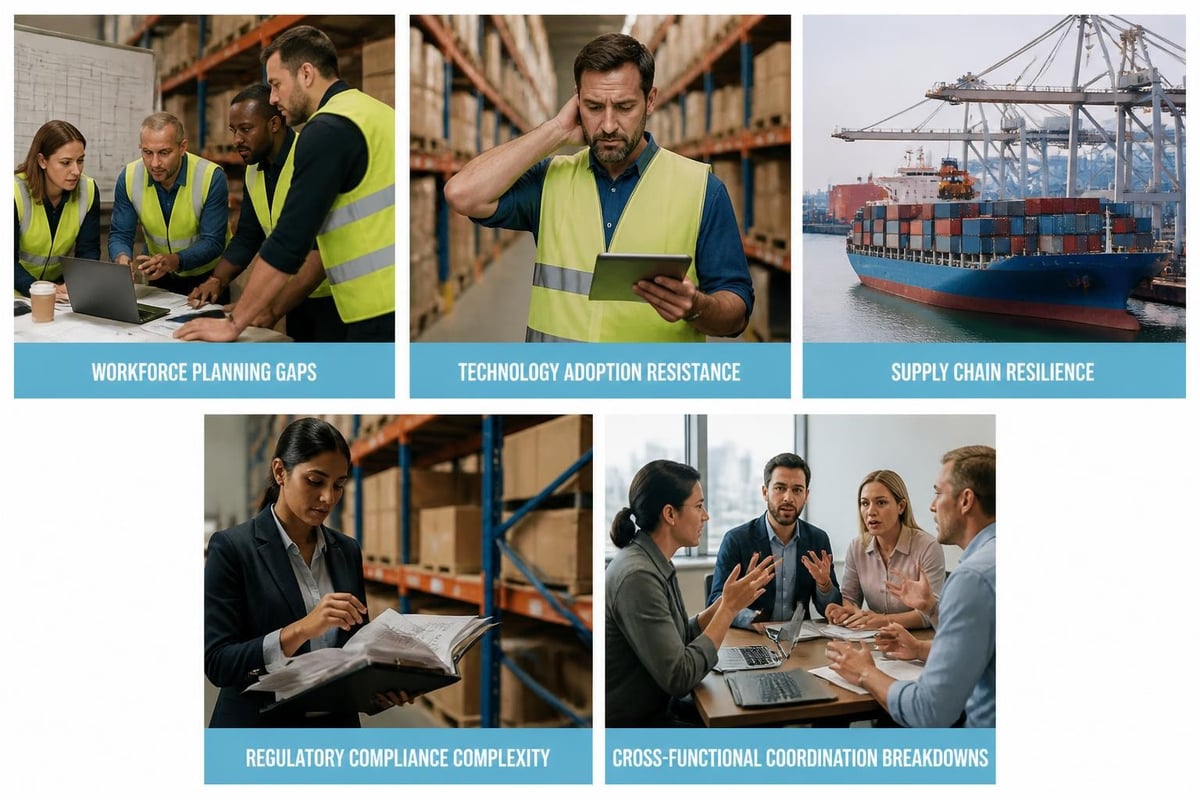
The Global Supply Chain Institute at University of Tennessee identifies five critical challenges in planning talent and leadership development: workforce gaps, technology adoption, resilience planning, sustainability mandates, and cross-functional integration. Standard leadership development addresses none of these with the operational specificity logistics demands.
The Operational Reality Gap
Logistics executives operate in a context most leadership coaches don't understand:
- Asset-intensive decision-making where a single routing error costs tens of thousands
- Regulatory compliance across jurisdictions with direct liability consequences
- Union negotiations and labor relations in warehouse and transportation networks
- Safety protocols where leadership failures result in injuries or fatalities
- 24/7 operations requiring distributed decision authority without losing control
Generic coaching about "strategic thinking" or "executive presence" misses the point. The question isn't whether a VP of Operations can present to the board but whether they can rebuild trust with a warehouse team after a preventable accident, restructure routes when fuel costs spike 40%, or navigate a carrier partnership that's failing without destroying long-term relationships.
The Leadership Challenges That Derail Logistics Organizations
Three patterns emerge when logistics and freight companies delay executive coaching intervention. These aren't theoretical risks. They're observable failures with quantifiable consequences.
Pattern One: Operational Excellence Without Strategic Vision
A regional freight brokerage grew revenue 300% in four years through aggressive carrier partnerships and technology investment. The COO, promoted from operations manager, excelled at execution. Lanes were optimized. Customer SLAs hit 99.2%. Carrier networks expanded.
The problem surfaced when a Fortune 500 prospect asked about ESG initiatives, technology roadmap, and talent strategy. The COO had none. The company lost the contract and three months later faced a talent exodus when a competitor launched with better benefits and remote work options the leadership team hadn't considered viable.
The diagnosis: The COO possessed deep operational knowledge but no framework for strategic planning, competitive positioning, or organizational development. Executive coaching delivers the structured thinking required to translate operational wins into strategic advantage.
Pattern Two: Command-and-Control Leadership in a Distributed Workforce
A third-party logistics provider (3PL) with 12 warehouses across North America struggled with turnover rates exceeding 60% annually in warehouse operations. The VP of Logistics, a 20-year veteran, ran operations with military precision: strict protocols, top-down directives, minimal deviation tolerance.
It worked until 2024 when warehouse workers gained leverage in a tight labor market. Exit interviews revealed a consistent theme: workers respected the VP's competence but felt no autonomy, development opportunity, or psychological safety to raise operational concerns. Two safety incidents went unreported until they became OSHA investigations.
The intervention: Executive coaching for logistics and freight companies must address the sector's hierarchical culture while building adaptive leadership capabilities. The VP learned to delegate decision authority, implement feedback loops, and create development pathways. Turnover dropped to 34% within 18 months. Safety reporting increased 400%.
The lesson: Operational control and employee empowerment aren't opposites. They require sophisticated leadership that most logistics executives never develop without external support.
Pattern Three: Siloed Leadership Destroying Cross-Functional Performance
A freight forwarding company organized by service line: ocean, air, ground, customs brokerage. Each division operated independently with separate P&Ls, customer relationships, and technology systems. Revenue grew, but complexity created friction.
The breaking point came when a major automotive client needed integrated services across all modes. No single executive owned the relationship. Sales blamed operations for inconsistent service. Operations blamed technology for system incompatibility. Technology blamed leadership for never funding integration. The client moved to a competitor offering seamless multi-modal coordination.
The root cause: Five executives, each excellent in their domain, couldn't function as a leadership team. They lacked trust, clear decision rights, and shared accountability frameworks. Executive coaching for logistics and freight companies addressed this through team-based intervention focusing on role clarity, communication protocols, and joint problem-solving on real operational challenges.
| Leadership Gap | Operational Symptom | Business Impact | Coaching Focus |
|---|---|---|---|
| Strategic Planning Deficit | Reactive decision-making, no 3-year roadmap | Lost market opportunities, talent attrition | Scenario planning, competitive analysis, vision development |
| Command-Control Rigidity | High turnover, safety under-reporting, low engagement | Operational risk, recruiting costs 40%+ of revenue | Delegation frameworks, feedback systems, trust-building |
| Cross-Functional Silos | Missed revenue, client defection, duplicated effort | 15-30% efficiency loss, customer concentration risk | Team dynamics, shared metrics, accountability structures |
What Executive Coaching for Logistics and Freight Companies Must Deliver
The sector doesn't need coaching. It needs precision intervention designed for logistics-specific leadership challenges. That requires coaches who understand supply chain economics, operational constraints, and industry dynamics.
Sector-Specific Diagnostic Assessment
Effective executive coaching for logistics and freight companies starts with diagnostics that capture operational context. Standard 360-degree feedback asking about "collaboration" and "communication" produces useless platitudes.
Better assessment asks:
- How does the executive respond when a carrier fails mid-transit with perishable cargo?
- What decision framework guides trade-offs between service levels and margin protection?
- How effectively does the leader navigate union negotiations, safety incidents, or regulatory violations?
- What's the executive's approach to technology investment when capital is constrained?
These questions reveal leadership patterns that matter in logistics: judgment under pressure, risk calibration, stakeholder management across asymmetric power dynamics, and resource allocation in capital-intensive environments.
Coach Matching Based on Industry Expertise
A coach with 20 years of experience in pharmaceutical leadership brings minimal value to a freight executive managing driver recruitment, DOT compliance, and fluctuating diesel costs. The contexts don't translate.
Top executive coaching firms succeed in logistics by matching executives with coaches who have supply chain operations experience, understand industry economics, and can pressure-test strategic thinking against operational reality. When a coach has run warehouse operations, managed carrier networks, or led logistics transformations, they recognize the difference between theoretical best practices and operational feasibility.

Intervention Plans Aligned to Business Outcomes
Executive coaching for logistics and freight companies must connect to measurable business impact, not personal development abstractions. The intervention plan should specify:
- Operational KPIs: On-time delivery consistency, safety incident reduction, cost per mile improvement
- Leadership behaviors: Decision delegation, cross-functional collaboration, strategic planning cadence
- Cultural indicators: Employee engagement scores, voluntary turnover rates, safety reporting frequency
- Business outcomes: Customer retention, margin expansion, talent attraction success
One freight company tied executive coaching outcomes to three metrics: driver retention above 70% (from 52%), customer NPS above 40 (from 18), and operational margin improvement of 2 points. The coaching focused exclusively on leadership behaviors that influenced those outcomes: communication clarity with drivers, customer relationship depth, and cost discipline in route planning.
Results after 12 months: 73% driver retention, NPS of 44, and 2.3-point margin improvement. Total coaching investment: $180,000 across four executives. Margin improvement alone delivered $4.2 million additional profit on $190 million revenue.
Critical Coaching Applications in Logistics Leadership
Executive coaching for logistics and freight companies addresses specific leadership scenarios that determine competitive advantage. What executive coaching requires at the senior level is different from mid-level leadership development because the decisions carry greater organizational consequence and complexity.
Navigating Digital Transformation Without Destroying Operations
A mid-sized LTL carrier needed to implement a new TMS (transportation management system) to remain competitive. The CTO understood technology. The COO understood operations. Neither understood how to lead change in an organization where drivers, dispatchers, and warehouse workers had operated the same way for 15 years.
The coaching intervention focused on change leadership: building coalition across stakeholders, communicating vision that resonated with frontline workers, creating early wins to build momentum, and addressing resistance without alienating experienced staff.
The framework developed:
- Stakeholder mapping identifying influence and impact for each role
- Communication cadence with role-specific messaging (drivers care about route efficiency, dispatchers about system reliability, customers about visibility)
- Pilot program design that created champions instead of mandating adoption
- Feedback loops that allowed operational refinement before full rollout
Implementation took 18 months instead of the planned 9, but adoption hit 94% vs. industry average of 67% for similar transformations. The executive team learned change leadership through real application, not classroom theory.
Building Resilience Through Crisis Leadership
When COVID-19 disrupted global supply chains in 2020, logistics executives faced unprecedented challenges: port congestion, driver shortages, customer demand volatility, and cost inflation. Some companies thrived. Most struggled. The difference was leadership.
One executive team receiving coaching pre-pandemic had developed scenario planning capabilities, distributed decision-making frameworks, and crisis communication protocols. When disruption hit, they executed:
- Rapid scenario modeling of demand patterns across customer segments
- Proactive carrier communication maintaining relationships when capacity tightened
- Transparent customer updates that preserved trust during service failures
- Distributed authority allowing regional managers to make real-time decisions
Revenue grew 28% in 2020-2021 while competitors contracted. The leadership capabilities developed through executive coaching for logistics and freight companies became the operating system for crisis response.
Talent Development in a Sector Facing Generational Transition
The logistics sector faces a leadership vacuum. The average age of transportation managers exceeds 50. Retirement creates succession gaps, but most companies lack development pipelines.
One regional carrier with 400 employees identified this problem in 2023. The CEO and three VPs were all 58+. No succession plan existed. The coaching intervention addressed talent development as strategic priority:
- Identification of high-potential leaders in operations, sales, and customer service
- Structured development plans with rotational assignments, mentoring, and decision authority
- Leadership pipeline metrics tracking readiness for next-level roles
- Knowledge transfer protocols capturing institutional knowledge before retirements
Two years later, the company promoted three internal candidates to VP roles, reduced external recruiting costs by 60%, and created a talent brand that improved recruiting outcomes. The coaching didn't just prepare individuals. It built organizational capability.
Measuring ROI in Executive Coaching for Supply Chain Leaders
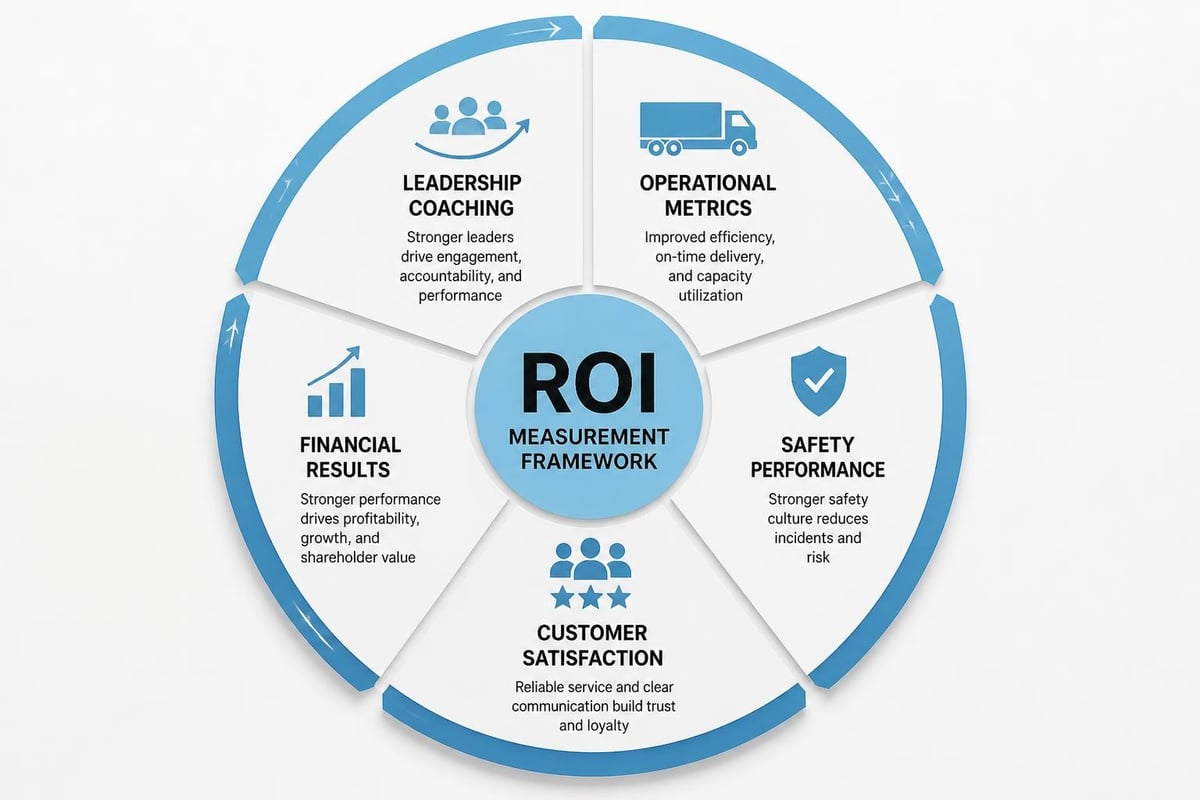
Logistics companies operate on thin margins. Every investment requires ROI justification. Executive coaching for logistics and freight companies succeeds when it delivers measurable impact on business performance.
| Metric Category | Specific Indicators | Measurement Period | Expected Improvement |
|---|---|---|---|
| Operational Efficiency | Cost per mile, On-time delivery %, Asset utilization | Quarterly | 5-15% improvement |
| Talent Retention | Voluntary turnover (drivers, warehouse, office), Time to fill critical roles | Semi-annual | 20-40% reduction in turnover |
| Safety Performance | Incident rate, Near-miss reporting, OSHA violations | Monthly | 30-60% incident reduction |
| Customer Satisfaction | NPS, Customer retention rate, Revenue per customer | Quarterly | 15-25 point NPS increase |
| Financial Performance | Operating margin, Revenue growth, Working capital efficiency | Annual | 2-5 point margin improvement |
These metrics matter because they connect leadership development to shareholder value. When measuring return on investment from executive coaching, logistics companies should track operational KPIs alongside traditional engagement metrics.
Addressing Toxic Leadership in Safety-Critical Operations
The logistics sector tolerates toxic leadership patterns that would end careers in other industries. The justification: results matter more than style. A warehouse manager who hits productivity targets while creating hostile work environments keeps the job. A transportation director who delivers margin improvement through driver intimidation gets promoted.
This tolerance carries costs. Safety incidents increase. Turnover spikes. Compliance risks grow. Organizations handle toxic leadership differently across industries, but in logistics the consequences can be fatal.
Executive coaching for logistics and freight companies must address abrasive leadership directly. The intervention framework:
Diagnostic Phase: Documenting Impact
Toxic leaders rarely recognize their impact. They see themselves as demanding, not destructive. The coaching starts with evidence:
- 360-degree feedback revealing patterns across reports, peers, and customers
- Turnover analysis showing disproportionate attrition in their teams
- Safety incident correlation linking leadership behavior to risk-taking
- Engagement data demonstrating cultural damage
One distribution center manager saw turnover data showing 78% annual turnover in his operation vs. 41% company average. Exit interviews revealed consistent themes: fear of retaliation, lack of psychological safety, punitive response to mistakes. He genuinely believed he was driving performance. The data showed he was destroying it.
Intervention Phase: Behavioral Reconstruction
Insights from reformed toxic leaders reveal that change requires three elements: genuine motivation, structured behavioral alternatives, and accountability mechanisms.
The coaching developed specific behavior substitutions:
- Replace public criticism with private feedback
- Replace directive commands with collaborative problem-solving
- Replace attribution of failure to individuals with system analysis
- Replace accessibility barriers with regular engagement forums
The manager implemented "safety huddles" where warehouse workers could raise concerns without fear. Initially awkward, these became the mechanism for preventing three serious incidents in the first six months. Workers started reporting near-misses because they trusted the response would be system improvement, not blame.
Sustainability Phase: Cultural Integration
Individual behavior change doesn't last without organizational reinforcement. The coaching extended to the executive team, implementing policies that prevented toxic leadership patterns:
- Leadership competency frameworks including psychological safety and trust-building
- Promotion criteria weighting people development alongside operational results
- Compensation alignment linking bonuses to engagement scores and retention rates
- Succession planning prioritizing leaders who build capability, not dependency
The distribution center reduced turnover to 39% within 18 months. Safety incidents dropped 61%. Productivity increased 12% because workers stopped hiding mistakes and started solving problems collaboratively.
Integration with Learning and Development Ecosystems
Executive coaching for logistics and freight companies delivers maximum value when integrated with broader learning strategies. The Institute for Supply Management’s expansion to end-to-end supply chain learning reflects industry recognition that leadership development requires comprehensive approaches.
The integration model combines:
- Certifications (APICS, ISM, CSCMP) providing technical knowledge
- Executive coaching developing leadership capabilities and strategic thinking
- Action learning projects applying concepts to real business challenges
- Peer learning networks enabling cross-company knowledge sharing
One 3PL company sent executives through supply chain certification while simultaneously providing coaching focused on applying technical knowledge to business strategy. The combination proved more effective than either intervention alone. Certifications provided frameworks. Coaching ensured application to competitive advantage.
For companies seeking scalable leadership development, enterprise corporate coaching providers deliver structured programs that complement internal L&D initiatives while providing external perspectives and specialized expertise.
The Strategic Imperative: Leadership as Competitive Advantage
The logistics and freight sector faces unprecedented disruption. E-commerce growth, sustainability mandates, autonomous vehicles, warehouse automation, and shifting trade policies create strategic complexity that operational excellence alone cannot navigate.
Supply chain leadership capabilities identified by the World Economic Forum emphasize adaptability, systems thinking, digital fluency, and stakeholder collaboration. These capabilities don't emerge from operational experience. They require intentional development.
Executive coaching for logistics and freight companies builds these capabilities through structured intervention that connects individual leadership growth to organizational outcomes. The question isn't whether logistics companies need leadership development. It's whether they'll invest in it before competitive pressures, talent shortages, or operational failures force the issue.
Companies that view leadership development as strategic investment gain advantages competitors cannot easily replicate. Technology can be copied. Processes can be benchmarked. Logistics networks can be built. But leadership culture, once established, creates durable competitive advantage because it touches every decision, every relationship, and every opportunity across the organization.
For women-owned logistics firms facing unique scaling challenges, strategic partners like Rise Reign Rule address operational drag through their Profit Architecture framework, which complements leadership development by creating the systems infrastructure that allows leadership capabilities to translate into scalable growth.
Similarly, for logistics professionals managing the emotional complexity of high-stakes leadership, resources like Pernett Coaching & Consulting LLC provide emotional intelligence development and self-awareness capabilities that strengthen executive presence and decision-making under pressure.
Frequently Asked Questions
What makes executive coaching for logistics different from general business coaching?
Logistics executive coaching must address sector-specific contexts: 24/7 operations, safety-critical decisions, regulatory compliance, distributed workforces, asset-intensive operations, and union dynamics. Generic business coaching lacks the operational credibility and industry knowledge to guide executives through supply chain leadership challenges effectively.
How long does executive coaching take to produce measurable results in freight operations?
Most logistics coaching engagements show behavioral changes within 90 days and measurable business impact within 6-9 months. Operational metrics like safety incidents and employee engagement typically improve first, followed by customer satisfaction and financial performance. Comprehensive leadership transformation requires 12-18 months of sustained coaching intervention.
Can executive coaching address toxic leadership in logistics organizations?
Yes, when structured properly. Coaching for toxic leaders requires evidence-based diagnostics, behavioral intervention focused on specific pattern changes, accountability mechanisms, and organizational support. Success rates improve significantly when the leader genuinely commits to change and the organization reinforces new behaviors through policies, promotion criteria, and cultural expectations.
What ROI should logistics companies expect from executive coaching investments?
Well-designed executive coaching programs deliver 3:1 to 7:1 ROI through measurable improvements in operational efficiency (5-15%), talent retention (20-40% turnover reduction), safety performance (30-60% incident reduction), and margin expansion (2-5 points). ROI depends on coaching quality, executive engagement, and alignment to specific business outcomes.
How do logistics companies select the right executive coach?
Effective coach selection prioritizes industry expertise, coaching methodology, business outcome focus, and cultural fit. The best coaches have supply chain operations experience, understand logistics economics, can pressure-test strategic thinking against operational reality, and demonstrate track records of measurable leadership transformation in similar organizational contexts.
Executive coaching for logistics and freight companies addresses the sector's leadership crisis by developing capabilities that operational experience alone cannot build. When logistics executives gain strategic vision, adaptive leadership skills, and the ability to navigate complexity while maintaining operational excellence, the entire organization benefits through improved performance, stronger culture, and sustainable competitive advantage. Noomii Leadership Coaching delivers precision-matched executive coaching with logistics sector expertise, evidence-based diagnostics, and measurable ROI frameworks that connect leadership development directly to operational outcomes and business results.
“`json
{
“@context”: “https://schema.org”,
“@type”: “FAQPage”,
“mainEntity”: [
{
“@type”: “Question”,
“name”: “What makes executive coaching for logistics different from general business coaching?”,
“acceptedAnswer”: {
“@type”: “Answer”,
“text”: “Logistics executive coaching must address sector-specific contexts: 24/7 operations, safety-critical decisions, regulatory compliance, distributed workforces, asset-intensive operations, and union dynamics. Generic business coaching lacks the operational credibility and industry knowledge to guide executives through supply chain leadership challenges effectively.”
}
},
{
“@type”: “Question”,
“name”: “How long does executive coaching take to produce measurable results in freight operations?”,
“acceptedAnswer”: {
“@type”: “Answer”,
“text”: “Most logistics coaching engagements show behavioral changes within 90 days and measurable business impact within 6-9 months. Operational metrics like safety incidents and employee engagement typically improve first, followed by customer satisfaction and financial performance. Comprehensive leadership transformation requires 12-18 months of sustained coaching intervention.”
}
},
{
“@type”: “Question”,
“name”: “Can executive coaching address toxic leadership in logistics organizations?”,
“acceptedAnswer”: {
“@type”: “Answer”,
“text”: “Yes, when structured properly. Coaching for toxic leaders requires evidence-based diagnostics, behavioral intervention focused on specific pattern changes, accountability mechanisms, and organizational support. Success rates improve significantly when the leader genuinely commits to change and the organization reinforces new behaviors through policies, promotion criteria, and cultural expectations.”
}
},
{
“@type”: “Question”,
“name”: “What ROI should logistics companies expect from executive coaching investments?”,
“acceptedAnswer”: {
“@type”: “Answer”,
“text”: “Well-designed executive coaching programs deliver 3:1 to 7:1 ROI through measurable improvements in operational efficiency (5-15%), talent retention (20-40% turnover reduction), safety performance (30-60% incident reduction), and margin expansion (2-5 points). ROI depends on coaching quality, executive engagement, and alignment to specific business outcomes.”
}
},
{
“@type”: “Question”,
“name”: “How do logistics companies select the right executive coach?”,
“acceptedAnswer”: {
“@type”: “Answer”,
“text”: “Effective coach selection prioritizes industry expertise, coaching methodology, business outcome focus, and cultural fit. The best coaches have supply chain operations experience, understand logistics economics, can pressure-test strategic thinking against operational reality, and demonstrate track records of measurable leadership transformation in similar organizational contexts.”
}
}
]
}
“`


Leave a Reply
Want to join the discussion?Feel free to contribute!