

Executive Coaching for Government Agencies in 2026
Government agencies face leadership challenges that private sector organizations rarely encounter. Budget constraints, political transitions, regulatory scrutiny, and mission complexity create conditions where standard leadership development fails. Most government leaders navigate procurement rules that favor compliance over effectiveness, vendor relationships that prioritize process over outcomes, and stakeholder environments where a single misstep can trigger congressional hearings. Yet many agencies still approach executive coaching for government agencies as a checkbox exercise rather than a strategic intervention.
The gap between what agencies need and what they procure costs billions in lost productivity, talent attrition, and failed initiatives. This article examines how the most effective agencies design and implement executive coaching for government agencies that delivers measurable results while maintaining the accountability standards public service demands.
Why Traditional Leadership Development Fails Government Executives
Government executives operate under constraints that make conventional corporate coaching models ineffective. A 2025 audit of federal leadership programs revealed that 67% of coaching engagements produced no measurable change in leadership behavior, team performance, or mission outcomes. The problem isn't lack of investment. It's misalignment between program design and operational reality.
The core failures break down into three categories:
- Procurement processes that select coaches based on price and certification rather than government sector expertise and track record
- Development plans disconnected from agency mission, strategic priorities, and performance management systems
- Lack of integration with existing frameworks like the U.S. Office of Personnel Management’s executive development guidance and competency models
When agencies treat coaching as a benefit rather than a performance intervention, they get what they pay for: generic sessions that feel good but change nothing. The alternative requires rethinking how executive coaching for government agencies fits into talent strategy, succession planning, and organizational transformation.

The Hidden Cost of Ineffective Executive Development
Most agencies measure coaching program success through participation rates and satisfaction surveys. These metrics obscure the real cost of ineffective development.
Consider a mid-sized federal agency that invested $400,000 in executive coaching over 18 months. Satisfaction scores averaged 4.2 out of 5. But when leadership examined actual outcomes, they found that coached executives showed no improvement in:
- Decision quality under pressure
- Cross-functional collaboration
- Team engagement scores
- Strategic initiative completion rates
The agency had purchased activity, not results. The follow-on costs included delayed modernization projects, continued siloing between departments, and the loss of three high-potential leaders who cited poor leadership as their reason for leaving public service.
This pattern repeats across government. Without clear diagnostic frameworks, precision matching between coaches and executive needs, and accountability for measurable outcomes, agencies waste limited resources while leadership gaps widen.
What Distinguishes Effective Executive Coaching for Government Agencies
The agencies that achieve measurable results from coaching investments share five operational characteristics. These aren't theoretical best practices. They're observed patterns from programs that have survived budget cuts, leadership transitions, and inspector general reviews.
Evidence-Based Diagnostics Before Coach Assignment
High-performing programs begin with validated assessment tools that identify specific behavioral patterns, leadership gaps, and organizational impact. Generic 360-degree feedback doesn't meet this standard. Effective diagnostics reveal:
- Decision-making patterns under resource constraints and political pressure
- Communication effectiveness across hierarchical and political stakeholder groups
- Ability to drive change within bureaucratic systems
- Emotional regulation and judgment when managing public scrutiny
Research on determinants of executive coaching effectiveness confirms that coach-client matching based on specific competency gaps produces significantly better outcomes than matching based on availability or general credentials.
The Council of the Inspectors General on Integrity and Efficiency coaching program demonstrates this principle in practice. Their model requires diagnostic assessment, competency mapping, and documented development plans before any coaching engagement begins. This approach has produced measurable improvements in leadership effectiveness scores and cross-agency collaboration.
Coaches With Demonstrated Government Sector Expertise
Certification alone doesn't predict coaching effectiveness in government settings. The operational environment requires coaches who understand:
- Federal or state budgeting cycles and their impact on initiative timing
- Political appointment transitions and continuity planning
- Congressional or legislative oversight dynamics
- Public accountability standards and media relations
- Civil service regulations and labor relations frameworks
| Coach Background | Effectiveness in Government Settings | Common Gaps |
|---|---|---|
| Corporate-only experience | Low to moderate | Misunderstands political constraints, timeline rigidity, stakeholder complexity |
| Former government executive + coaching certification | High | May carry organizational biases, limited external perspective |
| Cross-sector with government clients | High | Requires verification of actual government work, not just claims |
| Academic or theoretical focus | Low | Lacks operational credibility with senior leaders |
Programs that restrict coach selection to those with verified government experience and client references from comparable agencies report 3x higher satisfaction and measurable outcome achievement compared to open marketplace approaches.
Integration With Performance Management and Mission Objectives
Executive coaching for government agencies fails when it exists as a standalone benefit disconnected from performance systems. Effective programs tie coaching directly to:
- Strategic plan deliverables and agency priority goals
- Individual performance improvement plans and succession readiness
- Team effectiveness metrics and cross-functional initiative outcomes
- Compliance requirements and regulatory mandate achievement
The Government of British Columbia’s executive coaching model exemplifies this integration approach. Coaching engagements require documented alignment with organizational objectives, supervisor involvement in goal-setting, and quarterly progress reviews tied to performance evaluation cycles.
This level of integration demands more upfront planning than most agencies invest. But it's the only approach that produces ROI justifiable to budget authorities and oversight bodies. Similar models for enterprise corporate coaching providers demonstrate how structured alignment drives measurable outcomes.

Addressing the Unique Challenges of Public Sector Leadership Development
Government executives face leadership challenges that rarely appear in corporate settings. These challenges require coaching approaches specifically designed for public service contexts.
Managing Across Political Cycles Without Compromising Mission
Political transitions create leadership discontinuity that private sector executives never experience. A new administration or elected official can fundamentally change strategic direction, budget priorities, and stakeholder relationships overnight.
Effective executive coaching for government agencies prepares leaders to:
- Maintain mission focus while adapting to new political leadership
- Build stakeholder relationships across political and ideological divides
- Communicate organizational value propositions to changing audiences
- Preserve institutional knowledge and team morale during transitions
These aren't soft skills. They're survival competencies for government executives who want to sustain long-term initiatives beyond election cycles. Coaches without government experience often miss this entirely, focusing instead on generic change management frameworks that ignore political realities.
Navigating Budget Constraints and Procurement Rigidity
Government budget processes impose timeline constraints and resource limitations that demand different leadership approaches than corporate environments. Executives must excel at:
Budget cycle planning:
- Securing funding 12-18 months before initiative launch
- Justifying resource requests through evidence-based business cases
- Delivering results within fixed appropriations with no flexibility for overruns
Procurement compliance:
- Executing programs through contracting vehicles that limit vendor selection and timeline control
- Managing vendor relationships within strict ethical and legal boundaries
- Achieving outcomes despite acquisition timelines that often exceed 6-12 months
Coaches who understand these constraints help executives develop workarounds, stakeholder influence strategies, and communication approaches that work within procurement and budget realities rather than pretending they don't exist.
Building High-Performance Teams Under Civil Service Regulations
Government executives typically have less personnel flexibility than corporate leaders. Civil service protections, union agreements, and political appointment systems create talent management constraints that require specialized leadership approaches.
The U.S. Chief Human Capital Officers Council’s guidance on executive development acknowledges these constraints and emphasizes development strategies that work within regulatory frameworks rather than ignoring them.
Effective coaching helps government leaders:
- Maximize team performance through motivation and development rather than firing and hiring
- Navigate performance improvement processes that require extensive documentation
- Build diverse, high-functioning teams despite limited recruitment flexibility
- Develop succession pipelines when promotion timelines extend 2-3 years
Designing Procurement Approaches That Deliver Coaching Effectiveness
How agencies procure coaching services largely determines program outcomes. Most procurement strategies optimize for process compliance rather than results. This creates a predictable failure pattern.
The Problem With Lowest Price Technically Acceptable Contracting
Many agencies use LPTA (Lowest Price Technically Acceptable) procurement for coaching services. This approach selects vendors who meet minimum qualification standards at the lowest bid price. For commodity services, LPTA works. For executive coaching, it virtually guarantees poor outcomes.
Why LPTA fails for coaching:
- It commoditizes a service where coach-executive fit determines effectiveness
- It incentivizes vendors to minimize coach compensation, driving away experienced practitioners
- It prevents agencies from evaluating actual track records and results
- It creates no accountability for measurable outcomes beyond engagement completion
Agencies that achieve results from executive coaching for government agencies use best-value procurement that evaluates:
- Demonstrated expertise with government clients at similar organizational levels
- Matching methodology and coach selection process
- Measurement frameworks and outcome accountability
- Integration approaches with agency performance management systems
Building Vendor Accountability Through Outcome-Based Contracts
Standard coaching contracts pay for hours delivered. This creates no vendor incentive to drive results. Outcome-based contracting shifts risk and aligns vendor success with agency objectives.
| Contract Structure | Vendor Incentive | Agency Risk | Typical Outcomes |
|---|---|---|---|
| Fixed hours regardless of results | Deliver minimum viable service | High | Low satisfaction, no measurable change |
| Fee tied to completion + satisfaction | Meet participant expectations | Moderate | Good engagement, limited organizational impact |
| Fee tied to measurable performance improvement | Drive documented results | Low | Significant leadership and team performance gains |
The World Bank’s coaching program documentation illustrates how international organizations structure coaching contracts with clear outcome expectations, measurement protocols, and vendor accountability.
Few government agencies use outcome-based contracting for coaching. Those that do report dramatically higher program effectiveness and easier budget justification in subsequent years. Recent developments in AI adoption and executive accountability create additional opportunities for measurement and outcome tracking.
Measuring What Matters: Beyond Satisfaction to Organizational Impact
Government programs that can't demonstrate measurable results don't survive budget cycles. Yet most coaching program evaluations focus on participant satisfaction rather than organizational outcomes.
The Three-Level Measurement Framework
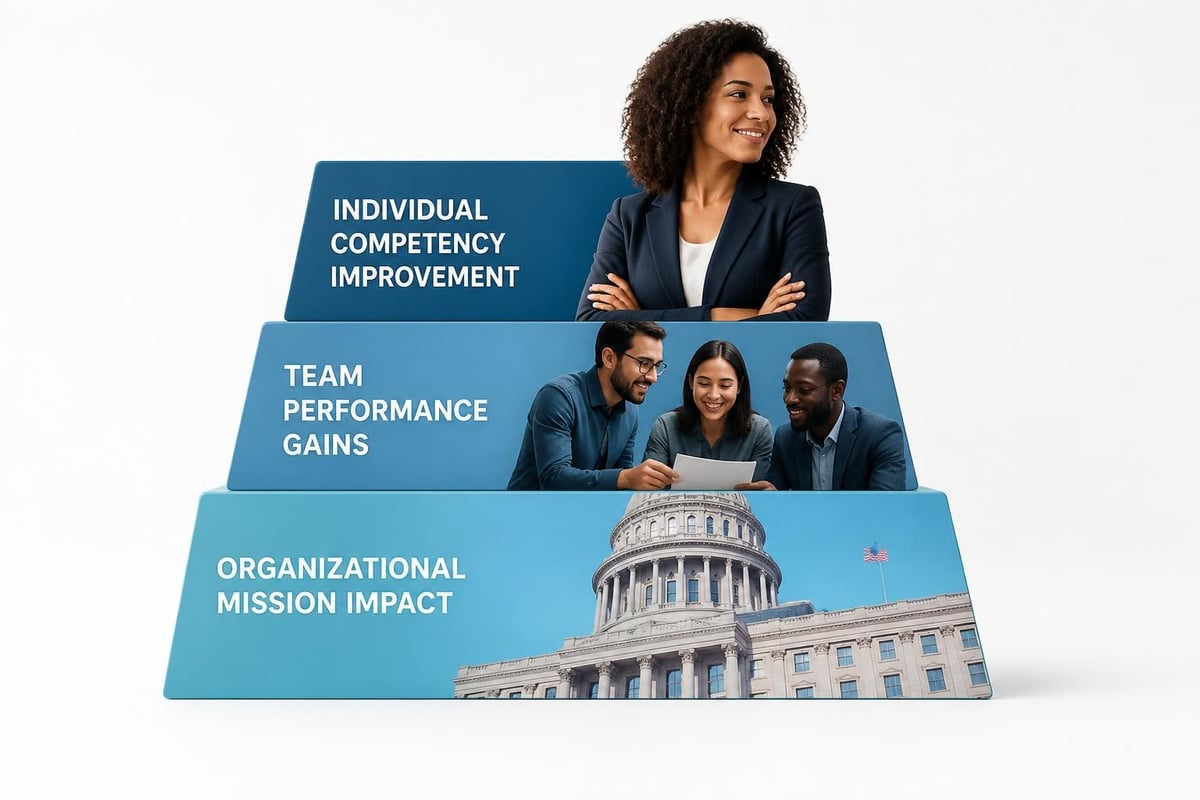
Effective measurement requires tracking results at individual, team, and organizational levels:
Individual executive level:
- Improvement in specific competency gaps identified through diagnostic assessment
- Progress on performance improvement plan objectives
- Leadership effectiveness scores from direct reports and stakeholders
- Decision quality metrics tied to strategic initiative outcomes
Team level:
- Employee engagement score changes
- Cross-functional collaboration effectiveness
- Project completion rates and timeline performance
- Innovation and problem-solving metrics
Organizational level:
- Strategic initiative achievement rates
- Mission outcome indicators
- Talent retention and succession readiness
- Operational efficiency and cost effectiveness
This framework allows agencies to connect coaching investments to mission-critical outcomes. It also provides the evidence base needed to justify continued funding and program expansion.
Case Study: Transforming Leadership During Modernization
A federal agency responsible for critical infrastructure modernization faced a leadership crisis in 2024. Three divisions operated in silos, innovation initiatives stalled in bureaucracy, and the executive team struggled to drive consensus on modernization priorities. Employee engagement scores had declined for four consecutive quarters. Political pressure was mounting.
The diagnosis revealed specific patterns:
- Executives avoided cross-divisional conflict, allowing territory disputes to block collaboration
- Decision-making defaulted to consensus-seeking that produced lowest-common-denominator outcomes
- Communication focused on internal process rather than mission impact and stakeholder value
- Leadership team lacked shared frameworks for priority-setting and resource allocation
The intervention combined:
- Individual executive coaching focused on productive conflict management and decision accountability
- Team coaching establishing shared decision protocols and priority frameworks
- Integration with performance management system tying leader evaluations to cross-functional outcomes
- Quarterly measurement of collaboration metrics, decision quality, and modernization progress
Results after 12 months:
- Modernization initiative completion rate increased from 34% to 78%
- Cross-divisional collaboration score improved 41 points
- Employee engagement reversed decline with 23-point increase
- Three strategic partnerships launched that had stalled for 18+ months
The lesson: Executive coaching for government agencies produces measurable results when it targets specific organizational problems, integrates with performance systems, and holds coaches accountable for documented outcomes rather than engagement completion.
What Government HR Leaders Need From Coaching Vendors
Agency HR leaders and Chief Human Capital Officers face the challenge of designing programs that satisfy political leadership, budget authorities, oversight bodies, and program participants simultaneously. This requires vendors who understand government constraints and deliver measurable results.
Non-Negotiable Vendor Capabilities
Based on patterns observed across successful government coaching programs, effective vendors must demonstrate:
- Government sector expertise with verified client references from comparable agencies
- Coach matching methodology that goes beyond credential verification to assess sector experience and competency alignment
- Integration capabilities with federal or state performance management systems and competency frameworks
- Measurement protocols that track individual, team, and organizational outcomes
- Compliance with ethics, confidentiality, and procurement regulations specific to government
Vendors who primarily serve corporate clients often lack these capabilities. They approach government work as a revenue opportunity rather than a specialized discipline requiring different methodologies and expertise. The research from Harvard Kennedy School’s GovLab on working effectively with government reinforces that generic corporate approaches fail in public sector contexts.
Questions to Ask During Vendor Selection
Procurement evaluations should dig past marketing claims to assess actual capabilities:
- Which government agencies have you served in coaching programs exceeding 50 participants?
- What percentage of your coach network has direct government executive experience?
- How do you match coaches to participants beyond credential and availability?
- What outcome measurements do you track beyond satisfaction and completion rates?
- How do your programs integrate with OPM competency frameworks and agency performance systems?
- What happens when a coach-participant match isn't working effectively?
- How do you ensure coaches understand political dynamics and budget constraints?
Vendors who provide specific examples, client references, and documented methodologies deserve serious consideration. Those who offer generic responses or can't cite government-specific experience should be screened out regardless of price.
The Political and Cultural Barriers That Derail Government Coaching Programs
Even well-designed programs fail when they ignore organizational culture and political dynamics. These barriers require executive sponsorship and change management expertise to overcome.
Overcoming the "Coaching as Remediation" Stigma
In many agencies, coaching carries a stigma as something you get when you're failing. This perception kills program effectiveness before it starts. High performers avoid participation to prevent being labeled as having problems. The result is adverse selection where only struggling leaders participate, reinforcing the stigma.
Successful programs reframe coaching as executive development for high-potential leaders and strategic initiatives. They:
- Limit initial cohorts to high performers and executives leading critical priorities
- Position coaching as a competitive benefit tied to succession planning
- Require executive team participation to model the behavior
- Communicate coaching as standard practice for leaders managing complexity, not a remediation tool
This framing shift changes who participates and how the organization perceives the program. It also makes it easier to expand coaching to broader leadership populations once the initial cohort demonstrates results.
Managing Resistance From Career Executives
Government executives who have succeeded for decades using existing approaches often resist development programs. They view coaching as implicit criticism of their current effectiveness. This resistance intensifies when coaching is mandated rather than voluntary.
Effective programs address resistance through:
Diagnostic transparency: Sharing assessment results that reveal specific gaps between current capabilities and future demands rather than labeling executives as deficient
Peer influence: Leveraging respected executives who have benefited from coaching to advocate for program value
Mission connection: Linking coaching to mission-critical initiatives and agency strategic priorities rather than individual development
Choice and control: Allowing executives to participate in coach selection and goal-setting within structured frameworks
The most common mistake is pushing forward despite resistance, creating superficial participation that wastes resources. Better to address resistance directly, start with willing participants, and let results build momentum.
Building Sustainable Programs That Survive Budget Cycles and Leadership Transitions
Government programs that depend on a single executive champion or budget allocation rarely survive. Sustainable executive coaching for government agencies requires institutional integration and documented value.
Creating Institutional Infrastructure
One-time coaching engagements produce limited value. Sustainable impact requires:
- Integration with talent management systems and succession planning processes
- Multi-year budget commitments tied to strategic plan objectives
- Measurement systems that track outcomes across budget and leadership cycles
- Knowledge transfer protocols that preserve program learning despite personnel changes
Agencies should avoid pilot programs that lack defined success criteria and expansion plans. Better to launch smaller programs with clear outcome expectations and institutional integration from the start.
Documenting Value for Future Budget Justification
Every coaching program should produce documentation that supports future funding requests:
- Baseline and post-intervention measurements for key performance indicators
- Specific examples of strategic initiatives accelerated or improved through coaching
- Talent retention data for coached versus non-coached executives
- Cost-benefit analysis connecting coaching investment to organizational outcomes
- Stakeholder testimonials from political leadership, program participants, and oversight bodies
This documentation serves multiple purposes beyond budget justification. It provides evidence for program refinement, supports knowledge sharing with other agencies, and creates accountability for continuous improvement. Publications like U.S. Presidential Report often cover innovative government programs, and well-documented coaching initiatives can demonstrate leadership excellence in public service.
Organizations seeking to implement these approaches should evaluate providers based on their ability to deliver government-specific expertise, measurable outcomes, and compliance-aligned processes. Resources like top executive coaching firms can help agencies compare options and identify providers with demonstrated public sector capabilities.
Executive coaching for government agencies fails when procurement favors process compliance over results, when programs lack integration with mission objectives, and when measurement focuses on satisfaction rather than organizational impact. The agencies achieving measurable leadership development results use evidence-based diagnostics, match executives with coaches who have government sector expertise, and hold vendors accountable for documented outcomes. Noomii Leadership Coaching delivers structured coaching programs designed specifically for government agencies, combining precision coach matching, compliance alignment, and measurable outcome tracking to help public sector leaders drive mission success.


Leave a Reply
Want to join the discussion?Feel free to contribute!