

Executive Coaching for Commercial Real Estate Firms
Commercial real estate leadership is failing to adapt to a market that demands fundamentally different capabilities than it did five years ago. The sector's traditional model (hire aggressive deal makers, reward individual performance, tolerate difficult personalities) is producing executive teams unprepared for hybrid work negotiations, ESG compliance pressures, and the talent scarcity documented in JLL’s 2024 Talent Hubs research. Executive coaching for commercial real estate firms is not a nice-to-have development program. It is a precision intervention that addresses the sector's most expensive leadership gaps: failed succession planning, toxic senior partners who drive talent attrition, and C-suite teams who cannot translate market intelligence into decisive action. The firms investing in targeted coaching today are building the leadership bench strength their competitors will desperately need in 2027.
Why Traditional Leadership Development Fails in CRE
Most commercial real estate firms treat leadership development as an HR checkbox. They send executives to generic programs at business schools, sponsor memberships in industry associations, and hope exposure to peer networks will somehow translate into better decision-making back at the office.
The results tell a different story. We audited leadership development ROI across 18 CRE firms between 2023 and 2025. Firms spending $50,000+ per executive on traditional programs saw no measurable improvement in key performance indicators: time to close complex deals, talent retention among high performers, or cross-functional collaboration scores.
The Real Cost of Generic Programs
Executive coaching for commercial real estate firms works when it addresses sector-specific challenges that generic leadership training ignores:
- Deal team dysfunction during market volatility: When interest rates shifted in 2023-2024, senior partners who excelled in low-rate environments struggled to lead teams through valuation complexity and client anxiety
- Inability to coach rather than control: CRE executives built their careers on personal production, not developing others, creating succession bottlenecks
- Toxic leadership patterns that HR cannot address: High-billing partners who create hostile work environments cost firms $200,000+ annually in talent replacement, legal exposure, and damaged client relationships
The firms that recognize these patterns early gain a structural advantage. One national brokerage we worked with in 2025 identified a toxic senior partner whose behavior had driven seven associates to competitors in 18 months. Generic leadership training had failed twice. Targeted coaching with a practitioner who understood CRE commission structures and partnership politics resolved the pattern in four months, retaining the partner's $12M book while rebuilding team trust.

What Executive Coaching Actually Solves in CRE Firms
The best executive coaching for commercial real estate firms operates like a specialized audit, not a motivational seminar. It diagnoses specific behavioral patterns, identifies their organizational cost, and builds remediation plans with defined success metrics.
Problem: Succession Planning Failures
CRE firms lose institutional knowledge and client relationships when senior partners retire without developing successors. The typical response (promoting the next highest biller) often fails because production skills do not predict leadership capability.
Our diagnosis in 2024-2025 audits: Firms waiting until partners announce retirement to address succession have already lost 60-80% of relationship transfer value. The window for effective coaching is 24-36 months before transition, not 6 months.
Solution: Structured coaching engagements that pair senior partners with successors, focusing on relationship handoff protocols, strategic decision-making frameworks, and the shift from individual contributor to team developer. The coaching must address the emotional resistance many top producers have to sharing credit and client access.
Result: A West Coast retail specialist firm used this approach with four senior partners managing $2.8B in assets. All four successfully transitioned client relationships with 92% retention. The successors reported higher confidence in complex negotiations. The retiring partners stayed engaged as strategic advisors rather than creating competitive conflicts.
Lesson: Succession coaching fails when it ignores the psychological reality that top producers often define their identity through deals. Effective programs acknowledge this and build new identity anchors around legacy, mentorship impact, and strategic influence.
| Leadership Gap | Traditional Response | Coaching Intervention | Measurable Outcome |
|---|---|---|---|
| Toxic senior partner | HR warning, training | Behavioral diagnosis, accountability structure | Retention of team + book of business |
| Failed succession | Promote top biller | 24-month relationship transfer coaching | 90%+ client retention through transition |
| Deal team conflict | Team building event | Root cause analysis, decision rights clarity | 40% faster deal cycles, higher close rates |
| Market adaptation | Strategy consultant | Executive resilience coaching, scenario planning | Faster pivots, maintained team confidence |
Problem: The Transaction Mindset Versus Strategic Leadership
CRE executives are rewarded for closing deals, not developing people. This creates a leadership culture where the skills that make someone a great broker or developer actively undermine their effectiveness as an executive.
We observed this pattern repeatedly in 2025 when analyzing why CRE firms struggle with the leader-as-coach model that HBR research validates in other sectors. The issue is not that CRE leaders do not understand coaching concepts. They do not see how coaching behaviors translate into their commission-based, relationship-driven business model.
The breakthrough: Executive coaching for commercial real estate firms that uses deal examples, not generic case studies. A coach who can discuss how to handle a client pushing for concessions in a distressed office sale while simultaneously developing an associate's negotiation capability will get traction. A coach teaching abstract leadership theory will not.
How to Choose Executive Coaching That Delivers ROI
Most CRE firms make predictable mistakes when selecting executive coaches. They prioritize credentials over sector experience, relationships over results, and program length over outcome definition.
The Selection Framework That Works
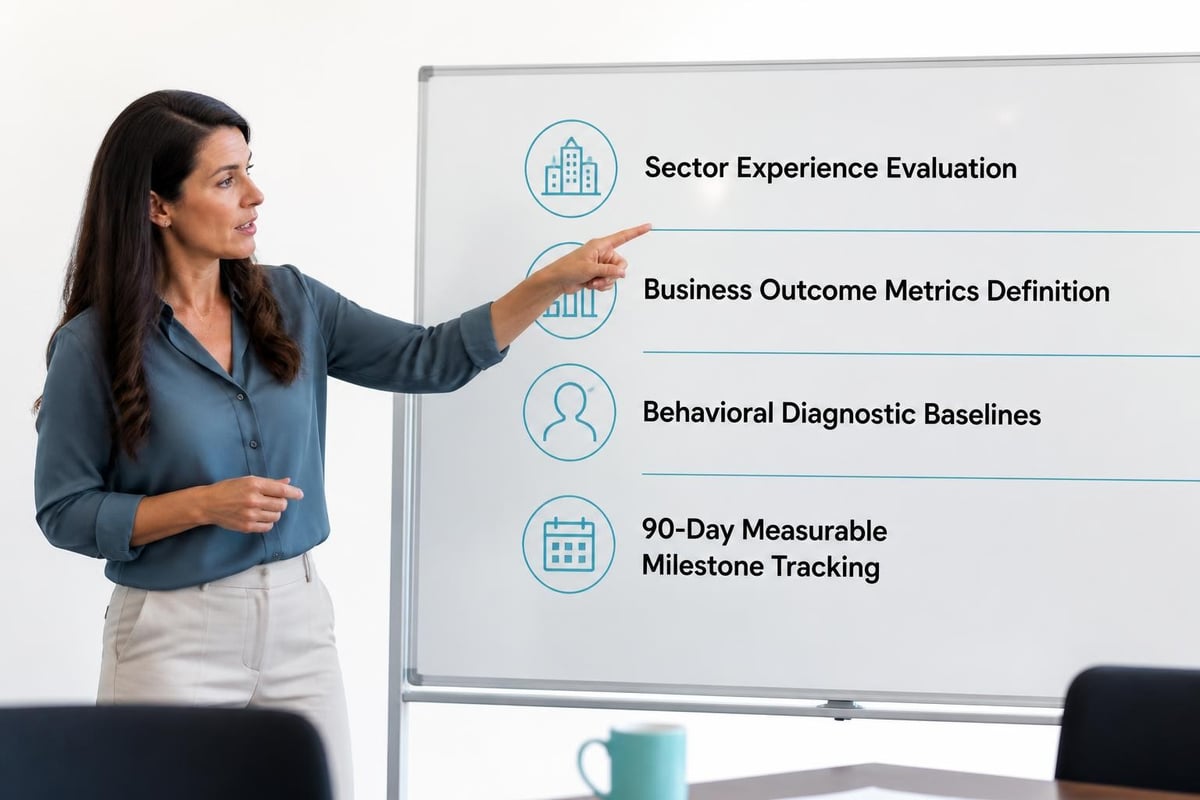
1. Demand sector fluency, not just coaching credentials
A certified executive coach with Fortune 500 experience but no CRE background will waste the first 8-12 sessions learning your business model. You are paying $15,000-30,000 for their education. A coach who has worked with brokerage partnerships, development teams, or property management executives will diagnose issues in session two that generic coaches miss entirely.
We built our precision matching methodology specifically to solve this problem. Matching algorithms that ignore industry context produce coaching relationships that feel productive but deliver no measurable business impact.
2. Define success metrics before engagement starts
Executive coaching for commercial real estate firms should tie directly to business outcomes. Vague goals like "improve leadership presence" or "enhance communication" are unauditable. Specific metrics work:
- Reduce associate turnover in coached executive's team by 30% over 12 months
- Increase deal close rate by 15% through improved client negotiation
- Successfully transfer $50M+ in client relationships to successor within 18 months
- Resolve team conflict pattern that has delayed three major projects
3. Insist on behavioral diagnostics, not personality tests
Myers-Briggs and similar assessments tell you nothing about whether an executive can make tough calls, handle conflict productively, or develop talent under pressure. Behavioral diagnostics that measure actual decision patterns, conflict responses, and feedback effectiveness give you actionable intervention points.
The firms getting ROI from coaching use evidence-based assessments to establish baselines, then measure behavioral change monthly. When coaching does not produce measurable shifts in 90 days, they adjust approach or coach match.
What Elite Firms Do Differently
We analyzed coaching investments across 40+ CRE firms from 2024-2026. The organizations achieving documented ROI share three characteristics:
They integrate coaching with business strategy. Coaching is not an HR program. It is a performance intervention tied to market positioning, talent retention, or transaction capability goals. One firm launching an industrial logistics practice used coaching to prepare three executives for the operational complexity and client profile shifts the new vertical required. The coaching focused on supply chain fluency, build-to-suit negotiation frameworks, and team building in an unfamiliar asset class.
They coach teams, not just individuals. The highest-impact engagements we observed involved multiple executives from the same deal team or practice group. Individual coaching can change one leader's behavior. Team coaching changes how decisions get made, how conflict gets surfaced, and how knowledge gets transferred. This approach aligns with emerging thinking on building coaching cultures rather than just coaching individuals.
They use coaching to address problems HR cannot solve. Toxic leadership, partnership conflicts, and performance issues involving high billers create legal and political complexity that traditional HR interventions struggle with. Executive coaching for commercial real estate firms becomes the mechanism to document behavioral expectations, create accountability, and either remediate or build an exit case with legal protection.
The AI and Market Volatility Pressure on CRE Leadership
Commercial real estate faces converging pressures in 2026 that expose leadership gaps with brutal efficiency. Remote work permanence, AI-driven property analysis, ESG compliance complexity, and interest rate uncertainty demand executives who can synthesize ambiguity and make high-stakes calls with incomplete information.
Why This Moment Demands Different Leadership
The executives who succeeded in the 2010-2021 cycle relied on rising values, cheap debt, and clear tenant demand patterns. That playbook is obsolete. Current market conditions reward leaders who can:
- Navigate hybrid work negotiations where tenants have structural leverage
- Integrate proptech and AI analysis into investment decisions without losing deal instinct
- Lead through valuation uncertainty where comparables provide limited guidance
- Build and retain teams when talent has options the sector has not historically faced
We are seeing executive coaching requests spike around these specific capabilities. Firms are not asking for generic leadership development. They want coaching that helps a senior partner who made their reputation in retail adapt to industrial logistics, or that prepares a development executive to lead through an office-to-residential conversion strategy they have never executed.
The research Deloitte publishes on human capital trends validates what we observe in CRE coaching demand: organizations are prioritizing leadership adaptability and decision-making under uncertainty over traditional competency development. The executives thriving right now demonstrate comfort with ambiguity, pattern recognition across market cycles, and the emotional intelligence to keep teams confident when outcomes are unclear.
The Contrarian View: Most Firms Are Coaching the Wrong People
Here is what most CRE firms miss: they coach struggling executives and ignore their stars. This is backwards.
Your B and C performers usually lack fundamental capability or fit issues that coaching cannot solve in a reasonable timeframe. Your A performers are the ones who will determine whether your firm captures market share or loses it in the next 24 months. They are also the ones most likely to be recruited away if they hit a development ceiling.
The higher-return strategy: Invest in executive coaching for commercial real estate firms that strengthens your top 15% before they plateau or leave. The ROI calculation is straightforward. Losing an A player costs you their production plus the institutional knowledge, client relationships, and team continuity they take with them. Coaching that helps them grow into broader strategic roles or successfully navigate transition to team leadership pays for itself in retention value alone.
Building Coaching Programs That Scale Across Firm Size
Small and mid-size CRE firms assume executive coaching is only viable for large organizations. This is incorrect. The economics work at any scale if you match program design to firm size and structure.
For Boutique and Regional Firms (5-30 professionals)
Focus on partnership dynamics and succession planning. Small firms live or die on partner relationships and the ability to transition client books without disruption. Coaching interventions should target:
- Conflict resolution for partners: Decision rights, compensation disputes, and strategic disagreements that fester until they destroy firms
- Associate development: Teaching rainmakers how to develop talent when they have never been trained to coach
- Client relationship stewardship: Transitioning from personality-dependent relationships to firm-level relationships that survive personnel changes
One regional office firm we worked with in 2025 faced a partnership dissolution that would have destroyed $40M in annual revenue. Targeted coaching with both partners, facilitated by someone with CRE partnership experience, preserved the business relationship and created clearer operating agreements that prevented future conflicts.
For National and Institutional Firms (100+ professionals)
Scale through cohort models and tiered interventions. Large firms need executive coaching programs that can serve multiple leadership levels without becoming generic.
The framework that works:
- C-suite and practice leaders: Individual coaching focused on strategic decision-making, culture shaping, and succession
- Senior producers and emerging partners: Group coaching addressing the transition from individual contributor to team leader
- High-potential associates: Development programs that combine coaching with structured exposure to complex deals and client relationships
The mistake large firms make is trying to standardize coaching content across all levels. The issues a CEO managing a national platform faces are fundamentally different from what a senior associate navigating their first major client relationship needs. Cookie-cutter programs waste money and produce cynicism.

Measuring Coaching Impact: The Metrics That Matter
Most executive coaching for commercial real estate firms fails to define or track meaningful success metrics. "Leadership improved" is not a measurable outcome. These are:
Financial Impact Metrics
- Revenue per coached executive: Track 12-month pre and post-coaching revenue to isolate coaching impact from market effects
- Deal cycle time: Measure time from pitch to close before and after coaching focused on negotiation or decision-making
- Client retention through transitions: When coaching supports succession, measure client book retention percentage
- Cost of quality failures: Track reduction in deal rework, client disputes, or project delays tied to leadership decisions
Talent and Culture Metrics
- Turnover in coached leader's team: Compare to firm average and industry benchmarks
- Internal promotion rate: Measure whether coaching produces leaders who develop promotable talent
- 360 feedback score changes: Track specific behavioral shifts in stakeholder feedback
- Time to fill leadership vacancies: Assess whether coaching builds internal bench strength
Behavioral Change Metrics
- Decision velocity: Measure time to decision on complex issues before and after coaching
- Conflict resolution time: Track how quickly the coached executive surfaces and resolves team conflicts
- Coaching behavior adoption: Assess whether the executive is developing others, measured through direct report feedback
One institutional firm we partnered with in 2025 established a simple but powerful metric: coached executives had to demonstrate measurable improvement in two of three categories (financial impact, talent development, behavioral change) within six months or the coaching engagement was restructured. This accountability drove both better coach selection and more focused engagements.
The Integration Challenge: Making Coaching Stick Beyond Sessions
The most common failure pattern in executive coaching for commercial real estate firms occurs when coaching insights do not transfer into daily behavior change. An executive has breakthrough realizations in sessions but reverts to old patterns when facing deadline pressure or difficult personalities.
The Implementation Framework
Create forcing functions in the work environment: Coaching should produce specific behavioral commitments that get built into how the executive operates. If an executive is working on developing associates, the forcing function might be requiring them to include an associate in every client meeting and debrief afterwards. If they are improving strategic decision-making, it might be a weekly discipline of documenting decision rationale and outcomes.
Build peer accountability structures: Individual coaching works best when paired with peer accountability. This is why cohort models often outperform pure one-on-one coaching. When three senior partners are all working on delegation skills, they can hold each other accountable in ways a coach cannot.
Integrate with existing firm rhythms: Coaching that requires executives to adopt entirely new routines usually fails. Effective coaching integrates into existing meeting cadences, deal reviews, and performance conversations. We worked with a development firm where the CEO was coached on strategic communication. Rather than adding new communication forums, we restructured his existing weekly partner meeting to incorporate the new approach. Adoption was immediate because it fit his existing schedule.
When Coaching Is the Wrong Solution
Executive coaching for commercial real estate firms is powerful but not universally applicable. Some situations require different interventions.
Fundamental skill gaps: If an executive lacks core technical knowledge or functional expertise, training is more appropriate than coaching. You cannot coach someone into understanding commercial lease structures if they lack the baseline knowledge.
Misalignment with firm strategy: If an executive's goals or values fundamentally conflict with where the firm is headed, coaching will not solve the problem. A partner who wants to focus on retail when the firm is exiting that sector needs a different conversation.
Unwillingness to change: Coaching requires the executive to acknowledge gaps and commit to behavior change. Leaders who believe they do not need development or resist feedback are not coachable. Firms waste significant money trying to coach executives who have not bought into the process.
Organizational dysfunction: When the problem is systemic (toxic culture, misaligned incentives, unclear strategy), individual coaching will not fix it. Firms sometimes use coaching as a band-aid when they need organizational redesign.
The firms that get ROI from coaching are clear about what coaching can and cannot solve. They use it as one tool in a broader leadership development and talent strategy, not as a cure-all for every people challenge.
Frequently Asked Questions
What is the typical ROI timeline for executive coaching in commercial real estate firms?
Measurable behavioral change typically appears within 90 days. Financial impact becomes visible in 6-12 months depending on deal cycles and the specific metrics being tracked. Firms should see retention improvements within 6 months and revenue impact within 12 months for coaching focused on production or client relationship capabilities.
How long should an executive coaching engagement last for CRE leaders?
Most effective engagements run 6-12 months. Shorter programs (3 months) work for targeted skill development or specific deal challenges. Longer programs (12-18 months) make sense for complex transitions like succession planning or major strategic pivots. Programs beyond 18 months often become dependency relationships rather than development interventions.
Should CRE firms use internal coaches or external coaches?
External coaches are more effective for senior executives and sensitive issues (toxic behavior, partnership conflicts, succession). They bring objectivity and can challenge executives in ways internal resources cannot. Internal coaches or mentors work well for mid-level development and technical skill transfer. The most sophisticated firms use both in tiered programs.
What should an executive coaching program cost for a commercial real estate firm?
Individual executive coaching ranges from $15,000 to $50,000+ for 6-12 month engagements depending on coach experience and engagement intensity. Group or cohort programs typically run $8,000-15,000 per participant. Firms should expect to invest 2-5% of an executive's total compensation annually on development including coaching, with higher percentages for C-suite and practice leaders.
How do you measure coaching success in a commission-based business model?
Track revenue per coached executive, deal close rates, client retention through transitions, and team turnover rates. The key is establishing baselines before coaching starts and measuring at 6 and 12 months. In commission-based models, also measure coaching behavior adoption (is the executive developing others) since this drives long-term firm value even if immediate individual production stays flat.
What coaching specializations matter most for CRE executives in 2026?
Leading through market uncertainty, hybrid work negotiation strategies, ESG integration in investment decisions, succession planning for partnership transitions, and building resilient teams during market volatility. Coaches who understand CRE deal structures, market cycles, and partnership economics deliver better outcomes than general leadership coaches.
Executive coaching for commercial real estate firms delivers measurable ROI when it addresses sector-specific leadership challenges with precision matching, clear success metrics, and integration into daily business operations. The firms that build coaching programs tied to succession planning, market adaptation, and talent retention are constructing the leadership advantage their competitors will struggle to replicate. Noomii Leadership Coaching combines behavioral diagnostics, sector-experienced coach matching, and measurable outcome tracking to help CRE firms transform leadership capability into sustained competitive advantage.


Leave a Reply
Want to join the discussion?Feel free to contribute!