

Credit Risk Management Courses for Better Decision Making
Financial institutions and corporate lending teams face mounting pressure to make faster, more accurate credit decisions while protecting portfolios from unnecessary exposure. Building a culture of disciplined risk assessment requires more than spreadsheets and historical data. It demands leaders who understand credit risk frameworks, can coach their teams through complex decisions, and tie risk management directly to measurable business outcomes. Credit risk management courses offer structured pathways to develop these capabilities, combining technical knowledge with practical application that translates directly to better portfolio performance.
Why Credit Risk Education Matters for Leadership Development
Strong credit risk capabilities start at the leadership level. When managers understand how to identify, measure, and monitor credit exposures, they make cleaner decisions and coach their teams more effectively.
The New York Institute of Finance offers risk management and credit principles that focus specifically on business risk as it relates to borrowers, providing frameworks that mid-market companies can immediately apply. These educational foundations build the analytical muscle that separates reactive firefighting from proactive portfolio management.

Leaders who invest in credit risk management courses gain vocabulary and mental models that improve communication across departments. Finance teams speak the same language as operations, sales understands the constraints credit teams face, and executive decisions reflect realistic risk appetites backed by data.
Building Technical Competence Through Structured Learning
Credit risk management courses typically cover several core domains that form the foundation of sound risk practices:
- Credit analysis frameworks that evaluate borrower creditworthiness using financial statements, cash flow projections, and collateral assessment
- Portfolio management techniques including concentration risk, diversification strategies, and stress testing methodologies
- Risk measurement tools such as probability of default (PD), loss given default (LGD), and exposure at default (EAD)
- Regulatory compliance covering Basel III requirements, capital adequacy ratios, and reporting standards
- Early warning systems that identify deteriorating credit quality before losses materialize
The comprehensive introduction to credit risk management from Delft University of Technology combines theoretical concepts with practical applications, making technical frameworks accessible to professionals without advanced finance backgrounds. This balance matters especially for mid-market companies where leadership teams wear multiple hats and need immediately applicable knowledge.
Choosing the Right Credit Risk Training Path
Not all credit risk management courses serve the same audience or objectives. Matching training investments to organizational needs determines whether education drives measurable results or sits unused.
| Program Type | Best For | Time Commitment | Focus Area |
|---|---|---|---|
| Certificate Programs | Mid-level managers | 3-6 months | Comprehensive frameworks |
| Professional Certifications | Senior analysts | 6-12 months | Advanced techniques |
| Short Courses | Frontline staff | 2-8 weeks | Specific skills |
| Custom Corporate Training | Leadership teams | Flexible | Organization-specific challenges |
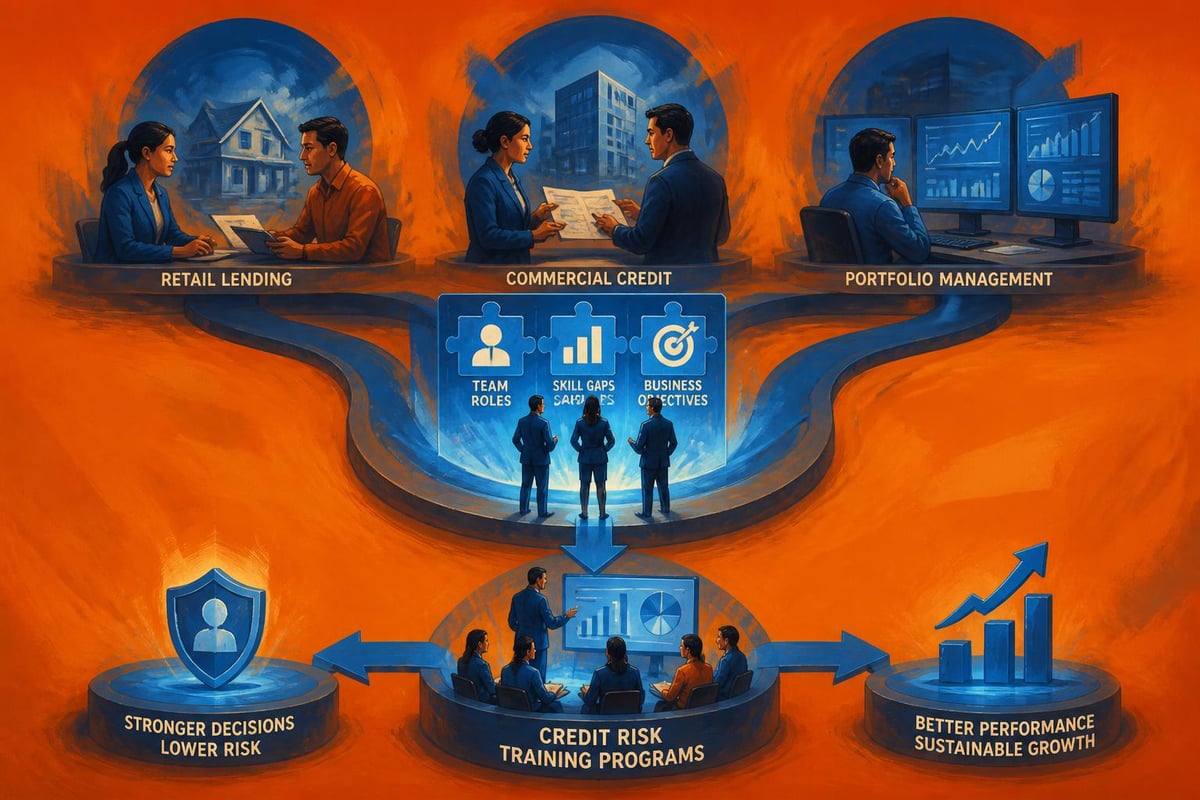
For retail lending teams, the American Bankers Association course on credit risk management in retail lending examines how banks identify, manage, and control risk levels through prudent practices. This specialized focus helps consumer credit teams develop skills directly applicable to their daily decisions.
Organizations seeking broader risk management capabilities should consider the NYU Certificate in Credit Risk Management, which provides tools to identify and manage credit risk among private and public entities in global markets. The program’s scope supports professionals managing diverse portfolios across multiple geographies.
Integrating Learning with Business Results
Education delivers value when knowledge transfers into changed behavior and improved outcomes. The best credit risk management courses include case studies, simulations, and application exercises that mirror real portfolio challenges.
Practical application accelerates impact. Teams that work through live credit decisions during training sessions build muscle memory and confidence. They practice difficult conversations about declining applications, learn to structure loan covenants that protect exposure without killing deals, and develop early intervention protocols when borrowers show stress signals.
Just as Noomii’s corporate coaching rolls up sleeves and coaches live in meetings rather than lecturing from the sidelines, effective credit training embeds learning in actual workflows. Participants bring current deals, the instructor guides analysis in real time, and teams leave with decisions made and frameworks internalized.
Connecting Risk Management to Organizational Performance
Credit risk capabilities tie directly to several business outcomes that matter to mid-market companies and Fortune 500 divisions:
- Faster decision cycles when teams use consistent frameworks and speak common language
- Lower loss rates through earlier identification of deteriorating credits
- Higher approval rates on quality deals because analysis separates real risk from perceived risk
- Stronger cross-functional collaboration when sales, operations, and credit align on risk appetite
- Better capital allocation by accurately pricing risk and optimizing portfolio composition
The Federal Reserve’s supervisory guidance on credit risk management outlines expectations for financial institutions, providing regulatory context that helps organizations understand minimum standards while building capabilities that exceed compliance baselines.
For companies managing development plans across leadership teams, credit risk education fits naturally into broader capability-building initiatives. Finance leaders who understand risk frameworks make better strategic decisions, operations managers who grasp credit fundamentals structure deals more effectively, and executives who speak the language of credit risk allocate resources with greater confidence.
Measuring Training ROI Through Clear KPIs
Smart organizations tie educational investments to measurable outcomes. Before launching credit risk management courses, establish baseline metrics and tracking mechanisms:
- Portfolio quality indicators: charge-off rates, delinquency trends, watch list migration
- Decision quality measures: approval accuracy, false positive/negative rates, deal structure strength
- Operational efficiency: time to decision, rework frequency, escalation volume
- Team capability assessments: pre- and post-training knowledge tests, case study performance
Understanding the ROI of coaching and consulting provides frameworks for measuring educational impact that extend beyond traditional training metrics. The same principles apply to credit risk education: look for behavior change, track business outcomes, and connect learning to performance improvements.
Building Sustainable Risk Management Capability
One-time training rarely creates lasting change. Organizations that build durable credit risk capabilities embed learning into ongoing leadership development and operational cadence.
Monthly case study reviews where teams analyze recent decisions, both successful and problematic, reinforce frameworks and build collective wisdom. Quarterly portfolio reviews that connect credit decisions to actual performance close feedback loops and sharpen judgment. Annual skill refreshers keep frameworks current as markets, regulations, and organizational priorities evolve.
The American Bankers Association’s course on managing, monitoring, and measuring credit risk explores processes that work at both individual loan and portfolio levels, providing structures that organizations can implement as ongoing practices rather than one-time exercises.

For professionals seeking comprehensive credentials, the New York Institute of Finance professional certificate in credit risk and credit analysis delivers structured progression across five courses, building depth that supports long-term career development alongside immediate business application.
Leaders who want accountability coaches who understand business fundamentals can explore resources like those available from accountability partners who help executives translate learning into consistent execution. Combining technical credit training with leadership coaching creates powerful synergy where knowledge becomes action and action produces results.
Credit risk management courses build the analytical foundations and decision frameworks that separate reactive lending from strategic portfolio management. When organizations invest in structured learning, measure outcomes against clear KPIs, and embed knowledge into operational rhythms, they create sustainable competitive advantages through better credit decisions and stronger team capabilities. Noomii delivers practical corporate coaching that ties leadership development directly to measurable business results, working month to month with no long contracts so you stay because progress is visible across your priorities.



Leave a Reply
Want to join the discussion?Feel free to contribute!