
Corporate Coaching for CPG Brands: What Actually Works
Consumer packaged goods brands operate in one of the most unforgiving business environments in commerce. SKU proliferation, retailer consolidation, shrinking shelf space, direct-to-consumer disruption, and algorithmic merchandising have compressed decision cycles and elevated the cost of leadership mistakes. Yet most corporate coaching for consumer packaged goods brands still treats CPG executives like generic enterprise leaders, missing the sector's unique pressures entirely. The gap between what coaching providers promise and what CPG organizations actually need is widening, and the consequences show up in missed revenue targets, failed launches, and leadership churn at critical moments.
Why Generic Executive Coaching Fails CPG Leaders
Corporate coaching for consumer packaged goods brands must address a reality most providers don't understand: CPG leadership isn't about managing complexity, it's about executing at velocity while complexity compounds. The executive who can navigate a matrix organization, satisfy private equity timelines, renegotiate retailer terms, and launch innovation into a saturated category operates in a fundamentally different environment than a SaaS VP or healthcare administrator.
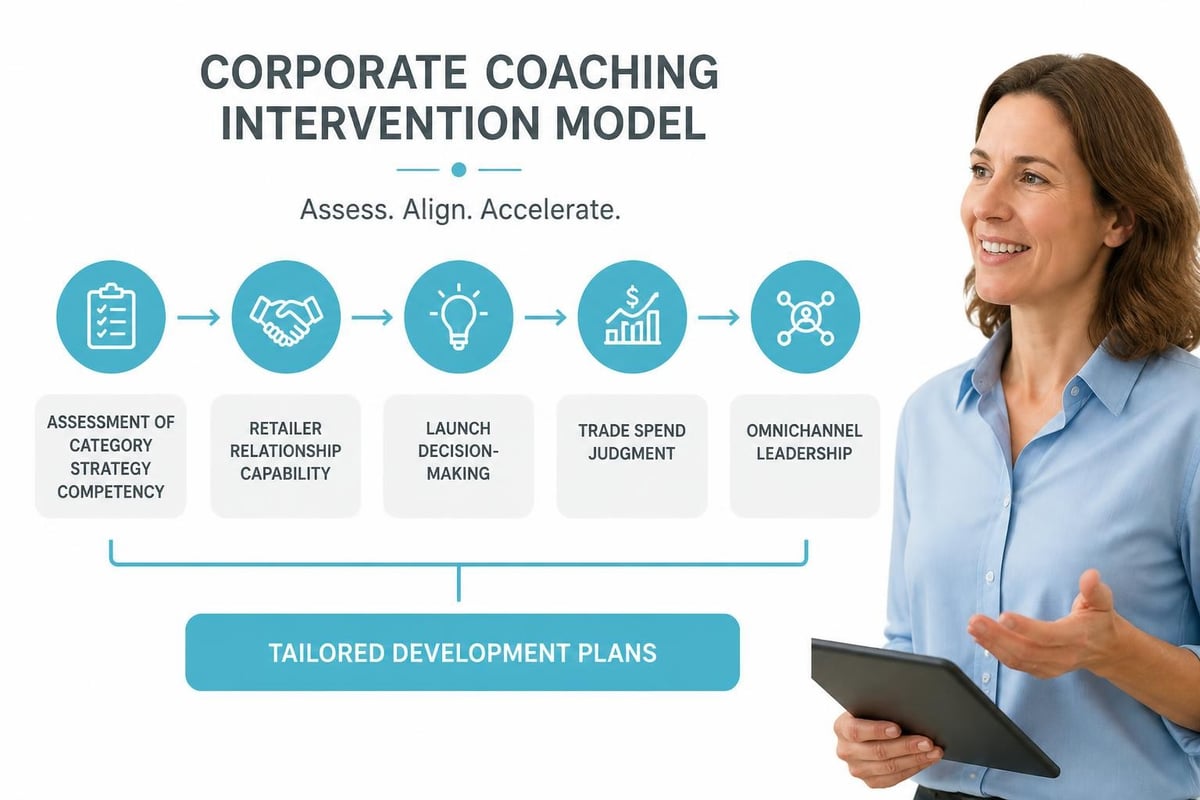
The problem starts with diagnosis. Standard leadership assessments measure collaboration, strategic thinking, and communication but ignore the competencies that separate effective CPG leaders from failing ones. Can the executive read syndicated data and translate share shifts into actionable category strategy? Do they understand trade spend efficiency, not just conceptually but in practice? Can they make a launch decision with incomplete information on a compressed timeline? These capabilities don't appear on generic 360 reviews.

According to Deloitte’s 2024 consumer products industry outlook, capability gaps in leadership and talent development rank among the top barriers to executing growth agendas in CPG. The report highlights that many organizations recognize they need stronger leaders but lack structured interventions to build the specific skills their business models demand. Generic coaching programs don't close these gaps because they weren't designed with CPG's operational cadence in mind.
The Execution Gap Most Coaches Miss
In a recent engagement with a mid-sized food and beverage company, leadership coaching was introduced to address "poor cross-functional collaboration" between brand, sales, and supply chain. The diagnosis was accurate but incomplete. The real issue wasn't collaboration skills but conflicting performance metrics and decision rights that coaching alone couldn't resolve. Brand wanted innovation velocity, sales needed margin protection, and supply chain required production stability. No amount of communication workshops fixed the underlying misalignment.
Effective corporate coaching for consumer packaged goods brands must diagnose these structural tensions first, then develop leaders who can navigate them. That requires coaches with CPG operating experience, not just executive presence credentials. It also requires interventions that address:
- Retailer dynamics and power asymmetry in negotiations and joint business planning
- Promotional effectiveness and the leadership judgment required to shift spending without tanking velocity
- Speed-to-market pressures that compress strategic planning into 90-day cycles
- Omnichannel execution across traditional retail, e-commerce, quick commerce, and direct channels
The best coaching outcomes in CPG don't come from teaching communication frameworks. They come from pattern recognition, decision-making under ambiguity, and building the judgment to make trade-offs between conflicting priorities in real time.
What Effective CPG Coaching Actually Addresses
The most successful corporate coaching for consumer packaged goods brands we've observed shares a common characteristic: it treats leadership development as a performance intervention, not a personal growth exercise. This distinction matters because it changes what gets measured, how coaches are selected, and what outcomes justify the investment.
Matching Coaches to CPG Context
CPG organizations waste resources when they match executives with generalist coaches who lack sector fluency. A coach who has never managed a category review, navigated a retailer reset, or launched into a dominated shelf set can't provide the contextual guidance that accelerates development. This isn't about credentialism but about recognizing that coaching impact increases when the coach understands the business pressures the leader faces daily.
| Coaching Focus | Generic Approach | CPG-Specific Approach |
|---|---|---|
| Strategic Planning | Annual framework development | 90-day cycle adaptation and rapid reprioritization |
| Stakeholder Management | Influence without authority | Retailer negotiation and buyer relationship strategy |
| Decision-Making | Consensus building and buy-in | Speed and conviction under incomplete data |
| Innovation Leadership | Ideation and creativity workshops | Launch timing, trade-offs, and failure management |
| Team Development | Engagement and retention | Cross-functional execution in matrixed structures |
The precision matching of coaches to CPG-specific challenges directly impacts program ROI. Leaders don't need another session on emotional intelligence. They need coaching on how to make a go/no-go decision on a line extension when consumer testing is directional but not definitive, when production requires a six-week lead time, and when the retailer meeting is in three days. That's the judgment gap most coaching programs ignore.
Building Leaders Who Can Execute Through Retailers
The retailer-supplier power dynamic in CPG creates leadership challenges that don't exist in most industries. Executives must simultaneously partner with and compete against the retailers who control their market access. This requires a specific type of commercial judgment and relationship capability that standard coaching rarely addresses.
One beverage company brought in corporate coaching for consumer packaged goods brands after three consecutive failed category reviews with a major retailer. The initial assumption was that the sales leadership lacked presentation skills or strategic thinking. The real issue was different: the team couldn't translate syndicated data into a retailer-relevant growth story because they optimized for brand performance, not total category growth. The coaching intervention focused on reframing strategic narratives and building the analytical capability to identify white-space opportunities that served both parties.
The results were measurable: the next category review resulted in expanded distribution for two SKUs and a 12% increase in allocated shelf space. More importantly, the leadership team developed a repeatable capability they applied across other retailer relationships. This is what effective corporate coaching for consumer packaged goods brands delivers-capability that compounds across multiple business contexts.
The Role of Coaching in CPG Transformation Initiatives
Consumer packaged goods brands are redesigning operating models to compete in omnichannel commerce, as outlined in EY’s analysis of how CPG companies can create operating models that reignite growth. These transformations require new capabilities, different decision rights, and leadership behaviors that traditional training doesn't build quickly enough. Coaching becomes the intervention that accelerates adoption and sustains behavior change through organizational redesign.
The challenge isn't just skills development but changing how leaders process information and make decisions. Consider the shift from managing traditional retail to executing omnichannel strategies. Leaders must now integrate:
- Real-time e-commerce performance data alongside slower-moving syndicated scan data
- Direct-to-consumer insights that sometimes contradict retailer feedback
- Quick commerce execution requiring supply chain agility most CPG brands weren't built for
- Digital shelf optimization that demands different capabilities than physical merchandising
These shifts overwhelm many CPG executives because they require simultaneous mastery of multiple business models. Generic change-management training teaches the theory of adaptation; coaching builds the capability to execute through the transition. Prosci’s change management case studies from manufacturing and consumer goods contexts demonstrate that sustained behavior change requires targeted support, not just communication and training.
Addressing the Leadership Deficit in Digital Commerce
According to NielsenIQ’s Consumer Outlook guide to 2026, e-commerce, sustainability, and omnichannel execution will continue reshaping CPG competitive dynamics. Yet most CPG executives built their careers in traditional retail and lack direct experience in digital-first commerce. This creates a leadership gap that coaching must close faster than traditional development approaches allow.
One frozen food manufacturer faced this exact challenge when a private equity owner mandated aggressive e-commerce growth. The VP of Sales had 20 years of retail experience but had never managed a direct-to-consumer P&L or optimized for algorithmic visibility. The coaching program focused on three areas:
- Building digital commerce fluency through exposure to e-commerce operators and tactical immersion in platform economics
- Developing talent strategies to hire and integrate digital-native leaders without alienating the traditional sales organization
- Creating decision frameworks for allocating trade spend between traditional retail support and digital shelf optimization
Within six months, the leader had built a credible e-commerce strategy, hired two experienced digital operators, and reallocated 15% of trade spend to support online growth. The investment in targeted coaching delivered faster capability development than hiring a replacement executive would have.
Coaching ROI in CPG: What Actually Gets Measured
Most organizations struggle to quantify coaching ROI because they measure the wrong outcomes. Engagement scores and self-reported confidence gains don't justify executive coaching investments to CFOs or private equity owners. Corporate coaching for consumer packaged goods brands must demonstrate impact through business metrics that matter to P&L owners.
The clearest ROI comes from interventions that address specific performance gaps with measurable consequences:
- Failed launches or extensions due to poor cross-functional execution
- Lost distribution or shelf space from ineffective retailer relationship management
- Margin erosion caused by promotional spending without velocity discipline
- Leadership turnover in critical commercial or supply chain roles
- Delayed transformation initiatives that miss market windows
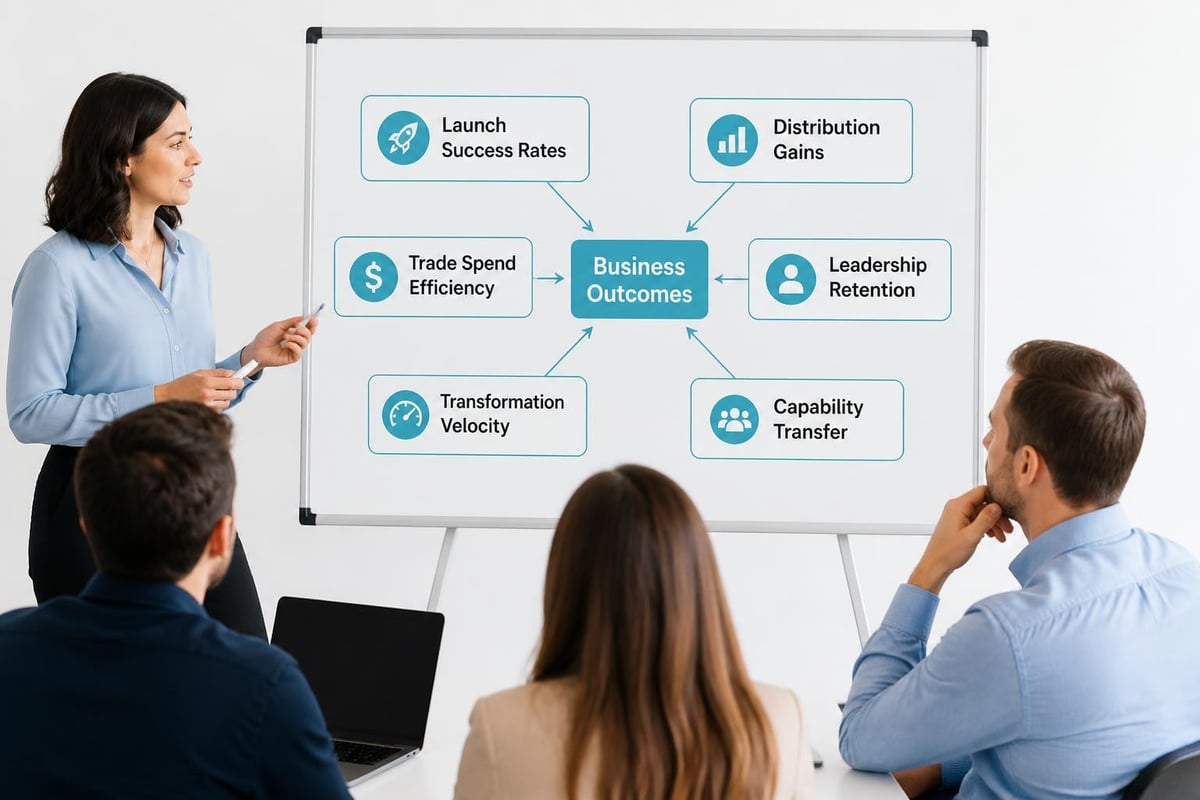
When coaching targets these issues directly, ROI calculation becomes straightforward. The cost of a failed launch typically exceeds the investment in coaching the cross-functional team by 10x or more. The impact of retaining a critical VP through targeted development support versus a six-month search and ramp period is easily quantified.
Building Internal Capability Versus Buying External Expertise
Many CPG organizations face a decision: invest in developing existing leaders through corporate coaching for consumer packaged goods brands or hire external talent with the required experience. The answer depends on time horizon and organizational culture, but coaching often delivers better long-term value when the fundamentals are sound.
A personal care company compared the cost of executive coaching investments against the fully loaded cost of external hires for three VP-level roles requiring omnichannel expertise. The analysis revealed that coaching existing leaders cost 40% less and retained institutional knowledge, customer relationships, and cultural fit that external hires would take 18 months to build. The trade-off was speed: external hires could execute immediately while coached internal leaders required 4-6 months to develop comparable capability.
The company chose a hybrid approach: hired one external VP to lead the transformation and invested in coaching three internal VPs to accelerate their development. This balanced immediate execution needs with long-term capability building and cost efficiency.
How CPG HR Leaders Should Evaluate Coaching Providers
Most corporate coaching for consumer packaged goods brands fails at the procurement stage because HR leaders select providers using criteria that don't predict CPG success. Credentials, testimonials, and methodology decks matter less than sector experience and diagnostic precision. Harvard Business Review’s analysis of what it takes to become an effective executive coach emphasizes that coach competency and contextual expertise drive impact more than certification pedigree.
When evaluating coaching providers for CPG contexts, focus on these questions:
Does the provider demonstrate CPG operating experience? Generic executive coaches can't provide the pattern recognition and contextual guidance that CPG leaders need. Look for providers who can discuss category dynamics, retailer strategies, and trade-offs specific to your subsector.
How does the provider diagnose leadership gaps? Standard assessments miss competencies that matter in CPG. Effective providers use diagnostic tools that measure commercial judgment, execution velocity, and decision-making under ambiguity, not just behavioral preferences.
What evidence exists of CPG-specific outcomes? Case studies and references should demonstrate measurable business impact in CPG contexts. Improved launch success rates, expanded distribution, better trade spend efficiency, or reduced leadership turnover in commercial roles provide clearer proof than satisfaction surveys.
How does the matching process work? Precision coach matching that considers sector experience, functional expertise, and leadership challenge specificity drives better outcomes than random assignment or availability-based matching.
What measurement framework guides the engagement? Effective providers define success metrics upfront and track progress against business outcomes, not just coaching activity completion.
The Talent Strategy Connection
According to PwC’s workforce research on hopes and fears, employees and managers increasingly expect coaching and development support as part of the employment value proposition. In competitive CPG talent markets, the availability of high-quality leadership coaching influences retention and attraction, particularly for high-potential leaders evaluating opportunities.
This shifts the ROI calculation. Coaching isn't just a performance intervention; it's a talent strategy component that signals investment in leader development. Several CPG organizations now include access to executive coaching in VP-level offer packages as a retention and attraction tool. The cost of coaching becomes trivial compared to the risk of losing critical commercial or innovation leaders to competitors.
FAQ: Corporate Coaching for Consumer Packaged Goods Brands
What makes corporate coaching for CPG different from general executive coaching?
CPG coaching must address sector-specific pressures including retailer power dynamics, syndicated data interpretation, trade spend optimization, launch velocity, and omnichannel execution. Generic executive coaching focuses on universal leadership skills but misses the commercial judgment and execution capabilities that separate effective CPG leaders from failing ones. The best CPG coaching combines leadership development with operational context and business model fluency.
How long does effective CPG leadership coaching typically take?
Targeted interventions addressing specific performance gaps (failed launches, retailer relationship issues, cross-functional execution problems) often show measurable progress in 3-4 months. Broader capability development for executives transitioning to larger roles or new business models typically requires 6-9 months. The timeline depends on the complexity of the leadership challenge, the executive's starting capability, and the intensity of coaching engagement. Monthly sessions rarely build capability fast enough for CPG's velocity; bi-weekly or weekly engagement delivers better results.
Should CPG companies build internal coaching capability or use external providers?
Most CPG organizations benefit from external providers for executive and VP-level coaching because internal coaches rarely have the sector expertise, seniority, and organizational distance required for effective interventions at that level. Internal capability works well for frontline and mid-level leader development where scale matters and challenges are more standardized. The optimal approach uses external providers for senior strategic coaching and builds internal capability for broader population development.
What ROI should CPG companies expect from leadership coaching investments?
ROI varies by intervention type, but measurable outcomes include reduced leadership turnover (typically 60-80% retention improvement for at-risk executives), improved launch success rates (15-25% improvement in cross-functional execution), expanded distribution (measurable shelf space or authorization gains), and faster transformation adoption (30-40% acceleration in capability development versus training alone). The clearest ROI comes from coaching that prevents expensive failures or accelerates time-to-competency in critical roles.
How do you match coaches to CPG-specific leadership challenges?
Effective matching requires understanding both the business context (category dynamics, retailer relationships, organizational complexity) and the individual leadership gap (commercial judgment, execution velocity, strategic capability). The best providers use structured diagnostics to identify specific competency gaps, then match coaches based on relevant CPG operating experience, functional expertise, and demonstrated outcomes in similar contexts. Generic matching based on availability or surface-level fit rarely delivers optimal results in CPG environments.
Corporate coaching for consumer packaged goods brands succeeds when it treats leadership development as a performance intervention grounded in sector realities, not a generic growth exercise. The organizations that get this right see measurable improvements in launch execution, retailer relationships, and commercial leadership capability that directly impact P&L performance. Noomii Leadership Coaching delivers precision-matched coaching solutions designed for CPG's unique pressures, combining sector-experienced coaches with evidence-based diagnostics and measurable business outcomes that justify the investment.



Leave a Reply
Want to join the discussion?Feel free to contribute!