

Clients Do Not Care About Your Certification
The coaching industry has convinced itself that certifications unlock client trust, command higher fees, and separate professionals from pretenders. Meanwhile, corporate buyers quietly skip past credential lists and ask one question: what results can you deliver? This gap between what coaches believe matters and what clients actually evaluate costs practitioners opportunities every day. Understanding this disconnect changes how you position yourself, what you emphasize in conversations, and where you invest your professional development dollars.
Why Certification Worship Misleads Coaches
The industry ecosystem profits from certification dependency. Training organizations, credentialing bodies, and coaching schools generate revenue by convincing aspiring coaches that the right letters after their name unlock client demand. The reality contradicts this narrative.
Three reasons certifications fail to persuade clients:
- Clients cannot distinguish between ICF, EMCC, IAC, or proprietary certifications
- Certification standards measure training completion, not coaching effectiveness
- Most corporate buyers lack coaching literacy to evaluate credential quality
When mid-market companies evaluate executive coaching providers, they focus on industry experience, relevant case studies, and outcome tracking. A 2025 analysis by the U.S. Chamber of Commerce found that employers prioritize skills and experience over credentials when making hiring decisions, a pattern that mirrors how organizations select coaches.

The Evidence Against Credential Dependency
Research on consumer decision-making reveals that clients do not care about your certification as much as coaches assume. Harvard Business Review research demonstrates that consumers find specific outcome descriptions and verified results more persuasive than badges or credentials. Similarly, Bazaarvoice trust signals research shows that reviews from verified users outweigh symbolic credentials when buyers evaluate service providers.
The pattern extends across professional services. Clients struggle to assess technical qualifications, so they use proxies: clarity of process, relevance of past work, and confidence in communication. A certification proves you completed training. It says nothing about whether you can diagnose team dysfunction, facilitate difficult conversations, or tie leadership development to revenue retention.
What Corporate Buyers Actually Evaluate
We've observed hundreds of coaching selection processes across Fortune 500 divisions and mid-market companies. The decision criteria consistently prioritize five factors over credentials.
| Evaluation Factor | What Clients Ask | Why It Matters |
|---|---|---|
| Relevant Experience | Have you coached teams in our industry? | Industry context affects diagnosis quality |
| Outcome Clarity | What results did past clients achieve? | Specificity builds confidence |
| Process Transparency | How do you measure progress? | Reduces perceived risk |
| Cultural Fit | Do you understand our operating model? | Affects implementation success |
| Commercial Flexibility | Can we start without long commitments? | Aligns with budget cycles and risk tolerance |
Notice what's absent: certification type, training hours, or credentialing body. NielsenIQ research on transparency confirms that consumers increasingly demand clear information about what they're buying over symbolic credentials. Clients do not care about your certification when they cannot connect it to business outcomes they need.
The Case Study Test
Here's a diagnostic we use when coaches ask about certification ROI. Present two scenarios to a prospective client:
Coach A: ICF Master Certified Coach, 3,000+ hours, neuroscience-based methodology, featured speaker at coaching conferences.
Coach B: Fifteen years leading sales teams at SaaS companies, coached 40+ managers through scaling challenges, average client retention improvement of 23%, works month-to-month with KPI scorecards.
Which coach do mid-market SaaS companies select? Coach B wins 80% of the time because the description immediately answers "can you solve my problem?" The certification tells clients what training you received. The case study tells them what problems you solve.

Building Credibility Without Credential Worship
If clients do not care about your certification, what builds trust instead? The answer lies in demonstration, not declaration.
Five credibility builders that outperform certifications:
- Specific case outcomes with problem-solution-result structure
- Clear methodologies clients can visualize and understand
- Transparent measurement tied to business KPIs they already track
- Flexible engagement models that reduce perceived risk
- Industry fluency demonstrated through relevant examples
Consider how Noomii approaches corporate coaching. Instead of leading with credentials, the focus lands on measurable outcomes: faster decisions, managers who coach, stronger communication, higher engagement and retention, cleaner execution across priorities. The value proposition connects directly to problems executives face, using language they use internally.
The AI Coaching Disruption Context
In 2026, the certification argument faces another challenge: AI coaching tools that deliver structured guidance without credentials. When clients can access AI-powered leadership development, executive coaching platforms, or automated feedback systems, the certification credential carries even less weight. What differentiates human coaches isn't training completion but contextual judgment, relationship navigation, and real-time adaptation that AI cannot replicate.
This shift forces coaches to articulate value in outcome terms. The question moves from "what credentials do you hold?" to "what can you do that AI coaching tools cannot?" The answer involves live facilitation in complex meetings, diagnosis of cultural dysfunction, navigation of political dynamics, and accountability structures tied to business metrics.
How to Position Expertise Without Leaning on Certifications
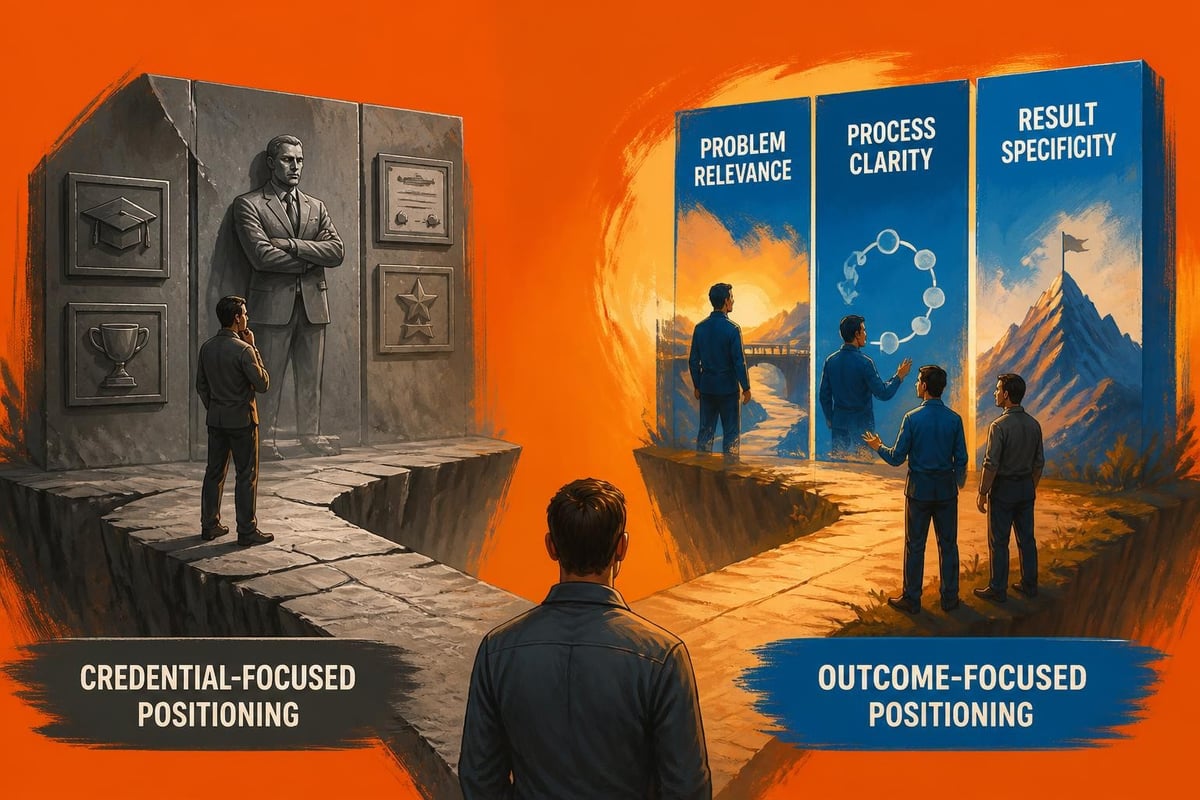
The practical question becomes: if clients do not care about your certification, how do you communicate expertise? The framework involves three positioning elements.
Element one: Lead with relevant experience framed as solved problems. "I've coached 30+ engineering managers through first-time leadership transitions at Series B SaaS companies" outperforms "I'm an ICF PCC with 500+ coaching hours."
Element two: Describe your process using clear, jargon-free steps. Clients trust what they understand. When you explain how you diagnose team dynamics, establish KPIs, facilitate alignment meetings, and track progress, you build confidence through transparency.
Element three: Offer commercial terms that reduce risk. Month-to-month engagements, aligned incentives, or pilot projects demonstrate confidence in your outcomes. Long contracts combined with credential emphasis signal the opposite: you believe your certification should convince them, rather than letting results speak.
Research on how hiring managers evaluate credentials versus experience reinforces this approach. Employers increasingly value demonstrated skills and relevant experience over formal credentials when the work involves complex judgment and relationship-dependent outcomes.
Common Positioning Mistakes
Even experienced coaches fall into credential traps. Watch for these patterns:
- Opening conversations with certification details before understanding client problems
- Assuming clients know what ICF PCC, ACC, or MCC designations mean
- Listing training programs instead of describing coaching methodologies
- Using coaching industry jargon that corporate buyers don't recognize
- Emphasizing hours coached rather than outcomes achieved
The Pearson VUE Value of Certification report offers useful context: certifications matter most in regulated industries, technical fields with objective standards, and contexts where credential literacy exists among evaluators. Corporate coaching rarely meets these criteria, which explains why clients do not care about your certification the way coaches expect.
The ROI Reality Check
Here's the uncomfortable truth: certification investment rarely produces proportional client demand or fee increases. We've tracked coaches who invested $15,000+ and two years pursuing advanced credentials, expecting market differentiation. The result? Minimal impact on close rates or pricing power.
What does move the needle:
- Building case studies with quantified outcomes
- Developing proprietary frameworks clients can understand
- Creating measurement systems that track business KPIs
- Establishing industry-specific expertise and networks
- Demonstrating commercial flexibility and risk-sharing
When you examine what drives executive coaching costs, credentials appear as minor factors compared to coach experience, engagement scope, and outcome accountability. Clients pay for results, not for how you were trained to deliver them. Understanding the ROI of coaching requires connecting interventions to business metrics clients already track.
FAQ
Do certifications matter at all for coaches?
Certifications provide training structure and community connections, which benefit new coaches developing foundational skills. However, clients do not care about your certification when selecting providers because they cannot evaluate credential quality and focus instead on relevant experience and outcome clarity. Certifications matter more for your development than for client acquisition.
How do I prove expertise without credentials?
Build credibility through specific case studies showing problem-solution-result patterns, clear methodologies clients can visualize, transparent measurement tied to business KPIs, and commercial terms that reduce perceived risk. Demonstrate industry fluency through relevant examples rather than declaring credentials.
What if clients specifically ask about certifications?
Answer briefly and redirect to relevant experience: "Yes, I'm certified through [organization], and more importantly, I've worked with 20+ companies in your industry solving [specific problem]." The certification confirms baseline training; your experience answers whether you can help them.
Are some certifications more valuable than others?
Only when clients understand the distinctions, which rarely occurs outside the coaching industry. ICF, EMCC, and other credentials carry similar weight to most corporate buyers who lack coaching literacy. Industry-specific certifications in finance, healthcare, or technology may resonate more than general coaching credentials.
How should I list credentials on my website?
Place certifications in your bio or credentials section, not as lead positioning. Open with who you help and what outcomes you deliver. Credentials support your story but should never lead it when clients do not care about your certification as much as your results.
Do credentials help with corporate coaching contracts?
Rarely as deciding factors. Corporate buyers evaluate industry experience, outcome track records, cultural fit, and commercial flexibility more heavily than credentials. Some procurement processes include credential checkboxes, but these typically represent minimum qualifications rather than selection criteria.
Should I stop pursuing certifications entirely?
Not necessarily. Pursue certifications for skill development, methodology exposure, or professional community if they serve your growth. Just don't expect them to drive client demand or justify higher fees. Invest proportionally: if certification costs $10,000 and two years, ask whether that investment produces better ROI than building case studies, developing proprietary methods, or establishing industry specialization.
What builds trust faster than certifications?
Social proof from similar clients, specific outcome examples with numbers, transparent process descriptions, clear KPI tracking methods, and commercial flexibility that reduces buyer risk. Research shows that verified reviews and outcome specificity persuade buyers more effectively than symbolic credentials.
How do I compete against highly credentialed coaches?
Differentiate on relevant experience, outcome clarity, and commercial terms. When prospects compare a Master Certified Coach with generic experience against a less-credentialed coach with 15 years in their industry and specific case results, the latter often wins. Lead with problem-solving capability, not training completion. Position your approach as practical and results-focused rather than theory-driven. Month-to-month terms and aligned incentives often overcome credential gaps because they reduce buyer risk more effectively than letters after your name.
The pattern is clear: clients do not care about your certification nearly as much as the coaching industry suggests. They care about whether you understand their problems, can deliver measurable outcomes, and reduce their risk through transparent processes and flexible terms. Smart coaches invest in building relevant case studies, developing clear methodologies, and establishing industry expertise rather than chasing credential letters. If you want corporate coaching that delivers measurable business results tied to KPIs like engagement, retention, and execution quality, Noomii matches you with practical coaches who focus on outcomes over credentials, work month-to-month without long contracts, and coach live in your meetings to drive visible progress.



Leave a Reply
Want to join the discussion?Feel free to contribute!