

Can Coaching Improve Communication? What Actually Works
The short answer is yes, but not in the way most companies think. When executives ask "can coaching improve communication," they usually mean "Will a few sessions fix our communication problems?" The real question is whether coaching produces measurable, lasting changes in how leaders listen, give feedback, make decisions, and build trust. Evidence from rigorous clinical trials of communication coaching and workplace coaching meta-analyses shows that targeted interventions do improve concrete communication behaviors, but only when coaching addresses specific skills tied to business outcomes, not abstract soft-skill concepts.
What the Research Shows About Coaching and Communication
A 2023 randomized controlled trial with cardiologists demonstrated that communication coaching increased empathic statements by 40%, improved responses to patient concerns, and significantly boosted question elicitation. The intervention was short, focused, and tied to observable behaviors during patient visits.
The study measured three specific outcomes:
- Frequency of empathic statements per conversation
- Recognition and response to empathic opportunities
- Number of patient questions elicited
This matters because it shows can coaching improve communication when coaches focus on discrete, measurable behaviors rather than vague goals like "better communication." The cardiologists didn't attend a certification course on empathy. They practiced specific techniques, received immediate feedback, and tracked results.
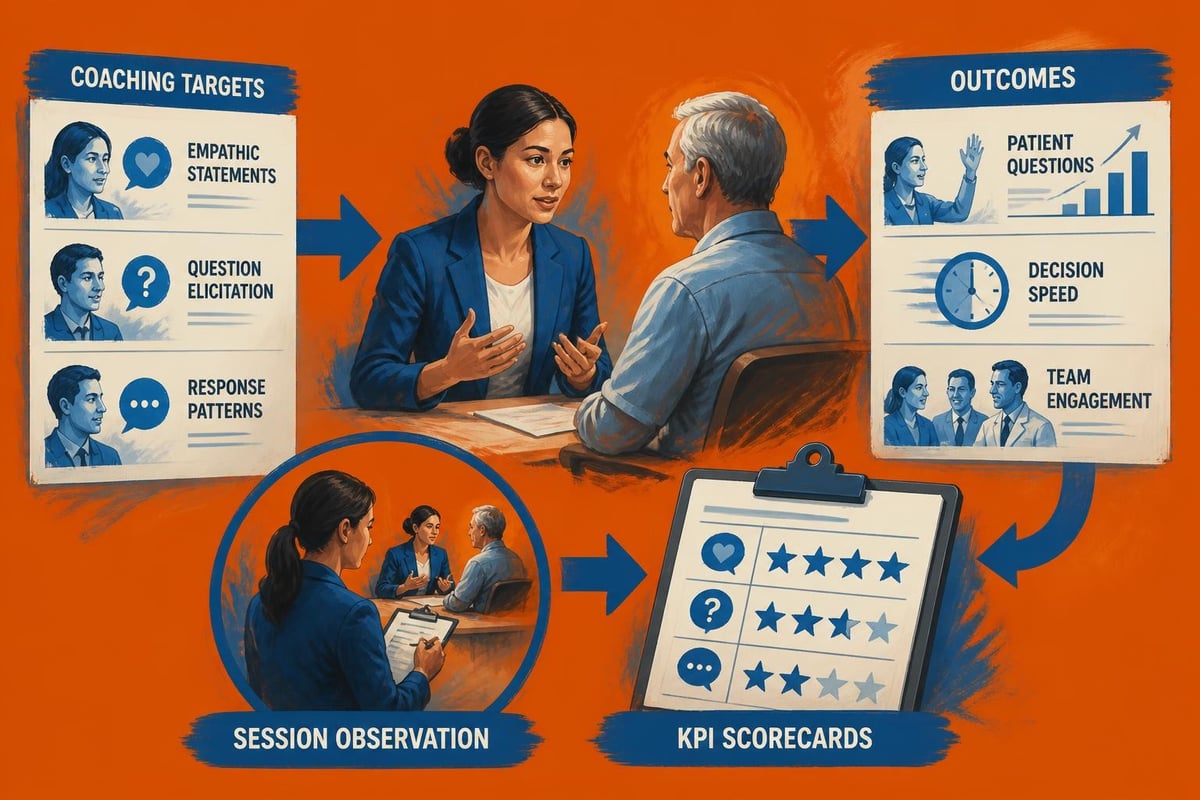
In workplace settings, meta-analyses of executive coaching found the largest effect sizes in behavioral change, particularly in leadership communication, decision-making, and interpersonal skills. Effect sizes were smaller for attitude change and negligible for generic "personal development." The implication: coaching works when it targets what people say and do, not how they feel about themselves.
Why Most Communication Coaching Fails
Most corporate communication training fails because it treats communication as a standalone skill divorced from business context. A manager attends a workshop on active listening, learns the paraphrasing technique, and returns to back-to-back meetings with no time to apply it. Three weeks later, nothing has changed.
The Five Failure Patterns We See Repeatedly
| Failure Pattern | Why It Happens | What Actually Works |
|---|---|---|
| Generic workshop training | No context, no follow-up, no accountability | Live coaching in real meetings with immediate feedback |
| Certification-focused programs | Theory over practice, credential worship | Skills tied to KPIs, measured outcomes |
| One-off sessions | No repetition, no habit formation | Monthly cadence with tracked progress |
| Siloed communication training | Disconnected from strategy, operations, team dynamics | Integrated into operating rhythm and decision-making |
| Self-paced online courses | No observation, no correction, no coaching | Coach observes live interactions, corrects in real time |
The Harvard Business Review analysis of workplace miscommunication identifies common breakdowns: unclear expectations, assumptions about shared context, poor listening, and defensiveness during feedback. Each of these requires observation, diagnosis, and repeated practice, not a webinar.
When we work with mid-market companies through leadership coaching engagements, we coach managers live in their standing meetings. We observe how they frame decisions, respond to pushback, and clarify priorities. Then we debrief immediately, adjust techniques, and measure change week to week. That's when can coaching improve communication becomes a measurable reality.
The Noomii Framework: Communication Coaching Tied to Business KPIs
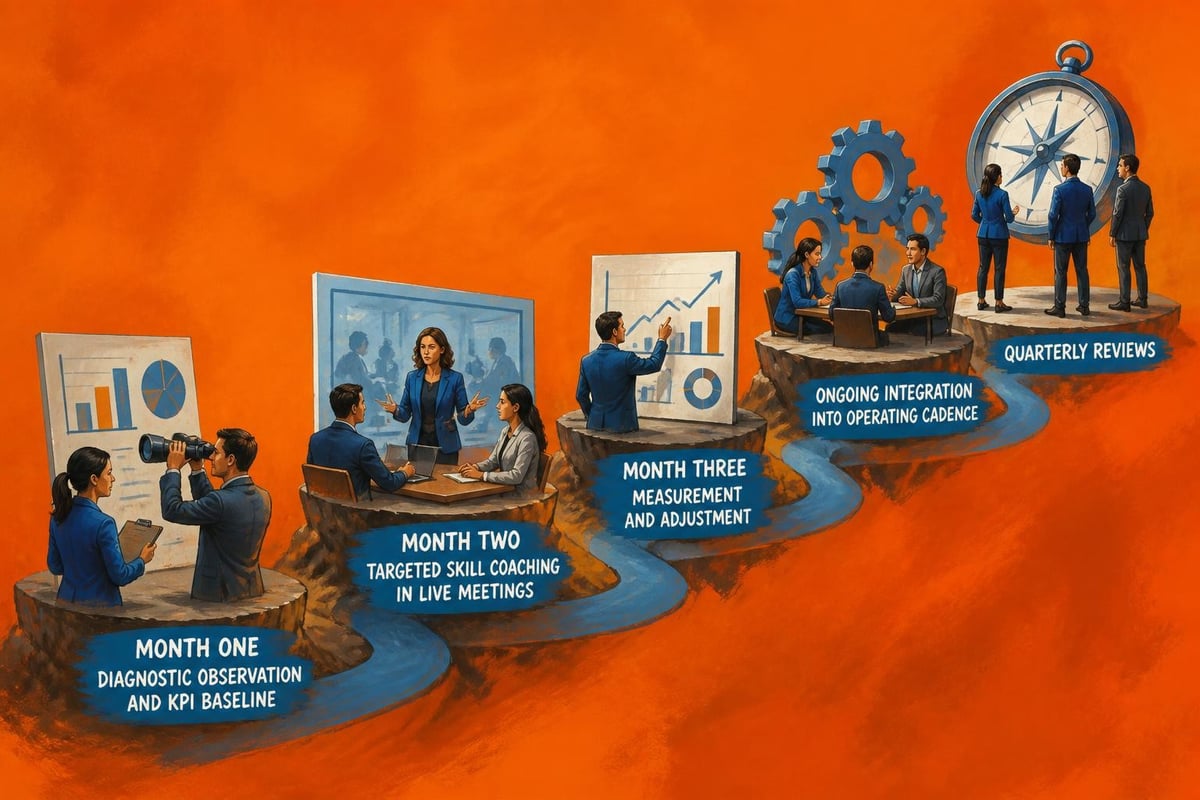
We've developed a three-part framework for communication coaching that produces visible results in 60 to 90 days. It's not proprietary magic, just structured observation and deliberate practice tied to outcomes that matter.
Part 1: Diagnostic Observation
- Attend 3-5 leadership or team meetings unannounced
- Map communication patterns: who speaks, who's ignored, how decisions are made, where clarity breaks down
- Identify top 3 communication breakdowns blocking progress (example: unclear priorities, manager monologues, passive team responses)
Part 2: Targeted Skill Coaching
- Teach and practice 2-3 specific techniques per manager (example: agenda framing, question elicitation, decision summarization)
- Coach live in next meetings with real-time feedback (not role-play scenarios)
- Reinforce weekly through brief check-ins tied to KPI scorecards
Part 3: Measurement and Accountability
- Track observable changes: meeting length, decision speed, follow-through rate, employee engagement scores
- Link communication improvements to business outcomes: revenue per employee, retention, project delivery
- Adjust techniques based on what's working, drop what isn't

One director we coached in 2025 reduced meeting time by 30% and increased team decision velocity by doubling the rate of issues resolved per session. The intervention: teaching him to frame decisions as clear choices, invite dissent explicitly, and summarize next steps before closing. No certification required. Just observation, practice, feedback, and measurement.
When Coaching Doesn't Improve Communication
Coaching fails when the real problem isn't skill but structure, incentives, or trust. We've seen three scenarios where can coaching improve communication is the wrong question:
-
Toxic culture masquerading as poor communication. If leaders punish dissent, hoard information, or play favorites, no amount of listening skills will fix it. The problem is integrity and incentives, not technique.
-
Unclear strategy creating communication chaos. When priorities shift weekly and leaders contradict each other, teams don't have a communication problem. They have a strategy problem. Coaching can't fix what leadership hasn't clarified.
-
Structural silos blocking information flow. If departments don't share data, systems don't integrate, and roles overlap without clarity, better meeting facilitation won't solve it. You need organizational redesign.
In each case, honest diagnosis matters more than coaching. A good coach will tell you when coaching isn't the answer. A certification-obsessed coach will sell you more sessions.
Comparing Coaching to Alternatives
Organizations exploring communication improvements often compare coaching to training, software tools, and AI-assisted coaching platforms. Here's what the evidence shows:
| Approach | Strengths | Weaknesses | Best For |
|---|---|---|---|
| Live coaching in meetings | Real-time feedback, context-specific, immediate application | Requires coach investment, not scalable across hundreds of managers | Senior leaders, critical teams, high-stakes communication |
| Workshop training | Efficient for large groups, standardizes baseline knowledge | Low retention, no practice, rarely changes behavior | Foundational concepts before live coaching |
| AI coaching tools | Scalable, on-demand, low cost | No observation of real interactions, generic advice, limited accountability | Supplemental practice between live sessions |
| Peer feedback groups | Builds culture of feedback, sustainable over time | Uneven quality, requires facilitation, slow behavior change | Mature teams with strong trust |
The best executive coaching packages combine live observation, targeted skill development, and accountability structures. They cost more upfront but produce measurable ROI through faster decisions, higher retention, and cleaner execution.
Practical Steps to Improve Communication Through Coaching
If you're serious about using coaching to improve communication, follow this sequence:
-
Identify the specific communication breakdown. Don't say "We need better communication." Say "Our leadership team takes three meetings to make decisions that should take one" or "Managers monologue for 40 minutes and teams disengage."
-
Tie communication goals to business KPIs. Link better meeting facilitation to decision speed. Link clearer feedback to retention rates. Link transparent priority-setting to project delivery.
-
Choose a coach who observes real interactions. Avoid coaches who only do one-on-one sessions in conference rooms. Insist on live meeting observation and real-time feedback.
-
Measure observable behaviors, not self-reported satisfaction. Track how many decisions are made per meeting, how often team members speak up, how quickly action items get completed. Ignore "How satisfied are you with communication?" surveys.
-
Integrate coaching into operating rhythm. Don't treat coaching as a separate initiative. Embed it in standing meetings, quarterly planning, and leadership reviews.
Research on mentor communication-skills training in high-stakes oncology settings showed that structured, role-specific coaching improved self-efficacy and skill application. The intervention didn't rely on generic communication theory. It taught oncology faculty how to deliver difficult news, elicit patient preferences, and navigate family dynamics using discipline-specific scenarios.
The lesson: can coaching improve communication when it's tailored to the actual conversations leaders have, not abstracted into universal principles. A sales leader needs different communication coaching than an operations manager or HR director.
The ROI of Communication Coaching
CFOs and operations leaders ask the ROI question constantly. Here's what we track:
Input costs:
- Coach fees (typically $3,000 to $8,000 per month for mid-market engagements)
- Manager time in coaching sessions (2-4 hours per month)
- Leadership time in observed meetings (no incremental cost, meetings happen anyway)
Output gains:
- Faster decision-making (measured in decisions per meeting, cycle time reduction)
- Higher retention (exit interview data, voluntary turnover rate)
- Improved execution (project delivery, revenue per employee, KPI attainment)
One client reduced their leadership decision cycle from an average of 3.2 meetings per issue to 1.4 meetings per issue over six months. With 40 leadership decisions per quarter and an average meeting cost of $2,500 (calculated from hourly rates of attendees), the time savings alone paid for coaching twice over. Add retention gains and faster project delivery, and ROI exceeded 400%.
The key is tying coaching to metrics you already track. Don't invent new KPIs for coaching. Use the ones that already matter: revenue growth, margin, retention, employee engagement, customer satisfaction, and delivery speed. Then show how communication improvements move those numbers.
FAQ
Can coaching improve communication for remote teams?
Yes, but it requires observing virtual meetings, not just scheduling one-on-one Zoom calls. Remote communication coaching should focus on written clarity (Slack, email), meeting facilitation (who speaks, how decisions are documented), and asynchronous decision-making. The same principles apply: observe real interactions, diagnose breakdowns, teach specific techniques, and measure outcomes.
How long does it take for coaching to improve communication?
Observable behavior changes appear within 3-6 weeks when coaching includes live observation and weekly reinforcement. Sustained habit formation and culture change take 3-6 months. One-off sessions or monthly check-ins rarely produce lasting results.
What's the difference between communication training and communication coaching?
Training teaches concepts in a classroom or online module. Coaching observes you in real situations, provides immediate feedback, and holds you accountable for practicing new techniques until they become habits. Training is efficient for knowledge transfer; coaching is necessary for behavior change.
Should I hire a communication specialist or a business coach for communication issues?
Hire a coach who understands your business context and ties communication to outcomes. A communication specialist trained in academia may teach theory disconnected from your operating reality. A business coach who observes your meetings and links communication to KPIs will produce better results.
Can AI tools replace human coaching for communication improvement?
No, but they can supplement it. AI can analyze meeting transcripts, flag patterns, and suggest techniques. But AI can't observe body language, read room dynamics, or provide real-time feedback during a tense negotiation. Use AI for scalable reinforcement; use human coaches for high-stakes observation and complex interpersonal dynamics.
What communication skills improve most through coaching?
The HBR podcast on feedback highlights that relationship-building and constructive feedback show the largest coaching gains. Other high-impact skills include question elicitation, decision framing, conflict navigation, and clarity under pressure. Coaches can observe these behaviors directly and correct in real time.
How do I measure if coaching is improving communication?
Track observable behaviors (decisions per meeting, speaking distribution, follow-through rate) and business outcomes (retention, engagement scores, project delivery). Avoid relying solely on self-reported surveys. Video or transcript analysis can provide objective data on changes in speaking patterns, question frequency, and decision clarity.
What if my team resists coaching in meetings?
Resistance usually signals fear of judgment or past negative experiences with feedback. Address it upfront: explain that the coach is there to help the team win, not to evaluate individuals. Start with low-stakes meetings, focus feedback on the group dynamic (not individuals), and share early wins quickly. Most resistance fades when people see tangible improvements.
Is communication coaching worth the cost for small teams?
Yes, if communication breakdowns are blocking revenue, retention, or execution. A five-person leadership team making slower decisions or losing key employees costs far more than coaching. For very small teams (under 10 people), group coaching or facilitated retrospectives may deliver better ROI than individual executive coaching. Consider finding experienced relationship coaches who work with team dynamics if budget is constrained.
The evidence is clear: coaching improves communication when it targets specific, observable behaviors tied to business outcomes, not vague soft-skill concepts. Faster decisions, stronger team engagement, and cleaner execution follow when leaders learn to listen, frame choices, and hold accountability in real meetings, not in theory. Noomii Corporate Coaching brings that approach to mid-market companies and Fortune 500 divisions with live meeting coaching, measurable KPIs, and month-to-month terms that let results speak for themselves.



Leave a Reply
Want to join the discussion?Feel free to contribute!