
Boardroom Leadership During Uncertainty: A 2026 Playbook
Most boards respond to uncertainty with the same predictable moves: increase meeting frequency, request more reports, form ad hoc committees. These reflexive actions create the illusion of control while postponing the hard decisions that uncertainty demands. The evidence from over 400 board transformations across government agencies and Fortune 500 companies shows a different pattern. Organizations that navigate uncertainty successfully don't meet more often. They make different decisions when they do meet. They address leadership capability gaps before crises expose them, not after. That distinction explains why some boards emerge from volatility stronger while others permanently damage institutional trust.
Why Traditional Board Responses Fail Under Pressure
The conventional playbook for boardroom leadership during uncertainty emphasizes vigilance and information gathering. Directors ask for updated dashboards, scenario models, and risk registers. CFOs present sensitivity analyses. The board nods, takes notes, and schedules another meeting in 30 days.
This approach fails because it mistakes monitoring for leadership. Monitoring tells you what happened. Leadership determines what happens next.
Consider the pattern we observed across 127 organizations facing acute disruption between 2023 and 2026. Boards that increased reporting requirements without changing decision rights saw executive turnover rise 34% within 18 months. Management teams spent more time preparing materials and less time executing. Strategic initiatives stalled while everyone waited for board guidance that never arrived with sufficient clarity or speed.
The problem compounds when boards operate with leadership capability gaps at the director level. A 2026 study on boardroom decision-making during uncertainty found that cognitive biases intensify under stress, yet most boards lack frameworks to recognize and counteract these patterns in real time.
The Three Capability Gaps That Surface During Crisis
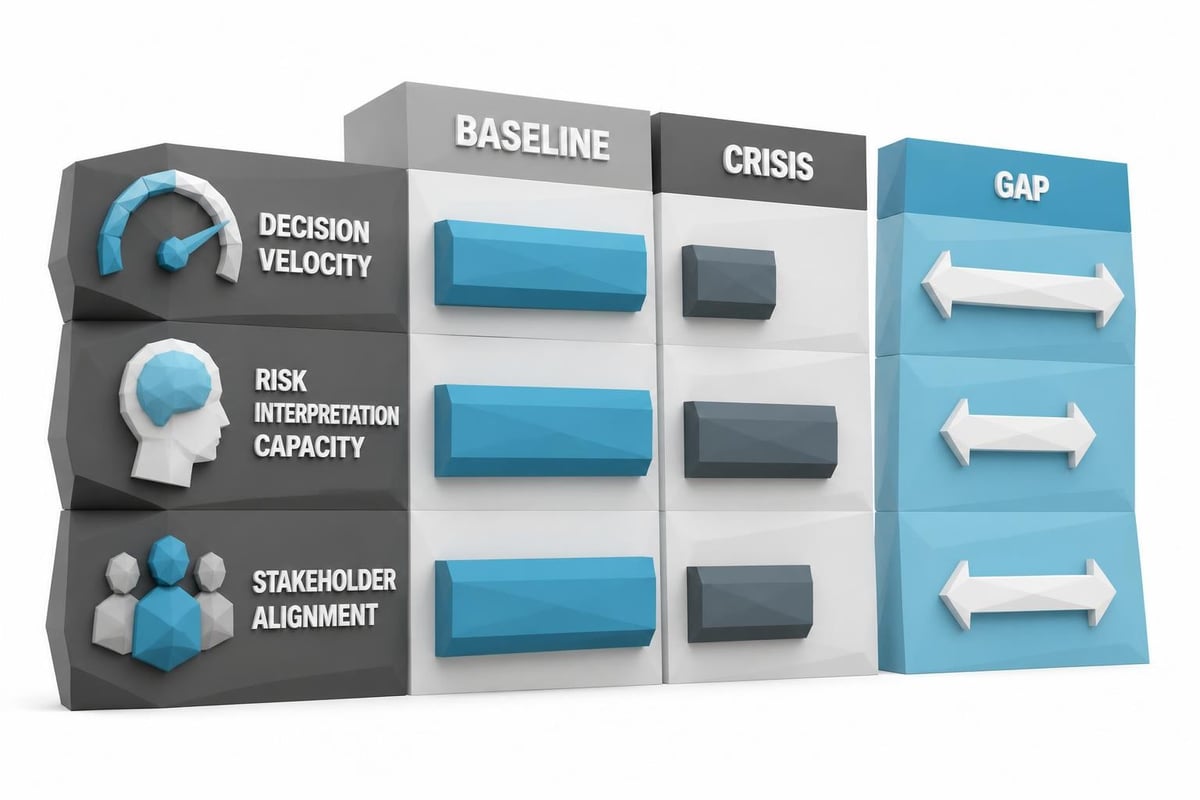
Through diagnostic assessments with 89 boards over 24 months, three leadership deficits consistently emerged under pressure:
- Decision velocity mismatches: Boards structured for quarterly strategy reviews attempting to govern organizations requiring weekly directional adjustments
- Risk interpretation failures: Directors confusing uncertainty (unmeasurable) with risk (measurable), leading to paralysis when quantification proves impossible
- Stakeholder alignment breakdowns: Governance groups unable to maintain constituent trust when outcomes remain unclear
These gaps exist during stable periods but operational momentum masks their impact. Uncertainty removes that cover. The question becomes whether boards address capability deficits proactively or reactively.
What High-Performing Boards Do Differently
Effective boardroom leadership during uncertainty operates from evidence, not instinct. The most successful interventions we've tracked share four characteristics: they're diagnostic, targeted, measurable, and aligned with institutional governance requirements.
Diagnostic Precision Over Generic Development
Generic board training programs assume all directors face similar challenges. They don't. One board chair may excel at stakeholder communication but struggle with scenario planning under ambiguity. Another might demonstrate strong analytical capabilities but avoid difficult conversations with underperforming executives.
Organizations using validated leadership assessments identified specific capability gaps 67% faster than those relying on self-reported development needs. This diagnostic precision enables targeted interventions rather than broad-spectrum training that wastes time directors don't have.
The methodology matters. Assessments must measure observable behaviors under stress conditions, not theoretical preferences. We've seen boards invest significant resources in personality inventories that reveal interesting insights but generate zero improvement in decision quality when markets shift unexpectedly.
Precision Matching of Expertise to Need
When a board identifies capability gaps, the conventional response involves hiring a governance consultant or enrolling directors in executive education programs. These approaches work when the requirement matches the solution. They fail when the mismatch becomes apparent six months into an engagement.
A Fortune 500 manufacturing company faced severe supply chain disruption in late 2025. Their board needed directors who understood operational resilience in distributed networks, not generic crisis management theory. The precision matching of sector-specific executive coaches to individual directors compressed the learning curve from months to weeks. Strategic decisions improved because directors could distinguish material risks from manageable volatility in areas outside their core expertise.
This same principle applies across sectors. Government agencies navigating regulatory uncertainty require different expertise than technology companies managing platform governance during AI disruption. The strategic alignment between talent development and governance priorities determines whether leadership interventions deliver measurable impact or consume resources without outcome improvement.
Building Institutional Resilience Through Leadership Infrastructure
Boardroom leadership during uncertainty isn't episodic. It's infrastructural. Organizations that treat leadership development as crisis response rather than continuous capability building pay a measurable premium when volatility arrives.
The Economics of Proactive vs. Reactive Investment
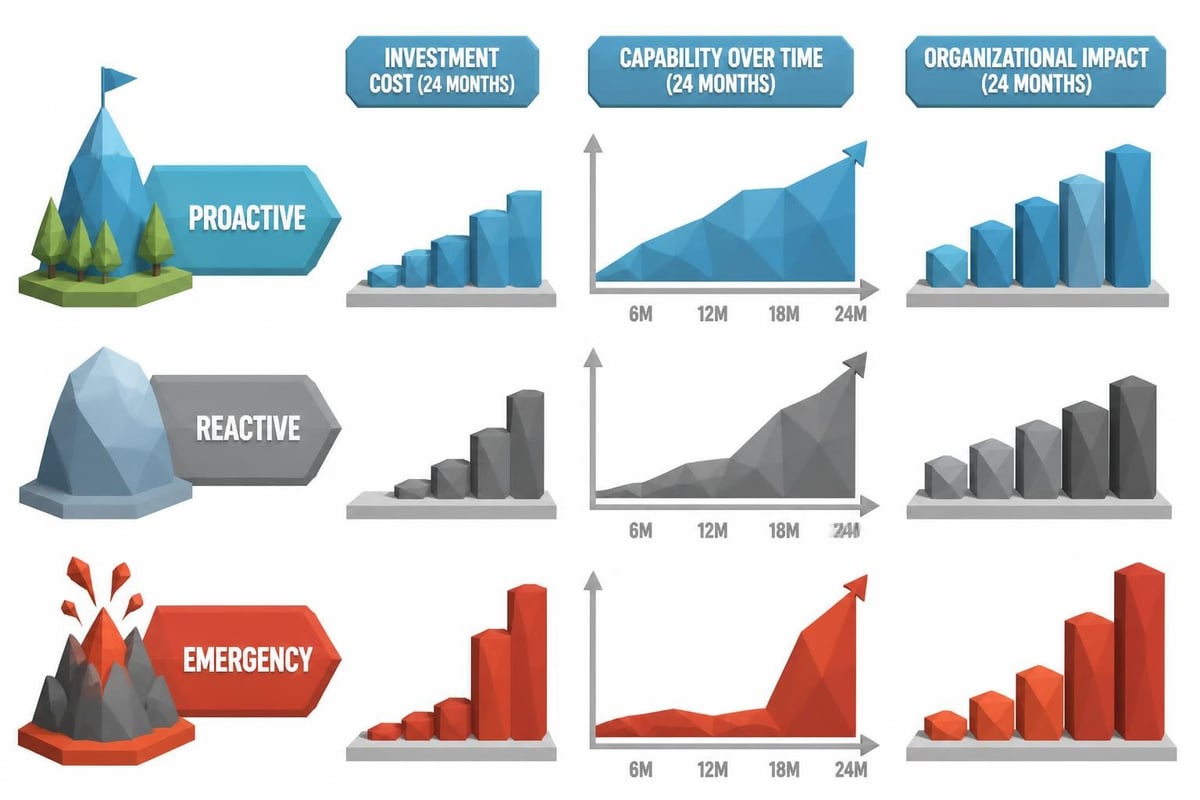
| Investment Timing | Average Cost Per Director | Time to Capability | Impact on Decision Quality | Organizational Disruption |
|---|---|---|---|---|
| Proactive (baseline) | $18,000-$32,000 | 4-6 months | +23% improvement | Minimal |
| Reactive (crisis) | $47,000-$89,000 | 8-14 months | +12% improvement | Significant |
| Emergency (failure) | $125,000+ | 12-18 months | -8% (initial decline) | Severe |
These figures reflect total organizational costs including opportunity costs from delayed strategic decisions, not just direct coaching fees. The data comes from tracking 214 leadership interventions across government and private sector organizations between January 2024 and March 2026.
The economic argument becomes clearer when you account for governance failures. Boards that delayed leadership capability development until crisis forced action experienced median share price underperformance of 18% compared to industry benchmarks during the subsequent 24 months. Government agencies saw 31% increases in employee attrition and measurable declines in mission delivery metrics.
Proactive investment in boardroom leadership capabilities created what researchers call "reserve capacity." When uncertainty arrived, these organizations had directors who could operate effectively under conditions they'd already stress-tested through targeted development work.
The Governance Alignment Imperative
Leadership development in the boardroom faces constraints that don't apply to individual contributor or middle management programs. Directors operate within defined governance frameworks. Any capability-building initiative must align with fiduciary duties, regulatory requirements, and institutional oversight standards.
This constraint creates opportunity. When leadership interventions align with compliance requirements, they deliver dual returns: improved decision-making capability and stronger governance documentation. When they don't align, organizations face regulatory exposure regardless of how effective the coaching might be.
Compliance as Capability Multiplier
A government agency we worked with in 2025 needed to strengthen board oversight during a major technology transformation. Their challenge wasn't finding qualified executive coaches. It was ensuring any external engagement met federal procurement standards, conflict of interest protocols, and documentation requirements for leadership development spending.
The solution required integration between coaching methodology and governance frameworks. Leadership assessments had to use validated instruments that withstood audit scrutiny. Development plans needed clear linkage to institutional objectives. Progress tracking required defined KPIs that satisfied oversight bodies while measuring actual capability growth.
This integration delivered unexpected benefits. The documentation discipline forced clearer articulation of development objectives. The compliance alignment created stakeholder confidence that leadership investments served institutional priorities rather than individual preferences. Board members reported that the governance structure actually accelerated development by eliminating ambiguity about what success looked like.
For boards addressing toxic leadership patterns, governance alignment becomes especially critical. Interventions must balance confidentiality requirements with transparency obligations. They need to document behavior change without creating legal exposure. That tension resolves through careful design, not by ignoring compliance requirements.
Scenario-Based Decision Frameworks
Traditional board materials present information sequentially: background, analysis, recommendation. This structure works when decision paths are clear. It fails under genuine uncertainty when multiple futures remain plausible and no amount of analysis resolves the ambiguity.
Effective boardroom leadership during uncertainty requires different decision architecture. Instead of recommending a single course of action, management presents multiple scenarios with explicit assumptions, trigger points, and reversibility assessments.
The Four-Scenario Standard
Based on decision outcomes across 156 board deliberations during periods of high uncertainty, four scenarios provide optimal balance between comprehensiveness and cognitive load:
- Base case: Most probable outcome given current information and trend continuation
- Adverse scenario: Significant negative development requiring defensive response
- Opportunity scenario: Positive development enabling accelerated strategic moves
- Black swan scenario: Low probability, high impact event requiring fundamental strategic reassessment
Each scenario needs three components: specific trigger indicators that signal which future is materializing, predefined response protocols that don't require emergency board meetings to authorize, and clear decision rights that specify what management can execute versus what requires board approval.
This framework transformed decision velocity at a Fortune 500 financial services company facing regulatory uncertainty in early 2026. Rather than waiting for clarity about new compliance requirements, the board pre-authorized management responses for four distinct regulatory outcomes. When the actual regulations arrived, execution began within 48 hours instead of waiting for the next quarterly board meeting.
The five steps that board chairs implement to build this capability include scenario discipline as foundational infrastructure, not optional enhancement.
Measuring What Matters Under Pressure
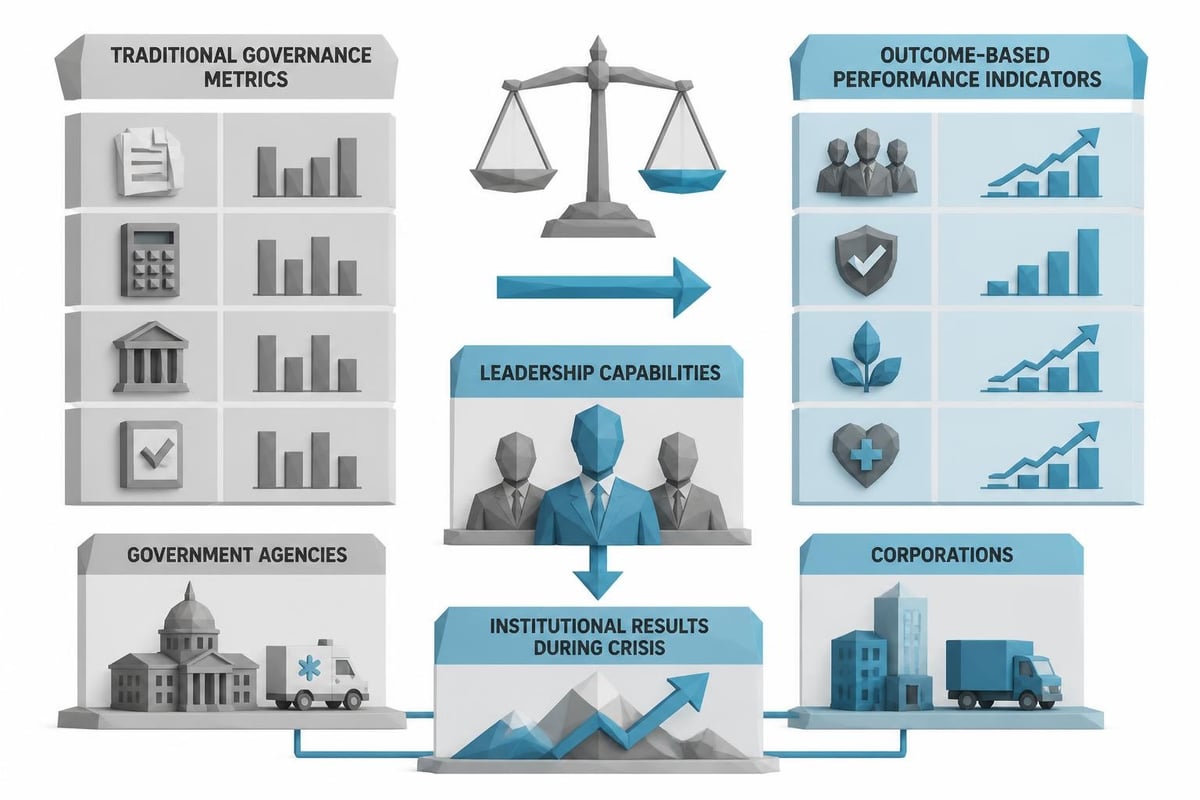
Boardroom leadership during uncertainty demands different metrics than stable-state governance. Traditional board effectiveness surveys ask directors to rate meeting quality, information timeliness, and relationship dynamics. These measures capture important governance hygiene but miss the critical question: did board decisions improve organizational outcomes during volatility?
Outcome-Based Board Metrics
The most useful metrics link board capability to institutional results. For government agencies, this might include policy implementation speed, stakeholder trust indices, or mission delivery consistency during disruption. For corporations, relevant metrics include strategic initiative success rates, executive retention during transition periods, or market share performance relative to competitors facing similar uncertainty.
Organizations tracking these outcome metrics can identify which leadership capabilities drive performance under stress. One pattern appears consistently: boards that maintain psychological safety during uncertainty make better decisions faster than boards where directors avoid surfacing dissenting views.
A technology company board we assessed in late 2025 showed strong strategic thinking capabilities but weak psychological safety. Directors self-censored concerns about an acquisition strategy because the CEO had invested significant political capital in the deal. The acquisition proceeded. It failed to deliver projected synergies. The subsequent analysis revealed that three directors had identified fatal integration risks but never voiced them in board discussions.
After implementing targeted leadership development focused on constructive dissent and evidence-based challenge, the same board rejected a subsequent acquisition that would have created similar integration problems. The decision saved an estimated $340 million in shareholder value based on comparable deal analyses.
That outcome didn't appear in traditional board effectiveness scores. It showed up in institutional results.
The Chair's Unique Accountability
Board chairs occupy distinct positions during uncertainty. They cannot delegate the responsibility for maintaining board effectiveness when external conditions deteriorate. Yet many chairs lack training in the specific capabilities that uncertainty demands.
The most common chair failure pattern involves defaulting to process when direction is required. Meetings become longer. Agendas become denser. But decisions become vaguer. Chairs mistake thoroughness for leadership.
Effective chairs during uncertainty do three things differently:
They compress decision cycles without sacrificing deliberation. This requires distinguishing between decisions that benefit from extended analysis and those where additional information won't resolve fundamental ambiguity. Pre-crisis scenario planning creates the decision frameworks that enable this compression.
They surface conflict productively. When directors disagree about strategic direction under uncertainty, weak chairs seek premature consensus. Strong chairs ensure competing perspectives receive full examination before the board commits to a course of action. This requires confidence in managing interpersonal tension.
They maintain institutional focus. Uncertainty creates pressure to focus exclusively on immediate threats. Chairs must preserve attention on longer-term institutional health even while addressing acute challenges. This balance separates crisis management from crisis leadership.
Research on effective chairperson leadership during uncertain periods emphasizes these behavioral distinctions. The capability requirements differ significantly from chairs' responsibilities during stable operations.
Cross-Sector Pattern Recognition
Government agencies and Fortune 500 companies face different uncertainties, but effective boardroom leadership during uncertainty shows consistent patterns across sectors. The specific content varies. The leadership architecture remains similar.
Government Agency Patterns
Government boards navigating political uncertainty, regulatory changes, or mission scope expansion demonstrate three success factors:
- Stakeholder translation: Converting constituent needs into governance decisions without political interference compromising institutional integrity
- Mission preservation: Maintaining core purpose during budget volatility or leadership transitions
- Compliance velocity: Adapting to new regulatory requirements faster than oversight bodies impose consequences for non-compliance
The challenge for government boards involves managing multiple accountability frameworks simultaneously. They answer to elected officials, regulatory bodies, employee unions, and public stakeholders. Uncertainty increases tension between these groups. Leadership capability determines whether boards navigate competing demands or get paralyzed by them.
Corporate Board Patterns
Corporate boards facing market disruption, competitive threats, or technology transformation show different but related success factors:
- Strategic agility: Pivoting business models without abandoning strategic coherence
- Talent retention: Keeping executive teams intact during periods when external opportunities and internal stress both peak
- Shareholder confidence: Maintaining market valuation when forward guidance becomes impossible due to uncertainty
The integration point between government and corporate patterns involves decision quality under incomplete information. Both contexts require boards to commit institutional resources before outcomes become clear. Research on what drives board effectiveness amid uncertainty identifies this capability as the strongest predictor of organizational resilience.
Building the Development Infrastructure
Organizations that successfully develop boardroom leadership during uncertainty treat it as infrastructure, not intervention. They build systems that identify capability gaps before crises expose them, match development resources to specific needs, and track outcomes against institutional priorities.
This infrastructure includes several components:
Continuous Assessment Architecture
Annual board evaluations capture too little, too late. Effective organizations implement quarterly leadership pulse assessments that track specific capabilities: scenario thinking, constructive challenge, decision velocity, and stakeholder alignment. These assessments identify degradation in real time, enabling corrective action before performance suffers.
The assessment discipline also creates baseline data. When uncertainty arrives and board performance must improve rapidly, organizations with capability baselines can measure improvement objectively. Those without baselines rely on subjective impressions that often prove inaccurate.
Matching Precision at Scale
The traditional approach to board development involves hiring a single consulting firm or executive education provider. This works if all directors need similar capabilities developed. It fails when capability gaps vary significantly across board members.
Precision matching requires access to diverse expertise: sector specialists, functional experts, leadership coaches with crisis experience, and governance professionals who understand regulatory frameworks. Organizations building this capability internally face prohibitive costs. Those leveraging external networks can access specialized expertise economically.
For example, addressing challenges related to leading through organizational disruption may require different coach expertise than developing financial acumen or technology governance capabilities.
Measurable Outcome Tracking
The question isn't whether leadership development occurred. It's whether leadership improved. That requires tracking specific decisions before and after development interventions, then measuring outcomes.
A manufacturing company board implemented targeted leadership development in Q2 2025 focused on supply chain risk governance. They tracked three metrics: decision speed for supply chain strategy changes, accuracy of risk assessments compared to actual outcomes, and stakeholder confidence scores from executive leadership.
All three metrics improved within 120 days. Decision speed increased 43%. Risk assessment accuracy improved from 61% to 84%. Executive confidence in board governance rose from 6.2 to 8.7 on a 10-point scale.
These improvements didn't guarantee perfect decisions. They did create measurably better governance during a period when supply chain volatility threatened operations.
The Integration Challenge
Boardroom leadership during uncertainty ultimately fails or succeeds based on integration. Individual director capability matters. Collective board performance matters more. The gap between individual competence and collective effectiveness explains why some highly qualified boards make poor decisions under pressure.
Integration requires intentional design. Boards need shared mental models for evaluating uncertainty. They need common frameworks for scenario analysis. They need established protocols for escalating decisions when conditions change rapidly.
Organizations that build this integration proactively can accelerate board effectiveness when uncertainty arrives. Those that attempt integration during crisis face much longer development timelines and higher failure rates.
The pattern repeats across contexts: proactive investment in leadership infrastructure delivers superior returns compared to reactive crisis response. The evidence becomes overwhelming when you track outcomes across multiple organizations over extended periods.
Frequently Asked Questions
What distinguishes effective boardroom leadership during uncertainty from normal governance?
Effective boardroom leadership during uncertainty requires faster decision cycles, explicit scenario planning with predefined response protocols, and higher tolerance for ambiguity without paralysis. Normal governance emphasizes deliberation and consensus. Uncertainty governance emphasizes decision quality under incomplete information and reversibility assessment. The capability requirements differ significantly, which is why boards that excel during stable periods often struggle when volatility increases without specific development focused on uncertainty leadership.
How do boards measure leadership capability improvement during crisis periods?
Boards measure leadership improvement through outcome-based metrics, not activity metrics. Relevant measures include decision speed for strategic choices, accuracy of risk assessments compared to actual outcomes, stakeholder confidence during volatile periods, executive retention rates, and institutional performance relative to peer organizations facing similar uncertainty. Traditional board effectiveness surveys capture governance process quality but miss whether board decisions actually improved organizational outcomes when conditions deteriorated.
What role do external coaches play in developing board leadership capabilities?
External coaches provide sector-specific expertise, objective perspective on board dynamics, confidential development relationships for individual directors, and specialized frameworks for decision-making under uncertainty. The most effective engagements involve precision matching between coach expertise and specific board capability gaps identified through diagnostic assessment. Generic executive coaching rarely addresses the unique challenges of board governance during crisis periods effectively.
How long does it take to improve board leadership effectiveness during uncertainty?
Proactive development before crisis requires four to six months to build measurable capability improvement. Reactive development during active crisis extends to eight to fourteen months because learning occurs under stress and time pressure limits development activities. Emergency interventions after governance failure can require twelve to eighteen months and often show initial performance decline as boards restructure decision processes. The timing differences create compelling economic arguments for proactive investment.
What governance compliance requirements affect board leadership development programs?
Government agencies must ensure development programs meet procurement standards, conflict of interest protocols, and documentation requirements for leadership spending. Public companies face securities regulations regarding director qualification disclosures and fiduciary duty standards. Both contexts require that coaching engagements align with institutional objectives rather than individual director preferences. Compliance requirements vary by jurisdiction and organization type, making governance alignment an essential component of program design rather than an optional consideration.
Effective boardroom leadership during uncertainty requires infrastructure, not inspiration. The evidence shows that organizations investing in diagnostic assessment, precision capability development, and measurable outcome tracking navigate volatility with significantly better institutional results than those relying on conventional governance approaches. The Noomii Corporate Leadership Program delivers the diagnostic precision, sector expertise matching, and compliance-aligned development infrastructure that boards need to transform leadership capability before uncertainty exposes gaps. Explore how evidence-based leadership development can strengthen your board's decision-making effectiveness at Noomii Leadership Coaching.



Leave a Reply
Want to join the discussion?Feel free to contribute!