

AI Is Exposing Weak Leaders: What It Reveals in 2026
The arrival of generative AI in enterprise environments has created an unexpected consequence: it’s functioning as an X-ray machine for leadership competence. Over the past eighteen months, organizations implementing AI tools have discovered that technology adoption failures rarely stem from the technology itself. Instead, AI is exposing weak leaders by revealing the decision-making vacuums, accountability gaps, and cultural dysfunctions that existed all along but remained hidden behind bureaucratic complexity and information asymmetry. What boards and CHROs are discovering is uncomfortable but actionable: the same executives who struggle with AI adoption are often the ones creating bottlenecks across the organization.
The Information Advantage Has Collapsed
For decades, senior leaders maintained positional power through exclusive access to information. They controlled what reached their teams, how data flowed upward, and which insights shaped decisions. AI has obliterated this advantage overnight.
The Arrival of Generative AI: The Ultimate Leadership X-Ray Machine
The arrival of generative AI in enterprise environments has created an unexpected consequence: it’s functioning as an X-ray machine for leadership competence. Over the past eighteen months, organizations implementing AI tools have discovered that technology adoption failures rarely stem from the technology itself. Instead, AI is exposing weak leaders by revealing the decision-making vacuums, accountability gaps, and cultural dysfunctions that existed all along but remained hidden behind bureaucratic complexity and information asymmetry. What boards and CHROs are discovering is uncomfortable but actionable: the same executives who struggle with AI adoption are often the ones creating bottlenecks across the organization.
The Information Advantage Has Collapsed
For decades, senior leaders maintained positional power through exclusive access to information. They controlled what reached their teams, how data flowed upward, and which insights shaped decisions. AI has obliterated this advantage overnight.
When teams can query company data directly, generate market analysis independently, and access institutional knowledge without executive gatekeepers, the leader’s role transforms fundamentally. Leaders who relied on information control rather than judgment quality now face a competence crisis they cannot hide.
What Gets Revealed When Information Democratizes
The shift exposes three critical leadership deficits:
- Inability to make trade-off decisions: When everyone has the same data, leaders must actually choose between competing priorities rather than delaying under the guise of “gathering more information.”
- Lack of strategic judgment: Access to insights doesn’t equal knowing what matters, and weak leaders demonstrate they never developed this muscle.
- Absence of decision frameworks: Without proprietary processes for evaluation, leaders default to consensus-seeking that stalls execution.
Organizations deploying AI assistants across management layers report a consistent pattern: high-performing leaders accelerate because they already possessed strong judgment frameworks, while struggling executives become more visible obstacles as their teams bypass them for faster decision support.
Broken Processes Surface Immediately
AI implementation functions as an organizational stress test. A Fortune 500 client recently rolled out an AI tool designed to streamline contract reviews across legal, procurement, and business units. Within three weeks, the project stalled completely.
The problem wasn’t the technology. The AI worked exactly as designed. What it exposed was that nobody actually owned the contract approval process. Legal thought procurement had final authority. Procurement believed business unit leaders made the call. Business units assumed legal held veto power.
For years, this ambiguity had been masked by manual workflows, informal hallway conversations, and individual workarounds. People figured it out case by case. AI removed that cushion and revealed the leadership vacuum underneath.
The Accountability Test
When processes break down during AI adoption, the pattern reveals which leaders have actually built functioning systems versus those who’ve been coasting on talented individuals compensating for organizational dysfunction.
| Leadership Response | What It Signals | Organizational Outcome |
|---|---|---|
| “Let’s form a committee to study this” | Avoidance of ownership | Project delays, team frustration |
| “I’ll decide by Friday, here’s the framework” | Clear accountability | Rapid iteration, momentum |
| “This is too complex for AI right now” | Fear of exposure | Competitive disadvantage |
| “What’s broken in our process that AI revealed?” | Diagnostic thinking | Structural improvement |
The most capable executives treat AI failures as diagnostic gold. They ask what the breakdown reveals about decision rights, workflow design, and organizational clarity. Weak leaders blame the technology, request more vendor demos, or create working groups that produce nothing.
Decision Hesitation Becomes Visible
Before AI, indecisive leaders could hide behind lengthy analysis cycles, endless stakeholder meetings, and the fiction that perfect information was just one more report away. AI is exposing weak leaders by eliminating these excuses and revealing hesitation for what it is: an inability to manage uncertainty and accountability.
A government agency implementing AI for citizen service requests discovered their middle management layer was the bottleneck. The AI correctly categorized 94% of requests and routed them to appropriate departments. But requests sat in management queues for an average of eight days because supervisors wouldn’t commit to action without executive sign-off on edge cases.
The irony? Executives had already delegated this authority. Managers simply never exercised it because the organization had normalized decision avoidance as a risk-mitigation strategy.
The Speed Differential
Organizations with decisive leadership cultures are pulling away from competitors at an accelerating rate. When AI surfaces an opportunity or flags a risk, strong leaders:
- Establish decision criteria in advance
- Assign clear ownership with authority boundaries
- Set decision deadlines measured in days, not weeks
- Accept that 80% certainty with speed beats 95% certainty with delay
- Learn from outcomes rather than punishing reasonable mistakes
Weak leaders do the opposite. They treat every AI insight as requiring perfect certainty before action, create decision-making processes that diffuse accountability across multiple stakeholders, and optimize for avoiding blame rather than capturing value.
The performance gap is measurable. Companies in the top quartile of decision effectiveness are seeing 40% faster AI implementation cycles and 3x higher ROI on automation investments compared to bottom-quartile peers.
Toxic Patterns Can No Longer Hide
AI is exposing weak leaders by making toxic leadership behaviors impossible to disguise. When systems create transparency, leaders who rely on control through fear, information hoarding, or credit theft find themselves operating in hostile territory.
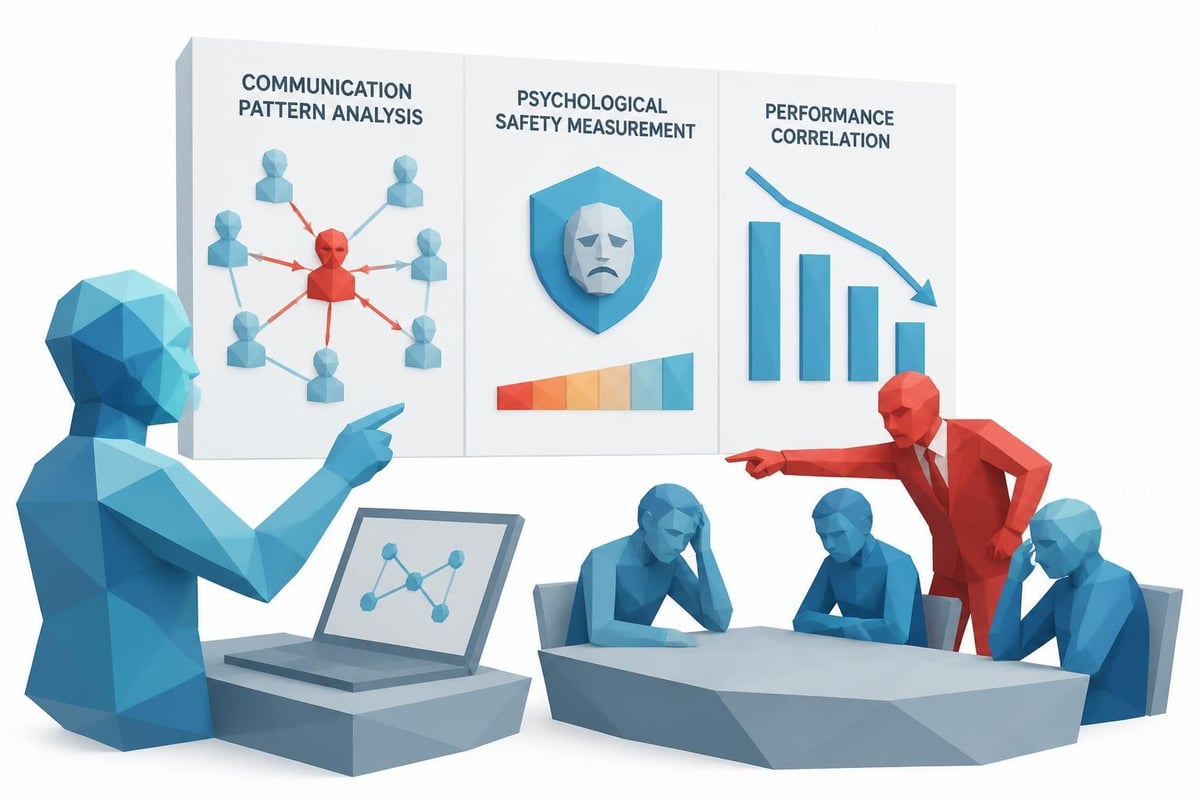
Consider feedback mechanisms. AI-powered pulse surveys, sentiment analysis of communication patterns, and automated 360-degree assessments make it harder for toxic leaders to maintain the gap between their self-perception and their actual impact. A manufacturing company recently discovered through AI analysis of Slack communications that their highest-performing plant had the lowest psychological safety scores, directly correlated with one executive’s communication style.
The Transparency Dilemma
Leaders who built careers on taking credit for team successes while deflecting accountability for failures face a new reality. AI systems that track contribution, decision-making, and outcomes create an evidence trail that’s difficult to manipulate.
Behaviors that AI illuminates:
- Bottlenecking: When one leader consistently delays decisions that could be made at lower levels
- Credit theft: Attribution analysis shows who generated insights versus who presented them
- Inconsistent standards: Pattern recognition reveals when rules apply selectively based on relationships
- Information hoarding: Access logs demonstrate who restricts data flow without justification
The organizations addressing these patterns proactively are implementing evidence-based leadership diagnostics that identify behavioral gaps before they become cultural crises. The ones ignoring the signals are watching talent leave for competitors who’ve created healthier environments.
The Capability Development Gap
Perhaps the most significant way AI is exposing weak leaders is by revealing that many organizations have treated leadership development as a checkbox exercise rather than capability building. Research shows AI project failures are fundamentally organizational learning problems, not technology deficits.
A financial services firm invested $12 million in AI tools for their wealth management division. Eighteen months later, adoption sat at 23% and ROI was negative. The post-mortem revealed the real issue: executives hadn’t developed the capabilities to lead in an AI-augmented environment.
They didn’t know how to:
- Redesign workflows around AI capabilities
- Coach teams through automation anxiety
- Evaluate AI outputs for quality and bias
- Make build-versus-buy decisions for AI tools
- Create governance frameworks for AI usage
These weren’t technology skills. These were leadership capabilities that required new mental models, judgment frameworks, and organizational design thinking. The executives who succeeded had invested in developing these competencies. The ones who failed had assumed their existing leadership approaches would translate automatically.
The Learning Velocity Problem
The pace of AI advancement means leadership capability gaps compound quickly. An executive who was adequate in 2024 becomes a liability in 2026 if they haven’t continuously developed their capacity to work with these systems.
Organizations are discovering they need leaders who can:
- Rapidly prototype new processes without waiting for perfect planning
- Experiment with AI applications and learn from failures publicly
- Translate technical capabilities into business value
- Navigate the ethical complexities of automation decisions
- Build trust in environments where change is constant
These capabilities don’t emerge from traditional leadership training. They require immersive experience, structured reflection, and often external coaching focused on adaptive leadership rather than conventional management skills.
What High-Performing Leaders Do Differently
The executives thriving in AI-enabled environments share identifiable patterns that separate them from struggling peers. These aren’t theoretical best practices but observed behaviors from organizations successfully navigating this transition.
They establish decision rights explicitly. Before implementing any AI system, effective leaders map decision authority, create escalation criteria, and document who owns what. They eliminate the ambiguity that AI exposes.
They build feedback loops into everything. Rather than treating AI as a deployment project, strong leaders create continuous learning systems. They establish metrics, review outcomes weekly, and adjust based on evidence rather than opinions.
They normalize intelligent failure. Organizations led by capable executives treat AI experiments as learning opportunities. They distinguish between failures from poor execution (unacceptable) and failures from testing new approaches (valuable data).
They invest in their own development. The best leaders recognize they don’t have all the answers and actively seek coaching, peer learning, and external perspectives. They understand that leadership development isn’t a destination but an ongoing capability-building process.
The Board-Level Conversation That’s Not Happening
Most boards are asking the wrong questions about AI. They want to know about cybersecurity risks, compliance frameworks, and competitive positioning. These matter, but they miss the fundamental issue: AI is exposing weak leaders throughout the management ranks, and board-level leadership assessment processes haven’t caught up.
Boards should be asking:
- Which executives are accelerating with AI access versus slowing down?
- What does our AI adoption pattern reveal about decision-making effectiveness across business units?
- Are we developing leadership capabilities at the pace our AI strategy requires?
- What toxic patterns are our new transparency tools revealing that we’ve been ignoring?
The honest answers to these questions are often uncomfortable. They reveal that some C-suite executives who looked effective in slower, less transparent environments lack the capabilities needed now. They expose that succession planning hasn’t accounted for AI-era leadership requirements. They demonstrate that psychological safety at work is lower than leaders claim because people are afraid to surface what AI is revealing.
The Succession Planning Blind Spot
Traditional executive assessment focuses on past performance, industry relationships, and strategic vision. These still matter, but they’re insufficient indicators of who will succeed in AI-augmented environments.
The executives positioned for advancement now demonstrate:
- Adaptive decision-making: They change their minds when evidence shifts
- Transparency comfort: They operate effectively when their decisions are visible
- Capability humility: They acknowledge skill gaps and invest in closing them
- Systems thinking: They see how AI reveals organizational design problems, not just automates tasks
- Ethical judgment: They navigate the complex trade-offs AI enables without defaulting to what’s easy
Boards conducting succession planning without evaluating candidates against these criteria are selecting for yesterday’s leadership requirements.
The CHRO’s Diagnostic Opportunity
Chief Human Resources Officers are sitting on the most valuable dataset for understanding how AI is exposing weak leaders: the patterns emerging from implementation projects, engagement surveys, exit interviews, and performance data.
Smart CHROs are connecting these dots to answer critical questions:
- Where are our leadership gaps most acute? By mapping AI adoption success rates against business units and leaders, patterns emerge quickly. The divisions struggling aren’t failing because of technology complexity. They’re failing because of leadership inadequacy.
- Who needs immediate intervention? Some executives can develop the capabilities they’re missing with targeted coaching. Others can’t or won’t. Early identification determines whether intervention happens before or after expensive failures.
- What’s our leadership pipeline reality? If AI is exposing weaknesses in current leaders, what does that suggest about the readiness of their successors? Often the answer is sobering: organizations have been promoting people who excelled at navigating broken systems rather than fixing them.
- How do we accelerate capability development? The CHROs making progress are implementing structured leadership development that addresses AI-era requirements specifically, not generic management training with AI content added as an afterthought.
The organizations making this diagnostic work actionable are those partnering with executive coaching focused on measurable behavioral change, not feel-good development experiences that check boxes without building capabilities.
Frequently Asked Questions
Why does AI expose leadership weaknesses more than other technologies?
AI exposes leadership weaknesses because it democratizes information access, automates routine decision support, and creates transparency around who actually adds value versus who simply controls access to resources. Previous technologies typically enhanced existing workflows without fundamentally challenging power structures. AI eliminates information asymmetry and reveals whether leaders possess genuine judgment capabilities or just positional authority.
How can organizations identify which leaders will struggle with AI adoption before it becomes a crisis?
Organizations can identify at-risk leaders by evaluating three indicators: decision velocity (how quickly they make choices when given adequate information), transparency comfort (whether they operate effectively when their decisions are visible to broader teams), and learning agility (whether they actively develop new capabilities or rely solely on existing experience). Leaders weak in these areas will struggle as AI implementation accelerates regardless of their past performance.
What’s the most common leadership failure pattern during AI implementation?
The most common failure pattern is treating AI as a technology deployment rather than an organizational design challenge. Weak leaders focus on vendor selection, feature comparisons, and technical specifications while avoiding the harder work of clarifying decision rights, redesigning workflows, building team capabilities, and establishing governance frameworks. This results in technically successful implementations that deliver no business value because the organizational context wasn’t prepared.
Can leaders who struggle initially with AI adoption develop the necessary capabilities?
Some can, others cannot. The differentiator is whether the struggle stems from skill gaps (teachable) or fundamental leadership deficits like inability to handle accountability, resistance to transparency, or unwillingness to make decisions under uncertainty. Leaders demonstrating genuine curiosity, actively seeking coaching, and making visible capability investments typically succeed. Those defending current approaches, blaming technology or teams, and avoiding development opportunities rarely improve regardless of intervention intensity.
What should boards do when AI reveals significant leadership weaknesses in the C-suite?
Boards should conduct honest capability assessments against AI-era leadership requirements, establish clear development timelines with measurable milestones, and make succession decisions based on evidence rather than tenure or past performance. The worst response is hoping the problem resolves itself. AI adoption accelerates, competitive pressure increases, and leadership gaps compound quickly. Boards that act decisively on what AI reveals about executive capability typically see improved organizational performance within 12-18 months.
AI is not creating leadership problems but it is making them impossible to ignore. Organizations that treat these revelations as diagnostic opportunities rather than threats will build competitive advantages through stronger decision-making cultures, clearer accountability structures, and more capable leadership at every level. The Noomii Corporate Leadership Program helps organizations translate what AI exposes into measurable leadership improvement through evidence-based diagnostics, precision coach matching, and targeted interventions that address specific capability gaps. If your organization needs to strengthen leadership effectiveness as AI reveals where you’re vulnerable, Noomii Leadership Coaching delivers the structured approach and measurable results that boards and CHROs require.
When teams can query company data directly, generate market analysis independently, and access institutional knowledge without executive gatekeepers, the leader’s role transforms fundamentally. Leaders who relied on information control rather than judgment quality now face a competence crisis they cannot hide.
What Gets Revealed When Information Democratizes
The shift exposes three critical leadership deficits:
- Inability to make trade-off decisions: When everyone has the same data, leaders must actually choose between competing priorities rather than delaying under the guise of “gathering more information”
- Lack of strategic judgment: Access to insights doesn’t equal knowing what matters, and weak leaders demonstrate they never developed this muscle
- Absence of decision frameworks: Without proprietary processes for evaluation, leaders default to consensus-seeking that stalls execution
Organizations deploying AI assistants across management layers report a consistent pattern: high-performing leaders accelerate because they already possessed strong judgment frameworks, while struggling executives become more visible obstacles as their teams bypass them for faster decision support.

Broken Processes Surface Immediately
AI implementation functions as an organizational stress test. A Fortune 500 client recently rolled out an AI tool designed to streamline contract reviews across legal, procurement, and business units. Within three weeks, the project stalled completely.
The problem wasn’t the technology. The AI worked exactly as designed. What it exposed was that nobody actually owned the contract approval process. Legal thought procurement had final authority. Procurement believed business unit leaders made the call. Business units assumed legal held veto power.
For years, this ambiguity had been masked by manual workflows, informal hallway conversations, and individual workarounds. People figured it out case by case. AI removed that cushion and revealed the leadership vacuum underneath.
The Accountability Test
When processes break down during AI adoption, the pattern reveals which leaders have actually built functioning systems versus those who’ve been coasting on talented individuals compensating for organizational dysfunction.
| Leadership Response | What It Signals | Organizational Outcome |
|---|---|---|
| “Let’s form a committee to study this” | Avoidance of ownership | Project delays, team frustration |
| “I’ll decide by Friday, here’s the framework” | Clear accountability | Rapid iteration, momentum |
| “This is too complex for AI right now” | Fear of exposure | Competitive disadvantage |
| “What’s broken in our process that AI revealed?” | Diagnostic thinking | Structural improvement |
The most capable executives treat AI failures as diagnostic gold. They ask what the breakdown reveals about decision rights, workflow design, and organizational clarity. Weak leaders blame the technology, request more vendor demos, or create working groups that produce nothing.
Decision Hesitation Becomes Visible
Before AI, indecisive leaders could hide behind lengthy analysis cycles, endless stakeholder meetings, and the fiction that perfect information was just one more report away. AI is exposing weak leaders by eliminating these excuses and revealing hesitation for what it is: an inability to manage uncertainty and accountability.
A government agency implementing AI for citizen service requests discovered their middle management layer was the bottleneck. The AI correctly categorized 94% of requests and routed them to appropriate departments. But requests sat in management queues for an average of eight days because supervisors wouldn’t commit to action without executive sign-off on edge cases.
The irony? Executives had already delegated this authority. Managers simply never exercised it because the organization had normalized decision avoidance as a risk-mitigation strategy.
The Speed Differential
Organizations with decisive leadership cultures are pulling away from competitors at an accelerating rate. When AI surfaces an opportunity or flags a risk, strong leaders:
- Establish decision criteria in advance
- Assign clear ownership with authority boundaries
- Set decision deadlines measured in days, not weeks
- Accept that 80% certainty with speed beats 95% certainty with delay
- Learn from outcomes rather than punishing reasonable mistakes
Weak leaders do the opposite. They treat every AI insight as requiring perfect certainty before action, create decision-making processes that diffuse accountability across multiple stakeholders, and optimize for avoiding blame rather than capturing value.
The performance gap is measurable. Companies in the top quartile of decision effectiveness are seeing 40% faster AI implementation cycles and 3x higher ROI on automation investments compared to bottom-quartile peers.
Toxic Patterns Can No Longer Hide
AI is exposing weak leaders by making toxic leadership behaviors impossible to disguise. When systems create transparency, leaders who rely on control through fear, information hoarding, or credit theft find themselves operating in hostile territory.
Consider feedback mechanisms. AI-powered pulse surveys, sentiment analysis of communication patterns, and automated 360-degree assessments make it harder for toxic leaders to maintain the gap between their self-perception and their actual impact. A manufacturing company recently discovered through AI analysis of Slack communications that their highest-performing plant had the lowest psychological safety scores, directly correlated with one executive’s communication style.
The Transparency Dilemma
Leaders who built careers on taking credit for team successes while deflecting accountability for failures face a new reality. AI systems that track contribution, decision-making, and outcomes create an evidence trail that’s difficult to manipulate.
Behaviors that AI illuminates:
- Bottlenecking: When one leader consistently delays decisions that could be made at lower levels
- Credit theft: Attribution analysis shows who generated insights versus who presented them
- Inconsistent standards: Pattern recognition reveals when rules apply selectively based on relationships
- Information hoarding: Access logs demonstrate who restricts data flow without justification
The organizations addressing these patterns proactively are implementing evidence-based leadership diagnostics that identify behavioral gaps before they become cultural crises. The ones ignoring the signals are watching talent leave for competitors who’ve created healthier environments.
The Capability Development Gap
Perhaps the most significant way AI is exposing weak leaders is by revealing that many organizations have treated leadership development as a checkbox exercise rather than capability building. Research shows AI project failures are fundamentally organizational learning problems, not technology deficits.
A financial services firm invested $12 million in AI tools for their wealth management division. Eighteen months later, adoption sat at 23% and ROI was negative. The post-mortem revealed the real issue: executives hadn’t developed the capabilities to lead in an AI-augmented environment.
They didn’t know how to:
- Redesign workflows around AI capabilities
- Coach teams through automation anxiety
- Evaluate AI outputs for quality and bias
- Make build-versus-buy decisions for AI tools
- Create governance frameworks for AI usage
These weren’t technology skills. These were leadership capabilities that required new mental models, judgment frameworks, and organizational design thinking. The executives who succeeded had invested in developing these competencies. The ones who failed had assumed their existing leadership approaches would translate automatically.
The Learning Velocity Problem
The pace of AI advancement means leadership capability gaps compound quickly. An executive who was adequate in 2024 becomes a liability in 2026 if they haven’t continuously developed their capacity to work with these systems.
Organizations are discovering they need leaders who can:
- Rapidly prototype new processes without waiting for perfect planning
- Experiment with AI applications and learn from failures publicly
- Translate technical capabilities into business value
- Navigate the ethical complexities of automation decisions
- Build trust in environments where change is constant
These capabilities don’t emerge from traditional leadership training. They require immersive experience, structured reflection, and often external coaching focused on adaptive leadership rather than conventional management skills.
What High-Performing Leaders Do Differently
The executives thriving in AI-enabled environments share identifiable patterns that separate them from struggling peers. These aren’t theoretical best practices but observed behaviors from organizations successfully navigating this transition.
They establish decision rights explicitly. Before implementing any AI system, effective leaders map decision authority, create escalation criteria, and document who owns what. They eliminate the ambiguity that AI exposes.
They build feedback loops into everything. Rather than treating AI as a deployment project, strong leaders create continuous learning systems. They establish metrics, review outcomes weekly, and adjust based on evidence rather than opinions.
They normalize intelligent failure. Organizations led by capable executives treat AI experiments as learning opportunities. They distinguish between failures from poor execution (unacceptable) and failures from testing new approaches (valuable data).
They invest in their own development. The best leaders recognize they don’t have all the answers and actively seek coaching, peer learning, and external perspectives. They understand that leadership development isn’t a destination but an ongoing capability-building process.

The Board-Level Conversation That’s Not Happening
Most boards are asking the wrong questions about AI. They want to know about cybersecurity risks, compliance frameworks, and competitive positioning. These matter, but they miss the fundamental issue: AI is exposing weak leaders throughout the management ranks, and board-level leadership assessment processes haven’t caught up.
Boards should be asking:
- Which executives are accelerating with AI access versus slowing down?
- What does our AI adoption pattern reveal about decision-making effectiveness across business units?
- Are we developing leadership capabilities at the pace our AI strategy requires?
- What toxic patterns are our new transparency tools revealing that we’ve been ignoring?
The honest answers to these questions are often uncomfortable. They reveal that some C-suite executives who looked effective in slower, less transparent environments lack the capabilities needed now. They expose that succession planning hasn’t accounted for AI-era leadership requirements. They demonstrate that psychological safety at work is lower than leaders claim because people are afraid to surface what AI is revealing.
The Succession Planning Blind Spot
Traditional executive assessment focuses on past performance, industry relationships, and strategic vision. These still matter, but they’re insufficient indicators of who will succeed in AI-augmented environments.
The executives positioned for advancement now demonstrate:
- Adaptive decision-making: They change their minds when evidence shifts
- Transparency comfort: They operate effectively when their decisions are visible
- Capability humility: They acknowledge skill gaps and invest in closing them
- Systems thinking: They see how AI reveals organizational design problems, not just automates tasks
- Ethical judgment: They navigate the complex trade-offs AI enables without defaulting to what’s easy
Boards conducting succession planning without evaluating candidates against these criteria are selecting for yesterday’s leadership requirements.
The CHRO’s Diagnostic Opportunity
Chief Human Resources Officers are sitting on the most valuable dataset for understanding how AI is exposing weak leaders: the patterns emerging from implementation projects, engagement surveys, exit interviews, and performance data.
Smart CHROs are connecting these dots to answer critical questions:
Where are our leadership gaps most acute? By mapping AI adoption success rates against business units and leaders, patterns emerge quickly. The divisions struggling aren’t failing because of technology complexity. They’re failing because of leadership inadequacy.
Who needs immediate intervention? Some executives can develop the capabilities they’re missing with targeted coaching. Others can’t or won’t. Early identification determines whether intervention happens before or after expensive failures.
What’s our leadership pipeline reality? If AI is exposing weaknesses in current leaders, what does that suggest about the readiness of their successors? Often the answer is sobering: organizations have been promoting people who excelled at navigating broken systems rather than fixing them.
How do we accelerate capability development? The CHROs making progress are implementing structured leadership development that addresses AI-era requirements specifically, not generic management training with AI content added as an afterthought.
The organizations making this diagnostic work actionable are those partnering with executive coaching focused on measurable behavioral change, not feel-good development experiences that check boxes without building capabilities.
Frequently Asked Questions
Why does AI expose leadership weaknesses more than other technologies?
AI exposes leadership weaknesses because it democratizes information access, automates routine decision support, and creates transparency around who actually adds value versus who simply controls access to resources. Previous technologies typically enhanced existing workflows without fundamentally challenging power structures. AI eliminates information asymmetry and reveals whether leaders possess genuine judgment capabilities or just positional authority.
How can organizations identify which leaders will struggle with AI adoption before it becomes a crisis?
Organizations can identify at-risk leaders by evaluating three indicators: decision velocity (how quickly they make choices when given adequate information), transparency comfort (whether they operate effectively when their decisions are visible to broader teams), and learning agility (whether they actively develop new capabilities or rely solely on existing experience). Leaders weak in these areas will struggle as AI implementation accelerates regardless of their past performance.
What’s the most common leadership failure pattern during AI implementation?
The most common failure pattern is treating AI as a technology deployment rather than an organizational design challenge. Weak leaders focus on vendor selection, feature comparisons, and technical specifications while avoiding the harder work of clarifying decision rights, redesigning workflows, building team capabilities, and establishing governance frameworks. This results in technically successful implementations that deliver no business value because the organizational context wasn’t prepared.
Can leaders who struggle initially with AI adoption develop the necessary capabilities?
Some can, others cannot. The differentiator is whether the struggle stems from skill gaps (teachable) or fundamental leadership deficits like inability to handle accountability, resistance to transparency, or unwillingness to make decisions under uncertainty. Leaders demonstrating genuine curiosity, actively seeking coaching, and making visible capability investments typically succeed. Those defending current approaches, blaming technology or teams, and avoiding development opportunities rarely improve regardless of intervention intensity.
What should boards do when AI reveals significant leadership weaknesses in the C-suite?
Boards should conduct honest capability assessments against AI-era leadership requirements, establish clear development timelines with measurable milestones, and make succession decisions based on evidence rather than tenure or past performance. The worst response is hoping the problem resolves itself. AI adoption accelerates, competitive pressure increases, and leadership gaps compound quickly. Boards that act decisively on what AI reveals about executive capability typically see improved organizational performance within 12-18 months.
AI is not creating leadership problems but it is making them impossible to ignore. Organizations that treat these revelations as diagnostic opportunities rather than threats will build competitive advantages through stronger decision-making cultures, clearer accountability structures, and more capable leadership at every level. The Noomii Corporate Leadership Program helps organizations translate what AI exposes into measurable leadership improvement through evidence-based diagnostics, precision coach matching, and targeted interventions that address specific capability gaps. If your organization needs to strengthen leadership effectiveness as AI reveals where you’re vulnerable, Noomii Leadership Coaching delivers the structured approach and measurable results that boards and CHROs require.



Leave a Reply
Want to join the discussion?Feel free to contribute!