
Leadership Coaching Programs for Oil and Gas Teams
The best coaching programs for oil and gas leadership combine a baseline diagnostic, a coach who understands operational and safety-critical environments, and metrics tied to retention, performance and behavior change. Generic executive coaching rarely holds up in this sector, because the pressures are specific: thin bench strength, aging workforces, volatile capital cycles and leaders who must make high-consequence decisions with incomplete information.
For HR, L&D and People leaders, the question is rarely whether to invest in coaching. It is how to structure a program so it survives a downturn, satisfies governance requirements and produces evidence a CFO will accept. This article covers what to build, how to choose, and how to prove it worked.
Why Oil and Gas Leadership Needs a Different Coaching Design
Oil and gas leadership coaching needs a distinct design because the sector's leadership problems are structural, not just behavioral. Leaders are promoted for technical excellence, then asked to manage people, contractors, regulators and communities at the same time.
Three conditions shape the work:
- Talent pressure. The IEA's World Energy Employment 2024 report identifies skilled-labour shortages as a risk for the energy sector. When experienced people are scarce, the cost of a poor manager rises, because every lost engineer or supervisor is hard to replace.
- Skills in transition. In the same IEA research, energy companies surveyed rank digital skills, including data analysis, programming and digital literacy, highly when hiring. Leaders now manage teams whose skill mix differs from the one they grew up in.
- Portable talent. The IEA also reports that oil and gas workers have skills applicable to sectors including carbon capture, low-emissions fuels, geothermal and wind. Your best people have options. Leadership quality becomes a retention lever, not a soft benefit.
The conventional view treats coaching as a perk for the executive suite. In this sector, the higher-return population is often the layer below: superintendents, asset managers, HSE leaders and operations directors who convert strategy into daily decisions.
What Strong Coaching Programs for Oil and Gas Leadership Include
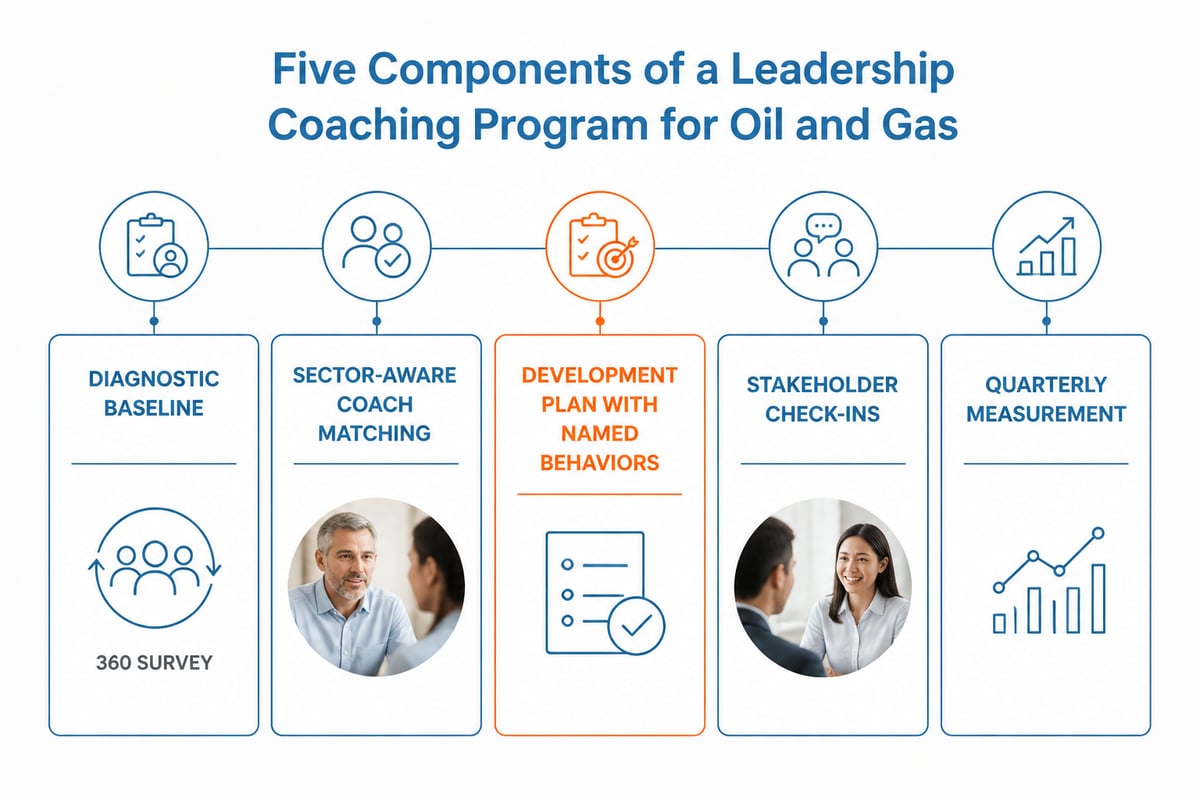
Strong coaching programs for oil and gas leadership share five components: a diagnostic baseline, sector-aware coach matching, a written development plan, stakeholder involvement and recurring measurement. If a vendor cannot describe all five, you are buying sessions, not a program.
1. A diagnostic baseline
Start with data, not assumptions. A 360 survey surfaces the gap between how a leader sees their impact and how peers, direct reports and managers experience it. In operational environments, that gap often shows up as a leader who is respected for technical judgment but avoided when bad news needs to travel upward.
2. Coach matching by function, level and industry
A coach who has never worked near a drilling operation, pipeline network or refinery can still be valuable, but only if they are matched on the dimensions that matter: function, seniority, industry context and the leader's specific goals. Noomii's approach is to hand-match human coaches on exactly those factors, with coaches sourced, interviewed and matched to each leader's needs.
3. A development plan with named behaviors
"Improve communication" is not a plan. A useful plan names the behavior ("escalates schedule risk within 24 hours"), the stakeholders who will notice, and the business outcome it protects.
4. Stakeholder check-ins
Without manager and peer input, coaching becomes a private conversation that the organization cannot see. Periodic stakeholder check-ins keep the leader accountable and give HR evidence of change.
5. Recurring measurement
Quarterly reporting against retention, performance and leadership KPIs keeps the program funded through budget reviews.
Who Should Be Coached: A Role-Based Targeting Model
The right participants are the leaders whose decisions carry the most operational and cultural weight, not simply the most senior. A role-based model helps HR allocate limited coaching budgets where they change outcomes.
| Leader group | Typical coaching focus | Signal that coaching is warranted |
|---|---|---|
| Frontline and field supervisors | Directing crews, giving feedback, safety conversations | Rising turnover or incident reporting gaps on a single site |
| Asset and operations managers | Cross-functional alignment, problem ownership, escalation | Decisions routinely pushed upward |
| HSE and compliance leaders | Influence without authority, difficult conversations | Resistance from production leaders |
| Functional heads (engineering, finance, supply chain) | Strategic partnership, managing digital change | Siloed priorities slowing execution |
| Executives and succession candidates | Enterprise decision-making, board and investor communication | Thin pipeline for senior roles |
Succession candidates deserve particular attention. A coaching engagement for high-potential leaders, run before a promotion rather than after a stumble, is cheaper than an expensive replacement and a lost year.
A Framework for Evaluating Providers: The Five-Question Screen
You can evaluate any provider by asking five questions and rejecting those who answer vaguely. This screen works for coaching platforms, boutique firms and internal programs alike.
- How are coaches selected for each leader? Look for a described process, not a directory to browse.
- What is measured, and when? Ask for sample reporting that ties to retention, performance and leadership KPIs.
- How does the provider handle multi-site or multi-country delivery? Oil and gas teams span time zones. Coordinated delivery across regions matters.
- What happens if the match is wrong? Look for terms that protect you before commitment. With Noomii, there is no payment until the coach selection and development plan are approved.
- Does the provider align with your governance requirements? Ethics, confidentiality and reporting boundaries should be explicit.
One more note on credentials. Many buyers treat an ICF credential as a requirement. Noomii has published its reasoning on why ICF certification is not mandatory for executive coaching, and the underlying point holds: judge coaches on experience, references and fit with your leaders, not on a single badge.
Evidence That Coaching Changes Leadership Behavior
Evidence on coaching comes from two places: peer-reviewed research on coaching-style leadership, and program-level outcomes from organizations that track results. Both matter, and neither should be overstated.
On the research side, a 2024 study in Frontiers in Psychology, Building a committed workforce, analyzed 402 valid responses and found that coaching leadership significantly enhanced employee engagement, including vigor, devotion and absorption. The practical reading for oil and gas: when supervisors coach their teams instead of only directing them, engagement rises. That is a strong argument for coaching the supervisors themselves, so they can model the behavior.
On the program side, Noomii reports the following across its corporate engagements:
- Leaders showed observable behavior change after engagement
- Coaching effectiveness ratings across goal alignment, support and accountability were strong
- Senior leaders rated coach professionalism highly
- A Fortune 500 global electronics manufacturer re-commissioned coaching engagements due to documented impact
These are ratings and observations, not guarantees. The right use of them is to set expectations: measure behavior change first, because business outcomes lag.

Case Pattern: From Task Execution to Problem Ownership
A documented Noomii engagement shows what operationally minded leadership change looks like. The details below are limited to what the engagement record states.
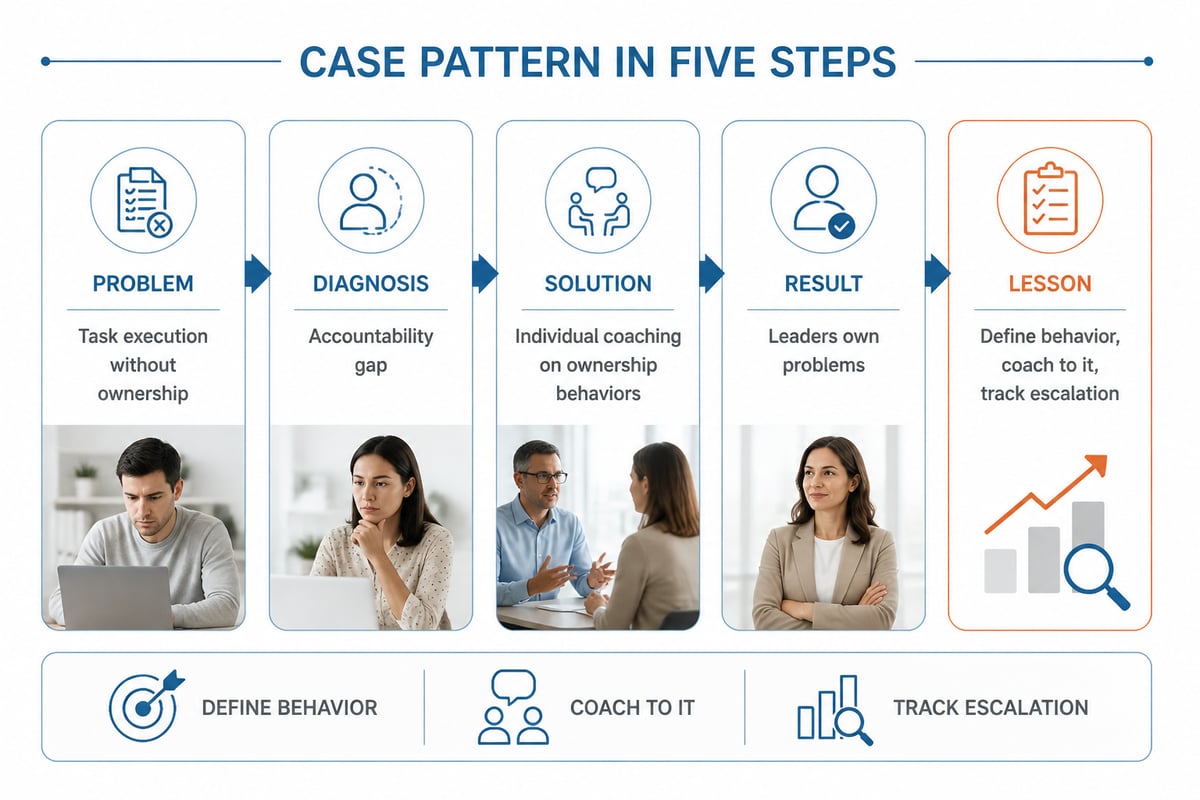
- Problem: Leaders at a Fortune 1000 international therapeutics company were executing assigned tasks but not owning outcomes.
- Diagnosis: The pattern pointed to an accountability and decision-rights gap, not a skills deficit.
- Solution: Individual coaching engagements aimed at ownership behaviors.
- Result: Leaders moved from task execution to problem ownership.
- Lesson: The same gap can appear in capital-intensive operations, where work is highly procedural and ownership can erode. A pharmaceutical context is not an oil and gas context, but the diagnostic logic transfers: define the behavior, coach to it, and watch whether decisions stop traveling upward.
For a comparable sector-adjacent example, see how Noomii structures coaching programs for biotech leadership teams, another regulated, technically driven environment.
A Common Mistake: Designing the Program Around the Energy Transition
Designing a leadership program around the energy transition narrative is a mistake when it drives the curriculum instead of the diagnosis. The transition is real, and the CSIS analysis of the global workforce and the energy transition examines the transferable oil and gas skills and the role of on-the-job training. But your leaders do not all need transition-themed coaching.
What they need is help with the underlying capabilities that any strategic pivot requires:
- Making decisions faster with partial data
- Leading teams through role redefinition
- Holding cross-functional conversations about trade-offs
- Retaining people who now have outside options
The IEA's analysis of green and digital energy jobs helps HR teams see which skills are sought in those roles. Use it to inform workforce planning, then let the 360 data decide who needs which kind of coaching.
Running the Program: Phases and Governance
A workable program runs in four phases, and each needs an owner on the HR side. The sequence matters more than the duration.
- Scope. Agree on populations, outcomes and success metrics with business leaders, not only HR.
- Baseline. Run the 360 survey and capture the starting KPIs (retention in target teams, engagement scores, performance indicators already in use).
- Coach. Hand-matched coaches work with leaders against a written plan, with stakeholder check-ins at agreed points.
- Report. Review quarterly. Decide whether to extend, redirect or stop.
Governance deserves explicit attention in regulated, safety-critical settings. Confirm what coaches share with the organization (themes and progress, not session content), how conflicts of interest are handled, and how the program aligns with ethical and regulatory standards. Compliance alignment is a design input, not an afterthought.
For global operations, coordination matters. Noomii has delivered coordinated multi-coach engagements across five countries, which is the relevant scale reference for organizations with distributed assets.
Organizations that want a structured option can look at Noomii's Executive and Leadership Coaching for Organizations, which pairs 1:1 coaching cycles with a free 360 leadership survey, hand-matched coaches, behavior frameworks, stakeholder check-ins and quarterly ROI reporting. Pricing and scope are best discussed directly with the team on the page.
Measuring ROI Without Overclaiming
Credible ROI measurement links coaching to three layers of evidence: behavior, team indicators and business outcomes. Skip the layers in the wrong order and the numbers will not hold up.
- Behavior: 360 re-assessment, stakeholder feedback, manager observations.
- Team indicators: Engagement, voluntary turnover in the leader's team, speed of decisions and escalation patterns.
- Business outcomes: Retention of critical roles, promotion readiness, performance KPIs set during scoping.
Resist the temptation to attribute large financial returns to coaching alone. In capital-intensive businesses, commodity prices and project timelines move results far more than any leadership program. The honest claim is narrower and more defensible: coaching moved these behaviors, and these team-level indicators followed. A reporting rhythm that shows this quarterly gives the board something concrete.
Frequently Asked Questions
What are coaching programs for oil and gas leadership?
They are structured development engagements that pair leaders in energy organizations with trained coaches, built around a baseline assessment, a written plan and measurable goals. The best ones address sector-specific pressures such as safety accountability, workforce shortages and cross-functional decision-making.
Who benefits most from leadership coaching in oil and gas?
Frontline supervisors, asset and operations managers, HSE leaders and succession candidates tend to produce the largest returns, because their decisions translate directly into culture, safety behavior and retention. Executives benefit too, particularly around enterprise decision-making.
Does the coach need oil and gas experience?
Sector familiarity helps, but fit on function, level and goals matters more. Ask how the provider matches coaches and whether the coach has worked with leaders in operational, regulated or safety-critical settings.
How do you measure the impact of leadership coaching?
Track behavior change through a 360 baseline and re-assessment, team indicators such as engagement and turnover, and business KPIs agreed at scoping. Quarterly reporting keeps the evidence current.
How long does a coaching engagement take?
Duration depends on the goals, the population and the leader's role. Discuss scope with your provider rather than relying on a standard number.
Is coaching worth it during a downturn?
Downturns increase the cost of poor leadership, because leaders manage restructuring, retention risk and reduced resources at the same time. A targeted program aimed at critical roles is easier to defend than a broad rollout.
Start this week by listing the roles where a leadership failure would cost you the most, then run a 360 baseline on that group before you commit to any vendor. Noomii's Executive and Leadership Coaching for Organizations is built around that sequence, with hand-matched coaches and quarterly ROI reporting, and you can Book a Free Strategy Call with Noomii Leadership Coaching to talk through which of your leaders to prioritize.


Leave a Reply
Want to join the discussion?Feel free to contribute!