
Leadership Development Providers in the Nordics: A Guide for Organizations
Leadership development providers in the Nordics fall into four groups: business schools, local consultancies, specialist coaching firms and internal academies, and the right choice depends on whether you need a cohort program, a cultural fit, or measurable behavior change at the individual level. Most buying decisions go wrong because organizations compare brands instead of delivery models. A Swedish consultancy, a Danish business school and a global coaching network solve different problems, and treating them as interchangeable produces expensive programs that leaders attend and then ignore.
This guide is written for HR, L&D and People leaders who own leadership quality and succession. It maps the provider landscape, explains what Nordic workplaces require that imported programs often miss, and gives you a scorecard you can use in your next RFP.
What the Nordic leadership context demands from any provider
Nordic organizations expect leaders to coach, consult and decide with their teams rather than direct from above, and any provider that teaches command-and-control habits will fail here. Flat hierarchies, high employee autonomy and strong consensus norms (the Swedish lagom, the Danish janteloven undertone, the Finnish preference for plain speech) shape what good leadership looks like.
That has three practical consequences for buyers.
- Authority is earned through facilitation. Leaders who cannot run a decision process with empowered specialists lose credibility quickly.
- Psychological safety is a baseline, not a differentiator. Teams expect to challenge their managers. Programs that treat candor as an advanced skill are behind the local norm.
- Imported frameworks need translation. A U.S. style executive presence module can land badly in an organization where self-promotion is socially costly.
There is also a talent dimension. Nordic labor markets are tight in technical and specialist roles, and leadership quality is a documented retention lever. WTW’s 2025 analysis of talent attraction and retention in Nordic high-demand roles points to leadership development as part of Norwegian retention strategies. If your best engineers leave because of a weak manager, no benefits package fixes it.
The four types of leadership development providers in the Nordics
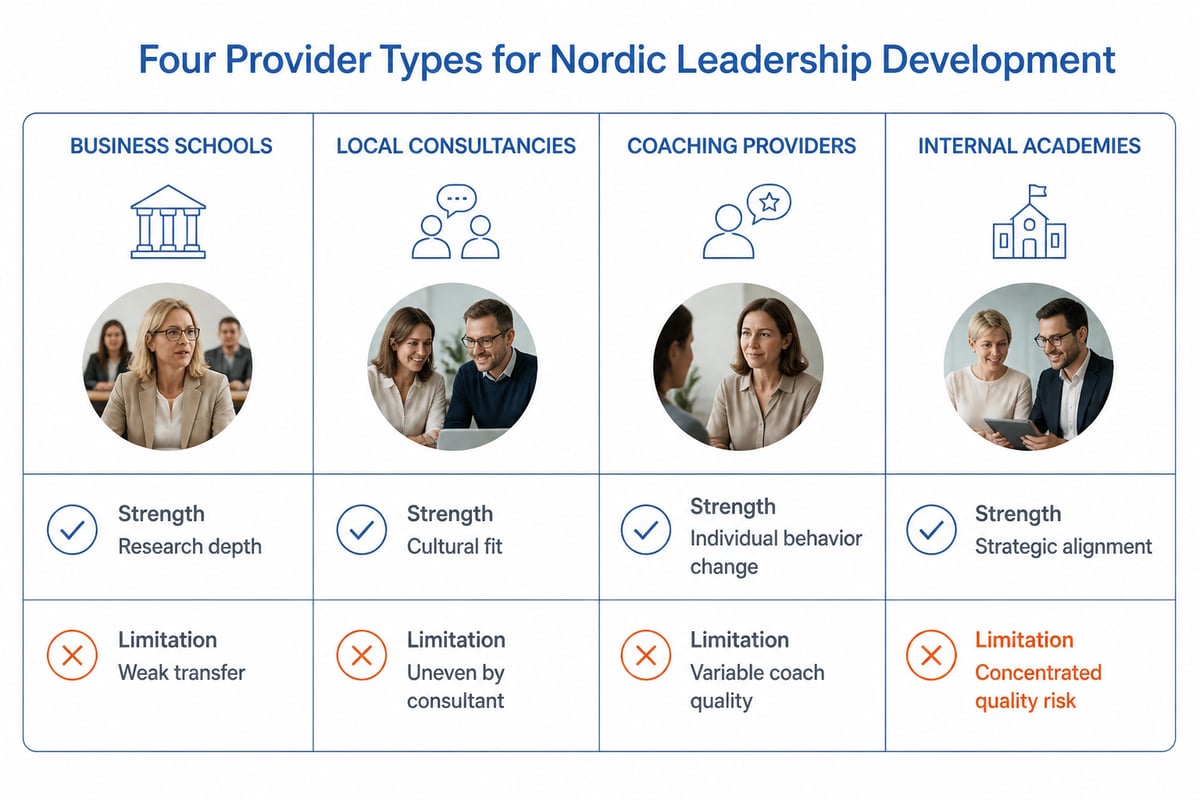
The market sorts into four provider types, each with a distinct strength and a distinct blind spot.
Business schools and university executive education
Nordic business schools offer credible, research-backed cohort programs and strong alumni networks. They suit organizations building a shared leadership vocabulary across a senior group. The weakness is transfer: a week on campus rarely changes how a leader handles a difficult conversation on Tuesday morning. Cohorts also move at a fixed pace, so a leader with an urgent problem waits for the next module.
Local consultancies and training firms
Regional firms, many of them Swedish, Norwegian or Danish, bring language fluency, cultural fit and consultants who know your sector. Their rosters are often built around senior individual consultants, which means quality varies by who is assigned to you, not by the firm's brand. Ask who will actually deliver, and whether they have worked in your industry. Coverage is the usual limit: a firm strong in Stockholm may have little capacity for your teams in Helsinki or Reykjavik.
Specialist coaching providers and platforms
Coaching-led providers work with leaders individually, which is where behavior change happens. The best ones diagnose first, match carefully and report on outcomes. The risk is variable coach quality and thin measurement, so insist on seeing how matching works and what gets reported. This category is also the strongest fit for multi-country organizations that need coordinated delivery across borders.
Internal academies with external partners
Large Nordic employers often run their own leadership academies and bring in outside faculty selectively. This keeps content aligned with company strategy but concentrates the quality risk in a small internal team. External partners work best when they plug specific gaps: a cohort of new managers, a succession slate, a failing team.
How to compare leadership development providers in the Nordics
A fair comparison uses the same criteria across every vendor, scored before you see pricing. Use this table as a starting scorecard and weight the rows to match your priorities.
| Criterion | What to ask | Red flag |
|---|---|---|
| Diagnostic rigor | What validated assessment precedes the program? | Content is set before any leader is assessed |
| Cultural fit | How is the material adapted for flat, consensus-driven teams? | Frameworks are translated, not rebuilt |
| Delivery model | Cohort, individual or blended? Who exactly delivers? | Senior sellers, junior deliverers |
| Multi-country reach | Can you deliver in Swedish, Danish, Norwegian, Finnish and English? | One office, one language |
| Measurement | What KPIs are reported, how often, and to whom? | Satisfaction scores as the only metric |
| Governance | How does it handle data protection and ethical standards? | Vague answers on confidentiality |
Weight measurement and diagnostics heavily. They are the two criteria that separate programs that change behavior from programs that produce good feedback forms.
Why measurement is the deciding criterion
Most leadership programs are judged on attendance and satisfaction, and neither predicts whether a leader behaves differently six months later. Our view is blunt: if a provider cannot show you a plan for tracking behavior change against retention, performance and engagement indicators, you are buying an event, not a development program.
This is the central argument in our analysis of leadership development without behavior change, and it applies with extra force in the Nordics. Flat organizations have fewer layers to absorb a weak manager, so one leader who does not change affects a larger share of the team. The cost compounds, as we outline in the ROI problem in leadership coaching.
Ask every vendor for three things before you shortlist them:
- A sample report showing how impact is tracked over time.
- The specific KPIs they would tie to your goals, such as retention in a named population or promotion readiness.
- What happens if the data shows a leader is not changing.
The third question is the most revealing. Providers who have never been asked it tend to answer with process rather than consequences.
A contrarian view: cohort programs are not the default for senior leaders
The conventional wisdom is that you run one large program and cascade it. For senior leaders, that is often wrong. Executives have different problems, different blind spots and very little time for generic content. A cohort works well for first-time managers who share the same learning curve. It works poorly for a CFO navigating a restructuring or a division head repairing a damaged team.
A sounder design for senior populations is individual coaching, anchored in a shared diagnostic, with cohort touchpoints only where peer exchange adds value. This also solves a Nordic-specific problem: in small national business communities, senior leaders are reluctant to expose weakness in a room where they will meet the same peers at industry events for the next decade. One-to-one work removes that friction.
Where coaching-led development fits, and what to expect from Noomii
Coaching-led development is the right model when you need individual behavior change, coordinated delivery across countries, or evidence of impact for a board. For those cases, Noomii's Leadership Development Programs are designed with your HR, L&D or People team around your business strategy, with pilot programs available so you can test before scaling.
The facts that matter for a buyer comparing vendors:
- Hand-matched coaches. Human coaches are sourced, interviewed and matched by function, level, industry and goals. Payment is made only after the coach selection and development plan are approved.
- A free 360 leadership survey for every participant, which gives you a diagnostic baseline before coaching begins.
- Quarterly ROI reports tied to retention, performance and leadership KPIs.
- Coordinated multi-coach delivery across global teams, including delivery across five countries.
Results Noomii has documented
These come from Noomii's own engagement data, not from third-party research, so treat them as vendor-reported and verify them in your own pilot.
- Coaching effectiveness is rated 8 to 9 out of 10 across goal alignment, support and accountability, and coach professionalism is rated 10 out of 10 by senior leaders.
- Noomii reports that leaders showed observable behavior change after engagement.
- Repeat coaching engagements have been re-commissioned by a Fortune 500 global electronics manufacturer due to documented impact.
- Leaders at a Fortune 1000 international therapeutics company moved from task execution to problem ownership.
Noomii is not built for individuals seeking personal life coaching or for small teams wanting a fixed-price package. It is designed for organizations with a defined leadership problem and the appetite to measure it.
A five-step process for selecting a provider
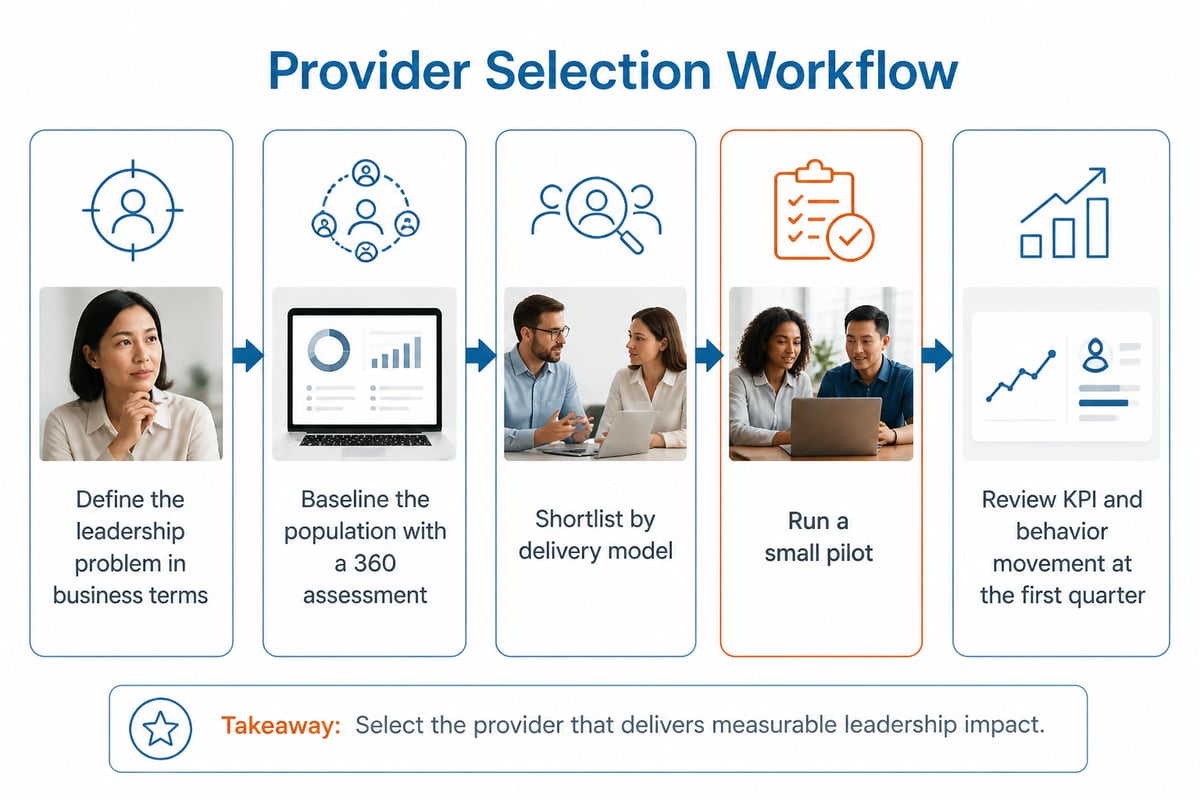
Selecting well is a sequence, and skipping steps is where costly mistakes happen. This is the process we recommend to People leaders.
- Define the leadership problem in business terms. "Improve leadership" is not a brief. "Reduce regretted attrition in our engineering managers" is.
- Baseline the population. Run a validated assessment or 360 before talking to vendors, so you know what you are solving.
- Shortlist by delivery model first, brand second. Decide whether you need cohort, individual or blended delivery, then compare providers within that model.
- Pilot a small group. A defined pilot reveals matching quality, reporting quality and leader reaction before you commit a full budget.
- Review at the first quarter. Check behavior and KPI movement, then expand, adjust or stop.
Hypothetical example: a regional retention problem
The following is a hypothetical illustration, not a description of a real engagement.
Problem. A mid-market technology employer with offices in three Nordic countries is losing senior engineers, and exit interviews point to first-line managers.
Diagnosis. A 360 survey across the manager population shows strong technical credibility but weak feedback habits and unclear priority-setting.
Solution. Managers receive individual coaching matched to function and level, with a short shared module on feedback so the language is consistent across countries.
Result to measure. Retention in the engineering manager population and team engagement scores, reviewed quarterly.
Lesson. The diagnosis, not the program content, determined the design. Without the baseline, the company would likely have bought a generic management course.
Succession, public sector and the wider skills picture
Nordic governments invest in adult skills, and that shapes the leadership talent pool you hire from. An OECD report published in March 2025 notes that Denmark rolled out a scheme in 2024 to improve access to vocational education for people over 30 and address educational gaps. The implication for employers is that your people expect development as a normal part of work, so a leadership program is judged against a high baseline.
For succession planning, the pipeline matters more than any single program. Our look at the leadership pipeline crisis explains why promoting strong specialists into management without development support creates the weak managers you later pay to fix. Public agencies face the same pattern with added constraints: programs must align with mission objectives and meet governance and ethical standards, so ask any provider how its process handles confidentiality, documentation and compliance review.
For broader reading on how skills gaps relate to labor market outcomes, the OECD’s analysis of skills and labour market opportunities draws on the 2023 Survey of Adult Skills and is useful context for workforce planning.
Practical notes for Nordic operations
Several operational details influence how a program lands in practice, and none of them appear in a vendor brochure.
- Language. Confirm whether coaching can happen in the leader's working language. Many Nordic leaders operate in English but process difficult feedback better in their first language.
- Time zones and travel. Coordinated delivery across Helsinki, Stockholm, Oslo and Copenhagen is simpler than most regions, but remote coaching still needs scheduling discipline during summer holidays.
- Works councils and unions. In many Nordic workplaces, employee representatives expect transparency about how leadership assessments are used. Settle the data-use rules with HR and labor representatives before launching a 360.
- Facilities and operations. If you are planning on-site leadership retreats or workplace changes alongside a program, vendors in adjacent fields can help. For example, AI Robotics AS supplies professional service and cleaning robots across Scandinavia, which some facilities teams consider when freeing staff time for higher-value work.
For toxic or damaged team situations, which require a different intervention than general development, see our guidance on the cost of toxic leadership to the business.
Frequently asked questions
What are the main leadership development providers in the Nordics?
The market includes university business schools running executive programs, regional consultancies in Sweden, Norway, Denmark and Finland, specialist coaching providers, and company-run academies supported by outside faculty. Each suits a different need, so match the provider type to the problem before comparing individual firms.
How much does leadership development cost in the Nordics?
Cost varies widely with delivery model, seniority of participants and program length. Rather than benchmark on price alone, compare what each vendor reports on impact, and ask for a scoped proposal tied to your KPIs. For Noomii, contact the team for a program-specific conversation.
Should we choose a local provider or a global one?
Choose local when cultural nuance and language dominate, and global or coordinated multi-country delivery when your leaders span several countries. Some organizations combine both: a global coordinator with coaches matched to each leader's context.
How do we measure the impact of leadership development?
Define KPIs before launch, such as retention in a named population, promotion readiness and engagement scores. Baseline with a 360 assessment, then review quarterly. Satisfaction surveys alone do not show whether behavior changed.
Is coaching or a cohort program better for senior leaders?
Individual coaching usually fits senior leaders better because their challenges differ and peer exposure carries reputational risk. Cohorts work well for first-time managers with shared learning needs.
How long should a pilot run?
A pilot should run long enough to see at least one quarterly review of behavior and KPI movement. Agree the pilot scope and review points with the provider up front.

Start this week by running a baseline 360 on one group of leaders, so every vendor conversation begins with evidence instead of brochures. If you want a partner that matches coaches to each leader by function, level and industry, builds the plan with your People team through its Leadership Development Programs, and reports quarterly on retention and performance, you can book a free strategy call with Noomii Leadership Coaching to scope a pilot against your own KPIs.


Leave a Reply
Want to join the discussion?Feel free to contribute!