
Leadership Development Vendors in Kenya: How to Choose a Coach
Leadership development vendors in Kenya fall into four groups: local boutique coaching firms, pan-African consultancies, business school executive programs, and global coaching networks that supply coaches into Nairobi and beyond. The right choice depends less on brand than on whether the vendor can match a specific coach to a specific leader and prove behavior change afterward. For HR and L&D leaders responsible for succession, that second requirement is where most selections succeed or fail.
Kenya's market has matured quickly. Multinationals regionalizing from Nairobi, a strong banking and telecom sector, and a growing base of mid-market family businesses in transition have all raised demand for coaching that goes beyond the classroom. The supply side has not always kept pace with the quality bar those buyers now need. This article gives you a way to sort vendors, a five-test framework for choosing a coach, and the contract terms that protect your budget.
What Types of Leadership Development Vendors Operate in Kenya?
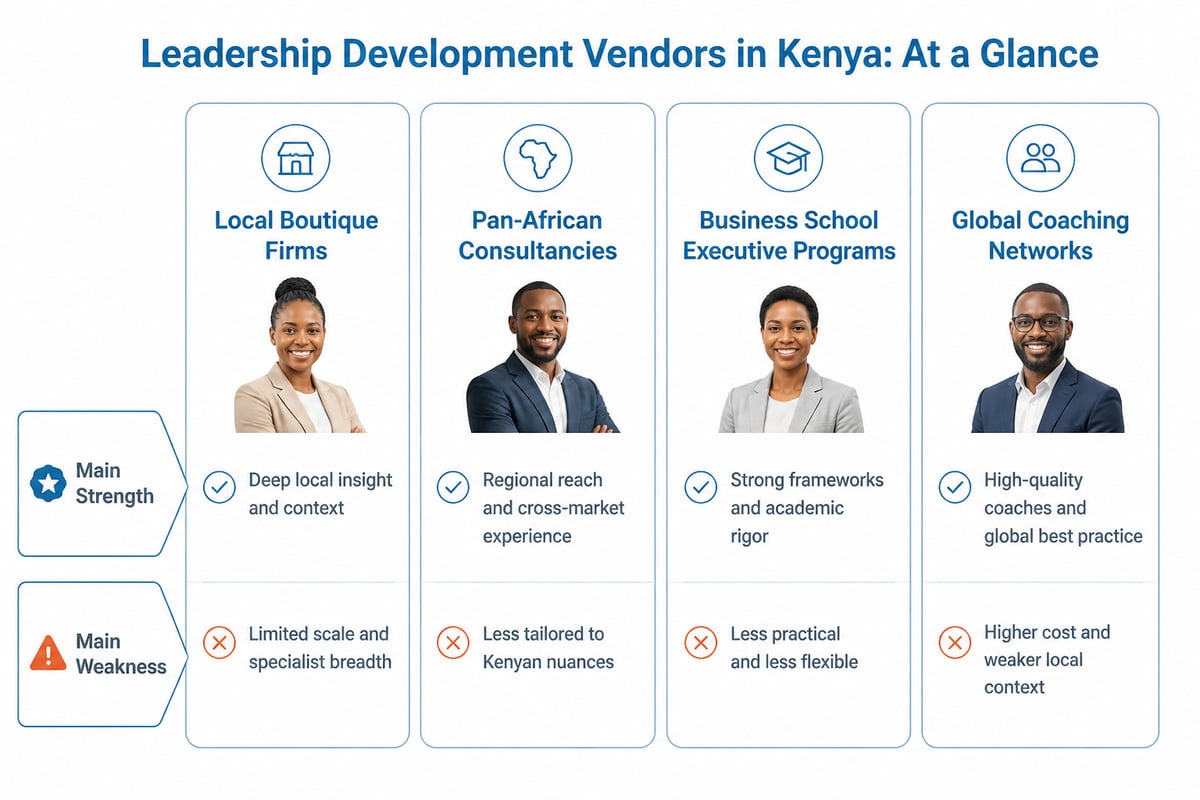
Four vendor types serve Kenyan organizations, and each solves a different problem well while creating predictable weaknesses elsewhere.
| Vendor type | Typical strength | Typical weakness |
|---|---|---|
| Local boutique firms | Cultural fluency, relationships, price flexibility | Thin bench for senior, cross-border or specialized needs |
| Pan-African consultancies | Regional reach, familiarity with multinational operating models | Coaching often bundled with broader consulting, so coach selection gets less rigor |
| Business school executive programs | Credibility, cohort learning, networking | Standardized content, limited individual follow-through |
| Global coaching networks | Coach depth by function and industry, measurement, multi-country coordination | Need to verify local context knowledge during matching |
Notice that none of these categories is inherently superior. A 40-person manufacturing firm in Nakuru preparing a second-generation leader has different needs than a regional bank headquartered in Westlands rolling coaching across five countries.
The mistake we see in vendor shortlists is treating the category as the decision. Buyers pick "a local firm" or "an international one" and then stop evaluating. The category narrows the field. It does not tell you whether the individual coach in front of your leader is any good.
You will also find directory-style listings of organizations active in Kenya's development and leadership space, which are useful for discovering names. Treat any directory as a starting list. A listing confirms existence, not coaching quality.
Why Most Vendor Selections Fail Before Coaching Starts
Selections fail because buyers evaluate the vendor's presentation instead of the mechanism that produces behavior change. A polished credentials deck says almost nothing about whether a particular coach will move a particular leader.
Here is the contrarian view: the strongest predictor of a successful engagement is not the vendor's size, awards or coach certifications. It is the quality of the matching process and the diagnostic work done before the first session. Certifications establish a floor. They do not distinguish a coach who has guided a CFO through a post-merger integration from one who has not.
Three failure patterns recur:
- Training mistaken for coaching. A workshop on emotional intelligence changes knowledge. Coaching changes what a leader does on Tuesday morning in a difficult meeting. Organizations that buy the first and expect the second are disappointed. Noomii has written about why leadership development without behavior change is so common and what separates programs that stick.
- Coach assigned from a roster. If the vendor hands you whoever is available, you are buying capacity, not fit.
- No baseline. Without a starting measure, any later improvement is anecdote.
The consequence of getting this wrong is not just wasted budget. A mismatched coach with a high-potential leader can cost you the leader's trust in development altogether, which makes the next intervention harder.
A Five-Test Framework for Evaluating a Leadership Coach in Kenya
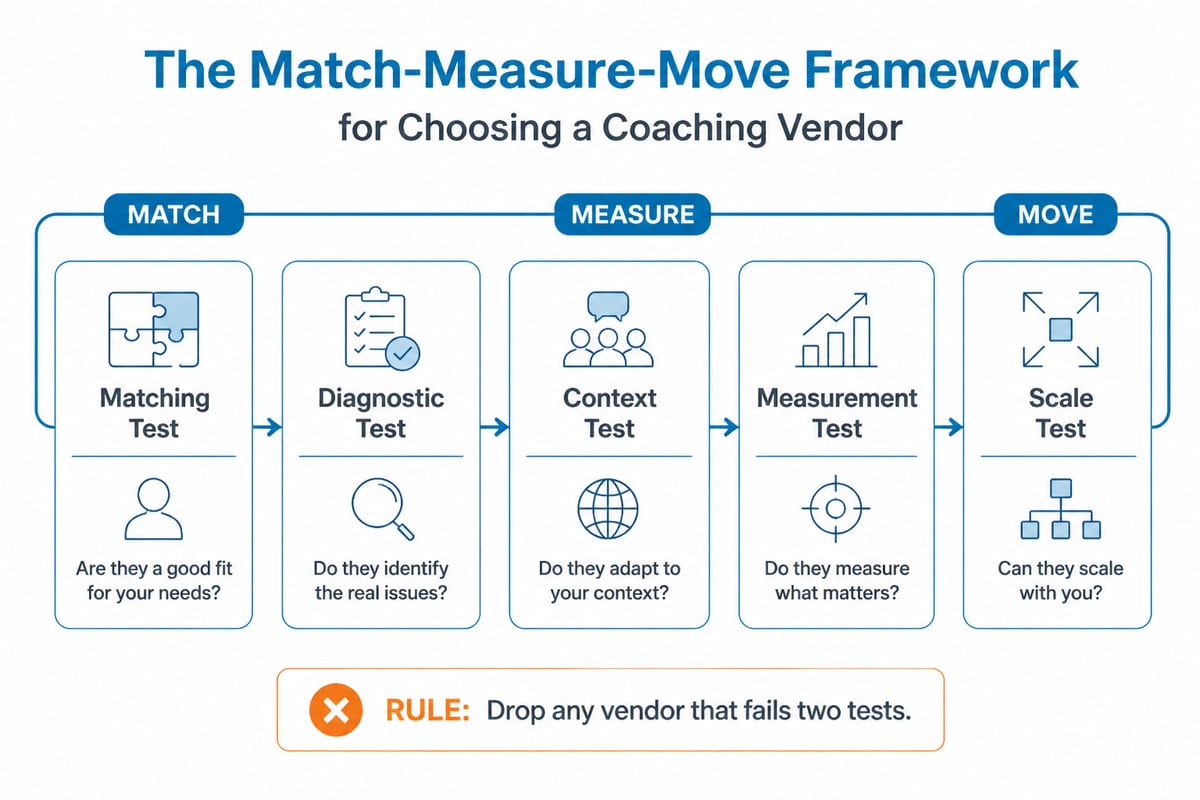
Use five tests, in order, and drop any vendor that fails two of them. We call this the Match-Measure-Move framework, because it checks whether a vendor can match well, measure honestly and move behavior.
Test 1: The Matching Test
Ask how the coach is selected for each leader. A credible answer names the criteria: function, seniority level, industry, and the leader's specific goals. A weak answer is "we have a great team of coaches."
Ask also whether you approve the coach before the engagement is committed. The best commercial arrangements let you review the proposed coach and development plan first, with payment tied to your approval rather than to a signature on day one.
Test 2: The Diagnostic Test
A coach who begins without data is guessing. Ask what assessment precedes the work. A 360-degree survey, which gathers structured input from a leader's manager, peers and direct reports, is the standard baseline because it exposes the gap between how a leader sees themselves and how others experience them. See how a leadership assessment should feed the development plan rather than sit in an appendix.
Test 3: The Context Test
Kenyan workplaces carry specific dynamics: hierarchical norms that shape how feedback travels, multi-ethnic teams, family ownership structures in mid-market firms, and regional leaders reporting into headquarters in other time zones. Ask the vendor how the coach handles these. You are not looking for stereotypes. You are looking for evidence the coach has worked in comparable settings or will adapt with the leader's input.
Test 4: The Measurement Test
Ask what the vendor will report, how often, and tied to what. Vague promises of "improved leadership presence" fail. Reports linked to retention, performance and defined leadership KPIs pass. If the vendor cannot show a sample report, assume reporting is an afterthought.
Test 5: The Scale Test
If you will coach beyond one leader, ask how delivery is coordinated. Multi-coach programs often fall apart because coaches work in silos and HR sees nothing consolidated. Coordination across coaches, and across countries if you operate regionally, is an operating capability, not a feature.
What Does Good Evidence of Coaching Impact Look Like?
Good evidence is specific, attributable to the engagement, and documented by someone other than the vendor's sales team. Be skeptical of aggregate claims without definitions.
Noomii's own engagement data illustrates the level of specificity worth asking any vendor for. Noomii reports that leaders showed observable behavior change after engagement and rates coaching effectiveness highly across goal alignment, support and accountability. The right way to use such figures is as a template for the questions you ask every vendor: what was measured, by whom, and against what baseline.
Two documented cases show what outcome language should sound like.
Hypothetical example: a global manufacturer's leadership challenge
- Problem: Leadership capability needed to grow across a geographically dispersed organization.
- Diagnosis: Development needs differed by leader and region, so a single program would not fit.
- Solution: Coordinated multi-coach delivery across several countries.
- Result: Documented impact is the test a buyer should look for before renewing coaching.
- Lesson: Repeat purchase is stronger evidence than a testimonial. When a buyer returns, the first engagement should have produced results the buyer could defend internally.
Hypothetical example: a therapeutics company's ownership gap
- Problem: Leaders may operate as task executors rather than owners of problems.
- Diagnosis: The gap is often behavioral and mindset-driven, not a skills deficit.
- Solution: Coach-led development focused on ownership and accountability.
- Result: The target is a visible shift from task execution to problem ownership.
- Lesson: Define the behavioral shift you want in plain language before you start. "Problem ownership" is observable. "Strategic thinking" often is not until you decompose it.
Both examples are hypothetical and not Kenyan, and you should say so when presenting them internally. What transfers is the discipline: a defined problem, a diagnostic, a matched intervention, and documented change.
Which Kenyan Organizations Need Which Kind of Coaching?
Match the engagement design to the business problem, because the same vendor can be right for one and wrong for another. A few patterns show up repeatedly in Kenya's market.
- Succession in family-led mid-market firms. The need is often a coach who can work with the incumbent leader and the successor, with strict confidentiality between the two. A single trusted coach for one leader may serve better than a broad program. See how executive coaching and leadership development fits succession scenarios.
- Regional leadership teams of multinationals. The need is coordination. Several coaches, one development framework, consolidated reporting.
- Banks, telecoms and large corporates with a manager pipeline. The need is scale with measurement. A structured corporate leadership development approach that ties individual coaching to a team and cultural view works better than isolated one-on-ones.
- A leader whose behavior is damaging a team. The need is targeted intervention, fast. Toxic patterns rarely correct themselves, and organizations tolerate them longer than they should. Noomii's fireside conversation on why organizations tolerate toxic leadership is a useful frame for HR leaders building the case to act.
For HR and L&D leaders, the practical implication is to write the problem statement first and the vendor requirements second. Reversing the order is how organizations end up with an impressive vendor solving the wrong problem.
How Do Global Coaching Networks Compare With Local Vendors?
Global networks bring depth of selection and measurement infrastructure; local vendors bring proximity and cultural fluency. Neither cleanly wins, and many Kenyan buyers combine them.
The comparison that matters is not local versus global in the abstract. It is what each can demonstrate against your five tests. A local boutique that has coached three generations of a family business may beat any global network on the context test. A global network may beat the boutique on the scale and measurement tests when you are coaching leaders in Nairobi, Lagos and Johannesburg simultaneously.
Ask global networks one extra question: how will you confirm this coach understands our operating environment? A good answer involves a pre-engagement conversation between the coach and the sponsor, not an assumption. Ask local vendors one extra question: what is your process when a leader needs a coach with a niche background you do not have in-house?
If you are weighing a network model, Noomii's approach is worth examining against these tests. Coaches are sourced, interviewed and matched by hand to each leader's function, level, industry and goals. No payment is due until you approve the coach selection and development plan. Every participant receives a free 360 leadership survey, and quarterly ROI reports tie results to retention, performance and leadership KPIs. For organizations that need a single coach for one struggling leader or many coaches across a full leadership team, Custom Coaching Solutions is the offering built for that range. Contact Noomii for specifics on scope and terms rather than assuming them.

What to Put in the Contract Before You Sign
Contract terms are where selection rigor becomes enforceable. Before signing with any vendor, secure these in writing:
- Coach approval rights. You review the proposed coach and development plan before the engagement is committed.
- A replacement path. A defined process, with no penalty, if the match is not working.
- A baseline assessment. Agreed at the start, not offered as an optional extra.
- Reporting cadence and content. Named metrics, named recipients, and a schedule. Quarterly is a sensible rhythm for behavior change, which does not show up in weeks.
- Confidentiality boundaries. What the coach shares with HR, the sponsor and the leader's manager, stated before the first session.
- Data handling. Where assessment data is stored and who can see individual results, especially important given Kenya's Data Protection Act.
- Success definition. Two or three behavioral outcomes that you and the vendor both agree will count as evidence.
Item seven is the one most contracts lack. Without it, every review meeting becomes a negotiation about what success meant.
What Is Changing in Kenya's Leadership Development Market in 2026?
Several shifts are reshaping how Kenyan buyers should evaluate vendors. First, demand is moving from event-based training to coaching tied to measurable outcomes, as finance leaders ask L&D to justify spend in the same terms as other investments. Second, hybrid and remote delivery has made it practical to access coaches with sector depth regardless of location, which widens your options beyond Nairobi-based practitioners. Third, boards and CHROs are paying closer attention to leadership conduct and culture risk, which raises the profile of governance-aligned programs.
The practical implication is that the standard for a defensible vendor decision is rising. A selection memo that says "reputable, well-reviewed, competitively priced" will look thin to a CFO or a board audit committee in 2026. One that documents your problem statement, the five tests, the evidence requested and the contract protections will not.
Frequently Asked Questions
How do I shortlist leadership development vendors in Kenya?
Start with the business problem, then identify which vendor type fits it: local boutique, pan-African consultancy, business school program or global network. Request the same information from each: how coaches are matched, what diagnostic comes first, and a sample outcome report. Drop vendors that cannot answer on matching and measurement.
What should leadership coaching cost in Kenya?
Pricing varies widely by coach seniority, engagement length and whether assessment and reporting are included. Compare total engagement scope rather than hourly rates, and ask what is bundled. For Noomii pricing and scope, contact Noomii directly instead of relying on assumptions.
How long before coaching produces visible results?
Behavior change typically needs several months of sustained work, which is why quarterly reporting is a sensible rhythm. Be wary of any vendor that promises transformation in weeks. Agree on early indicators, such as changed meeting behavior or feedback from direct reports, alongside longer-term KPIs.
Is a local coach always better for Kenyan leaders?
No. Local fluency is valuable, but the better question is whether the specific coach has relevant experience with your leader's function, level and challenge. Some leaders benefit from a coach with deep local context, others from a coach with specific industry or cross-border expertise. Test the match rather than assume it.
What is the difference between leadership training and leadership coaching?
Training transfers knowledge to groups through structured content. Coaching works one-to-one, or with small groups, on the specific behaviors a leader needs to change in real situations. Many organizations need both, but they should not be bought as substitutes.
Which Kenyan organizations should use multi-coach programs?
Organizations with several leaders across functions or countries, such as regional teams of multinationals, large banks and telecoms, benefit most. The value lies in coordinated delivery and consolidated reporting, so HR sees one picture rather than disconnected one-on-one engagements.
Before your next vendor meeting, write a one-page problem statement naming the leaders involved, the behavior you need to change and the two or three outcomes that would count as success, then hold every vendor to it. If you want a second opinion on that brief or help sourcing matched coaches for one leader or a full team, Book a Free Strategy Call with Noomii Leadership Coaching and walk through your situation with people who match coaches to leaders every day.


Leave a Reply
Want to join the discussion?Feel free to contribute!