
Executive Coaching Leadership Development That Works
The business case for executive coaching and leadership development has never been clearer, yet most organizations still treat it like a luxury perk rather than a strategic lever. In 2026, with leadership failures visible across Fortune 500 boardrooms and government agencies, the cost of getting this wrong is steep. Poor leadership drives turnover, kills innovation, and erodes cultures from the inside. The real question isn't whether to invest in leadership development but whether your approach actually changes behavior and delivers measurable results. Most programs don't. Here's what separates interventions that work from expensive theater.
The Leadership Crisis Hiding in Plain Sight
Organizations face a paradox. They promote technical experts into leadership roles, provide minimal development support, then wonder why engagement scores plummet and talent walks out the door. This pattern plays out in every sector, from healthcare organizations struggling with physician leadership to tech companies where brilliant engineers become toxic managers overnight.
What the Data Actually Shows
The evidence on coaching effectiveness is substantial when you look beyond vendor marketing. Peer-reviewed meta-analyses of workplace coaching demonstrate measurable impacts on leadership performance, decision quality, and organizational outcomes. But here's what those studies also reveal: generic coaching programs produce generic results. The interventions that move the needle share three characteristics:
- Precise diagnosis of leadership gaps using validated assessments, not superficial 360 surveys
- Targeted matching between coach expertise and specific leader challenges
- Accountability mechanisms that track behavioral change, not just participant satisfaction
Most organizations miss on all three. They buy coaching hours in bulk, assign coaches randomly, and measure completion rates instead of business impact.

The Toxic Leader Problem
One pattern we see repeatedly: organizations tolerate destructive leadership far too long. A senior executive delivers numbers but leaves wreckage in their wake. HR knows. The team knows. Senior leadership looks the other way until the damage becomes undeniable, usually when key talent exits or legal issues surface.
By 2026, this tolerance has become a liability. The cost of toxic leadership now includes reputation damage, regulatory scrutiny in certain sectors, and measurably higher replacement costs for talent. Addressing toxic leadership patterns requires more than a coaching conversation. It demands structured intervention with clear behavioral benchmarks and consequences.
What Effective Executive Coaching Actually Requires
Executive coaching and leadership development that produces results starts with honest diagnosis. Not the sanitized feedback leaders hear in most settings, but objective assessment of how their behavior impacts decisions, team performance, and organizational culture.
The Matching Problem Nobody Talks About
Assigning any available coach to a struggling executive is organizational malpractice. Yet it happens constantly. A leader dealing with conflict avoidance needs different expertise than one struggling with strategic thinking or change management. The coach's sector experience matters too. Financial services leadership operates under different constraints than manufacturing or education.
Effective matching considers:
- Specific behavioral issues identified through assessment
- Sector and regulatory context the leader operates within
- Leadership level and organizational complexity
- Cultural and communication style compatibility
- Track record with similar challenges
When matching works, leaders engage differently. They recognize the coach understands their context and has helped others navigate similar situations. When it doesn't, you get polite conversations that change nothing.
Building Intervention Plans That Actually Change Behavior
The gap between coaching conversations and behavioral change is where most programs fail. Leaders nod, agree to try new approaches, then revert to established patterns when pressure hits. Closing this gap requires structure most coaches and organizations avoid.
Problem-Diagnosis-Solution-Result Framework
One healthcare system we observed in 2025 faced a pattern of physician leadership failures. High performers in clinical roles struggled with team management, delegation, and organizational politics. Turnover in physician leadership roles averaged 18 months.
Problem: Technically brilliant physicians promoted to leadership without management foundation, creating team dysfunction and strategic drift.
Diagnosis: Assessment revealed consistent gaps in delegation, conflict resolution, and understanding organizational systems. Most physician leaders viewed administrative work as distraction from "real work."
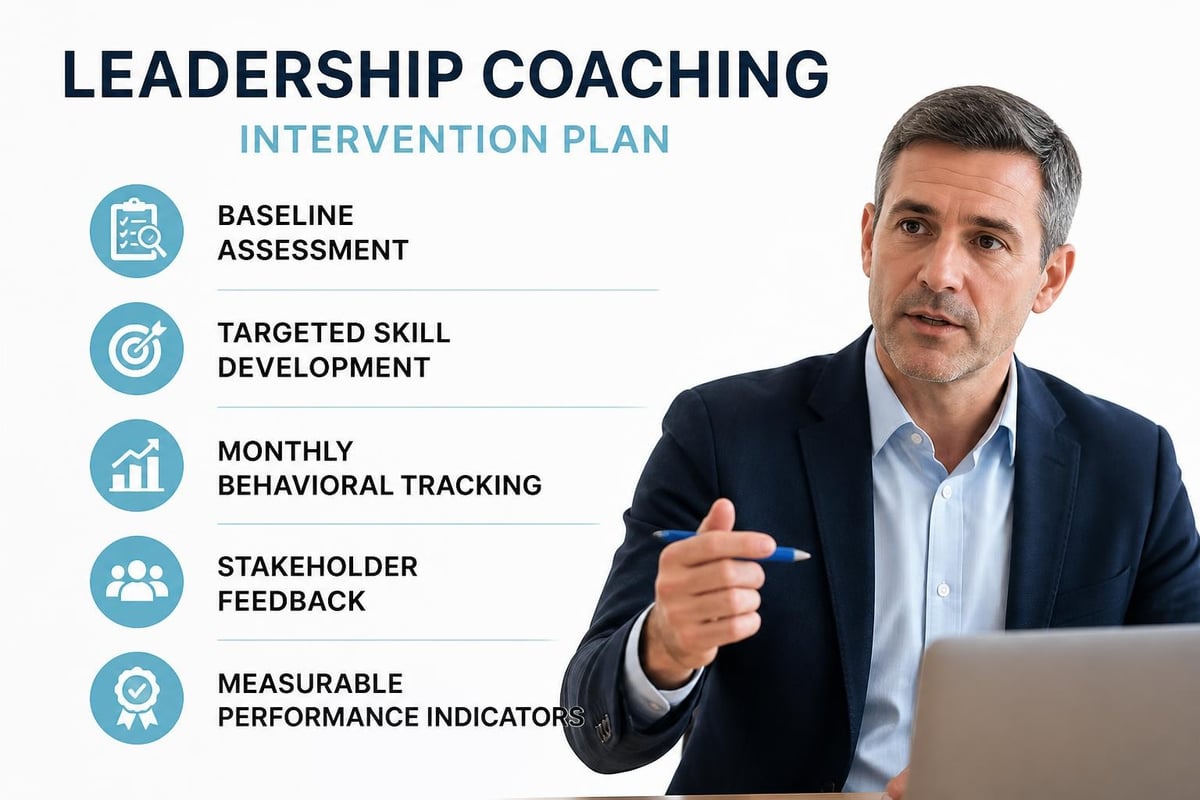
Solution: Targeted coaching focusing on delegation frameworks, stakeholder mapping, and reframing leadership identity. Monthly behavioral tracking against specific metrics: delegation frequency, team meeting effectiveness, peer relationship quality.
Result: Leadership tenure extended to average of 3.2 years. Team engagement scores improved 23%. Key talent retention increased measurably.
Lesson: Generic leadership training failed because it ignored identity shift required. Effective intervention addressed both skills and how physicians viewed leadership role itself.
The Accountability Architecture
Behavioral change without accountability is hope. Effective programs build accountability into the structure:
| Accountability Element | Measurement Approach | Review Frequency |
|---|---|---|
| Behavioral benchmarks | 360 feedback, peer observation | Quarterly |
| Team health indicators | Engagement scores, turnover data | Monthly |
| Decision quality | Outcome tracking, stakeholder input | Per major decision |
| Cultural impact | Skip-level conversations, climate surveys | Bi-annually |
This isn't about punishment. It's about creating visibility into whether coaching investments translate to different outcomes. When they don't, you adjust the intervention or make harder decisions about fit.
The Government and Enterprise Scale Challenge
Scaling executive coaching and leadership development across large organizations introduces different problems. Government agencies face budget constraints, procurement requirements, and mission-critical timelines. Fortune 500 companies need consistency across geographies while respecting local context.
What Works at Scale
The organizations getting this right in 2026 share common approaches:
Centralized assessment, distributed delivery. Use consistent diagnostic tools across the organization to identify patterns and prioritize interventions. Deploy coaches matched to specific needs rather than trying to maintain large internal coaching teams.
Tiered intervention strategy. Not every leader needs intensive one-on-one coaching. Some benefit more from peer coaching, structured cohorts, or targeted skill development. Reserve intensive executive coaching for high-impact leaders and critical situations.
Integration with existing frameworks. Coaching works best when aligned with competency models, succession planning, and performance management. Standalone programs create confusion and competing priorities.
The World Economic Forum’s analysis of workforce skills gaps reinforces this point. Leadership capability increasingly determines organizational adaptability in volatile environments. Yet most development approaches remain disconnected from business strategy.
The ROI Conversation Leaders Avoid
CHROs and learning leaders often struggle to demonstrate coaching ROI because they measure the wrong things. Participant satisfaction and completion rates tell you nothing about business impact. What matters:
- Retention of key talent in coached leader's teams versus baseline
- Decision velocity and quality measured through outcome tracking
- Team performance metrics before and after intervention
- Cultural health indicators in leader's sphere of influence
- Leadership bench strength over time
Real ROI Example from Manufacturing
A mid-sized manufacturer faced chronic production delays traced to weak frontline leadership. Supervisors avoided difficult conversations, tolerated performance issues, and escalated rather than resolved conflicts.
Investment: $180,000 in targeted coaching for 15 frontline leaders over six months
Measured outcomes:
- Production delays decreased 34%
- Quality incidents reduced 28%
- Voluntary turnover in supervised teams dropped from 31% to 12%
- Calculated ROI: 4.2x based on reduced turnover costs alone
The intervention worked because it focused on specific, observable behaviors tied to business outcomes. Coaches with manufacturing sector experience understood the pressures frontline leaders faced and could offer practical approaches, not theoretical frameworks.

Where Traditional Approaches Fall Short
Most executive coaching and leadership development programs fail before they start. The failure modes are predictable:
Failure Mode 1: The Perk Mentality
Offering coaching as executive benefit without clear objectives or accountability. Leaders enjoy conversations but nothing changes. Expensive therapy sessions masquerading as development.
Failure Mode 2: The Curriculum Trap
Designing leadership programs around content coverage rather than behavioral change. Leaders complete modules, check boxes, and return to old patterns.
Failure Mode 3: The Vendor Relationship
Selecting coaches based on procurement convenience rather than expertise match. You get whoever's available in the contract, not who the leader needs.
Failure Mode 4: The Avoidance Dance
Using coaching to avoid performance management. "We're getting them a coach" becomes code for "we're not ready to address the real problem."
Research from the Center for Creative Leadership documents these patterns and their costs. The organizations seeing results treat coaching as strategic intervention, not developmental amenity.
Building Coaching Into Leadership Culture
The most sophisticated organizations in 2026 embed coaching capability throughout leadership layers rather than treating it as external intervention. This doesn't mean everyone becomes a certified coach. It means coaching mindsets and skills become part of how leaders develop others.
The Cultural Shift Required
Moving from episodic coaching interventions to coaching culture requires:
-
Leadership modeling from the top. When executives visibly engage in their own development and demonstrate coaching approaches with direct reports, it signals priority.
-
Manager capability building. Training managers in coaching techniques creates multiplier effects. Not every conversation requires external coaches when internal capability grows.
-
Psychological safety foundation. Coaching works when leaders can be honest about gaps and struggles. Cultures that punish vulnerability kill the conditions coaching needs.
-
Systems alignment. Performance management, succession planning, and development conversations must reinforce coaching principles, not contradict them.
The Compliance and Governance Dimension
Government agencies and regulated industries face additional complexity. Leadership development must align with ethics standards, procurement rules, and documentation requirements. The American Psychological Association’s guidance on coaching psychology addresses ethical frameworks that matter in these contexts.
Compliance considerations include:
- Coach credentials and vetting meeting organizational standards
- Confidentiality boundaries in coaching relationships
- Documentation requirements for development investments
- Conflict of interest management when coaches work across organization
- Data privacy around assessment results and progress tracking
Organizations operating across state lines or internationally face additional complexity around coaching qualifications and regulatory alignment. Ignoring these dimensions creates liability risk.
What 2026 Leadership Demands
The leadership challenges organizations face keep evolving. Remote and hybrid work changed team dynamics and leadership visibility. AI adoption demands different decision frameworks. Regulatory complexity in multiple sectors increased. Economic uncertainty requires faster adaptation.
These shifts make executive coaching and leadership development more critical, not less. But they also demand evolution in how coaching gets delivered:
Shorter intervention cycles. Six-month coaching engagements miss the pace of change in many environments. Intensive, focused interventions followed by periodic reinforcement often work better.
Virtual delivery expertise. Coaches must be genuinely effective in virtual settings, not just tolerating video calls. The skills differ from in-person coaching.
AI and technology fluency. Leaders need coaches who understand how technology is reshaping leadership work, not those intimidated by it.
Systems thinking emphasis. Individual leadership development that ignores organizational systems and culture hits ceilings quickly. Effective coaches work at both levels.
Making the Investment Decision
When should organizations invest in executive coaching for their leadership teams? The clear signals:
- Leadership failures creating measurable business impact
- High-potential leaders at risk of derailment
- Strategic transitions requiring new capabilities
- Cultural issues traced to leadership behavior
- Succession gaps threatening continuity
What shouldn't trigger coaching investments:
- Avoiding difficult performance conversations
- Generic development without clear objectives
- Checking compliance boxes for training hours
- Copying competitor programs without context
The investment pays off when it's strategic, targeted, and measured against business outcomes. Everything else is expensive noise.
Frequently Asked Questions
What makes executive coaching different from leadership training?
Executive coaching provides personalized, behavior-focused interventions targeting specific leadership challenges through structured one-on-one relationships. Leadership training delivers content and frameworks to groups. Coaching changes behavior; training builds knowledge. Effective leadership development uses both strategically based on specific needs and learning objectives.
How long does it take to see results from executive coaching?
Measurable behavioral changes typically appear within 60-90 days when coaching focuses on specific, observable behaviors with clear accountability. Deeper leadership identity shifts and cultural impact require 6-12 months. Organizations seeing slower results usually lack clear objectives, accountability mechanisms, or proper coach matching to the leader's specific challenges.
What qualifications should executive coaches have?
Effective executive coaches combine formal coaching certification (ICF or equivalent), relevant sector experience, demonstrated expertise in the specific leadership challenges being addressed, and track record of measurable client outcomes. Credentials matter less than proven ability to drive behavioral change in contexts similar to your organization's situation and culture.
How do you measure ROI on executive coaching investments?
Track metrics directly tied to coached leader's impact: retention rates on their teams, decision quality outcomes, team performance indicators, cultural health scores in their organization, and leadership bench strength over time. Avoid measuring completion rates or satisfaction scores. ROI calculation should compare investment cost against measurable improvements in these business outcomes.
When should organizations use external coaches versus internal resources?
Use external coaches for senior executive development, toxic leadership interventions, situations requiring confidentiality from internal politics, specialized expertise not available internally, and when objectivity is critical. Internal resources work well for manager development at scale, cultural alignment needs, and when deep organizational context matters more than external perspective.
Executive coaching and leadership development delivers measurable results when organizations move beyond generic programs to targeted, evidence-based interventions that match specific leader challenges with proven coach expertise. The difference between programs that work and expensive theater comes down to diagnostic precision, accountability architecture, and measurement discipline. Noomii Leadership Coaching helps organizations solve complex leadership challenges through advanced assessments, precision coach matching, and scalable solutions that align individual growth with institutional priorities to create confident, adaptive leaders who drive measurable organizational success.



Leave a Reply
Want to join the discussion?Feel free to contribute!