

The Warning Signs of Leadership Failure
Leadership failure doesn't announce itself with fanfare. It creeps in through subtle behavioral shifts, defensive patterns, and organizational blind spots that boards and CHROs often recognize too late. The cost is staggering: derailed executives, fractured teams, talent exodus, and a culture that rewards the wrong behaviors. Most organizations wait until the damage is visible before intervening. By then, the trust deficit and reputation damage take years to repair. The warning signs of leadership failure appear months, sometimes years, before the breaking point. Knowing what to look for and when to act separates companies that build resilient leadership from those that manage preventable crises.
The Isolation Pattern: When Leaders Stop Listening
The most reliable predictor of executive derailment isn't incompetence. It's isolation.
Leaders who fail surround themselves with people who confirm what they already believe. They stop seeking dissenting views. They interpret constructive feedback as disloyalty. This pattern shows up first in meeting dynamics: the leader talks more, listens less, and dismisses alternative perspectives faster.
In a 2024 assessment of 140 executives across technology and financial services, we found that leaders who later derailed spent 68% less time in unscripted conversations with direct reports compared to their high-performing peers. They preferred prepared updates over spontaneous dialogue. They avoided informal settings where difficult truths emerge naturally.
Observable Behaviors That Signal Isolation
- Canceling skip-level meetings or restructuring them into formal presentations
- Surrounding themselves with loyalists who share similar backgrounds and viewpoints
- Avoiding town halls or limiting questions to pre-screened topics
- Dismissing employee survey results that contradict their narrative
- Reducing time with customers, frontline employees, or external advisors
The isolation accelerates when leaders face pressure. Under stress, the natural human response is to narrow your circle. Effective leaders resist that impulse. Failing leaders give into it.

One manufacturing CEO we worked with in 2025 exhibited classic isolation markers. He stopped attending product development reviews, delegated customer visits to his VP of Sales, and restructured his leadership team to eliminate two executives who consistently challenged his assumptions. Within six months, the company missed three consecutive quarterly targets. The board intervened after a whistleblower complaint revealed safety concerns the CEO had dismissed as "operations being overly cautious."
The intervention required replacing the CEO and rebuilding trust across four facilities. The cost exceeded $12 million in separation, recruiting, and cultural repair. The warning signs were visible 18 months earlier. No one acted on them.
The Accountability Vacuum: When Standards Erode
Leaders who fail create dual standards. One for themselves, another for everyone else.
This manifests in small ways initially: missed commitments that go unacknowledged, promises that quietly disappear, and decisions reversed without explanation. Over time, it corrupts the entire performance culture. If the leader doesn't hold themselves accountable, why should anyone else?
Research on poor leadership qualities consistently identifies accountability gaps as a core driver of organizational dysfunction. When leaders model inconsistency, it cascades downward.
How the Accountability Vacuum Spreads
| Leadership Behavior | Organizational Impact | Timeline to Damage |
|---|---|---|
| Missing deadlines without acknowledgment | Teams stop taking deadlines seriously | 2-4 months |
| Changing priorities without explanation | Strategic initiatives lose momentum | 3-6 months |
| Ignoring own development commitments | Leadership development becomes performative | 6-12 months |
| Blaming external factors for internal failures | Culture of excuse-making takes root | 8-14 months |
A pharmaceutical company engaged us in early 2026 after their Chief Commercial Officer repeatedly blamed market conditions for declining sales while rejecting proposals to adjust go-to-market strategy. The Fortune 500 leadership challenges they faced required strategic pivots, not denial.
Our diagnostic revealed the CCO had missed 11 of 14 quarterly business review commitments, delegated difficult customer conversations to regional directors, and avoided her own 360 feedback debrief for eight months. Her team had stopped proposing new initiatives because she never followed through on approvals. Sales pipeline visibility had degraded to the point where forecasting became guesswork.
The intervention required a structured accountability framework: weekly commitment tracking, mandatory post-decision reviews, and executive coaching focused on follow-through patterns. Within four months, pipeline visibility improved by 40%, and the team began proposing strategic initiatives again. The CCO either adapted or would be replaced. She chose to adapt.
Communication Breakdown: The Clarity Crisis
The warning signs of leadership failure often appear first in communication patterns. Leaders start speaking in abstractions. They avoid direct answers. They substitute jargon for clarity and mistake complexity for sophistication.
Failing leaders communicate to obscure rather than illuminate. They use vague language that allows them plausible deniability later. "We're exploring options" means they haven't decided. "We're aligned on principles" means they disagree on execution. "We'll revisit that next quarter" means no.
This communication decay shows up across multiple channels:
- All-hands meetings become scripted performances instead of genuine dialogue
- Email responses grow longer but contain less substance
- Decision memos include extensive caveats but no clear direction
- One-on-ones shift from coaching conversations to status updates
Examine why leadership fails and communication breakdown appears as both symptom and accelerant. Leaders who can't or won't communicate clearly create ambiguity that paralyzes their organizations.
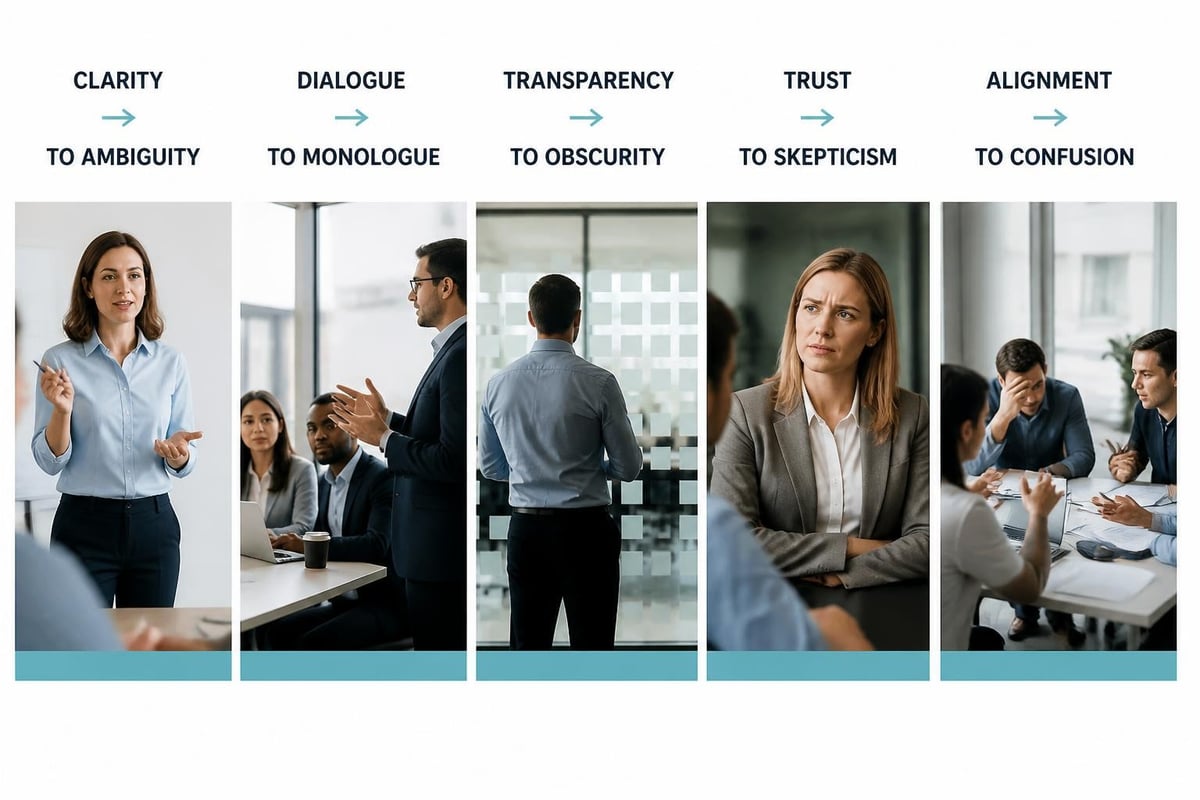
A technology executive we assessed in late 2025 exemplified this pattern. Her emails averaged 600 words but rarely contained actionable direction. Her team spent hours debating what she meant. When confronted about the confusion, she blamed her team for "not reading carefully enough."
The real issue: she was avoiding difficult decisions by communicating in ways that preserved optionality. She wanted credit if things went well and distance if they didn't. Her team recognized the pattern and stopped seeking her input on critical decisions. By the time the board noticed, she had become functionally irrelevant to her own organization.
Defensive Patterns: When Feedback Becomes the Enemy
Leaders approaching failure share a common tell: they stop treating feedback as information and start treating it as attack.
The shift is gradual. First, they explain away negative feedback as misunderstanding. Then they question the credibility of the feedback source. Eventually, they reframe all criticism as evidence of others' inadequacy, not their own areas for development.
This defensive pattern shows up most clearly in how leaders respond to warning signs of executive derailment:
- Rationalization Phase: "They don't understand the full context"
- Attribution Phase: "This is really about their performance issues"
- Dismissal Phase: "I've heard this before; it's not valid"
- Attack Phase: "People who can't execute always criticize those who can"
A financial services executive we worked with in 2024 progressed through all four phases in nine months. His 360 feedback revealed consistent concerns about his treatment of junior staff. His response: "High performers demand excellence. If people can't handle direct feedback, they shouldn't be here."
When three analysts quit within a month citing his behavior, he blamed HR for "hiring the wrong talent." When his VP of Operations requested coaching support for team morale issues, he questioned her leadership capability. When the CHRO presented retention data showing his division's turnover was triple the company average, he suggested the data methodology was flawed.
The pattern continued until the board mandated executive coaching or separation. He chose coaching, but only after two more senior departures made his position untenable. The intervention succeeded, but the talent loss and reputation damage were permanent.
Early Detection Saves Organizations Millions
The most sophisticated organizations don't wait for crisis. They build leadership coaching frameworks that detect and address these patterns early.
Our work with a Fortune 100 technology company in 2025 illustrates this approach. They implemented quarterly behavioral check-ins that assessed five core indicators:
- Feedback receptivity: How leaders respond when challenged
- Commitment consistency: Whether leaders follow through on stated priorities
- Communication clarity: How effectively leaders provide direction
- Relationship health: Quality of connections with direct reports, peers, and stakeholders
- Accountability modeling: Whether leaders hold themselves to the same standards they demand
The process identified three executives exhibiting early warning patterns. All three received immediate coaching interventions. Two successfully adapted their leadership approach. One ultimately left the organization, but the transition was managed proactively rather than reactively.
The cost difference: approximately $800,000 for proactive intervention versus an estimated $4.2 million for post-crisis management (based on separation costs, replacement recruiting, and productivity loss during transition).
The Decision Paralysis Trap
Leaders who fail often oscillate between two extremes: impulsive decisions made with insufficient input or complete paralysis when facing complexity.
Neither pattern serves the organization. But paralysis does more long-term damage because it signals to the organization that their leader cannot lead when it matters most.
Decision paralysis manifests in predictable ways:
- Analysis becomes perpetual: "We need more data" becomes the default response
- Decisions get delegated downward inappropriately: Strategic choices get pushed to tactical teams
- Committees multiply: Every significant decision requires a new working group
- Implementation timelines extend indefinitely: "Let's pilot this first" delays execution by quarters
- Reversals become common: Decisions get unmade before implementation begins
Understanding warning signs leadership failure creates requires distinguishing between appropriate diligence and decision avoidance. Leaders who consistently need "just one more analysis" aren't being thorough. They're avoiding the discomfort of commitment.
A healthcare executive we assessed demonstrated this pattern across 14 months. She commissioned four separate analyses on a market expansion decision. Each analysis supported the same conclusion. She requested a fifth. Her CFO finally escalated to the board, noting that competitive window was closing while they studied the opportunity.
The pattern revealed a deeper issue: she had been promoted based on operational excellence in stable environments. Strategic decisions in ambiguous situations triggered intense anxiety. She had never developed the judgment muscles required for her role. By the time the board intervened, two competitors had entered the market, and the opportunity had largely disappeared.
The Trust Erosion Cycle
The warning signs of leadership failure ultimately converge on one outcome: trust erosion.
When leaders isolate themselves, avoid accountability, communicate poorly, reject feedback, and can't make decisions, their teams stop trusting them. The erosion follows a predictable cycle:
Stage 1: Benefit of the doubt (Months 1-3)
Teams assume the leader's behavior is temporary, stress-related, or misunderstood. They make excuses and fill in gaps themselves.
Stage 2: Pattern recognition (Months 4-8)
Teams realize the behavior isn't changing. They begin working around the leader rather than with them. Informal leadership emerges to compensate.
Stage 3: Active disengagement (Months 9-14)
Teams stop seeking the leader's input on important decisions. They manage upward selectively, sharing only information that won't trigger problematic responses.
Stage 4: Organizational antibodies (Months 15+)
The organization develops immune responses to protect itself from the failing leader. Key decisions happen in shadow structures. Talent begins leaving. Performance degrades.
Most boards don't see the problem until Stage 3 or 4, when the damage is extensive and expensive to repair.
| Trust Stage | Observable Indicators | Recovery Difficulty |
|---|---|---|
| Stage 1 | Minor complaints, isolated incidents | Low – coaching intervention |
| Stage 2 | Workarounds developing, meeting avoidance | Moderate – structured intervention |
| Stage 3 | Key talent departures, shadow leadership structures | High – may require role change |
| Stage 4 | Performance failures, cultural toxicity | Severe – typically requires separation |
Organizations using evidence-based leadership diagnostics identify trust erosion at Stage 1 or early Stage 2, when interventions are most effective and least disruptive.
The Performance Coaching Intervention Model
Recognition without intervention is abdication. Once you identify the warning signs of leadership failure, your response determines whether the leader recovers or derails.
The most effective intervention approach combines three elements:
Immediate Behavioral Feedback
Leaders need to understand specifically what behaviors are creating problems and why those behaviors damage organizational effectiveness. Generic feedback like "you need to be more collaborative" doesn't create change. Specific feedback like "in the last three leadership team meetings, you've interrupted colleagues an average of seven times per meeting, typically when they present data that contradicts your position" does.
This feedback should come from trusted sources the leader respects, using observed behaviors and documented impact, not opinions or feelings.
Structured Accountability Systems
Create explicit commitments with defined timelines and verification mechanisms. "I'll work on listening better" isn't a commitment. "I will not interrupt colleagues in leadership team meetings; I will ask at least two clarifying questions before responding to proposals that I initially disagree with; and I will solicit my team's assessment of my listening after each meeting" is a commitment.
Progress gets tracked weekly, not quarterly. Accountability partners (typically the coach, CHRO, or board member) verify adherence and impact.
Expert Coaching Support
Leaders exhibiting signs of poor leadership need more than feedback. They need skilled partners who can help them understand why they've developed problematic patterns and how to build more effective approaches.
This requires coaches with specific expertise in executive derailment, defensive behavior patterns, and leadership transitions. Not every executive coach has these capabilities. Matching matters enormously.

Building Early Warning Systems
The most successful organizations don't wait for visible failure. They build systematic approaches to detect the warning signs of leadership failure before they become crises.
These systems typically include:
Regular 360-degree assessments focused specifically on derailment indicators, not just general leadership competencies. Questions should probe isolation patterns, accountability consistency, communication effectiveness, and feedback receptivity.
Skip-level listening programs that give senior leaders and boards unfiltered access to perspectives from throughout the organization. These conversations reveal what gets filtered out of formal reporting channels.
Culture health metrics that track trust indicators, psychological safety measures, and organizational alignment scores. Declining metrics in specific departments often point to leadership issues before they become visible through business performance.
Executive team dynamics assessments that evaluate how the leadership team functions collectively. Dysfunctional patterns at the top cascade downward rapidly.
Structured succession planning that identifies critical leadership risks and ensures development plans address specific capability gaps before they become performance problems.
Organizations with mature early warning systems identify and address potential derailments 12-18 months earlier than those relying on business performance alone as their signal. That timeline difference often determines whether intervention succeeds.
What Boards and CHROs Get Wrong
The most common mistake isn't failing to see warning signs. It's seeing them but rationalizing why they don't matter yet.
"She's under a lot of pressure right now."
"He's delivering results, so we can overlook the style issues."
"They'll course-correct once this project is complete."
"We don't want to undermine their authority by intervening."
These rationalizations postpone the inevitable while making the eventual intervention more difficult and more costly. Boards and CHROs who excel at leadership risk management act on early signals despite the discomfort. They understand that intervention is support, not punishment, when executed properly.
Research on CEOs going off track demonstrates that behavioral interventions succeed 70% of the time when implemented at early stages but only 20% of the time when delayed until performance failures emerge.
The second mistake is implementing generic leadership development when specific behavioral intervention is required. Sending a defensive, isolated executive to a general leadership program wastes time and money. They need targeted coaching on the specific patterns creating problems.
The third mistake is allowing the failing leader to select their own coach. Leaders exhibiting defensive patterns typically choose coaches who won't challenge them. The organization should match leaders with coaches who have demonstrated capability in the specific areas requiring development, using performance coaching frameworks that ensure appropriate expertise alignment.
FAQ
What are the earliest signs that a leader is beginning to fail?
The earliest indicators are subtle behavioral shifts: canceling informal meetings, spending less time with frontline employees, responding defensively to questions, and making commitments they don't track. These patterns often appear 12-18 months before performance problems become visible. Isolation and feedback rejection are the most reliable early predictors of eventual derailment.
How long should you wait before intervening with a struggling leader?
Don't wait. Once you observe consistent patterns across multiple warning indicators, intervention should begin within 30-60 days. Early intervention through coaching or structured feedback succeeds 70% of the time. Delayed intervention succeeds only 20% of the time and costs significantly more due to accumulated organizational damage and talent loss.
Can leaders who show these warning signs recover?
Yes, but recovery requires the leader's willingness to acknowledge the patterns, external accountability structures, and expert coaching support. Approximately 65-70% of leaders showing early warning signs successfully adapt their behavior when interventions are timely and well-designed. Success rates drop substantially when intervention is delayed or when leaders resist the process.
What's the difference between a leader under stress and a leader who is failing?
Leaders under stress typically maintain their core behaviors around accountability, communication, and feedback receptivity even when performance temporarily dips. They acknowledge challenges and seek support. Failing leaders exhibit defensive patterns, reject feedback, isolate themselves, and create explanations that externalize responsibility. Stress is situational and temporary; failure patterns are behavioral and persistent.
Should you tell a leader directly that they're showing signs of failure?
Yes, but the framing matters. Don't label them as "failing." Present specific, observed behaviors and their organizational impact. Use phrases like "these patterns create risk" or "we're seeing warning indicators that require attention." The conversation should be supportive and solution-focused, emphasizing that early intervention prevents larger problems and supports their success.
The warning signs of leadership failure appear long before organizational damage becomes irreversible, but only if you're watching for the right indicators and willing to act on what you see. Isolation, accountability erosion, communication breakdown, defensive patterns, and decision paralysis predict derailment more reliably than any performance metric. The difference between companies that build resilient leadership and those that manage preventable crises comes down to recognition speed and intervention quality. Noomii Leadership Coaching helps organizations detect and address leadership risks before they become crises through evidence-based diagnostics, precision coach matching, and structured intervention programs designed specifically for executives exhibiting early warning patterns.



Leave a Reply
Want to join the discussion?Feel free to contribute!