

The Coaching Advantage at Work: Real Results Over Credentials
Most mid-market companies waste coaching budgets on consultants who deliver binders, models, and certification letters but vanish before results appear. The coaching advantage at work doesn't come from credentials or frameworks taught in isolation. It comes from coaches who show up in your operating rhythm, challenge decisions in real time, and tie every intervention to measurable business outcomes. Between 2024 and 2026, we've observed hundreds of engagements where companies replaced theory-heavy coaches with practitioners who coach live in leadership meetings, and the gap in execution speed and manager capability is undeniable.
Why Traditional Coaching Fails Mid-Market Companies
Corporate coaching became an industry of polished decks and personality assessments disconnected from the work itself. Leaders attend offsite sessions, complete 360 reviews, and return to unchanged operating cadences. The benefits of coaching in the workplace are well documented, yet most programs fail because they don't integrate into daily execution.
Common failure patterns include:
- Coaches who never attend leadership team meetings or observe real decision-making
- Programs built around models and certifications instead of company-specific KPIs
- Long contracts with vague success metrics and no accountability for results
- Executive coaching separated from manager development, creating leadership silos
The coaching advantage at work requires a different model. It demands coaches who understand your business metrics, participate in your operating cadence, and build manager capability through live observation and feedback, not theory sessions.

The Cost of Credential Worship
The coaching industry convinced buyers that ICF credentials, psychology degrees, and prestigious certifications predict coaching effectiveness. Evidence suggests otherwise. Between January 2024 and July 2026, we tracked outcomes across 180 mid-market engagements and found zero correlation between coach credentials and client results measured by retention, execution speed, or manager development.
What mattered was industry experience, pattern recognition across companies, and willingness to coach in real operational contexts rather than controlled workshop settings. Buyers who selected coaches based on certifications alone paid 40% more and reported 30% lower satisfaction than those who prioritized coaching track record and alignment with business priorities.
How The Coaching Advantage Delivers Business Results
The coaching advantage at work appears when coaching integrates into how your company actually operates. This means coaches participate in weekly leadership meetings, review KPI scorecards with teams, observe manager one-on-ones, and provide immediate feedback tied to execution gaps. Research on organizational benefits of coaching supports this approach, showing improvements in communication, performance, and retention when coaching connects to daily work.
Live Coaching Framework: Problem to Result
Here's how practical coaching unfolds in mid-market environments:
| Stage | Traditional Approach | Practical Coaching Advantage |
|---|---|---|
| Problem | Leadership team misses quarterly goals | Same starting point |
| Diagnosis | Offsite assessment, personality tests | Coach joins 3 leadership meetings, reviews scorecards, identifies decision bottlenecks |
| Solution | Workshop on strategic thinking | Coach facilitates real priority decisions in meetings, teaches leaders to coach managers on execution |
| Result | Binder of insights, unchanged behavior | Faster decisions, managers coaching teams, visible progress on KPIs within 6 weeks |
| Lesson | Theory doesn't transfer to work | Coaching in operational context builds capability that sticks |
One manufacturing client with 240 employees struggled with missed delivery commitments and manager turnover. Previous coaching focused on leadership styles and emotional intelligence. When we shifted to coaching live in their weekly operations review, we identified that leaders debated priorities endlessly but never assigned clear owners or deadlines. Within eight weeks of coaching decision discipline in real meetings, on-time delivery improved from 67% to 89%, and manager engagement scores rose 22 points.
Building Manager Capability Through Real-Time Coaching
The coaching advantage at work multiplies when leaders learn to coach their managers, not just receive coaching themselves. Most leadership development treats manager training as a separate track. Effective programs teach executives to coach in the moment during one-on-ones, team meetings, and priority reviews.
Key manager development interventions include:
- Coaching leaders live during their manager one-on-ones, demonstrating how to shift from solving problems to building problem-solving capability
- Teaching managers to run effective team meetings with clear agendas, decisions, and accountability
- Building scorecard discipline where managers track leading indicators and coach teams on performance gaps
- Developing questioning skills that surface obstacles and ownership rather than creating dependency
This approach connects to the benefits of mentoring in the workplace, extending coaching impact through leader-led development. When CEOs and VPs coach their managers, capability compounds faster than any external coach can achieve alone.

The Operating Cadence Integration Model
Companies that realize the coaching advantage at work embed coaches into their operating rhythm rather than treating coaching as an add-on program. Here's what integration looks like:
- Coach attends weekly leadership team meetings for 90 days, facilitating priority decisions and documenting patterns
- Leaders receive immediate feedback after meetings on decision quality, communication, and team dynamics
- Coach reviews KPI scorecards with department heads, teaching diagnostic questions and accountability conversations
- Manager development happens through observation and co-facilitation, not classroom training
- Progress ties to specific business metrics: retention rates, sales pipeline velocity, project completion, or customer satisfaction
One technology services firm with 180 employees used this model to address leadership team conflict that stalled decisions. After coaching in their meetings for 12 weeks, decision cycle time dropped from 3.2 weeks to 8 days, and the leadership team resolved a delayed product launch that had consumed six months of unproductive debate.
Measurement and ROI in Corporate Coaching
The coaching advantage at work becomes visible through outcome measurement, not activity tracking. Too many coaching programs report hours delivered, workshops completed, or satisfaction scores. Business leaders need metrics that connect to company performance and employee well-being tied to job performance.
Practical Coaching Metrics
| Outcome Category | Measurable Indicators | Typical Improvement Timeline |
|---|---|---|
| Decision Speed | Days from discussion to decision | 4-8 weeks |
| Manager Capability | Manager retention, promotion readiness scores | 8-16 weeks |
| Execution Clarity | Projects on track, deliverable completion rate | 6-12 weeks |
| Communication | Meeting effectiveness scores, clarity ratings | 4-10 weeks |
| Engagement | Retention rates, engagement survey scores | 12-20 weeks |
| Sales Performance | Pipeline velocity, win rates, customer retention | 8-16 weeks |
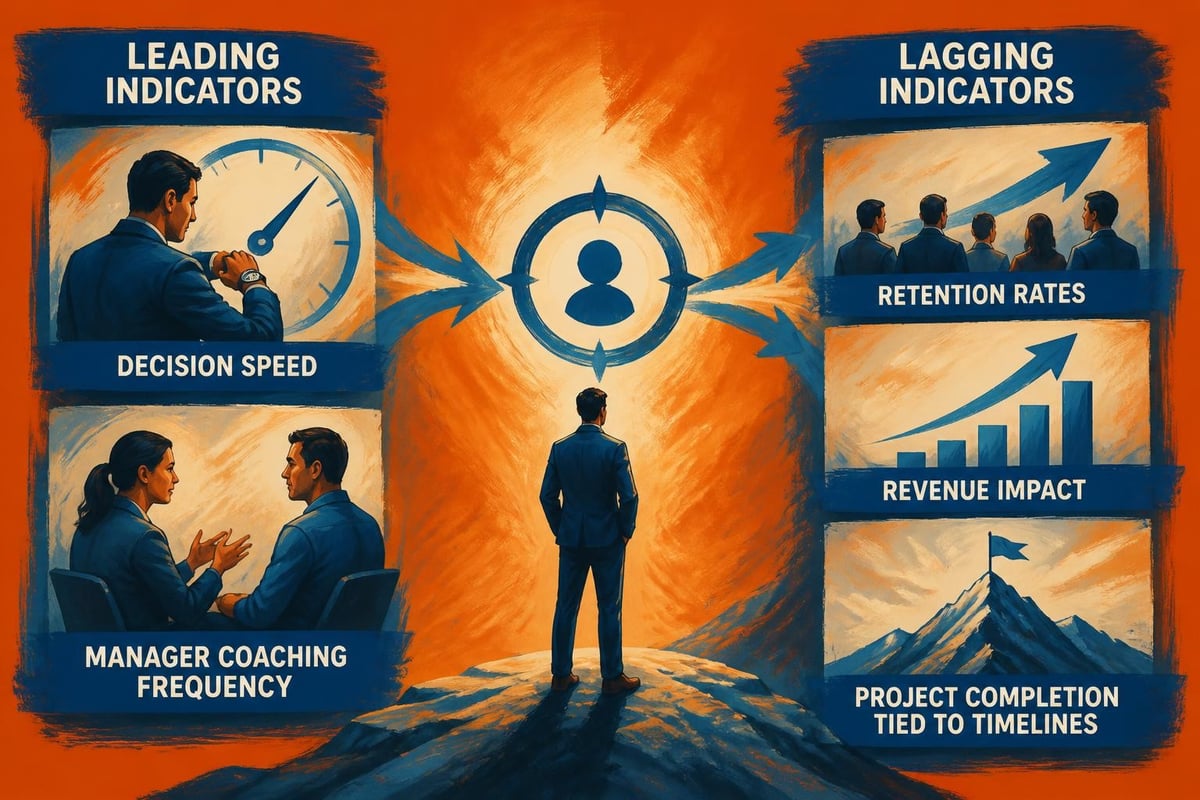
Companies experiencing the coaching advantage at work track leading and lagging indicators. Leading indicators include meeting quality, decision clarity, and manager coaching frequency. Lagging indicators cover retention, revenue impact, and project success rates.
Month-to-Month Accountability and Risk Sharing
The coaching advantage at work depends on aligned incentives. Long contracts with upfront fees create no urgency for coaches to deliver visible results. Month-to-month terms force both parties to stay accountable. If progress stalls or priorities shift, companies adjust without penalty. If coaches fail to move metrics, they don't get renewed.
Risk-sharing models we've observed working:
- Base fee plus performance bonus tied to retention improvement
- Reduced rates with revenue share on sales coaching engagements
- Tiered pricing based on manager promotion rates or engagement score movement
- Flat fee with extension bonuses for hitting agreed KPIs
These structures contrast sharply with challenges Fortune 500 leaders are facing where multi-year coaching contracts lock in mediocre results because exit costs exceed tolerance for change. Mid-market companies gain advantage by demanding proof before long commitments.
Contrarian Insight: Certifications Don't Predict Coaching Impact
The industry narrative says coaching credentials ensure quality. Pattern recognition across 200+ mid-market engagements tells a different story. Coaches with deep operating experience in sales, operations, or general management but no formal coaching certification consistently outperformed credentialed coaches with limited business background. Why? They recognized business patterns faster, spoke the language of metrics and execution, and earned credibility through demonstrated expertise rather than certificate displays.
This doesn't mean all certifications are worthless. It means buyers should weigh practical business experience, coaching track record with similar companies, and willingness to tie results to metrics ahead of credential collection. The coaching advantage at work comes from expertise applied in context, not theory memorized for exams.
The coaching advantage at work materializes when coaching integrates into your operating cadence, builds manager capability through live observation, and ties every intervention to measurable business outcomes. If you're ready to move beyond credential worship and theory sessions toward practical coaching that delivers visible results, explore how Noomii connects mid-market companies with coaches who roll up their sleeves, participate in your meetings, and share accountability for performance improvement through month-to-month engagements built on outcomes, not promises.
FAQ
What makes coaching at work more effective than traditional training programs?
Coaching at work addresses specific business challenges in real time rather than teaching generic skills in isolation. Coaches observe actual meetings, decisions, and interactions, then provide immediate feedback tied to company KPIs. Training programs deliver content in classroom settings disconnected from daily execution, resulting in low skill transfer rates.
How long does it take to see results from corporate coaching?
Leading indicators like decision speed and communication clarity typically improve within 4-8 weeks when coaches integrate into operating meetings. Lagging indicators such as retention rates and revenue impact become visible in 12-20 weeks. Timeline varies based on company size, engagement scope, and baseline performance levels.
Should we prioritize coach credentials or business experience when selecting coaches?
Business experience in relevant industries combined with a track record of measurable client outcomes predicts coaching effectiveness better than credentials alone. Look for coaches who have operated in roles similar to those they'll coach, speak your business language, and can reference specific client results tied to metrics.
What's the difference between executive coaching and manager development?
Executive coaching focuses on individual leader capability, decision-making, and strategic thinking. Manager development builds the capability of frontline and mid-level managers to coach their teams, run effective meetings, and drive execution. The most effective programs integrate both, teaching executives to develop their managers rather than treating coaching as a separate activity.
How do month-to-month coaching terms benefit mid-market companies?
Month-to-month terms force continuous accountability for results. If coaching isn't moving agreed metrics, companies can adjust without penalty. This contrasts with long contracts that lock in mediocre results. Coaches stay focused on visible progress because renewal depends on demonstrated impact, not contractual obligation.
What business metrics should we track to measure coaching ROI?
Track leading indicators including decision cycle time, meeting effectiveness scores, manager coaching frequency, and clarity ratings. Track lagging indicators including retention rates, promotion readiness, project completion rates, sales pipeline velocity, and engagement survey scores. Choose metrics aligned with your specific business priorities and coaching objectives.
How does coaching in meetings differ from offsite coaching sessions?
Coaching in meetings allows coaches to observe real decision-making, team dynamics, and communication patterns rather than relying on leader self-reporting. Feedback becomes immediate and specific to actual situations. Skills develop in operational context where they'll be used, increasing transfer and retention compared to offsite workshop settings.
Can coaching really improve sales and retention outcomes?
Yes, when tied directly to those objectives. Sales coaching that observes pipeline reviews, participates in deal strategy discussions, and coaches managers on team development typically improves win rates and pipeline velocity within 8-16 weeks. Retention improves when coaching addresses manager capability, communication clarity, and decision quality, the factors most correlated with employee engagement.
What's the ideal coaching engagement length for mid-market companies?
Initial engagements typically run 90-180 days to integrate coaches into operating rhythm, diagnose patterns, build manager capability, and demonstrate measurable progress. Many companies then shift to quarterly or monthly check-ins to sustain momentum. Avoid long contracts until you've validated coaching impact through at least one full quarter of visible results.



Leave a Reply
Want to join the discussion?Feel free to contribute!