

Certification Versus Client Acquisition in Coaching
Most mid-market companies hiring coaches don't ask about certification letters after your name. They ask what you've fixed, how fast you delivered, and whether you can prove it. The certification versus client acquisition debate misses this reality: buyers purchase outcomes, not credentials. This creates a painful gap for certified coaches who struggle to fill their pipeline while less credentialed practitioners with proven track records stay booked solid.
Why Certification Alone Won't Fill Your Calendar
The coaching industry has created a credential arms race that benefits training organizations more than working coaches. ICF credentials and similar certifications validate training hours and ethical standards, yet they don't teach client acquisition, diagnosis of business problems, or how to tie coaching to KPIs.
Three patterns emerge from thousands of corporate coaching engagements:
- Decision makers skip certification details and jump straight to case studies and references
- Procurement teams care about insurance and ethics, not training lineage
- Budget holders want ROI projections, not coursework transcripts
Understanding the difference between certification, credentialing, and accreditation helps coaches position themselves properly. But certification remains table stakes in certain markets, not a client magnet.
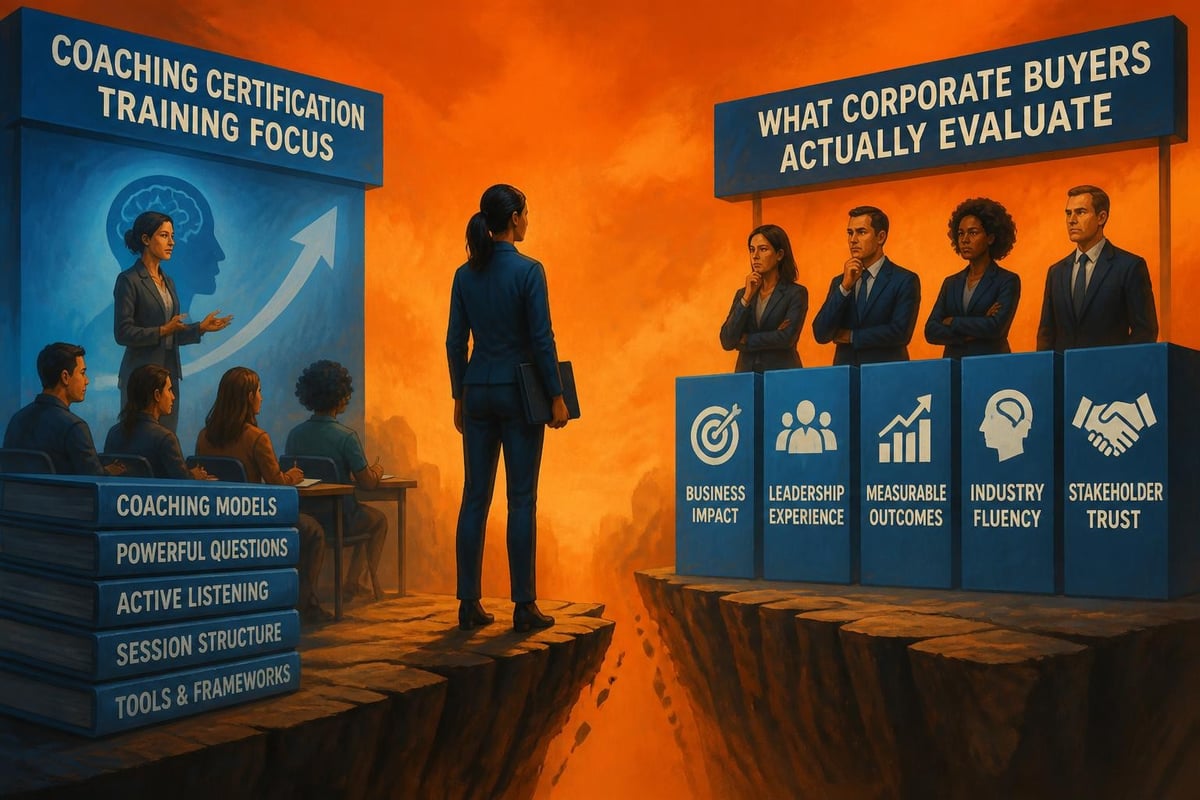
What Mid-Market Companies Actually Buy
Organizations with 25 to 500 employees operate differently than Fortune 500 divisions or solopreneurs seeking life coaches. They need practical solutions fast. When a VP of Operations says "my managers can't delegate" or "our leadership team talks past each other," they're describing business pain, not requesting certified methodologies.
The certification versus client acquisition gap widens because training programs teach:
- Questioning frameworks designed for one-on-one sessions
- Ethical boundaries appropriate for therapy-adjacent work
- Business setup and basic marketing tactics
- Theory-heavy models disconnected from operational reality
Meanwhile, buyers need coaches who can:
- Diagnose root causes in group settings quickly
- Coach live during actual leadership meetings
- Build scorecards that connect coaching to revenue, retention, or margins
- Adjust methods based on what moves the needle
| What Certification Teaches | What Buyers Actually Need |
|---|---|
| Listening and questioning techniques | Pattern recognition across industries |
| Session structure and presence | Real-time intervention in meetings |
| Ethics and boundaries | ROI projection and KPI alignment |
| Practice hours with peers | Case studies with measurable outcomes |
This explains why your certification alone will not get you clients. It's necessary in certain contexts but insufficient for consistent acquisition.
The Client Acquisition Signals That Matter More
After observing hundreds of successful coaching practices, five factors predict client flow better than credentials:
Specificity beats generalization. Executive coaches who say "I help Series B SaaS founders scale their leadership teams from 10 to 50 people" book faster than those claiming to "empower leaders to reach their potential." Narrow positioning communicates experience.
Proof precedes promises. A VP considering leadership development wants to see before-and-after metrics: turnover rates, promotion velocity, engagement scores, or revenue per employee. One anonymized case study with real numbers outweighs three certification logos.
Industry fluency closes deals. Understanding cap tables, gross margin, or EBITDA signals you've worked inside their world. Coaches who've held P&L responsibility or built teams themselves speak a different language than those trained only in coaching frameworks.
Speed and flexibility win. Mid-market companies can't wait for 12-week programs with rigid structures. They need someone who starts this week, coaches during their actual Monday leadership meeting, and adjusts based on what emerges. Month-to-month terms reflect this reality.
Referrability drives pipeline. The majority of corporate coaching work comes through direct referrals from previous clients, HR networks, and trusted advisors. Being remarkable at producing visible results matters more than being certified.

When Certification Actually Helps Acquisition
The certification versus client acquisition trade-off isn't binary. Credentials open doors in specific scenarios:
- Large enterprise procurement often requires certification for vendor approval
- Government and regulated industries mandate specific credentials
- Insurance and liability coverage may require ICF or equivalent certification
- First-time coaches use certification as borrowed credibility until they build case studies
Research on professional certifications in adjacent fields shows measurable revenue impact, but primarily when certification correlates with actual expertise and client outcomes. The certification itself doesn't cause the success; it signals investment in professional standards.
Why certification matters in life coaching differs from why it matters in corporate contexts. Individual consumers may value certification more heavily as a trust signal. Corporate buyers already have other trust mechanisms: references, case studies, pilot engagements, and network referrals.
Building a Client-Getting System Beyond Credentials
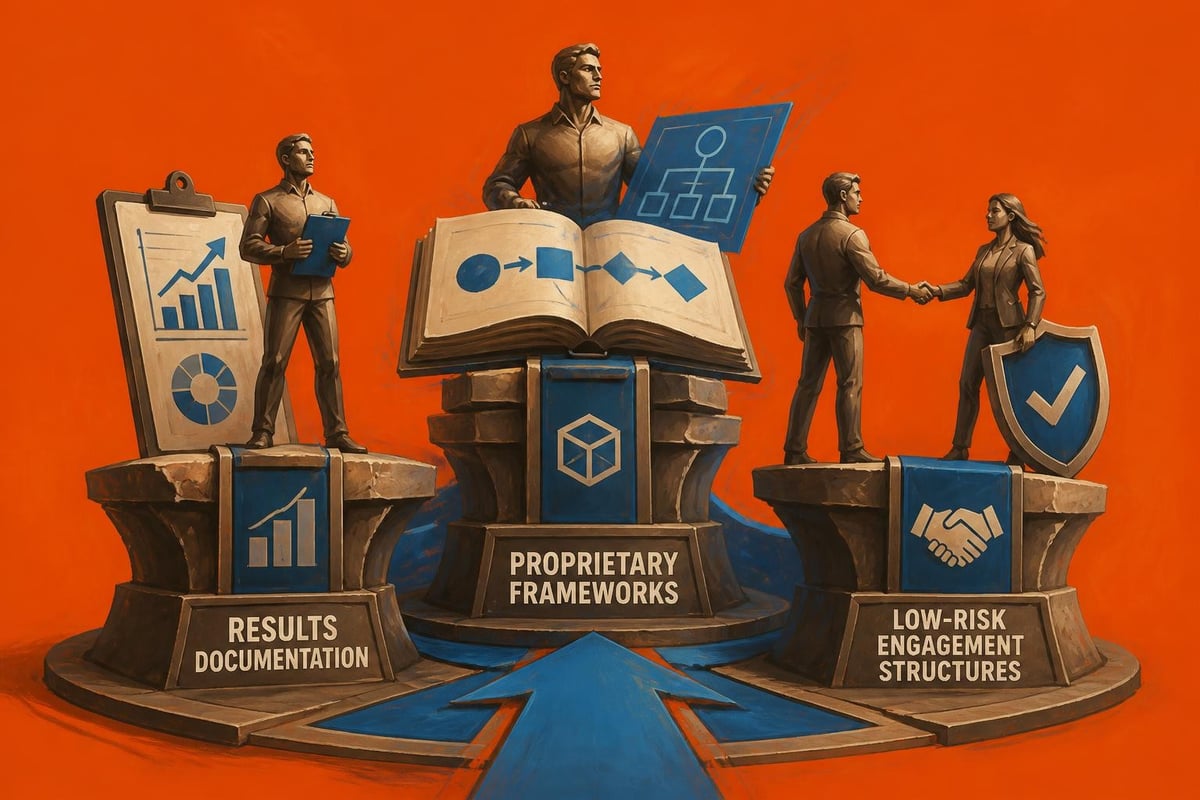
The coaches who solve the certification versus client acquisition puzzle do three things certification programs rarely teach:
Document Everything You Touch
Create a results library that captures:
- Initial diagnosis and hypothesis
- Specific interventions deployed
- Measurable changes in behavior or business metrics
- Client testimonials that mention specific outcomes
- Timeline from engagement start to visible improvement
This library becomes your actual sales tool. When a prospect describes a challenge, you can reference a similar situation, the solution you designed, and the result achieved.
Develop a Named Method or Framework
Certification teaches generic models. Effective practitioners develop proprietary approaches named after their insight. Examples include diagnostic assessments, facilitation formats, or scorecard designs that become associated with your practice.
A named method signals expertise. It suggests you've worked enough engagements to identify patterns and codify what works. Prospects remember "the KPI Alignment Sprint" more easily than "leadership coaching using ICF competencies."
Create Low-Risk Entry Points
Month-to-month terms, pilot programs, or shared-risk arrangements where part of your fee ties to measurable outcomes lower the barrier to trying you. Certification can't compete with "pay only if we hit the retention target together."
This approach particularly resonates with mid-market companies that lack the coaching budget sophistication of Fortune 500 firms but need results urgently.
What Google's Project Oxygen Teaches About This Debate
Google’s research on what makes effective managers identified eight behaviors that drive team performance. None involved credentials. All involved observable skills: being a good coach, empowering the team, being interested in employee success, being productive and results-oriented, communicating well, helping with career development, having a clear vision, and possessing key technical skills.
Organizations hiring coaches apply similar logic. They want evidence you can develop these behaviors in their leaders, measured through engagement scores, retention rates, or performance improvements. The certification versus client acquisition tension dissolves when you demonstrate this capability convincingly.
The pattern holds across industries and coaching specialties. Executive coaches working internationally succeed by showing cultural fluency and regional business context, not by stacking credentials. Leadership coaches in the United States differentiate through industry vertical expertise and proven methodologies, not training pedigree alone.
The Certification Trap for New Coaches
Many coaches spend $5,000 to $15,000 on certification, complete their hours, receive their credential, and then face an empty calendar. The certification versus client acquisition reality hits hard: training organizations sold education, not a business model.
This trap operates through three mechanisms:
Time displacement. Months spent in certification programs delay the market testing and iteration required to find your niche, refine your positioning, and develop your actual offer. Some coaches would progress faster by taking half those funds, working with five pilot clients at reduced rates, documenting the results thoroughly, and using those case studies for acquisition.
False confidence. Certification creates the illusion you're ready for any client. Reality teaches that industry context, business acumen, and situational pattern recognition matter more than coursework. The first ten real engagements teach more than most certification programs.
Misallocated investment. The money spent on certification might generate better ROI invested in a strong website, a results measurement system, attending industry conferences where buyers gather, or hiring a fractional business development consultant who understands corporate sales.
This doesn't argue against certification entirely. It questions whether certification should be your first major investment before testing market fit.
The certification versus client acquisition debate resolves when you recognize that credentials may open certain doors but proof of results keeps you booked. Mid-market organizations need coaches who diagnose quickly, intervene effectively, and tie progress to business metrics, not those with the longest string of letters after their name. Noomii connects companies with practical corporate coaches who deliver measurable outcomes through live facilitation, clear KPIs, and month-to-month accountability, helping you build leaders who actually move your business forward.
Frequently Asked Questions
Q: Does certification guarantee I'll get coaching clients?
A: No. Certification validates your training and ethical standards but doesn't directly generate client demand. Most corporate buyers prioritize proven results, relevant industry experience, and strong referrals over certification credentials when selecting coaches.
Q: When does certification actually help with client acquisition?
A: Certification helps most when selling to large enterprises with vendor requirements, regulated industries, government contracts, or when you need liability insurance that requires specific credentials. It's also useful for first-time coaches who lack case studies.
Q: What should I invest in instead of certification to get clients faster?
A: Focus on building a documented results library, developing industry-specific expertise, creating low-risk pilot programs, attending conferences where buyers gather, and building referral relationships with HR leaders and executives in your target market.
Q: How do I compete against certified coaches if I'm not certified?
A: Lead with specific case studies showing measurable outcomes, demonstrate deep industry knowledge, offer flexible engagement terms, provide clear ROI projections, and position your proprietary methods or frameworks as differentiated solutions to their exact problems.
Q: What matters more to corporate buyers than coaching certification?
A: Corporate buyers prioritize proven results in similar situations, industry fluency, ability to tie coaching to business KPIs, speed and flexibility in engagement structure, and strong references from peer companies or trusted advisors.
Q: Should new coaches get certified before taking clients?
A: Not necessarily. Many successful coaches start with pilot clients at reduced rates, document results thoroughly, build case studies, and invest in certification later only if their target market requires it or if they want the structured learning.
Q: How can I prove coaching ROI without certification credentials?
A: Track specific metrics before and after coaching engagements including retention rates, promotion velocity, engagement scores, revenue per employee, decision-making speed, or team performance indicators. Anonymized case studies with real numbers demonstrate value better than credentials.
Q: What's the biggest mistake coaches make regarding certification and clients?
A: Believing that completing certification means they're ready to attract clients. Most coaches need to invest equally in positioning, niche selection, case study development, and sales skills to build a sustainable practice.
Q: How do I position myself against more certified competitors?
A: Emphasize your practical business experience, specific industry expertise, measurable client outcomes, proprietary methodologies, and flexible engagement models. Many mid-market buyers value operational credibility over academic credentials.



Leave a Reply
Want to join the discussion?Feel free to contribute!