

Why Executive Coaching Often Fails: What Leaders Miss
Most organizations invest six figures annually in executive coaching programs that produce minimal measurable impact. The gap between expectation and reality isn't a mystery. After analyzing hundreds of corporate coaching engagements across government agencies and Fortune 500 companies, patterns emerge that explain why executive coaching often fails. The root causes are addressable, but only if leadership teams acknowledge what's actually broken.
The Coach Selection Problem No One Discusses
Organizations treat coach selection like vendor procurement rather than talent matching. The result is predictable mediocrity.
Comfort Over Competence
HR teams routinely select coaches based on familiarity, industry reputation, or existing relationships. This approach ignores a fundamental truth: the executive who needs developmental coaching most rarely responds to the coach who makes them comfortable. Research on coaching failures confirms that selecting for comfort rather than fit undermines engagement before the first session occurs.
The mismatch manifests in several ways:
- Senior leaders paired with generalist coaches lacking sector expertise
- Technical executives matched with coaches who have no operational background
- Change-resistant leaders assigned to coaches without behavioral intervention experience
- High-performing toxic leaders connected to coaches trained only in supportive methods
One government agency spent $340,000 on coaching for 12 senior executives in 2025. They used three coaches from their approved vendor list. Eight months later, behavioral assessments showed zero improvement in the targeted leadership competencies. The diagnosis was straightforward: none of the coaches had experience addressing entrenched resistance patterns or navigating public sector governance constraints.
The Missing Diagnostic Phase
Most coaching engagements begin with a kickoff conversation, not a structured diagnostic. This violates basic problem-solving principles. You cannot solve what you haven't accurately defined.
Organizations that skip evidence-based leadership diagnostics make three critical errors. First, they assume the presenting problem is the actual problem. Second, they allow executives to self-diagnose developmental needs without objective data. Third, they fail to identify systemic organizational factors that will undermine individual coaching work.
| Diagnostic Element | Standard Approach | Evidence-Based Approach |
|---|---|---|
| Problem Definition | Self-reported by executive | Validated assessment tools + 360 feedback + performance data |
| Success Criteria | Vague ("better leadership") | Specific KPIs tied to organizational outcomes |
| Systemic Factors | Ignored or minimized | Mapped and addressed in coaching plan |
| Baseline Measurement | Rarely established | Required before engagement begins |
A manufacturing company engaged coaching for five plant managers with "communication issues." Diagnostic assessments revealed the actual problem: unclear decision rights, competing directives from regional leadership, and zero accountability for cross-functional collaboration. The communication challenges were symptoms, not causes. Without addressing the systemic dysfunction, individual coaching would fail regardless of coach quality.
Why Executive Coaching Often Fails: Organizational Complicity
The phrase "executive resistance" appears in nearly every post-mortem on failed coaching engagements. This framing is incomplete. Executives resist when organizations create conditions that make coaching ineffective or risky.
No Executive Commitment Structure
Coaching requires time, vulnerability, and behavioral experimentation. Organizations that fail to create explicit protection for these requirements guarantee poor outcomes. Common approaches that lead to coaching failure include treating coaching as an optional activity that gets deprioritized when workload increases.
What organizational commitment actually requires:
- Protected time in calendars that cannot be overridden for operational demands
- Direct manager involvement in defining success criteria and reviewing progress
- Explicit messaging that coaching participation is strategic work, not personal development
- Consequences for non-participation or surface engagement
- Budget allocation that extends beyond initial engagement to reinforce behavioral change
A Fortune 500 financial services firm launched executive coaching for 40 vice presidents. Participation was "encouraged" but not required. Calendar invites were suggestions, not commitments. Within six weeks, 70% of sessions were being rescheduled or cancelled. The program was terminated after five months with participation rates below 40%. The organization blamed "executive schedules" rather than acknowledging they had designed the program to fail.
The Disengaged Boss Factor
Multiple analyses of coaching failures identify the same pattern: when an executive's direct manager is uninvolved in the coaching process, effectiveness drops dramatically. This isn't about micromanagement. It's about alignment and accountability.
Coaching creates change. Change requires support from the system. When a coached executive's boss doesn't understand the developmental goals, doesn't reinforce new behaviors, and doesn't adjust expectations to allow for experimentation, the executive faces an impossible choice: maintain old patterns or risk conflict with their manager.
One technology company invested in coaching for directors transitioning to VP roles. The CEO supported the initiative but didn't brief existing VPs on what to expect. When newly promoted leaders began testing different delegation approaches and decision frameworks, their managers interpreted the changes as inconsistency or lack of confidence. Three of seven participants reverted to previous behaviors within 60 days. The coaching "failed" because the organizational context was hostile to the intended development.

The Measurement Deficit That Masks Failure
Organizations that cannot measure coaching impact cannot improve coaching effectiveness. This creates a self-perpetuating cycle of mediocre programs.
Vanity Metrics Versus Real Outcomes
Post-engagement surveys showing that 85% of participants "found coaching valuable" reveal nothing about whether leadership capability improved or organizational outcomes changed. These satisfaction scores allow HR teams to report success while actual performance gaps persist unchanged.
Meaningful coaching measurement requires:
- Pre and post behavioral assessments using validated instruments
- 360-degree feedback comparing perception shifts across reporting relationships
- Specific performance metrics tied to the competencies being developed
- Team engagement or cultural health indicators when addressing leadership impact
- ROI calculations linking coaching investment to retention, productivity, or strategic outcomes
A healthcare system spent $280,000 on executive coaching across 15 senior leaders in 2024. Their evaluation consisted of participant satisfaction surveys and coach session attendance tracking. Both metrics exceeded 90%. When the CHRO analyzed actual leadership effectiveness through employee engagement scores, conflict incident rates, and succession bench strength, none showed improvement. The measurement framework had been designed to confirm success regardless of actual impact.
The Six-Month Abandonment Pattern
Most executive coaching engagements run six to twelve months. Behavioral change research shows that sustained transformation requires 18 to 24 months of consistent reinforcement. This timing gap explains why executive coaching often fails to produce lasting results even when initial progress occurs.
Organizations declare victory when the coaching engagement ends, not when new behaviors become embedded leadership habits. Without structured reinforcement, follow-up accountability, or environmental support, executives revert to previous patterns when pressure increases or organizational priorities shift. The return on coaching investment evaporates, but the measurement timeline has already concluded, so the regression goes undocumented.
The Hidden Resistance No One Addresses
Research on why coaching fails identifies 33 potential failure points, but one factor dominates: executives' internal resistance to examining how their own thinking patterns create the problems they're trying to solve. Most coaching approaches are poorly equipped to address this dynamic.
The Self-Awareness Trap
The assumption that increased self-awareness automatically generates behavioral change is perhaps the most common mistake in executive coaching. Executives can become extraordinarily self-aware about their dysfunctional patterns while continuing to execute those patterns with minimal modification.
One executive could articulate precisely how his need to control decision-making created bottlenecks, frustrated his direct reports, and limited organizational agility. He could describe the childhood experiences that shaped this pattern. He understood the business consequences. He did not delegate differently. Self-awareness without structured behavioral intervention and accountability produces insight without impact.
When Coaching Ignores Power Dynamics
Executive coaching typically treats leaders as individuals seeking personal growth. This framing ignores how positional power, organizational politics, and cultural norms shape what executives can actually change. Coaches who lack sophisticated understanding of these dynamics waste time on interventions that organizational reality will immediately override.
A chief operating officer received coaching focused on developing a more collaborative leadership style. The organizational culture rewarded aggressive individual accountability and punished perceived weakness. The CEO modeled command-and-control decision-making. Performance reviews emphasized decisive action over consensus-building. The coached executive attempted collaborative approaches, received negative feedback from peers and superiors, and returned to previous behaviors. The coaching "failed" because it operated in a vacuum disconnected from organizational power structures. Understanding how psychological safety operates in high-performing teams would have revealed this disconnect before the engagement began.

What Successful Coaching Actually Requires
Organizations that achieve measurable impact from executive coaching programs share specific characteristics that unsuccessful programs ignore.
Precision in Problem Definition
Before selecting a coach or beginning sessions, successful organizations conduct rigorous diagnostics that answer four questions:
- What specific leadership behaviors or competencies need to change?
- What organizational outcomes will improve when these changes occur?
- What systemic factors currently reinforce the problematic patterns?
- What environmental modifications are required to support new behaviors?
This diagnostic rigor prevents the most common failure pattern: solving the wrong problem efficiently. It also creates clear success criteria that enable meaningful measurement. Organizations that understand why coaching demand is growing but skip this foundational work join the majority of failed programs.
Coach-Client Matching That Addresses Reality
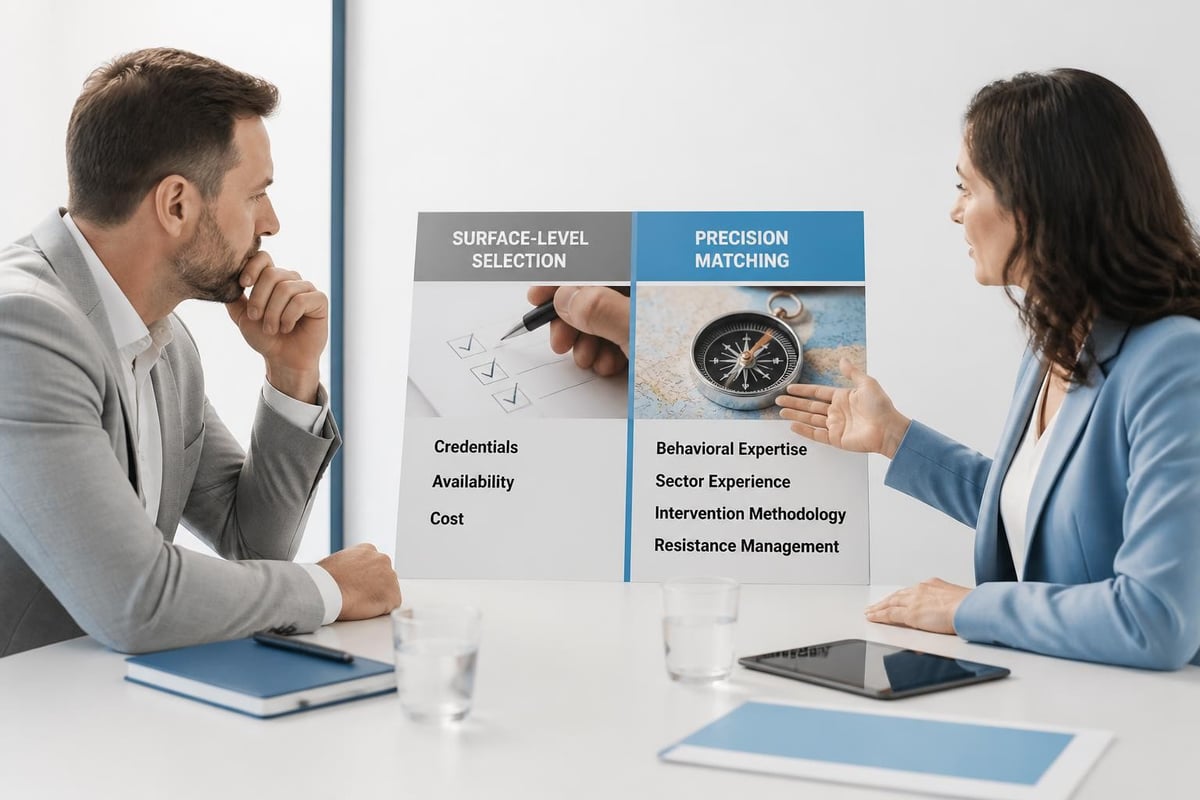
Generic coaching credentials matter less than specific expertise aligned to the executive's developmental challenge and organizational context. An executive struggling with conflict avoidance requires different coaching expertise than one managing toxic team dynamics or navigating strategic ambiguity.
Critical matching criteria include:
- Direct experience with the behavioral pattern being addressed
- Sector or industry knowledge relevant to the organizational context
- Methodology appropriate to the executive's resistance profile
- Track record with similar leadership levels and organizational complexity
- Cultural competence for the specific work environment
Organizations that treat all coaches as interchangeable based on certification credentials alone increase failure probability substantially. The matching process should be as rigorous as executive hiring, not procurement processing.
Structured Accountability Beyond Sessions
Coaching conversations create insights and commitments. What happens between sessions determines whether those commitments translate into behavioral change. Successful programs build structured accountability through several mechanisms:
- Regular check-ins between the executive's manager and coach (with executive consent)
- 360-degree feedback cycles timed to capture behavioral shifts
- Team or peer feedback integrated into coaching focus areas
- Environmental modifications that make new behaviors easier to sustain
- Executive peer cohorts that provide lateral accountability
A global consulting firm restructured their leadership and executive coaching program to include monthly triad meetings between each coached partner, their practice lead, and their coach. These 30-minute sessions focused exclusively on behavioral experiments, obstacles encountered, and system-level barriers requiring escalation. Partnership retention improved 23% and client satisfaction scores increased significantly for coached partners compared to historical baselines.
The Financial Reality Organizations Avoid
Executive coaching programs represent substantial investments. Understanding what business coaching costs helps organizations set realistic budgets, but few calculate the opportunity cost of ineffective programs.
The Hidden Costs of Failed Coaching
When executive coaching fails, organizations lose more than the engagement fees. Failed coaching damages executive confidence in developmental interventions, wastes HR credibility on ineffective programs, and delays addressing genuine leadership gaps while problems compound.
One manufacturing company spent $420,000 over 18 months on coaching that produced no measurable improvement in targeted leadership competencies. During that same period, three high-potential directors left citing lack of leadership effectiveness in their chain of command. Replacement costs, lost institutional knowledge, and delayed strategic initiatives totaled over $2 million. The failed coaching program's actual cost was five times the engagement fees.
ROI Requires Measurement Infrastructure
Organizations serious about coaching ROI build measurement systems before programs launch, not after. This infrastructure includes baseline data collection, interim progress tracking, outcome measurement at program completion, and longitudinal follow-up to assess sustainability.
| Measurement Component | Purpose | Timeline |
|---|---|---|
| Baseline Assessment | Establish starting point for all targeted competencies | Before coaching begins |
| Behavioral Progress Tracking | Monitor adoption of new approaches and identify obstacles | Monthly during engagement |
| Stakeholder Feedback | Assess whether changes are observable to relevant audiences | Quarterly during engagement |
| Outcome Measurement | Quantify impact on predefined organizational metrics | At engagement completion |
| Sustainability Check | Verify behavioral changes persist under pressure | 6 and 12 months post-engagement |
Organizations that implement this measurement discipline can answer definitively whether coaching delivered value. Those that rely on satisfaction surveys and attendance tracking cannot.
Governance and Compliance Factors
Government agencies and regulated industries face additional constraints that impact coaching effectiveness. Programs that ignore these requirements create implementation obstacles that undermine even well-designed interventions.
Regulatory Alignment Requirements
Public sector organizations and regulated entities must ensure coaching initiatives comply with procurement rules, ethics guidelines, and documentation standards. Coaches unfamiliar with these constraints recommend approaches that violate policy or create compliance risk.
One federal agency's coaching program nearly collapsed when the selected coaches proposed assessment tools that hadn't been validated for government use and recommended feedback processes that violated personnel regulations. Three months were lost redesigning the program to meet compliance requirements. Had governance factors been integrated during design, this delay would have been prevented.
Transparency and Documentation Standards
Organizations subject to oversight or audit requirements need coaching programs with robust documentation, clear decision trails, and defensible selection criteria. The informal, relationship-based coaching engagements common in private sector settings create unacceptable risk in these environments.
Successful programs build compliance into program design rather than treating it as an administrative burden. This includes documented coach selection criteria, standardized assessment protocols, consistent progress tracking, and clear linkage between coaching objectives and organizational mission requirements.
FAQ
What is the main reason why executive coaching often fails?
The primary reason executive coaching fails is misalignment between the coach's capabilities and the executive's specific developmental needs, compounded by lack of organizational support for behavioral change. Without precision matching and systemic reinforcement, even skilled coaches cannot overcome structural barriers to effectiveness.
How can organizations measure executive coaching success?
Successful measurement requires baseline behavioral assessments before coaching begins, quarterly 360-degree feedback during engagement, and specific KPIs linking coached competencies to organizational outcomes. Post-engagement satisfaction surveys alone are insufficient and often mask coaching failures.
What role does an executive's manager play in coaching success?
The executive's direct manager must be actively involved in defining coaching objectives, understanding developmental focus areas, reinforcing new behaviors, and adjusting expectations to support experimentation. When managers are disengaged from the coaching process, effectiveness drops substantially regardless of coach quality.
How long should executive coaching engagements last?
While most engagements run six to twelve months, sustained behavioral change typically requires 18 to 24 months of reinforcement. Organizations that declare success when coaching ends, without structured follow-up, often see executives revert to previous patterns when organizational pressure increases.
What should organizations look for when selecting executive coaches?
Organizations should prioritize specific expertise aligned to the executive's developmental challenge over generic credentials. Critical factors include direct experience addressing similar behavioral patterns, relevant sector knowledge, appropriate intervention methodology, and cultural competence for the organizational environment.
Why do executives resist coaching even when they recognize they need it?
Executive resistance often stems from organizational factors rather than individual unwillingness. When coaching participation isn't protected time, when managers don't support developmental goals, or when organizational culture punishes the vulnerability required for growth, rational executives resist engagement that creates professional risk.
Why executive coaching often fails comes down to preventable design flaws: poor coach matching, absent diagnostics, missing organizational support, and measurement systems designed to hide rather than reveal impact. Organizations that address these structural factors transform coaching from an expensive ritual into a strategic capability that develops leadership bench strength, improves retention, and drives measurable performance improvement. The Noomii Leadership Coaching program combines evidence-based diagnostics, precision coach matching using proprietary algorithms, and structured accountability systems that address the root causes of coaching failure while delivering measurable results aligned to your organizational priorities.



Leave a Reply
Want to join the discussion?Feel free to contribute!