

What Economic Uncertainty Means for Coaches in 2026
Economic downturns reveal which coaching practices built on solid value and which coasted on corporate training budgets. Understanding what economic uncertainty means for coaches isn’t about surviving a rough quarter. It’s about recognizing that the entire relationship between coaching and business results is being stress-tested right now, and the coaches who can’t demonstrate measurable impact won’t make it to recovery.
The Budget Scrutiny Reality
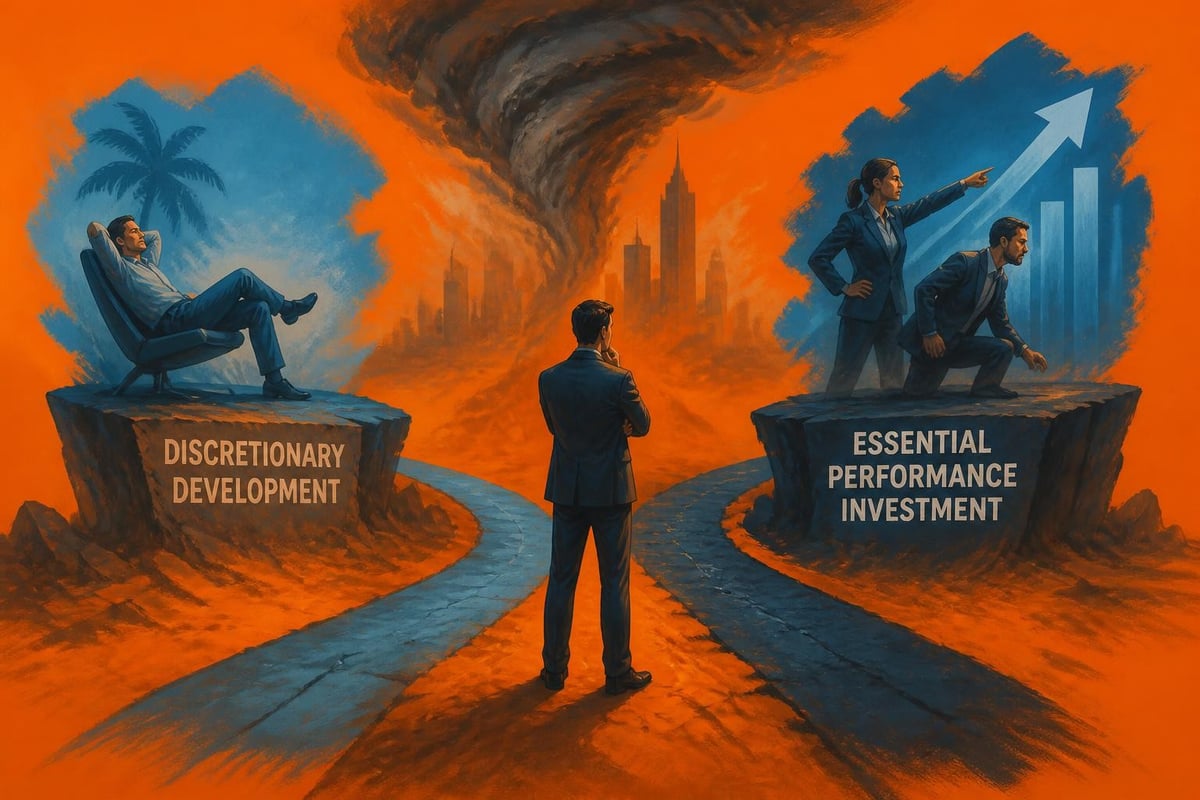
When CFOs sharpen their pencils, coaching often appears in two columns: discretionary development spend or essential performance investment. The difference determines whether your engagement continues or gets cut in the next round of budget reviews.
Coaching expenses that survive scrutiny:
- Leadership development tied to specific retention metrics
- Sales coaching with documented pipeline improvement
- Manager training that reduces HR escalations
- Team facilitation that accelerates project delivery
- Executive coaching for critical succession plans
What gets eliminated first:
- Exploratory discovery sessions without clear outcomes
- Certification-focused programs disconnected from business goals
- Long-term development plans with vague milestones
- Coaching engagements measured only by participant satisfaction
The pattern is consistent. Building a resilient coaching business during uncertain economies requires quantifying the value created, not just the hours delivered.
What Economic Uncertainty Means for Coaches: Service Adaptation
Coaches who maintain steady revenue during economic uncertainty share a common trait: they shifted what they sell before their clients demanded it. The traditional coaching model, focused on personal growth and long-term development, doesn’t match what companies need when they’re managing headcount, watching cash flow, and fighting for market share.
The Service Mix That Works Now
| Traditional Offering | What Companies Actually Buy |
|---|---|
| Leadership development program | Manager training that reduces turnover costs |
| Executive coaching package | Performance coaching tied to revenue goals |
| Team building workshop | Facilitation that resolves project bottlenecks |
| 360 assessment | KPI scorecards with accountability systems |
This shift doesn’t mean abandoning coaching fundamentals. It means framing those fundamentals around business outcomes that CFOs can justify. When Forbes discusses building coaching businesses during economic crises, the emphasis consistently lands on adapting services to meet current client needs, not waiting for the market to return to previous spending patterns.
Pricing Strategy Under Pressure
Month-to-month terms replaced annual contracts for good reason. Companies won’t commit to long coaching engagements when they can’t predict headcount six months out. This creates a pricing challenge: how do you maintain revenue without locking clients into commitments they’ll resent?
Three pricing models that work:
- Performance incentives – Base fee plus bonuses tied to measurable outcomes like retention improvement or sales target achievement
- Modular engagements – Separate pricing for assessment, implementation, and reinforcement phases clients can start and pause
- Shared risk arrangements – Reduced upfront fees with success-based payments when results exceed baseline
The coaches struggling right now are those who built their business on premium pricing justified by credentials rather than outcomes. A $15,000 monthly retainer doesn’t survive scrutiny when the ROI case depends on “leadership presence” instead of reduced manager turnover or faster decision-making.
Leading Teams Through Uncertainty
What economic uncertainty means for coaches extends beyond their own business survival. The leaders and managers they serve face unprecedented pressure to maintain team performance while managing anxiety, doing more with less, and navigating constant change.
Effective leadership during economic uncertainty requires coaches to shift from facilitation to in-the-trenches support. This means:
- Coaching live during actual team meetings where decisions stall
- Building scorecards that make priorities and accountability visible
- Training managers to have difficult conversations about performance
- Facilitating rapid problem-solving when projects hit obstacles
Theory doesn’t help. Frameworks presented in slide decks don’t change behavior. The coaching that survives budget cuts is coaching that shows up where work happens and ties directly to business results leaders can measure.

The Credential Versus Experience Debate
Economic uncertainty exposes an uncomfortable truth: coaching certifications mean almost nothing to clients under financial pressure. When budgets tighten, companies stop paying for credentials and start demanding proof of results.
I’ve watched this pattern for years. The coach with an ICF Master Certified credential gets passed over for the former operator who improved sales team performance by 40% in their last three engagements. The beautifully designed coaching program loses to the scrappy facilitator who shows up at 6 AM to coach the leadership team through their weekly operating review.
What Buyers Actually Evaluate
- Track record – Documented results with similar companies
- Industry knowledge – Understanding their business model and challenges
- Practical experience – Operating background, not just coaching training
- Flexibility – Willingness to adapt approach based on what’s working
- Speed – How quickly they can deliver visible improvements
This doesn’t mean credentials are worthless. It means they’re table stakes at best, and often irrelevant when companies need performance improvement right now. The performance coaching directory shows which coaches emphasize results over certifications.
Communication and Transparency
When managers lead teams during economic uncertainty, the coaches supporting them must model the same transparency and clear communication they’re teaching. This creates an interesting dynamic: coaches who can’t articulate their own value clearly shouldn’t be coaching executives on communication.
The transparency test:
- Can you explain exactly what measurable outcome your coaching will deliver?
- Can you show how that outcome ties to a specific business metric?
- Can you quantify the financial impact if that outcome is achieved?
- Can you describe what success looks like in 30, 60, and 90 days?
If those answers are vague, your coaching engagement is at risk regardless of how well sessions feel to participants.
The Resilience Factor
Building financial resilience applies equally to coaching businesses and the companies they serve. Coaches who maintain stable revenue during downturns typically have three characteristics:
- Diversified revenue across multiple clients rather than dependence on one or two large accounts
- Cash reserves sufficient to cover 6-12 months of expenses without new sales
- Flexible cost structure that scales down when demand drops without destroying the business
The coaches who panic during economic uncertainty are those who built practices dependent on steady corporate training budgets and premium pricing. When both disappear simultaneously, they discover their business had no resilience built in.

Adapting Your Positioning
What economic uncertainty means for coaches ultimately comes down to market positioning. Are you positioned as a nice-to-have development resource or an essential performance partner? The answer determines whether you’re fighting for scraps in a shrinking market or responding to increased demand.
Positioning shifts that work:
- From “leadership development” to “manager effectiveness that reduces HR costs”
- From “executive coaching” to “leadership coaching tied to strategic objectives”
- From “team building” to “team performance optimization with clear KPIs”
- From “culture transformation” to “accountability systems that drive execution”
These aren’t semantic games. They represent fundamental changes in what you sell, how you deliver it, and how clients evaluate whether it worked. Companies will continue buying coaching during economic uncertainty. They just won’t buy the same coaching they bought during growth periods.
The coaches who thrive are those who made this shift before it became mandatory. They built businesses on outcomes, not credentials. They priced based on value delivered, not hours consumed. They showed up where work happens rather than conducting sessions in conference rooms. And they can articulate ROI in terms CFOs understand, not coaching jargon that sounds impressive but means nothing to finance teams.
FAQ
What happens to coaching demand during economic downturns?
Total coaching demand doesn’t disappear during downturns, but it shifts dramatically toward performance coaching with measurable ROI. Discretionary development programs get cut while coaching tied to retention, sales performance, and operational efficiency often increases as companies need faster results from existing teams.
Should coaches lower their prices during economic uncertainty?
Lowering prices without changing your value proposition is a race to the bottom. Instead, restructure pricing around outcomes with performance incentives, shared risk models, or modular engagements that let clients control spending. Month-to-month terms work better than discounted annual contracts.
How can coaches prove ROI to skeptical buyers?
Tie every engagement to specific business metrics: retention rates, sales pipeline value, time to decision, project completion rates, or engagement scores. Track baseline performance before coaching starts, measure during the engagement, and document the financial impact of improvements. Vague participant satisfaction doesn’t justify budget.
What services do companies buy during uncertain times?
Companies prioritize coaching that addresses immediate pain: manager training that reduces turnover costs, sales coaching that improves close rates, team facilitation that breaks project bottlenecks, and leadership development for critical succession plans. Long-term exploratory development gets eliminated first.
How do coaching contracts change during downturns?
Long-term contracts become nearly impossible to sell during uncertainty. Month-to-month terms, performance-based pricing, and clearly defined exit points give companies the flexibility they need while providing coaches with opportunities to demonstrate value and extend engagements organically.
Should coaches specialize or diversify during economic uncertainty?
This depends on your market position. Deep specialization in a recession-resistant industry or high-demand service provides stability. Broad diversification across multiple client types and service offerings creates resilience if one segment collapses. The worst position is narrow specialization in a declining market.
What makes a coaching business financially resilient?
Financial resilience requires three elements: diversified revenue across multiple clients (no single client representing more than 25% of revenue), cash reserves covering 6-12 months of expenses, and a flexible cost structure that scales down without destroying service quality or business operations.
How should coaches communicate value during budget scrutiny?
Speak in business terms, not coaching language. Replace “enhanced leadership presence” with “managers making faster decisions with less escalation.” Replace “improved team dynamics” with “projects completing on schedule with fewer conflicts.” Quantify everything possible and tie it to metrics finance teams track.
Do coaching credentials matter during economic downturns?
Credentials matter far less during downturns than track record, industry knowledge, and documented results. Companies under financial pressure don’t pay premium prices for certification letters. They pay for coaches who can demonstrate they’ve solved similar problems and delivered measurable improvements in comparable environments.
Economic uncertainty separates coaches who deliver measurable business value from those who coasted on development budgets and credential worship. The practices that survive are those built on outcomes, flexibility, and proven results rather than certifications and long-term contracts. If your mid-market company needs leadership development and team coaching that ties directly to performance metrics, month-to-month terms, and visible ROI, Noomii Corporate Coaching delivers practical coaching focused on business results, not theory.



Leave a Reply
Want to join the discussion?Feel free to contribute!