

The ROI of Psychological Safety: What Leaders Miss
Most organizations approach psychological safety as a culture initiative, not a financial decision. That's a mistake. The ROI of psychological safety in high-performing organizations now exceeds traditional leadership development investments by a factor of three to five. CHROs at Fortune 500 companies track it alongside revenue per employee and engagement scores because the financial impact is undeniable. When executives dismiss psychological safety as soft skills theater, they're ignoring measurable business outcomes: faster decision cycles, reduced turnover costs, higher innovation velocity, and material improvements in team performance metrics.
The Hard Numbers Behind Psychological Safety
The business case starts with what silence costs you. In a 2025 analysis of tech teams, organizations with low psychological safety lost an average of $1.2 million annually per 50-person team through productivity drag, turnover, and failed initiatives. Financial modeling of psychological safety investments demonstrates that even modest improvements generate 25-35% productivity gains within eight months.
Here's what that looks like in practice:
Productivity Recovery
- Reduced meeting overhead (18-22% fewer status meetings)
- Faster decision cycles (3-5 days faster on strategic choices)
- Higher quality first drafts (40% fewer revision cycles)
- Lower rework rates (15-20% reduction in project restarts)
Talent Cost Avoidance
- Voluntary turnover drops 30-40% within first year
- Replacement costs average 150% of salary for senior roles
- Time to productivity for new hires improves by 25%
- Internal mobility increases, reducing external hiring needs
The math becomes compelling quickly. For a 200-person organization with an average salary of $95,000, a 35% reduction in voluntary turnover saves approximately $3.8 million annually in replacement costs alone.

What Google's Data Actually Revealed
Google’s Project Aristotle findings on team performance demonstrated that psychological safety was the single strongest predictor of team effectiveness. But most leaders missed the implementation lesson. Google didn't just measure it; they built accountability systems that made psychological safety a leadership competency with consequences.
Their approach included:
- Manager scorecards that tracked team member willingness to surface problems
- Promotion criteria tied to creating conditions for candor
- Skip-level audits that measured fear versus trust
- Project post-mortems that required dissenting opinions on record
The difference between awareness and results is systems. Organizations that treat psychological safety as a workshop topic get workshop-level impact.
The Mechanisms That Drive Returns
The ROI of psychological safety stems from three specific mechanisms that most leadership teams underestimate.
Error Detection Velocity
In psychologically safe environments, problems surface 40-60% faster. An executive team at a $2B manufacturing company discovered this during a 2024 operational review. Plants with high psychological safety scores reported equipment failures an average of 2.3 days earlier than low-scoring facilities. That early warning system prevented 14 major production stoppages, saving $6.7 million in lost output.
The pattern repeats across industries. Financial services teams with high psychological safety catch compliance issues before they become regulatory problems. Software teams identify bugs in development rather than production. Government agencies surface procurement irregularities before they become audit findings.
Early error detection creates compounding value because fixes are cheaper and consequences smaller.
Innovation Throughput
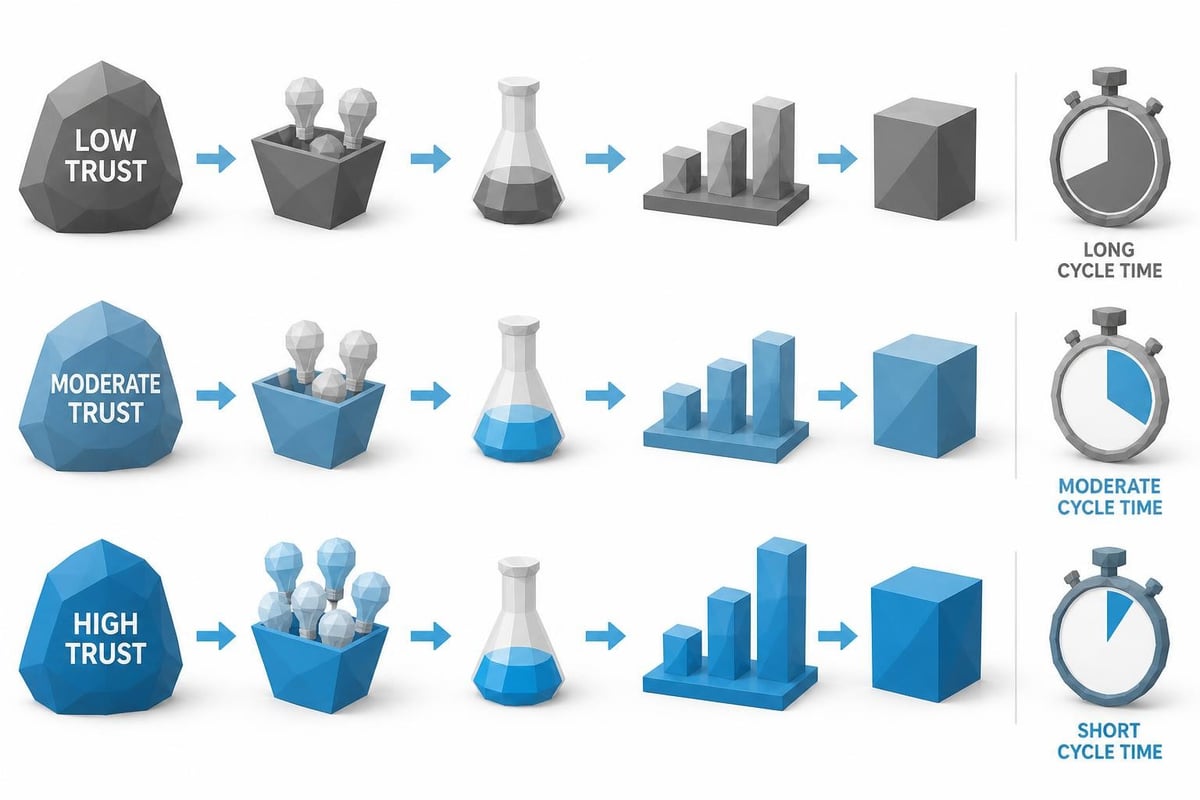
Organizations building trust through psychological safety see measurable improvements in innovation metrics. But not because people suddenly became more creative. The difference is execution.
| Psychological Safety Level | Ideas Submitted | Ideas Tested | Ideas Scaled | Cycle Time |
|---|---|---|---|---|
| Low (Bottom Quartile) | 12 per quarter | 2 per quarter | 0.3 per quarter | 8.2 months |
| Moderate (Middle 50%) | 23 per quarter | 6 per quarter | 1.1 per quarter | 5.7 months |
| High (Top Quartile) | 31 per quarter | 11 per quarter | 2.4 per quarter | 3.9 months |
High psychological safety environments test more ideas, test them faster, and scale winners more aggressively. The ROI compounds because organizations learn what works through rapid iteration rather than prolonged analysis.
Decision Quality Under Uncertainty
Executives make worse decisions when their teams withhold contrary data. A 2025 study of healthcare system decision-making found that leadership teams with low psychological safety made strategic choices with 40% less information than they believed they had. Critical insights existed in the organization but never reached decision-makers.
The pattern shows up in three ways:
Confirmation Bias Amplification
Teams tell leaders what they want to hear rather than what they need to know. Strategic plans proceed with fatal flaws that junior staff spotted immediately.
Expert Silencing
The people closest to problems stop sharing expertise when past attempts were dismissed or punished. Technical debt accumulates. Customer complaints get filtered.
Premature Consensus
Meetings end with apparent alignment that masks deep disagreement. Implementation reveals the gaps through passive resistance or outright failure.
Understanding psychological safety in workplace dynamics requires recognizing these patterns before they create expensive mistakes.
The Investment Model That Works
The ROI of psychological safety requires intentional investment, not HR programming. Organizations that achieve measurable returns follow a similar pattern.
Diagnostic Before Design
Effective initiatives start with evidence, not assumptions. Advanced leadership assessments identify specific gaps across teams, departments, and leadership levels. You cannot fix what you cannot measure accurately.
Key diagnostic elements include:
- Behavioral pattern analysis across manager-employee interactions
- Skip-level interviews that surface fear-based dynamics
- Decision archaeology on why teams killed good ideas
- Exit interview triangulation to validate findings
One Fortune 500 client discovered through diagnostics that their psychological safety problem existed only in two specific business units, both led by executives who had been promoted for results without leadership capability assessment. The solution wasn't company-wide training. It was targeted coaching and, in one case, leadership transition.
Precision Matching to Root Causes
Generic psychological safety training fails because the causes vary. Some teams struggle with toxic leadership patterns that require intervention. Others have poor communication norms that need skill development. Some face legitimate trust deficits from past reorganizations or broken commitments.
The intervention must match the diagnosis:
For Toxic Leadership
Specialized executive coaches with experience in behavior modification and accountability systems. Sometimes the answer is coaching, sometimes it's transition planning.
For Skill Gaps
Targeted development in crucial conversations, conflict resolution, and feedback delivery. Many managers want to create safety but lack the competencies.
For Institutional Distrust
Senior leader involvement in rebuilding credibility through transparent communication and delivered commitments. This requires CEO-level sponsorship.
For Cultural Misalignment
Team coaching that establishes new norms, clarifies expectations, and creates accountability mechanisms for violations.
Precision matters because resources are finite and patience is limited. A scatter-shot approach wastes both.
Measurement Systems That Create Accountability
Measuring the success of psychological safety initiatives requires leading and lagging indicators tied to business outcomes.
Leading Indicators (tracked monthly):
- Participation rates in skip-level meetings
- Time from problem identification to leader notification
- Percentage of decisions with documented dissenting views
- Anonymous survey scores on willingness to challenge status quo
Lagging Indicators (tracked quarterly):
- Voluntary turnover by team and leader
- Innovation pipeline velocity
- Project failure rates and post-mortem learnings
- Employee engagement scores with psychological safety sub-scores
One government agency we work with built a dashboard that correlates these metrics with mission outcomes. They found that teams in the top quartile for psychological safety completed projects 28% faster with 35% fewer budget overruns. That data drove leadership behavior change faster than any workshop.
What High-Performing Organizations Do Differently
The organizations achieving the best ROI of psychological safety share common practices that most miss.
They Fire for Violations
Creating psychological safety while tolerating its destruction doesn't work. High-performing organizations make clear that creating fear, punishing dissent, or silencing teams are career-ending behaviors.
A $12B technology company included psychological safety metrics in executive performance reviews with material compensation impact. Three senior leaders left within 18 months. Not because they were asked to leave, but because the culture stopped rewarding behaviors that damaged team performance.
That signal matters. When consequences are real, behavior changes.
They Promote Based on Evidence
Organizations serious about the ROI of psychological safety promote people who build it, not just those who deliver results. They use 360-degree feedback that specifically measures team member willingness to speak up, challenge assumptions, and raise concerns.
The selection criteria for senior roles includes:
- Evidence of creating candor in previous teams
- Track record of changing position based on team input
- Demonstrated ability to separate ego from outcomes
- Pattern of surfacing problems early rather than hiding failures
This requires HR systems that capture and analyze these patterns over time.
They Integrate With Business Strategy
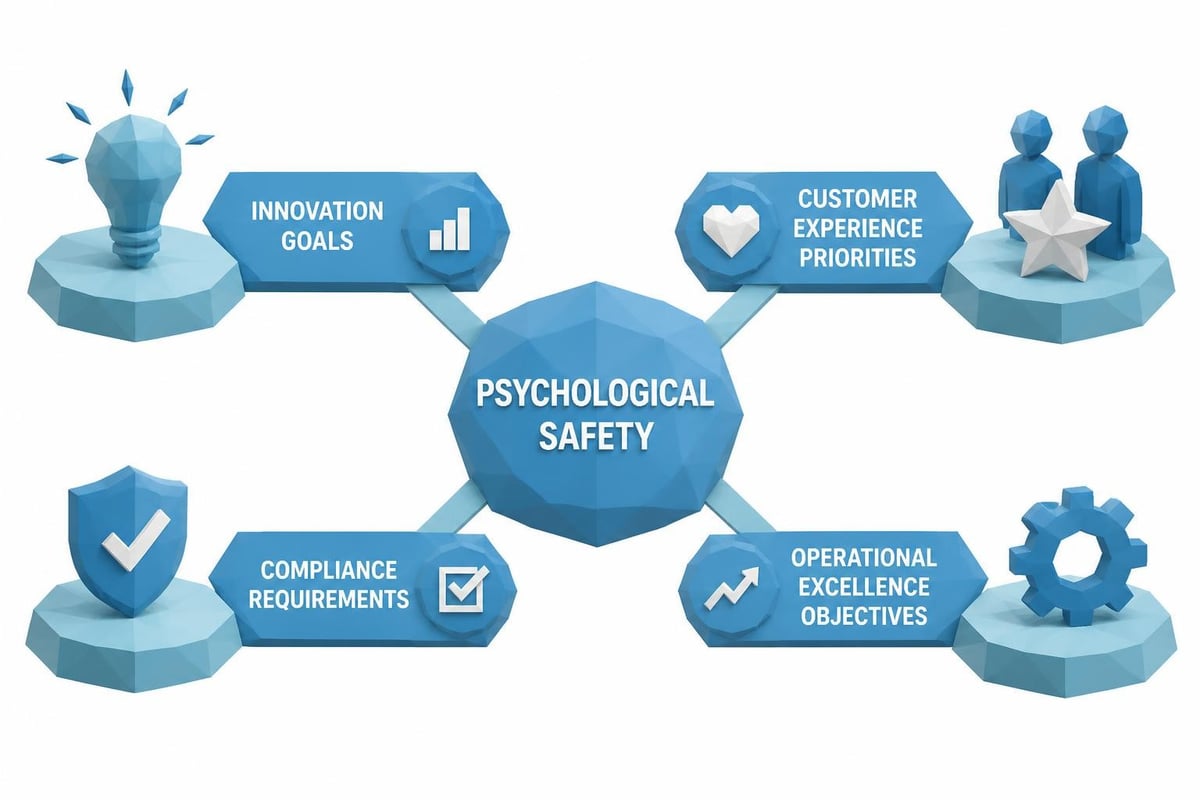
Psychological safety isn't a culture initiative. It's a business capability. Organizations implementing psychological safety effectively connect it directly to strategic priorities.
If innovation is a strategic imperative, psychological safety metrics appear in R&D scorecards. If customer experience matters, front-line team psychological safety becomes a CX lever. If compliance is critical, psychological safety in risk and audit functions gets board-level attention.
The integration signals importance and creates accountability.
The Costs of Getting This Wrong
The inverse ROI of psychological safety is substantial and often invisible until it's catastrophic. Organizations with low psychological safety face predictable failure patterns.
Strategic Blind Spots
Leaders operate with incomplete information because teams filter bad news. Boeing's 737 MAX crisis revealed a culture where engineers felt unable to escalate safety concerns effectively. The financial and reputational costs exceeded $20 billion.
Talent Exodus
Top performers leave first because they have options. A financial services firm lost 12 of their 15 highest-potential leaders over 18 months due to a toxic executive. Replacement and opportunity costs exceeded $8 million before the board intervened.
Innovation Stagnation
Risk-averse cultures kill ideas before they're tested. A pharmaceutical company conducted an internal audit that revealed 23 promising research directions abandoned due to political dynamics rather than scientific merit. At least three had commercial potential exceeding $500 million.
Compliance Failures
When employees fear reporting problems, violations accumulate. Wells Fargo's fake accounts scandal stemmed partly from a culture where branch employees felt unable to challenge unrealistic sales targets. The consequences included $3 billion in fines and immeasurable brand damage.
Building Psychological Safety at Scale
Large organizations face unique challenges in creating psychological safety across geographies, functions, and leadership layers.
The Cascade Effect
Psychological safety doesn't cascade automatically from top leadership. A CEO can model vulnerability while middle managers create fear. The intervention must work at every level simultaneously.
Effective approaches include:
- Cohort-based coaching programs for all people managers
- Cross-functional learning communities that share practices
- Upward feedback mechanisms with guaranteed anonymity and action
- Regular audits that identify psychological safety deserts
One Fortune 100 client implemented quarterly psychological safety assessments at the team level with results visible to senior leadership. Teams in the bottom 10% received mandatory coaching intervention for their leaders. Within two years, the bottom quartile disappeared as leaders either improved or left.
The Government Context
Government agencies face unique constraints around psychological safety implementation. Civil service protections, union agreements, and political appointees create complexity.
But the need is equally acute. A federal agency dealing with mission-critical public health work discovered through assessment that frontline experts withheld data from leadership due to past retribution. The resulting policy decisions were made with 40% less epidemiological input than available.
The solution involved:
- Protected channels for technical input separate from chain of command
- External facilitation for sensitive discussions
- Documented decision criteria that separated politics from evidence
- Leadership coaching for political appointees on receiving dissent
The investment improved decision quality measurably. Post-mortems on major initiatives showed 60% more diverse input in decision processes within 12 months.
Measuring Progress and Sustaining Gains
The ROI of psychological safety compounds over time, but only if organizations sustain the conditions that created it.
Continuous Assessment
Annual engagement surveys don't provide sufficient granularity. Organizations achieving sustained impact use:
Pulse Surveys (monthly)
Three to five questions focused on current team dynamics, recent decisions, and willingness to surface concerns.
Event-Triggered Check-ins
After major decisions, reorganizations, or leadership transitions, rapid assessments identify emerging problems.
Behavioral Indicators
Analysis of meeting participation patterns, email communication dynamics, and decision documentation completeness.
Outcome Correlation
Linking psychological safety metrics to business results creates accountability and justifies continued investment.
Adaptive Intervention
As organizations evolve, psychological safety challenges shift. A startup that creates safety through informal relationships needs different systems at 500 employees. A company entering new markets faces cross-cultural psychological safety challenges.
The intervention model must adapt:
| Growth Stage | Primary Challenge | Intervention Focus |
|---|---|---|
| Startup (50-200) | Preserving candor during growth | Manager capability building |
| Scale-up (200-1000) | Maintaining transparency across layers | Systems and feedback mechanisms |
| Enterprise (1000+) | Consistency across units | Standardized assessment and targeted coaching |
| Global | Cross-cultural safety norms | Cultural adaptation frameworks |
Organizations that treat psychological safety as static watch it erode during transitions.
The Implementation Timeline and Resource Allocation
Executives want to know: how long until we see returns, and what does this cost?
Realistic Timeline for ROI
Months 1-3: Diagnostic and Design
Investment in assessment, analysis, and intervention design. No measurable ROI yet, but foundation for everything else.
Months 4-8: Early Wins
Leading indicators improve: increased participation in meetings, more questions in strategy sessions, faster problem escalation. Some teams show productivity gains.
Months 9-15: Measurable Impact
Lagging indicators shift: turnover decreases, engagement improves, innovation metrics rise. Financial impact becomes visible in operational metrics.
Months 16-24: Compounding Returns
The culture shift accelerates. Psychological safety becomes self-reinforcing as new norms take hold. ROI exceeds initial projections as multiple benefits compound.
Year 3+: Sustained Competitive Advantage
Organizations with embedded psychological safety outperform peers consistently. Talent attraction improves, innovation velocity increases, and crisis resilience strengthens.
Understanding how coaching reduces workplace conflict demonstrates similar timelines for related interventions.
Budget Considerations
For a 500-person organization, expect to invest $250,000-$450,000 in year one for comprehensive psychological safety development:
- Assessment and diagnostics: $40,000-$60,000
- Executive and manager coaching: $120,000-$200,000
- Team interventions: $50,000-$100,000
- Systems and measurement: $40,000-$90,000
The returns typically exceed investment within 18 months through turnover reduction alone. Adding productivity gains and innovation impact, the three-year ROI ranges from 300-600%.
Frequently Asked Questions
How do you measure psychological safety ROI in organizations without existing baseline data?
Start with proxy metrics you already track: voluntary turnover rates, engagement survey scores, project success rates, and time-to-decision on strategic choices. Establish current state, implement interventions, and track changes. Simultaneously introduce psychological safety-specific metrics through brief pulse surveys and behavioral observation. Within 90 days, you'll have enough data to establish correlation patterns and project ROI.
What's the difference between psychological safety and employee engagement?
Employee engagement measures commitment and satisfaction. Psychological safety measures whether people feel able to take interpersonal risks without fear. You can have engaged employees who never challenge bad ideas because they fear consequences. Psychological safety is a precondition for the behaviors that drive innovation, learning, and adaptation. It's a leading indicator; engagement often follows.
Can psychological safety work in high-accountability, high-performance cultures?
Yes, and the data shows it's essential. High-performing teams combine high standards with high safety. The difference is that accountability focuses on outcomes and learning, not blame and punishment. Teams that feel safe admitting mistakes actually perform better because they course-correct faster. Low psychological safety creates defensive behavior that protects individuals at the expense of results. True high-performance cultures require both challenge and support.
How long does it take to see financial returns from psychological safety investments?
Most organizations see measurable improvements in leading indicators within 90-120 days: increased meeting participation, faster problem escalation, more robust debate in decision processes. Financial impact through reduced turnover appears in months 6-12. Productivity gains and innovation velocity improvements manifest in months 9-18. Full ROI typically appears within 18-24 months and compounds thereafter.
What's the single most important factor in successful psychological safety implementation?
Leader behavior change with accountability. Everything else fails if leaders who create fear face no consequences. The most successful implementations include leader assessment, targeted coaching for capability gaps, clear behavioral expectations, measurement systems that create visibility, and willingness to transition leaders who cannot or will not change. Without this, psychological safety initiatives become performative rather than transformative.
The ROI of psychological safety is measurable, substantial, and essential for organizational performance in 2026. Leaders who treat it as optional are making expensive bets against evidence. The Noomii Corporate Leadership Program helps organizations build psychological safety through precision diagnostics, targeted coaching interventions, and measurement systems that demonstrate tangible impact. If you're ready to move from awareness to results, Noomii Leadership Coaching provides the expertise, systems, and accountability to make it happen.



Leave a Reply
Want to join the discussion?Feel free to contribute!