
Leadership Development and Executive Coaching That Works
Most leadership development fails because organizations treat symptoms instead of diagnosing root causes. Boards invest millions in programs that produce temporary enthusiasm but negligible behavior change. The disconnect isn't about commitment or budget. It's about precision. Leadership development and executive coaching work when they're grounded in evidence, matched to specific leadership gaps, and measured against business outcomes. Everything else is expensive theater.
The data supports this observation. Harvard Business Publishing’s 2024 Global Leadership Development Study found that only 14% of organizations believe their current leadership development approaches are highly effective. That's an indictment of conventional wisdom. CHROs are protecting L&D budgets but struggling to demonstrate value. Meanwhile, Center for Creative Leadership research confirms that succession planning gaps and unclear development priorities are accelerating across sectors.
Why Most Leadership Development Misses the Mark
The problem starts with diagnosis. Organizations launch development initiatives based on generic competency models rather than actual performance gaps. A VP who derails projects through micromanagement gets sent to a two-day workshop on "strategic thinking." A director whose team turnover hits 40% annually attends a webinar series on "employee engagement." The intervention doesn't match the problem.
Real leadership gaps fall into predictable categories:
- Toxic behavioral patterns that erode psychological safety
- Inability to navigate ambiguity and make decisions with incomplete information
- Poor delegation that creates bottlenecks and burns out high performers
- Conflict avoidance that allows dysfunction to metastasize
- Lack of strategic perspective that keeps leaders stuck in operational weeds
Each requires a different intervention. Leadership development and executive coaching create impact when they start with precision diagnostics, not off-the-shelf curriculum.

Consider a case from a Fortune 500 manufacturing company. Their operations VP had strong technical skills but left a trail of burned relationships. Direct reports described him as brilliant but impossible. Exit interviews consistently cited his abrasive style. HR initially recommended a standard leadership course. The problem persisted.
The Cost of Mismatched Interventions
A proper diagnostic revealed the pattern: the VP interpreted any questioning as insubordination and responded with public criticism. His behavior wasn't about skill gaps. It was a deeply ingrained response to perceived threats to his authority. Understanding toxic leadership patterns requires recognizing that some leaders need behavioral intervention, not more training.
The organization paired him with an executive coach who specialized in abrasive leader remediation. The coach used 360-degree feedback, stakeholder interviews, and behavioral analysis to create a targeted plan. Six months later, team satisfaction scores improved 28%. Voluntary turnover dropped. The VP learned to recognize his triggers and implement new response patterns.
That's the difference between generic development and precise intervention. The latter costs less and delivers measurable results. The former creates compliance artifacts that sit on shelves.
What Actually Works in Executive Coaching
Executive coaching fails when it becomes therapy-lite or unfocused career conversations. It succeeds when it addresses specific business problems with clear success metrics. The best coaching engagements start with a problem statement, establish baseline measurements, and define what success looks like in 90 days, six months, and one year.
| Coaching Focus | Typical Duration | Success Indicators | Common Pitfalls |
|---|---|---|---|
| Toxic behavior remediation | 6-12 months | Team satisfaction scores, 360 feedback, retention | Stopping before new patterns solidify |
| New role transitions | 3-6 months | Time to full productivity, stakeholder confidence | Focusing on technical vs. political navigation |
| Strategic leadership | 6-9 months | Decision quality, vision clarity, resource allocation | Remaining too tactical |
| Team performance | 4-8 months | Team metrics, collaboration quality, goal achievement | Coaching individual vs. system |
The most effective engagements combine individual coaching with organizational context. A CEO being coached on decision-making needs more than personal insight. They need to understand how their decision patterns affect execution three levels down. That requires stakeholder input, systems thinking, and business acumen from the coach.
Here's what organizations miss: coach selection matters more than the coaching model. A certified coach with 2,000 hours who's never worked in your sector will struggle to add value to a CFO navigating regulatory complexity. Meanwhile, an experienced executive coach from financial services or healthcare brings context that accelerates insight.
The Matching Problem Nobody Talks About
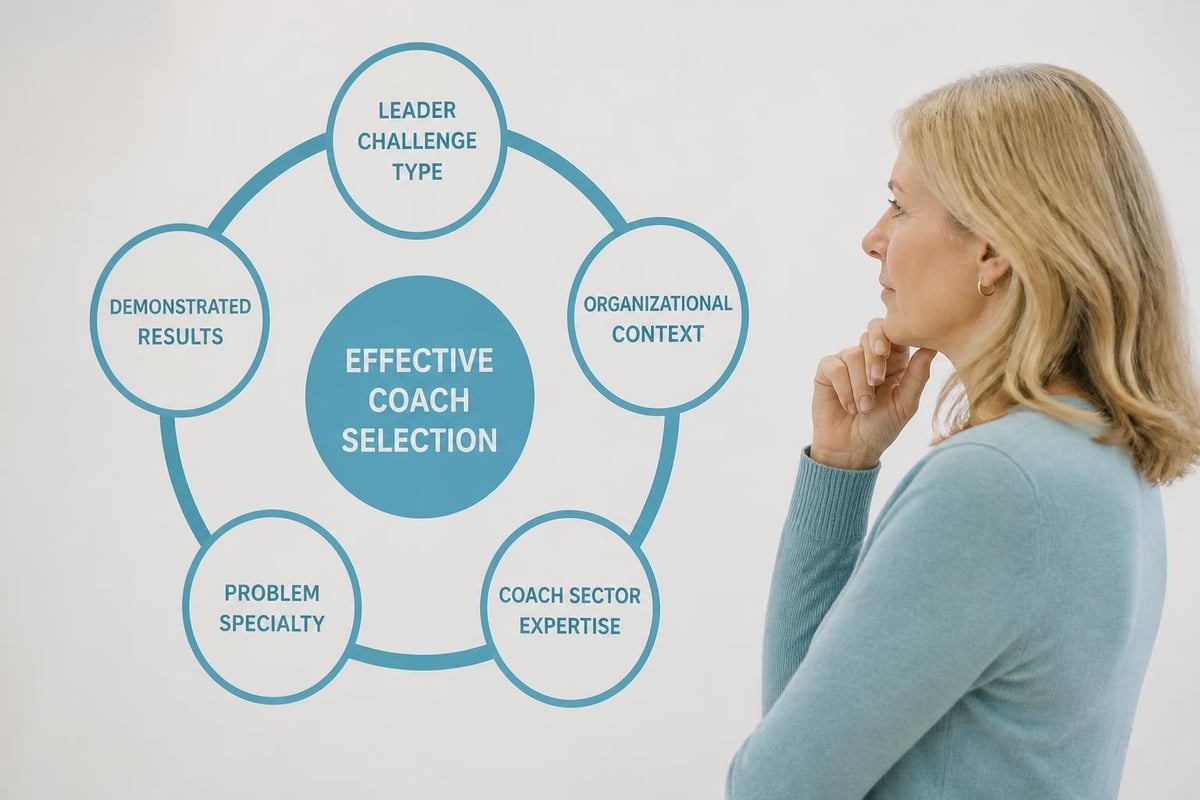
Most organizations select coaches based on availability, cost, or existing vendor relationships. That's like hiring surgeons based on their scheduling flexibility. The right match requires understanding the leader's specific challenge, the organizational context, and the coach's demonstrated expertise in similar situations.
Consider matching criteria that actually matter:
- Industry experience: Has the coach worked with leaders facing similar regulatory, competitive, or operational challenges?
- Problem specialty: Does the coach have a track record with this specific issue (conflict resolution, executive presence, strategic thinking)?
- Stakeholder complexity: Can the coach navigate the political dynamics of your organization's culture and structure?
- Assessment fluency: Does the coach use validated tools or rely on intuition and anecdote?
A government agency director dealing with workforce morale after a reorganization needs different coaching than a tech VP scaling a team through hypergrowth. The underlying leadership principles may be universal, but the application is highly contextual. Selecting the right coach determines whether the engagement produces breakthrough or just pleasant conversations.
Leadership Development in the Age of AI and Disruption
The skills that made leaders successful in 2020 are insufficient in 2026. Harvard Kennedy School research on leadership in the age of artificial intelligence identifies critical shifts. Leaders must now navigate AI-augmented decision-making, manage increasingly boundaryless teams, and drive performance in environments where traditional hierarchies are dissolving.
This changes what leadership development and executive coaching must address:
- Judgment under algorithmic influence: Leaders need to know when to trust AI recommendations and when human judgment should override data.
- Hybrid team orchestration: Managing distributed teams requires new skills in asynchronous communication, digital collaboration, and building trust without proximity.
- Continuous adaptation: The half-life of leadership strategies is shrinking. Leaders must learn faster than their markets evolve.
- Ethical complexity: AI, data privacy, and workforce automation create ethical dilemmas that textbooks haven't addressed.
Deloitte’s 2024 Global Human Capital Trends research reinforces this reality. Organizations that redesigned leadership development around human performance, not just competencies, reported significantly higher program effectiveness.
Building Development Programs That Scale
Here's the challenge for CHROs: executive coaching works but doesn't scale economically. Leadership workshops scale but rarely produce lasting behavior change. The solution isn't choosing between them. It's architecting an integrated system.
Effective programs combine three elements:
- Diagnostic precision: Use validated assessments to identify specific gaps across the leadership population
- Tiered interventions: Match intensity to need (workshops for foundational skills, coaching for complex challenges, peer learning for scaling best practices)
- Measurement discipline: Track behavior change, business impact, and ROI with the same rigor you apply to capital investments
A Fortune 500 technology company restructured their approach in 2025. They assessed their entire director-level population using behavioral diagnostics and 360 feedback. The data revealed three distinct clusters: 40% needed foundational delegation and feedback skills, 35% required strategic thinking development, and 25% had serious interpersonal or toxic patterns.
They deployed workshops for the first group, group coaching for the second, and intensive individual coaching for the third. The cost per leader decreased 30% compared to their previous one-size-fits-all approach. More importantly, measurable ROI from coaching improved because interventions matched actual needs.
The Governance and Compliance Dimension
Government agencies and highly regulated industries face constraints that commercial organizations often overlook. Leadership development isn't just about effectiveness. It must align with procurement requirements, ethics standards, conflict-of-interest rules, and documentation protocols.
A federal agency learned this the hard way. They engaged an executive coach for a senior leader without proper vetting. The coach had undisclosed business relationships that created perceived conflicts. The engagement ended abruptly, damaging the leader's reputation and triggering an investigation.
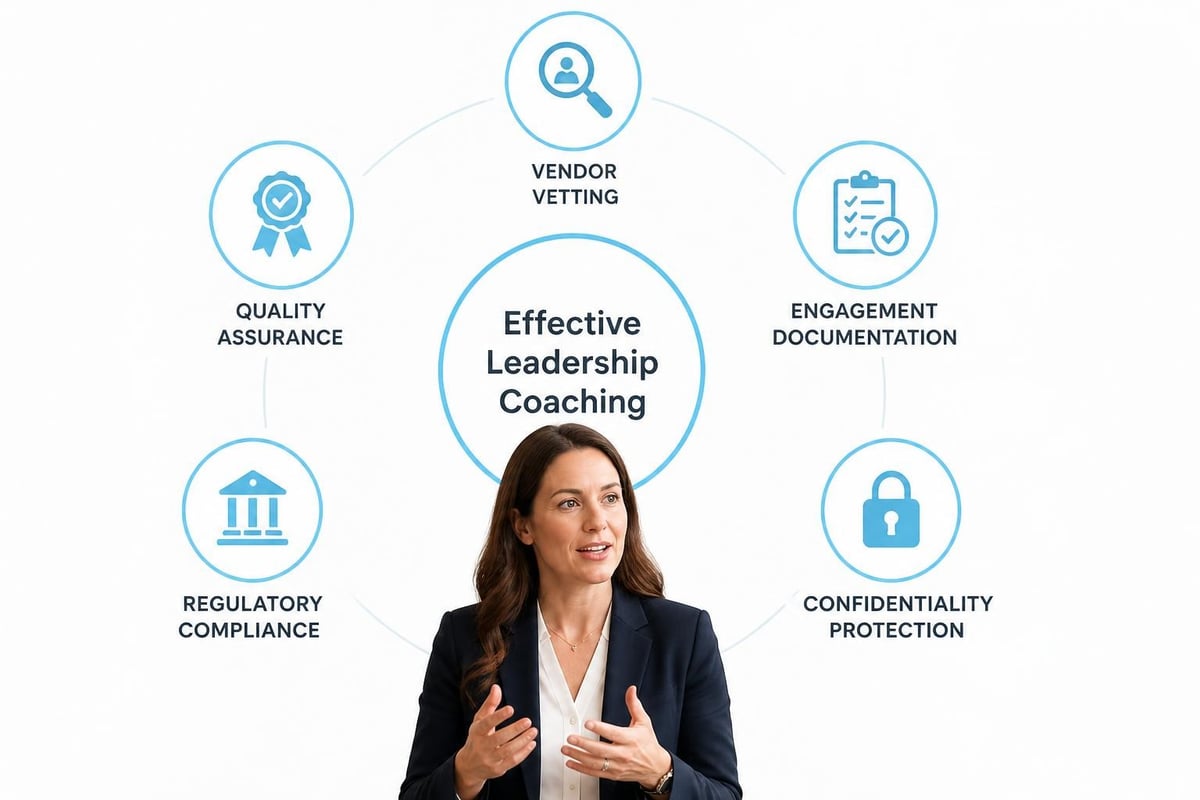
Compliance-aware programs establish clear protocols:
- Vendor vetting processes that verify credentials, check conflicts, and ensure insurability
- Documentation standards that protect confidentiality while meeting record-keeping requirements
- Engagement agreements that define scope, boundaries, stakeholder communication, and success metrics
- Quality assurance mechanisms that monitor coaching effectiveness without violating confidentiality
This isn't bureaucratic overhead. It's risk management. Leadership coaching for government and regulated sectors requires coaches who understand these constraints and can deliver impact within them.
The same principles apply to Fortune 500 companies navigating Sarbanes-Oxley, industry-specific regulations, or global data privacy requirements. Leadership development and executive coaching programs must demonstrate not just effectiveness but also compliance, ethical integrity, and governance alignment.
Measuring What Actually Matters
Most organizations measure leadership development through participation rates and satisfaction scores. Those metrics tell you nothing about behavior change or business impact. They're vanity metrics that make HR look busy while leaders continue failing.
Real measurement tracks three levels:
Individual Behavior Change
Did the leader's actual behavior shift? Use 360-degree feedback administered pre-program, mid-program, and post-program. Track specific behaviors tied to the development goals. If you're addressing a leader's conflict avoidance, measure whether they're now having difficult conversations. If you're developing strategic thinking, assess whether their decision quality improved.
Quantify behavioral shifts through:
- Direct reports' assessment of specific leadership behaviors
- Peer feedback on collaboration and influence effectiveness
- Stakeholder perception of executive presence and decision quality
- Self-awareness growth measured through validated instruments
Team and Organizational Outcomes
Leadership changes should improve team performance. Track metrics like team engagement scores, voluntary turnover, project delivery rates, innovation output, and cross-functional collaboration effectiveness. If coaching a VP doesn't improve their team's results, the coaching failed regardless of what the VP learned.
A pharmaceutical company coached 12 senior leaders in 2025. They tracked team metrics before, during, and after the engagements. Eight leaders showed significant team improvement. Three showed modest gains. One showed no change. That last leader needed a different intervention, which the data made obvious.
Business Impact
Connect leadership development to organizational priorities. CIPD’s evidence review on leadership development emphasizes that effective programs align individual growth with strategic objectives. If your priority is margin improvement, measure whether coached leaders are making better resource allocation decisions. If it's innovation, track whether they're creating environments where teams take intelligent risks.
Calculate ROI by comparing program costs against measurable business benefits. A $50,000 coaching engagement that prevents a $200,000 bad hire or accelerates a product launch by two months pays for itself. Measuring ROI from executive coaching requires defining success metrics before the engagement begins.
The Team Coaching Alternative
Individual executive coaching addresses personal leadership gaps. But many organizational challenges are systemic, not individual. When entire teams struggle with dysfunction, misalignment, or poor collaboration, team coaching often delivers better returns.
Team coaching focuses on collective patterns, decision processes, and relationship dynamics. A skilled team coach works with the group to surface unproductive norms, clarify roles, improve meeting effectiveness, and build psychological safety.
A healthcare organization used team coaching with their executive leadership team in 2025. The team had strong individual performers but poor collective decision-making. Meetings ran long without reaching conclusions. Passive-aggressive conflict undermined implementation. Trust was low.
Six months of team coaching produced dramatic shifts. The team established decision rights, created meeting protocols that separated discussion from decision-making, and developed norms for productive conflict. Strategic initiatives that had stalled for months moved forward. Board confidence in the executive team increased measurably.
Team coaching works best when:
- The problem is systemic rather than individual
- Multiple team members contribute to dysfunction
- The team must collaborate intensively to achieve goals
- Individual coaching would create fragmented solutions
Don't default to individual coaching when the system is broken. Fix the system.
What Leaders Are Missing About Development
Most executives see leadership development as something for others. They send their teams to programs while assuming they've already arrived. This is dangerous arrogance. The best leaders are continuous learners who seek feedback, challenge their assumptions, and invest in their own growth.
SHRM research on executive coaching found that high-performing executives increasingly view coaching the way elite athletes view training. It's not remediation. It's how you stay sharp, adapt to new challenges, and maintain peak performance.
Consider what separates great CEOs from good ones. It's not intelligence or experience. It's self-awareness, adaptability, and the humility to recognize their blind spots. These capabilities don't develop through osmosis. They require deliberate practice, honest feedback, and skilled guidance.
A CEO who hasn't had executive coaching in the past three years is likely operating with outdated mental models, unrecognized biases, and blind spots their organization is too polite to mention. That's not confidence. It's vulnerability.
Building a Development Culture From the Top
Leadership development and executive coaching cascade. When senior leaders model continuous learning, middle managers follow. When executives share their development goals publicly, it normalizes feedback-seeking and growth.
Organizations with strong development cultures share common practices:
- Leaders discuss their coaches and development goals openly: This destigmatizes coaching and signals that growth is expected at every level
- Succession planning includes development requirements: Promotions require demonstrating learning agility, not just current performance
- Development budget decisions happen at the board level: This ensures leadership capability gets strategic attention, not just HR operational focus
- Learning from failure is institutionalized: Leaders share mistakes and lessons without career penalty
A manufacturing company transformed their culture by having their CEO discuss his executive coaching engagement at an all-hands meeting. He shared what he was working on, why it mattered, and how it was helping him lead more effectively. Within six months, coaching requests from senior leaders increased 300%. The stigma evaporated.
That's how you scale development. Make it normal, expected, and visible from the top.
Contrarian View: Sometimes the Answer Is Removal, Not Development
Here's what makes boards and CHROs uncomfortable: not every leader can be developed. Some behavioral patterns are too entrenched. Some individuals lack the self-awareness required for growth. Some leaders are fundamentally mismatched to their roles.
Leadership development and executive coaching can't fix everything. Dealing with toxic leadership sometimes requires removal, not remediation. Organizations waste millions trying to coach leaders who should be exited.
The decision framework is straightforward:
| Factor | Invest in Development | Consider Transition |
|---|---|---|
| Self-awareness | Recognizes impact, seeks feedback | Blames others, rejects feedback |
| Track record | Isolated issues, overall strong performance | Pattern of team destruction across roles |
| Organizational damage | Contained, reversible impact | Widespread dysfunction, talent exodus |
| Willingness | Actively engaged in change process | Goes through motions, no behavior shift |
| Time horizon | Organization can afford development timeline | Immediate change required |
A financial services firm spent $150,000 coaching a senior leader over 18 months. The leader attended sessions, said the right things, but changed nothing. Team turnover remained at 45% annually. The organization finally made the transition decision they should have made at month six.
The sunk cost fallacy kills organizational performance. Know when to cut losses.
The Future of Leadership Development
World Economic Forum research on future skills identifies critical capabilities organizations must develop in leaders: analytical thinking, creative problem-solving, AI and big data literacy, resilience, and emotional intelligence. These aren't add-ons to traditional leadership. They're the new baseline.
The organizations winning at leadership development in 2026 are doing five things differently:
- Using AI for diagnostics and matching: Algorithms identify patterns in 360 feedback, match leaders to coaches based on expertise, and track development progress with greater precision than manual processes
- Delivering more coaching through digital platforms: Not replacing in-person work, but extending it through video sessions, asynchronous messaging, and AI-supported reflection tools
- Integrating development with workflow: Rather than pulling leaders out for multi-day programs, embedding micro-learning and coaching into regular work rhythms
- Measuring behavioral data, not just perceptions: Using meeting analysis, communication patterns, and decision tracking to quantify leadership effectiveness
- Building coach networks instead of vendor relationships: Maintaining access to specialized expertise across sectors, challenges, and geographies rather than limiting options to single-provider solutions
The shift is from programs to ecosystems. From events to continuous development. From generic to precise.
Organizations still relying on annual leadership workshops and hoping for culture change are falling behind competitors who treat leadership development as strategic capability building with measurable ROI.
Frequently Asked Questions
How long does executive coaching typically take to show results?
Behavioral change timelines vary by issue complexity, but most coaching engagements show measurable progress within 90 days. Simple skill gaps (presentation skills, meeting facilitation) often improve within 4-6 weeks. Complex behavioral patterns (toxic leadership, conflict avoidance) typically require 6-12 months for sustainable change. The key is establishing baseline metrics before coaching begins and tracking specific behaviors throughout the engagement.
What's the difference between leadership training and executive coaching?
Leadership training delivers content, frameworks, and skills to groups through workshops, courses, or programs. It's efficient for foundational knowledge but rarely produces lasting behavior change alone. Executive coaching is individualized, focuses on specific performance gaps, and drives behavioral change through guided practice, feedback, and accountability. Most effective development strategies combine both: training for knowledge, coaching for application and behavior change.
How do we measure ROI from leadership development programs?
Effective ROI measurement tracks three levels: individual behavior change (360 feedback, stakeholder assessments), team outcomes (engagement, retention, productivity), and business impact (revenue growth, cost reduction, strategic goal achievement). Calculate ROI by comparing program costs against quantified benefits such as reduced turnover costs, faster time-to-productivity for new leaders, improved decision quality, or accelerated project delivery. Organizations achieving strong ROI establish metrics before programs launch, not after.
When should we use team coaching instead of individual coaching?
Team coaching is more effective when problems are systemic rather than individual. Use team coaching when: multiple team members contribute to dysfunction, the team struggles with collective decision-making or collaboration, trust and psychological safety are low across the team, or individual coaching would create fragmented solutions. Use individual coaching when specific leaders have performance gaps, toxic behaviors, or development needs unrelated to team dynamics.
How do we select the right executive coach for our leaders?
Effective coach selection starts with precise problem diagnosis. Identify the specific leadership gap (strategic thinking, toxic behavior, conflict resolution, executive presence), then match coaches based on demonstrated expertise with similar challenges, relevant industry or sector experience, assessment methodology and tools, and track record with measurable results. Avoid selecting coaches solely on credentials, availability, or cost. The right match between leader challenge and coach expertise determines engagement success more than any other factor.
Leadership development and executive coaching deliver measurable results when organizations move beyond generic programs to precision interventions matched to actual performance gaps. The evidence is clear: diagnostic rigor, coach expertise alignment, and disciplined measurement separate programs that transform leadership from those that simply consume budget. Noomii Leadership Coaching helps organizations solve complex leadership challenges through evidence-based diagnostics, precision coach matching, and scalable solutions that align individual growth with institutional priorities, delivering the measurable impact boards and CHROs demand.



Leave a Reply
Want to join the discussion?Feel free to contribute!