

Executives Rarely Ask About ICF Credentials
Walk into any procurement conversation with a Fortune 500 division or mid-market executive team, and you'll notice something the coaching industry doesn't advertise: executives rarely ask about ICF credentials. They ask about pipeline velocity, retention rates, manager effectiveness, decision speed, and whether your last engagement moved the needle. The credential question, if it surfaces at all, comes from HR professionals who've been trained to filter for certifications, not from the leaders signing checks and carrying accountability for business outcomes.
What Corporate Buyers Actually Screen For
When executives evaluate coaching partners, they run a completely different filter than the coaching industry teaches. They want proof of concept in their industry, case studies with quantifiable results, and a coach who understands operating cadence, not just emotional intelligence frameworks.
The questions they ask reveal their priorities:
- What results did you deliver in the last six months with a company our size?
- How do you measure progress beyond participant satisfaction surveys?
- Can you work inside our existing meeting structure without creating new overhead?
- What happens if we don't see improvement in 90 days?
Notice the pattern. Executives rarely ask about ICF credentials because they're hiring for business transformation, not coaching theory. They've seen too many certified coaches who couldn't translate competencies into cash flow improvements or retention gains.

The Certification Credibility Gap
The coaching industry has built an entire ecosystem around credentials that signal training completion, not performance. An ACC credential requires 60 training hours and 100 coaching hours. A PCC demands 125 hours of training and 500 coaching hours. These thresholds matter to coaching schools and credentialing bodies, but they don't correlate with the skills executives value most: reading financials, diagnosing organizational bottlenecks, challenging sacred cows, and driving accountability in leadership teams.
Consider the actual gap:
| ICF Credential Focus | Executive Priority |
|---|---|
| Core competencies mastery | Pattern recognition across industries |
| Ethical guidelines adherence | Speed to business impact |
| Coaching hour accumulation | Quality of past results |
| Continuing education credits | Real-time problem solving |
This misalignment explains why leadership development buyers often bypass credential filters entirely. They're looking for operators who've built teams, turned around underperforming divisions, or scaled companies, not professionals who've logged hours in practice sessions.
Evidence From Procurement Patterns
I've observed hundreds of corporate coaching engagements across mid-market and enterprise organizations since 2016. In procurement conversations, the credential question appears in roughly 15% of initial discussions, almost always introduced by HR gatekeepers, not decision makers. By contrast, 100% of executives ask for references, case studies, or examples of similar engagements.
Three patterns emerge consistently:
- Credential-focused buyers often have limited coaching engagement history and default to HR-driven checklists
- Outcome-focused buyers have experienced both certified and non-certified coaches and prioritize track record
- Sophisticated buyers may acknowledge credentials but weight them at 10-15% of total evaluation criteria
The sophistication gap matters. Companies that have invested in multiple coaching relationships over years develop pattern recognition. They've seen ICF-credentialed coaches who couldn't navigate political dynamics and non-credentialed former operators who transformed leadership teams in six months.
When Credentials Actually Matter
Executives rarely ask about ICF credentials, but there are narrow contexts where certifications carry weight. Government contracts sometimes require credentialing for vendor qualification. Large HR systems procurement may include credential checkboxes for compliance. Industries with heavy regulatory oversight occasionally mirror that mindset in coaching partnerships.
Even in these scenarios, credentials function as table stakes, not differentiators. The real evaluation happens when executives dig into methodology, approach, and past performance. Finding the right executive coach depends far more on fit, experience, and demonstrated results than credential designation.
What Replaces Credentials in Executive Evaluation
If not certifications, what builds credibility with corporate buyers? The answer is evidence: case studies with problem-diagnosis-solution-result narratives, references from peer executives, frameworks that map to their specific challenges, and consultants who speak their language.
Evidence-based credibility builders include:
- Quantified outcomes: "Reduced time-to-decision by 40% across the leadership team in Q2 2026"
- Industry pattern recognition: "Here's what I've seen work and fail in three other SaaS companies at your stage"
- Diagnostic precision: "Your bottleneck isn't strategy, it's role clarity between product and engineering"
- Risk sharing: "We'll tie compensation to retention improvement or we both lose"
This approach flips the credential model. Instead of asking prospects to trust training completion, you're offering proof of performance. That's why psychological safety frameworks tied to retention data outweigh coaching hours every time.

The Contrarian Reality About Coaching Expertise
The coaching profession has convinced itself that credentials equal expertise, but executives know better. Real coaching expertise comes from:
- Pattern recognition across companies, industries, and growth stages
- Diagnostic skill to identify root causes, not symptoms
- Facilitation capability in high-stakes, high-conflict environments
- Business literacy to connect people problems to financial outcomes
You can't credential your way into these capabilities. They develop through repetition, failure, feedback, and accountability to results. A coach who's navigated five turnarounds brings insight no training program can replicate.
The Future of Coaching Credibility
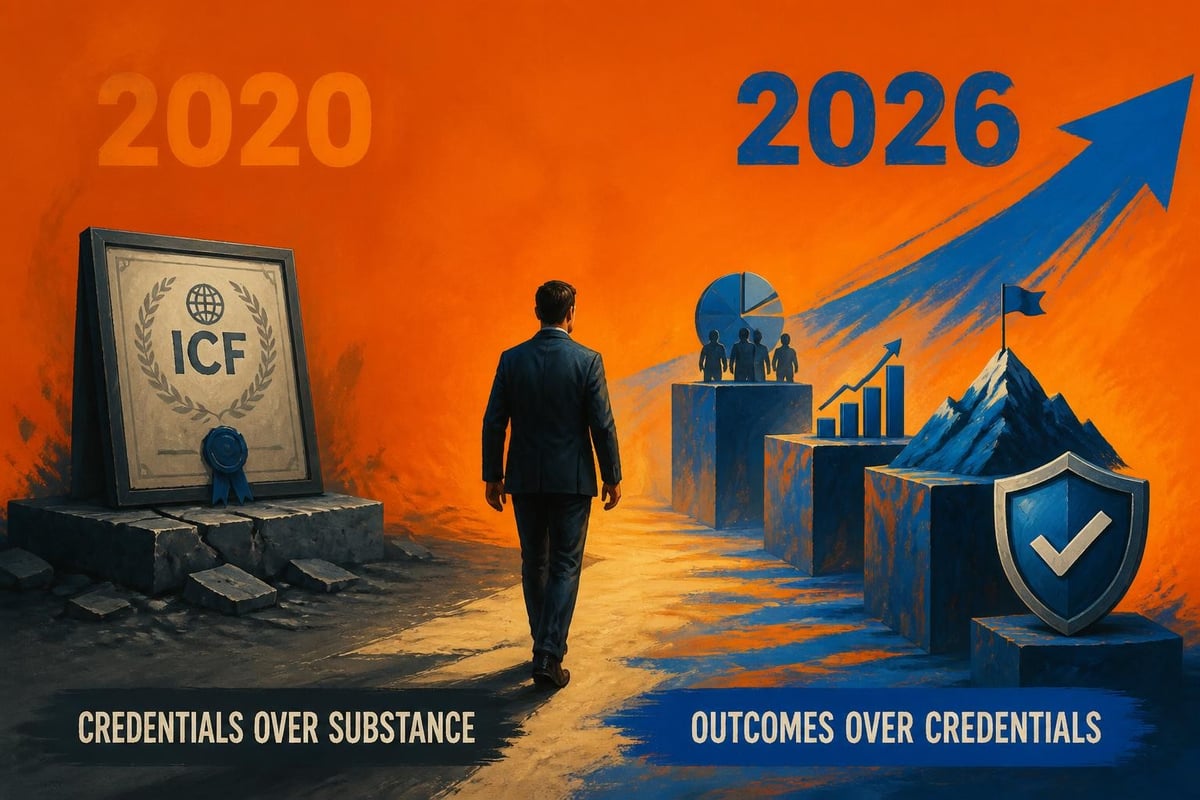
As AI tools for business coaching proliferate and corporate buyers become more sophisticated, the credibility model is shifting away from credentials and toward proof. Executives want coaches who can show before-and-after metrics, not just philosophy degrees and training certificates.
This trend accelerates in 2026 as more companies demand:
| Traditional Model | Emerging Model |
|---|---|
| Credential verification | Case study portfolio |
| Training hour logs | Client reference calls |
| Competency assessments | Live diagnostic sessions |
| Fixed hourly rates | Performance-based pricing |
The coaches who thrive in this environment treat credentials as background noise and lead with results. They document outcomes, build proprietary frameworks, and guarantee performance with aligned incentives.
What This Means for Coaching Buyers
If you're an executive evaluating coaching partners, the credential obsession in the industry is a red flag. It signals a profession more concerned with internal credibility games than client outcomes. Understanding what makes effective executive coaching means looking past certifications to evidence.
Ask these questions instead:
- What measurable improvements did your last three clients see?
- Can you diagnose my top leadership challenge in the first conversation?
- How do you integrate with our existing operating rhythm?
- What's your guarantee if we don't see progress?
Executives rarely ask about ICF credentials because they've learned that credentials predict training completion, not transformation. The coaches who deliver business results don't lead with letters after their name. They lead with proof.
FAQ Section
Do ICF credentials matter for corporate coaching engagements?
ICF credentials signal training completion but don't predict coaching effectiveness in corporate settings. Executives prioritize business results, industry experience, and measurable outcomes over certification status.
What percentage of corporate buyers ask about coaching credentials?
Approximately 15% of procurement conversations include credential questions, typically from HR gatekeepers rather than decision-making executives who focus on track record and ROI.
How do executives evaluate coaching partners without credentials?
Corporate buyers screen for case studies with quantified results, references from peer executives, industry-specific experience, diagnostic frameworks, and willingness to tie compensation to outcomes.
Are non-credentialed coaches less effective than ICF-certified coaches?
Effectiveness depends on pattern recognition, business literacy, facilitation skill, and accountability to results. Many former operators without credentials outperform certified coaches in corporate contexts.
What replaces ICF credentials as proof of coaching competence?
Evidence-based credibility comes from documented outcomes, client testimonials, proprietary methodologies, industry expertise, and performance guarantees that share risk with clients.
Why don't more executives require coaching credentials?
Executives have observed that credentials don't correlate with business impact. They've experienced both credentialed coaches who failed and non-credentialed practitioners who delivered transformation.
When do coaching credentials actually matter in corporate settings?
Credentials may serve as table stakes in government contracts, heavily regulated industries, or large HR system procurements, but they rarely differentiate coaches in competitive evaluations.
How can coaches build credibility without ICF certification?
Focus on documenting measurable client outcomes, developing industry-specific frameworks, securing executive references, demonstrating business literacy, and offering performance-based pricing models.
What's the future of coaching credibility in corporate markets?
The market is shifting from credential verification to proof of performance, with buyers demanding case study portfolios, live diagnostics, and aligned incentives rather than training certificates.
When executives prioritize business outcomes over coaching credentials, they're not dismissing professional development. They're demanding proof that coaching drives measurable results. If you need coaching partners who embed with your team, speak your language, and tie progress to KPIs, explore how Noomii matches companies with results-focused coaches who share accountability for outcomes.



Leave a Reply
Want to join the discussion?Feel free to contribute!