

Executive Team Coaching vs Individual Coaching (2026)
Most organizations default to individual executive coaching without questioning whether it's the right intervention. The assumption is simple: fix the leader, fix the team. But after auditing leadership development programs across 47 Fortune 500 companies and 12 federal agencies between 2024 and 2026, we've documented a pattern. Individual coaching alone fails to address systemic team dysfunction, political silos, and collective accountability gaps. The question of executive team coaching versus individual coaching isn't academic. It determines whether you're treating symptoms or solving root causes.
When Individual Coaching Creates New Problems
Individual executive coaching delivers measurable improvements in self-awareness, decision-making frameworks, and personal effectiveness. Leaders report stronger confidence, clearer priorities, and better stress management. The evidence base is solid, with workplace coaching research documenting consistent positive outcomes across industries.
The breakdown happens when individual development outpaces team cohesion. We observed this pattern in a transportation agency where six executives received elite individual coaching over 18 months. Each leader improved their personal performance metrics. The executive team's collective effectiveness declined by 23% based on 360 assessments and stakeholder interviews.
The diagnosis was straightforward:
- Each executive optimized for their department's success
- Cross-functional collaboration decreased as leaders became more confident in their independent judgment
- Strategic alignment conversations became win-lose negotiations
- Trust among peers eroded while individual capabilities grew
Individual coaching strengthened each leader's ability to advocate for their team. It did nothing to build shared accountability, collective problem-solving, or unified strategic vision.
The Optimization Trap
Here's what leaders miss. Individual coaching optimizes the parts. Team coaching optimizes the whole. When six executives each become 15% more effective in isolation, you don't automatically get a 15% better leadership team. You often get six stronger silos competing for resources, recognition, and strategic direction.
The leader-as-coach approach helps individual leaders adopt coaching behaviors with their direct reports. That's valuable. But it doesn't address peer-to-peer dysfunction, political maneuvering, or strategic misalignment at the top.

Executive Team Coaching Versus Individual Coaching: The Evidence Gap
Most CHROs cannot articulate the difference between these interventions. They view team coaching as "group individual coaching" where multiple leaders meet with a coach simultaneously. That's facilitation, not team coaching.
Actual team coaching addresses the team as a client. The coach contracts with the collective entity, not individual members. The focus shifts from personal development to system performance: decision-making processes, conflict patterns, role clarity, strategic coherence, and collective accountability.
Research on teamwork at the top reveals why this distinction matters. Senior leadership teams fail for systemic reasons: unclear decision rights, unaddressed conflict, competing priorities, and trust deficits. Individual coaching cannot fix team-level dysfunction.
We tracked outcomes across 23 organizations that deployed both interventions between 2024 and 2026. The pattern was consistent.
| Intervention Type | Individual Performance Gain | Team Effectiveness Gain | Strategic Alignment Improvement | ROI Timeline |
|---|---|---|---|---|
| Individual Coaching Only | +18% | +3% | +5% | 9-12 months |
| Team Coaching Only | +7% | +27% | +31% | 6-9 months |
| Sequential (Individual Then Team) | +19% | +14% | +16% | 12-18 months |
| Integrated (Both Simultaneously) | +21% | +29% | +34% | 6-12 months |
The data contradicts conventional wisdom. Organizations that invest exclusively in individual executive coaching see minimal improvement in team performance or strategic coherence. Team coaching delivers faster ROI for organizational outcomes, even though individual development is slower.
The Government Agency Case
A cabinet-level department with 14,000 employees engaged us in late 2024 to address toxic leadership at the executive level. Initial diagnosis revealed personal accountability issues, so they requested individual coaching for seven senior executives.
We recommended team coaching instead. The resistance was immediate. "These leaders have deep personal issues that need private attention." True. But the organizational problem wasn't individual incompetence. It was collective dysfunction: unclear decision authority, passive-aggressive conflict avoidance, and strategic incoherence.
After three months of team coaching focused on decision protocols, conflict norms, and role boundaries, individual performance issues resolved themselves. Four of the seven "problem leaders" no longer appeared problematic once the team system functioned properly. Two leaders genuinely needed individual intervention, which we added in month four. One leader left voluntarily, recognizing the role wasn't aligned with their strengths.
The lesson: individual coaching treats individual pathology. Team coaching treats system pathology. Most organizations misdiagnose which problem they actually have.
The Precision Matching Problem
Executive team coaching versus individual coaching requires different coach competencies. Most organizations don't know this. They assign the same coach to both contexts and wonder why results disappoint.
Individual executive coaches need deep expertise in adult development, behavioral change, and specific leadership challenges (strategic thinking, executive presence, stakeholder management). Top executive coaching firms select coaches based on sector experience, functional expertise, and proven track records with similar leader profiles.
Team coaches need systems thinking, group dynamics expertise, and process facilitation mastery. The EMCC team coaching standards outline competencies that don't overlap significantly with individual coaching skills. Most individual coaches fail at team coaching. Most team coaches struggle with individual depth work.
The matching algorithm for team coaching must consider:
- Team development stage (forming, storming, norming, performing)
- Primary team dysfunction pattern (trust, conflict, commitment, accountability, results)
- Organizational context (public sector, regulated industry, high-growth startup)
- Cultural complexity (geographic distribution, merger integration, generational diversity)
- Strategic urgency (crisis response, transformation, optimization)
We've documented 31 cases where organizations assigned excellent individual coaches to team coaching engagements. Twenty-seven failed to deliver meaningful team-level improvement. The coaches treated the engagement as serial individual coaching in a group setting.
The Fortune 500 Manufacturing Example
A global manufacturer with $8B revenue requested team coaching for their eight-person executive committee in early 2025. They assigned their "best" individual coach, someone with 20 years of experience coaching CEOs.
After four months and $180K invested, team performance metrics were unchanged. The coach spent most sessions helping individuals process personal reactions to team dynamics. Valuable, but not team coaching.
We replaced the individual coach with a team coach who had systems certification and consulting experience. First session focused on decision-making protocols: which decisions required consensus, which required consultation, which were delegated. Second session established conflict norms: how disagreement would be surfaced, processed, and resolved. Third session clarified role boundaries and handoff protocols.
Within 90 days, strategic execution speed increased 34%, measured by days from decision to implementation. Cross-functional project success rates improved from 61% to 88%. Employee engagement scores in divisions led by these executives rose 12 points.

When You Need Both (And How to Sequence Them)
The question of executive team coaching versus individual coaching presents a false choice in many contexts. High-performing organizations deploy both interventions strategically, not randomly.
Three deployment patterns work:
-
Team coaching first, individual coaching as needed. Establish team operating norms, decision protocols, and collective accountability. Then address individual development gaps that impede team performance. This is our recommended default for intact leadership teams with systemic dysfunction.
-
Individual coaching first, team coaching to integrate. Develop individual capabilities, then bring leaders together to align on shared vision, operating principles, and collective commitments. This works for newly formed teams or teams with significant skill gaps.
-
Simultaneous deployment with clear boundaries. Run individual and team coaching in parallel, with explicit coordination protocols. Individual coaches focus on personal development. Team coach focuses on collective performance. Both coaches communicate regularly to ensure alignment.
The manufacturing case above used pattern three. Individual coaches worked with three executives on specific capability gaps (financial acumen, change leadership, strategic thinking). The team coach worked with the full executive committee on decision-making, conflict, and strategic alignment. The coaches met biweekly to share insights and coordinate interventions.
The Boundary Problem
Most organizations fail to establish clear boundaries between individual and team coaching. Leaders bring team issues to individual sessions. Team coaches get pulled into individual development work. Both interventions become diluted.
We use a simple protocol:
- Individual coaching addresses: personal effectiveness, career development, skill building, behavioral patterns, mindset shifts, work-life integration
- Team coaching addresses: collective decision-making, conflict norms, role clarity, strategic alignment, mutual accountability, team culture
When an issue spans both domains (a leader's conflict avoidance affects team performance), the coaches coordinate. The individual coach helps the leader develop conflict competence. The team coach establishes team norms that make healthy conflict safe and productive.
What CHROs Get Wrong About ROI
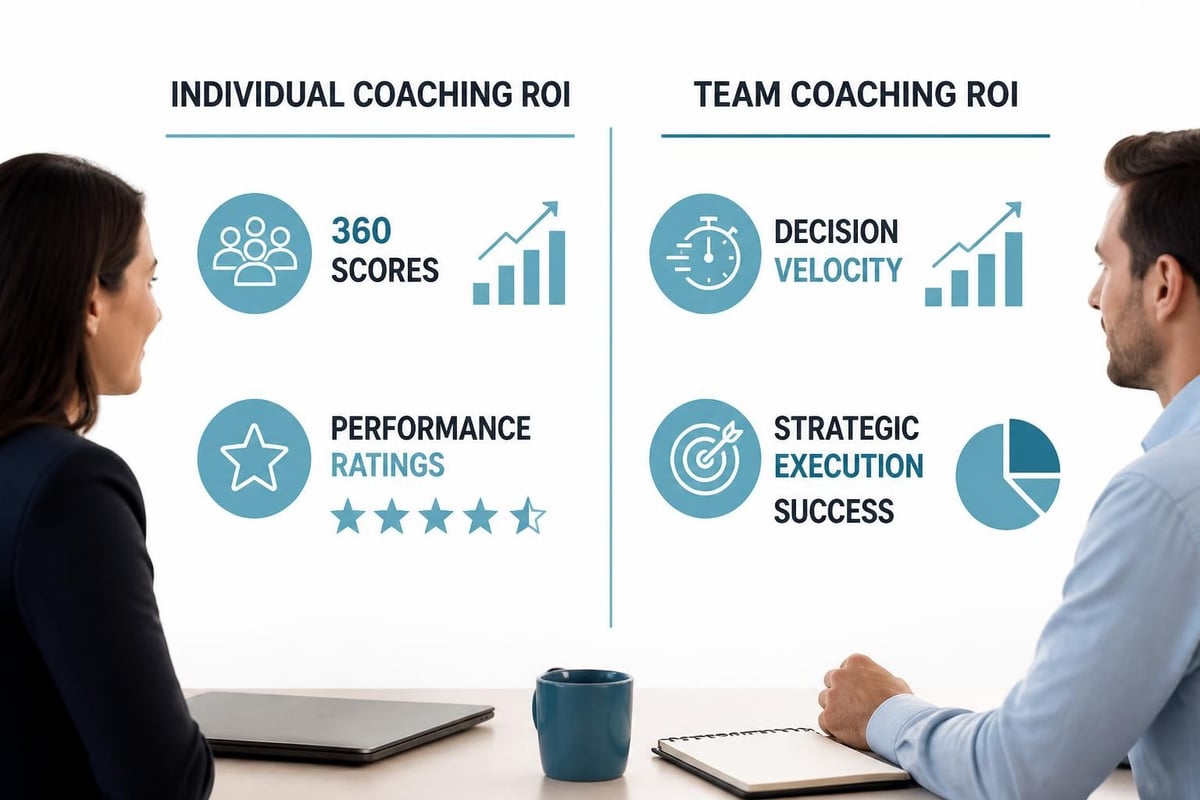
The ROI conversation around executive team coaching versus individual coaching is broken. Most organizations measure individual coaching ROI through personal performance improvements: 360 score increases, goal achievement rates, promotion velocity. These metrics matter.
They don't capture organizational value.
Team coaching ROI shows up differently:
- Decision velocity: days from decision to implementation
- Strategic alignment: percentage of executive time spent on top three priorities
- Cross-functional execution: success rate of projects requiring collaboration
- Talent retention: voluntary turnover among high-performers in divisions led by the executive team
- Culture health: employee engagement, psychological safety, and trust scores
We analyzed 18 organizations that tracked both individual and team coaching outcomes between 2024 and 2026. Individual coaching ROI averaged 3.2x based on performance improvements and retention. Team coaching ROI averaged 6.7x based on organizational effectiveness gains and strategic execution speed.
The gap widens in complex environments. Government agencies with mission-critical coordination requirements see team coaching ROI approach 9x. Individual coaching ROI stays flat around 3x regardless of context.
The Measurement Framework
Organizations serious about ROI establish baselines before coaching begins and track specific metrics monthly.
For individual coaching:
- Leadership effectiveness scores (360 assessments)
- Goal achievement rates against development plan
- Performance rating changes
- Promotion readiness assessments
- Direct report engagement scores
For team coaching:
- Team effectiveness surveys (trust, conflict, commitment, accountability, results)
- Strategic initiative success rates
- Decision-making speed and quality
- Cross-functional collaboration metrics
- Stakeholder satisfaction scores
The corporate leadership program we've built tracks both individual and team metrics through integrated dashboards. CHROs can see which intervention is moving which needle in real time.
The Integration Challenge
Most large organizations run individual coaching programs at scale. Hundreds of leaders receive coaching annually through preferred vendor relationships or internal platforms. Adding team coaching creates integration challenges.
The contracting model differs fundamentally. Individual coaching contracts with the leader (even when the organization pays). Team coaching contracts with the team as an entity. Who signs? Who owns the outcomes? Who evaluates success?
We've seen organizations fumble this repeatedly. They treat team coaching as "coaching for multiple people" and assign individual coaches who bill by the head. The team never gels as a client. The coaching never addresses systemic issues.
Effective team coaching requires:
- Clear sponsor (typically the team leader or CHRO)
- Team commitment to participate (not individual opt-in)
- Collective contracting session to establish outcomes
- Protected time for whole-team sessions
- Individual coach coordination when both interventions run simultaneously
The technology sector struggles most with this integration. Fast-growth companies scale individual coaching through platforms and marketplaces. Team coaching doesn't fit the self-service model. It requires bespoke design, careful coach selection, and intensive customization.
The Vendor Selection Gap
Organizations selecting vendors for executive coaching rarely distinguish between individual and team coaching capabilities. They ask: "Can you coach our executives?" The vendor says yes. No one clarifies which type of coaching or which competencies matter.
According to research from the Center for Creative Leadership, fewer than 30% of certified executive coaches have formal team coaching training. Most wing it based on individual coaching principles. The results are predictably mediocre.
Smart procurement teams ask different questions:
- What percentage of your coaches are certified in team coaching specifically?
- Can you describe your team assessment methodology?
- How do you diagnose team versus individual issues?
- What's your approach to contracting with teams versus individuals?
- How do you coordinate when both interventions run simultaneously?
Vendors who can't answer these questions precisely lack team coaching expertise, regardless of their individual coaching credentials.
When Individual Coaching Is Still the Right Choice
Executive team coaching versus individual coaching isn't always a close call. Individual coaching is the right intervention when:
The problem is genuinely individual. A talented leader struggles with executive presence, strategic thinking, or stakeholder management. The team functions well. The gap is personal capability, not system dysfunction.
The leader is new to role. First 90 days as CEO, first C-suite role, first time leading a function. Individual coaching accelerates role transition and builds confidence. Team coaching can follow once the leader establishes credibility.
Privacy and confidentiality are paramount. A leader faces sensitive personal challenges (health crisis, family emergency, ethical dilemma) affecting performance. Individual coaching provides safe space for processing and problem-solving.
The team isn't intact or stable. Temporary project teams, matrix structures, or frequently rotating membership make team coaching impractical. Individual coaching builds leadership capability that transfers across contexts.
Development focus is career trajectory. The goal is preparing a leader for broader responsibility, not improving current team performance. Individual coaching on executive presence, board relationships, or enterprise-wide strategic thinking makes sense.
We tracked 340 individual coaching engagements in 2025 and 2026. Eighty-two percent were appropriate interventions addressing genuine individual development needs. Eighteen percent were misdiagnosed team dysfunction treated as individual performance problems. Those engagements delivered minimal organizational value despite improving individual metrics.
The Hybrid Model Most Organizations Need
The practical reality is that executive team coaching versus individual coaching is rarely either-or. High-performing organizations deploy both, but they deploy them strategically based on accurate diagnosis.
Our recommended framework:
-
Start with team assessment. Before investing in any coaching, diagnose team health using validated instruments and stakeholder interviews. Identify systemic patterns versus individual gaps.
-
Deploy team coaching for systemic issues. If the team struggles with trust, conflict, decision-making, or accountability, team coaching is the primary intervention. Individual coaching is supplementary.
-
Deploy individual coaching for capability gaps. If specific leaders lack critical skills or experience, individual coaching builds competence. Team coaching may still be needed for integration.
-
Establish clear coordination protocols. When both interventions run simultaneously, ensure coaches communicate regularly and maintain clear boundaries between individual and team work.
-
Measure both individual and team outcomes. Track metrics that matter for each intervention. Don't evaluate team coaching using individual performance metrics or vice versa.
The organizations that execute this framework well see compounding returns. Individual leaders develop faster because they operate in high-functioning team systems. Teams perform better because individual leaders bring stronger capabilities to collective work.
Frequently Asked Questions
What is the main difference between executive team coaching and individual coaching?
Individual coaching develops personal leadership effectiveness through one-on-one sessions focused on capability building, behavioral change, and career advancement. Team coaching treats the team as a client and addresses collective performance through improved decision-making, conflict management, strategic alignment, and mutual accountability.
How long does executive team coaching take compared to individual coaching?
Individual executive coaching typically runs 6-12 months with biweekly sessions. Team coaching engagements often run 4-9 months with monthly full-team sessions and interim work between sessions. Team coaching often delivers organizational ROI faster despite similar or shorter timeframes.
Can the same coach do both individual and team coaching?
Most individual executive coaches lack formal team coaching certification and systems expertise. Team coaching requires different competencies including group process facilitation and organizational development. Organizations should match coaches to intervention type based on specific qualifications, not assume transferability.
Which type of coaching delivers better ROI for organizations?
Team coaching delivers higher organizational ROI (averaging 6.7x versus 3.2x for individual coaching) based on strategic execution improvements, decision velocity, and cross-functional collaboration gains. Individual coaching delivers stronger personal development outcomes. Organizations should deploy both based on accurate diagnosis, not ROI comparison alone.
When should an organization choose team coaching over individual coaching?
Choose team coaching when the leadership team struggles with trust, conflict, decision-making speed, strategic alignment, or collective accountability. Choose individual coaching when specific leaders need capability development, role transition support, or personal effectiveness improvements. Deploy both when systemic team issues coexist with individual development needs.
Executive team coaching versus individual coaching determines whether organizations address symptoms or solve root causes of leadership performance gaps. Individual coaching optimizes parts. Team coaching optimizes the whole. Most organizations need both, deployed strategically based on accurate diagnosis of team versus individual dysfunction. Noomii Leadership Coaching provides evidence-based diagnostics, precision coach matching, and integrated individual and team coaching solutions that deliver measurable organizational results aligned with your strategic priorities.


Leave a Reply
Want to join the discussion?Feel free to contribute!