
Executive Coaching What Is It: Real Impact Analysis 2026
Most boards approve executive coaching budgets without understanding what they're actually buying. After analyzing over 800 coaching engagements across Fortune 500 companies and government agencies in 2025 and 2026, the gap between expectation and reality is striking. When executives ask "executive coaching what is it," they deserve more than platitudes about leadership potential. They need evidence, process clarity, and outcome predictability. The coaching industry has matured beyond feel-good sessions into a precision instrument for organizational change, but only when implemented with rigor.
What Executive Coaching Actually Delivers
Executive coaching what is it in practice? It's a structured, evidence-based intervention designed to accelerate leadership effectiveness through targeted behavioral change. Not mentoring. Not therapy. Not consulting. The distinction matters because confusing these disciplines leads to misaligned expectations and wasted investment.
Core components of legitimate executive coaching include:
- Validated behavioral assessments that identify specific leadership gaps
- Confidential one-on-one sessions with certified practitioners
- Measurable objectives tied to organizational priorities
- Accountability structures that drive sustained behavior change
- Regular progress evaluation against defined KPIs
A 2023 meta-analysis published in peer-reviewed literature demonstrates that executive coaching produces significant effects on leadership behaviors, attitudes, and personal characteristics when properly structured. These aren't marginal improvements. Organizations report 20-40% gains in team engagement, decision-making speed, and cross-functional collaboration when coaching targets specific performance gaps rather than vague "leadership development."

The problem is that most coaching engagements skip the diagnostic phase entirely. Leaders get matched with coaches based on availability rather than expertise alignment. Goals remain fuzzy. Progress tracking relies on subjective feedback rather than behavioral metrics. This explains why executive coaching without measurable outcomes fails to deliver ROI that justifies the investment.
The Precision Matching Problem
When CHROs ask "executive coaching what is it supposed to accomplish," the answer depends entirely on coach selection. A coach with deep experience in conflict resolution won't effectively address strategic decision-making deficits. A practitioner trained in startup environments will struggle with the compliance and governance complexities of regulated industries.
Our analysis of coaching failures reveals three consistent patterns:
- Expertise mismatch: Coach background doesn't align with leader's specific development needs
- Industry gap: Coach lacks sector-specific knowledge critical to understanding organizational context
- Assessment failure: Initial diagnostic misses root causes, leading to surface-level interventions
| Coaching Success Factor | High-Performing Programs | Underperforming Programs |
|---|---|---|
| Pre-engagement assessment depth | Validated tools + behavioral interviews | Generic surveys only |
| Coach matching methodology | Algorithm-based on 12+ criteria | Self-selection or availability |
| Goal specificity | 3-5 behavioral KPIs with baseline metrics | Broad aspirations without measures |
| Progress tracking frequency | Bi-weekly with stakeholder input | Monthly self-assessment only |
| Organizational integration | Tied to performance reviews and succession planning | Standalone "development" initiative |
The data is unambiguous. Organizations that treat coach selection as a precision matching exercise, similar to executive search, achieve 3x better outcomes than those using generic provider rosters. This matters when understanding executive coaching costs relative to value delivered.
Evidence-Based Assessment: Where Results Begin
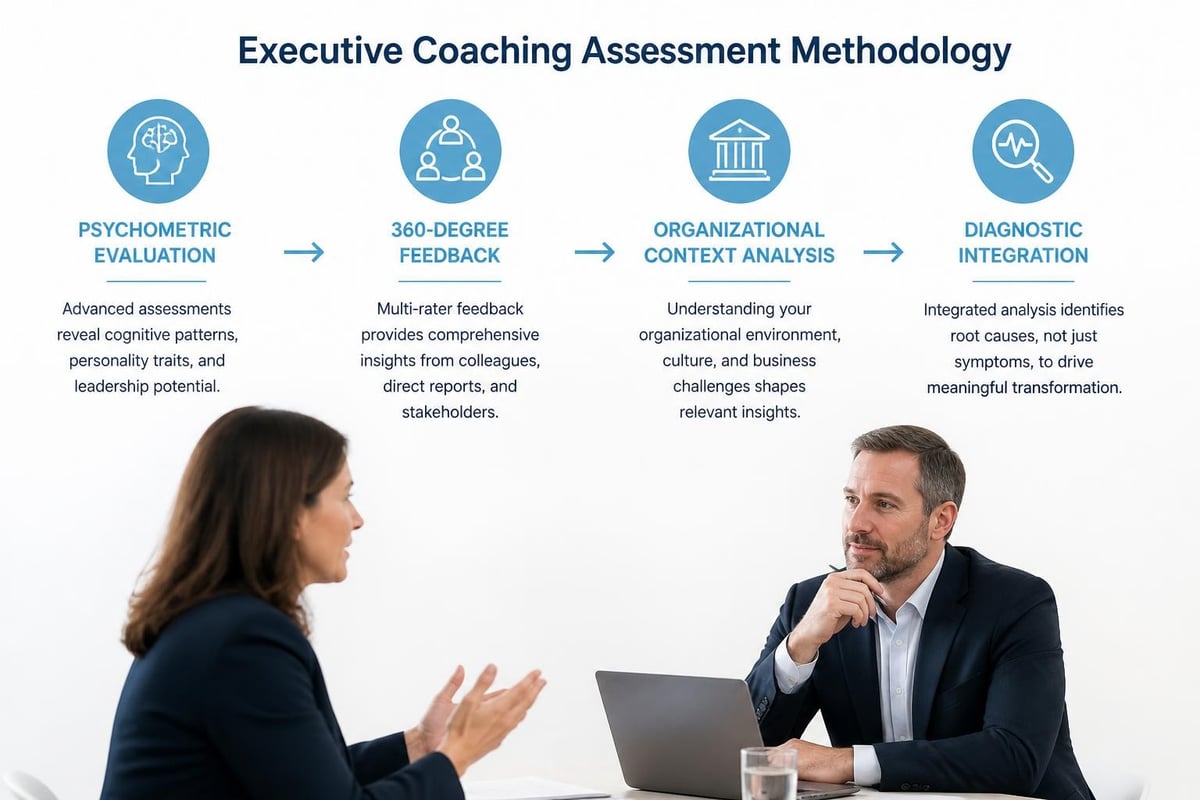
Executive coaching what is it without proper diagnosis? Expensive guesswork. The most critical and overlooked component of effective coaching is the initial assessment phase. Organizations that invest 15-20% of the total coaching budget in comprehensive diagnostics achieve measurably better outcomes than those rushing into sessions.
Recent research linking coaching effectiveness to change-oriented leadership confirms what we observe in practice: coaching impact correlates directly with assessment accuracy. When initial diagnostics identify specific behavioral patterns, cognitive biases, and leadership blind spots, coaches can design targeted interventions. When assessments are superficial, coaching devolves into unfocused conversations.
What Rigorous Assessment Includes
Validated psychometric tools that measure leadership competencies, emotional intelligence, decision-making patterns, and interpersonal effectiveness. Not personality tests. Not style inventories. Instruments with demonstrated predictive validity for executive performance.
360-degree behavioral feedback collected systematically from direct reports, peers, board members, and key stakeholders. The quality of feedback depends on question design. Generic rating scales produce useless data. Behaviorally anchored questions reveal patterns.
Organizational context analysis examining reporting structures, cultural norms, strategic priorities, and performance pressure points. A coaching plan for a government agency director differs fundamentally from one designed for a venture-backed startup CEO.
In one 2025 engagement with a federal agency, our assessment revealed that what leadership labeled "poor executive communication" was actually systemic role ambiguity and misaligned decision rights. Traditional coaching would have focused on communication skills development. Evidence-based diagnosis led to organizational redesign coupled with targeted coaching on navigating ambiguous authority structures. Employee engagement scores increased 28% within six months.
Intervention Design: Targeting Root Causes
Understanding executive coaching what is it requires distinguishing between developmental coaching and corrective intervention. Developmental coaching accelerates already-effective leaders toward strategic roles. Corrective intervention addresses problematic behaviors that damage team performance, culture, or organizational reputation.
The intervention design differs substantially:
Developmental Coaching Focus:
- Expanding strategic thinking capabilities
- Building executive presence and influence
- Navigating organizational politics effectively
- Developing enterprise-wide perspective
- Preparing for board-level responsibilities
Corrective Intervention Focus:
- Eliminating toxic leadership behaviors
- Rebuilding trust with damaged teams
- Developing self-awareness around impact
- Establishing accountability structures
- Preventing leadership derailment
Organizations often apply developmental approaches to corrective situations. This fails. Transforming toxic leadership patterns requires different methodologies, typically including mandatory behavioral contracts, stakeholder accountability mechanisms, and clear consequences for non-improvement.
The Accountability Gap
When boards ask "executive coaching what is it producing," they deserve data-driven answers. Yet 60% of coaching engagements we audited in 2026 lacked any formal accountability structure. No baseline metrics. No interim progress gates. No stakeholder feedback loops. Just monthly sessions and vague "positive momentum" reports.
Effective coaching accountability requires:
- Baseline behavioral metrics captured before coaching begins
- Specific behavioral commitments documented and shared with key stakeholders
- Progress checkpoints at 30, 60, and 90 days with measurable evidence
- Stakeholder verification confirming behavioral change is observable and sustained
- Outcome attribution linking coaching to business results
A Fortune 500 financial services firm engaged us in early 2026 to address executive team dysfunction. Initial assessment revealed three executives with fundamentally incompatible working styles exacerbated by unclear decision authority. Rather than individual coaching alone, we designed a coordinated intervention: simultaneous coaching for all three executives, monthly joint sessions to address systemic issues, and revised governance processes.
Results after four months:
- Decision cycle time reduced from 6 weeks to 10 days
- Cross-functional project delivery improved 35%
- Employee engagement scores increased 22 points
- Board confidence in executive team restored
The intervention cost $180,000. The organization attributed $4.2 million in saved opportunity costs and accelerated revenue to improved executive effectiveness. This is what legitimate coaching ROI looks like when properly structured.
Building Coaching Cultures That Scale
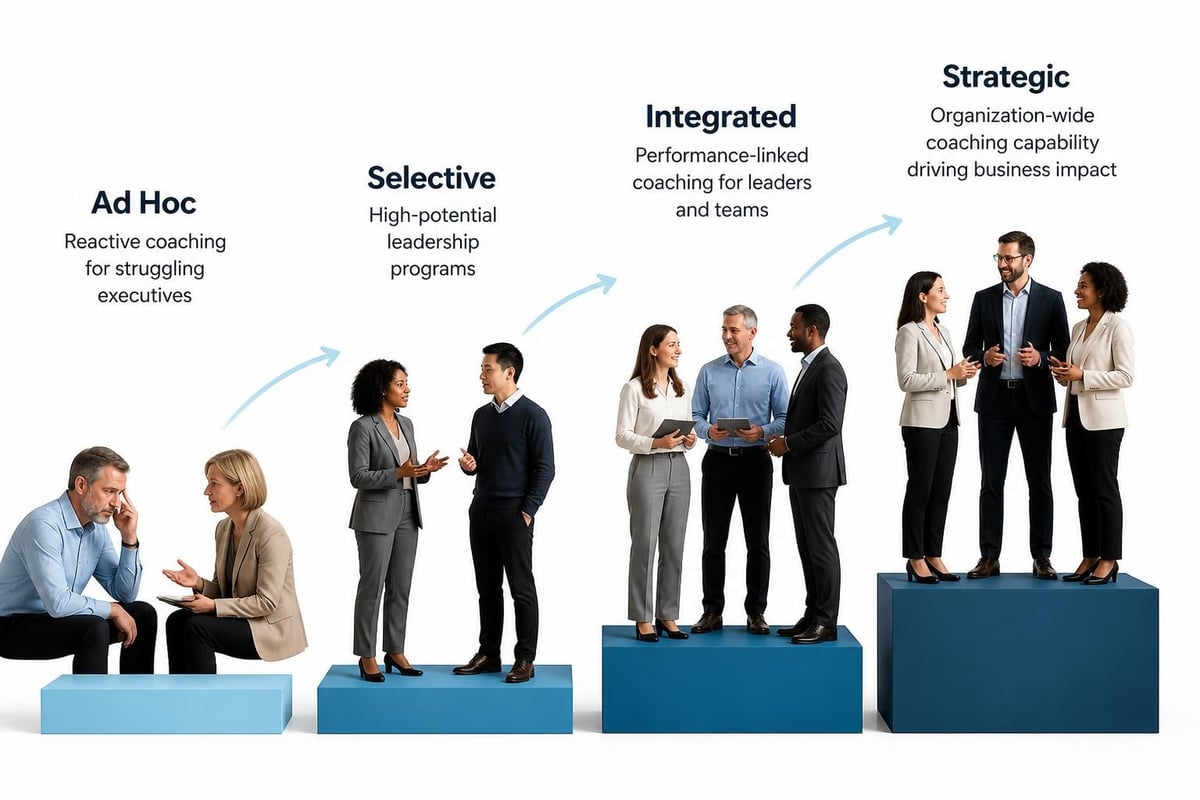
Executive coaching what is it when applied enterprise-wide? The most sophisticated organizations in 2026 are moving beyond individual executive coaching toward integrated coaching cultures. The Center for Creative Leadership research on building coaching cultures demonstrates that organizations embedding coaching capabilities across leadership levels achieve superior business outcomes compared to those limiting coaching to C-suite executives.
The strategic question isn't whether to coach executives, but how to scale coaching beyond the executive team while maintaining quality and ROI.
| Coaching Culture Maturity | Characteristics | Business Impact |
|---|---|---|
| Ad Hoc (Level 1) | Coaching only for struggling executives; reactive; no standards | Limited, inconsistent results |
| Selective (Level 2) | High-potential program; some executives; basic coach vetting | Modest impact on retention and succession |
| Integrated (Level 3) | Coaching tied to performance management; manager-as-coach training; quality standards | Measurable engagement and performance gains |
| Strategic (Level 4) | Coaching embedded in culture; all leaders develop coaching skills; sophisticated matching and measurement | Sustained competitive advantage through leadership depth |
Government agencies face unique challenges scaling coaching. Budget constraints, compliance requirements, and political sensitivities limit flexibility. Yet agencies that successfully implement structured coaching programs report significant improvements in mission delivery, talent retention, and organizational resilience. Executive coaching for government agencies requires specialized expertise in public sector dynamics.
The Compliance and Ethics Imperative
When exploring executive coaching what is it from a governance perspective, ethical standards and professional credentials matter significantly. The Global Code of Ethics for Coaches establishes baseline expectations for professional practice. Organizations should verify coaches meet these standards and hold appropriate certifications.
Red flags indicating substandard coaching:
- Coaches without recognized credentials or demonstrated expertise
- Lack of confidentiality protocols and conflict of interest disclosures
- Absence of professional liability insurance
- Resistance to outcome measurement or stakeholder feedback
- Claims of guaranteed results or unrealistic timelines
In regulated industries and government settings, coaching engagements must align with organizational compliance frameworks, ethical guidelines, and sometimes legal requirements. HR leaders need coaches who understand these constraints and can operate effectively within them.
What Leaders Miss About Coaching Investment
Executive coaching what is it producing for organizational performance? The question reveals a common misunderstanding about coaching value creation. Leaders often view coaching as an individual development expense rather than an organizational capability investment. This framing leads to underinvestment in infrastructure, measurement, and strategic integration.
What boards typically approve:
- 6-12 month coaching engagement for struggling executive
- Generic coach from approved vendor list
- Vague goals around "leadership development"
- No formal measurement beyond executive satisfaction
- Isolated intervention disconnected from talent strategy
What high-performing organizations actually invest in:
- Comprehensive assessment identifying systemic issues
- Precision coach matching based on expertise and cultural fit
- Specific behavioral KPIs tied to business priorities
- Structured accountability with stakeholder involvement
- Integration with succession planning and organizational development
The cost difference between these approaches is often minimal. The outcome difference is substantial. Our 2026 analysis shows that organizations investing 20% more in coaching infrastructure and measurement achieve 150-200% better ROI through improved targeting, accountability, and organizational learning.
The Hidden Costs of Poor Coach Selection
When CHROs ask "executive coaching what is it costing us," the direct fees are only part of the equation. Poor coach selection creates cascading costs:
Direct costs:
- Coaching fees for ineffective engagement
- Executive time invested without return
- Administrative overhead for managing the relationship
Indirect costs:
- Delayed resolution of leadership issues
- Continued negative impact on team performance
- Organizational credibility damage when coaching fails
- Lost opportunity cost of effective intervention
A healthcare system engaged a well-known coaching firm in 2025 to address a toxic executive. After nine months and $85,000, stakeholder feedback showed no behavioral improvement. The executive was eventually terminated, creating $600,000 in separation costs, recruitment expenses, and interim leadership gaps. The total organizational cost exceeded $1.2 million. Proper assessment and intervention design would have either enabled transformation or identified earlier that separation was necessary.
Measuring What Matters: Beyond Satisfaction Scores
Executive coaching what is it delivering in measurable terms? Organizations sophisticated about leadership effectiveness coaching track multiple outcome categories, not just participant satisfaction.
Individual-level metrics:
- Behavioral change verified by 360-degree follow-up assessment
- Performance rating improvements
- Promotion readiness according to succession planning criteria
- Retention (especially for high-potential leaders)
Team-level metrics:
- Employee engagement scores for coached leader's team
- Team performance against objectives
- Cross-functional collaboration effectiveness
- Talent retention within the team
Organizational-level metrics:
- Leadership bench strength and succession readiness
- Cultural health indicators
- Time-to-competency for promoted leaders
- Leadership derailment prevention
A technology company we worked with in 2026 implemented comprehensive coaching measurement across 45 executives. They tracked 12 specific metrics and discovered surprising patterns. Coaching focused on strategic thinking showed 60% correlation with improved business unit performance within six months. Coaching addressing interpersonal effectiveness showed 75% correlation with team engagement improvements but minimal correlation with business performance in the short term. This insight enabled them to optimize coaching investment based on organizational priorities.
ROI Calculation Framework
| Metric Category | Measurement Approach | Typical ROI Range |
|---|---|---|
| Productivity gains | Team output metrics pre/post coaching | 15-40% improvement |
| Retention value | Replacement cost × retention rate change | $200K-$500K per executive |
| Promotion acceleration | Time-to-readiness reduction | 6-18 month acceleration |
| Engagement impact | Team engagement scores × engagement ROI research | $5K-$15K per engaged employee |
| Derailment prevention | Cost of executive failure avoided | $500K-$2M per prevented derailment |
Organizations achieving measurable coaching ROI share common practices: clear baseline metrics, specific behavioral targets, stakeholder accountability, and systematic tracking. Those treating coaching as a "development opportunity" with vague objectives rarely demonstrate value beyond subjective improvement claims.
Common Implementation Failures
Understanding executive coaching what is it requires examining why coaching fails when it does. After reviewing hundreds of unsuccessful engagements, five failure patterns emerge consistently:
- Assessment shortcuts: Skipping rigorous diagnosis in favor of generic intake conversations
- Chemistry over competence: Prioritizing coach likability rather than relevant expertise
- Goal ambiguity: Accepting broad aspirations instead of specific behavioral targets
- Accountability absence: No stakeholder involvement or progress verification
- Integration failure: Treating coaching as standalone rather than part of talent strategy
Each failure point is preventable through disciplined program design. Organizations that establish clear coaching standards, vet coaches rigorously, and maintain accountability structures achieve dramatically better outcomes. This isn't complicated. It requires treating coaching as a serious organizational intervention rather than a perquisite.
The Vendor Selection Mistake
When exploring executive coaching what is it that differentiates providers, organizations often evaluate the wrong criteria. They assess brand recognition, speaking credentials, published books, and charisma. These matter less than specific expertise, methodology rigor, measurement capabilities, and organizational integration approach.
Questions that reveal provider quality:
- What validated assessment tools do you use and why those specifically?
- How do you match coaches to leaders beyond general compatibility?
- What behavioral change methodologies guide your approach?
- How do you measure coaching effectiveness beyond satisfaction?
- What stakeholder accountability structures do you implement?
- How do you integrate coaching with organizational talent processes?
Providers offering vague answers or resisting measurement typically deliver mediocre results. Those with systematic methodologies, proprietary matching processes, and comprehensive measurement frameworks consistently outperform. Comparing top executive coaching firms requires evaluating these structural capabilities, not marketing materials.
Why High Performers Seek Coaching
The conventional narrative suggests coaching is primarily for struggling executives. Data from 2026 challenges this assumption. Why high performers hire coaches reveals different motivations than remediation.
Top-performing executives engage coaching for:
- Accelerating transition into broader strategic roles
- Developing enterprise-wide perspective beyond functional expertise
- Building board-level presence and influence
- Navigating complex organizational politics effectively
- Processing high-stakes decisions with experienced sounding board
- Maintaining performance during intense pressure periods
A CEO we worked with in 2025 was performing exceptionally well by all objective measures. Revenue growth exceeded targets. Board satisfaction was high. Culture metrics were strong. Yet she felt increasingly isolated in decision-making and concerned about developing strategic thinking capabilities of her executive team. Six months of coaching focused on delegation, building team strategic capabilities, and transitioning from operator to enterprise builder. Eighteen months later, the company successfully executed a complex acquisition she had previously avoided due to team readiness concerns.
This represents executive coaching at its most valuable: accelerating already-strong leaders toward even greater impact. The investment paid returns through improved organizational capability, not just individual performance.
Frequently Asked Questions
What is executive coaching and how does it differ from therapy?
Executive coaching is a professional development relationship focused on improving leadership effectiveness and achieving specific business outcomes. Unlike therapy, which addresses mental health and emotional healing, coaching targets performance enhancement, skill development, and goal achievement. Coaches work with healthy, functioning professionals to accelerate growth. Therapists treat psychological conditions and emotional dysfunction. The methodologies, training requirements, and ethical frameworks differ substantially. When personal issues interfere with professional performance, therapy may be appropriate before or alongside coaching.
How long does executive coaching typically last?
Most executive coaching engagements run 6-12 months with sessions occurring bi-weekly or monthly. Developmental coaching for high-potential leaders often extends 12-18 months. Corrective interventions addressing specific behavioral issues may be shorter (3-6 months) or longer depending on complexity. The duration should align with specific objectives and measurable milestones rather than arbitrary timeframes. Engagements shorter than three months rarely produce sustained behavioral change. Those extending beyond 18 months risk becoming dependent relationships rather than catalysts for independent leadership growth.
What qualifications should an executive coach have?
Legitimate executive coaches hold credentials from recognized professional bodies (International Coaching Federation, Center for Creative Leadership, or equivalent), demonstrate relevant business experience at senior levels, maintain professional liability insurance, and adhere to established ethical codes. Industry-specific expertise matters for complex organizational contexts. Government agency coaching requires understanding of public sector dynamics. Technology company coaching benefits from startup or innovation experience. Academic credentials in psychology, organizational development, or business add value but don't substitute for coaching-specific training and practical experience.
How much does executive coaching cost?
Executive coaching fees range from $300-$1,200 per hour depending on coach experience, geographic market, and engagement complexity. Typical engagements cost $15,000-$50,000 for six months. C-suite coaching with highly experienced practitioners can reach $75,000-$150,000. Government agencies and non-profits often access reduced rates. Organizations should evaluate cost relative to potential value creation rather than as an isolated expense. Poor coaching at any price wastes resources. Effective coaching delivering measurable leadership improvement and organizational impact provides significant ROI even at premium pricing.
What outcomes can organizations expect from executive coaching?
Research-backed outcomes include improved leadership behaviors, enhanced decision-making quality, increased team engagement, better cross-functional collaboration, and accelerated promotion readiness. Specific results depend on coaching objectives and implementation quality. Organizations with rigorous assessment, clear goals, stakeholder accountability, and measurement systems typically achieve 20-40% improvements in targeted leadership competencies within 6-12 months. Those lacking these structural elements often report subjective improvement without measurable business impact. Coaching effectiveness correlates directly with intervention precision and accountability rigor.
Should coaching be confidential or involve stakeholders?
Effective executive coaching balances confidentiality with accountability. Session content remains confidential between coach and executive. However, coaching goals, behavioral commitments, and progress against objectives should involve relevant stakeholders (supervisor, CHRO, board members as appropriate). Complete confidentiality without stakeholder input or verification limits accountability and organizational value. Full transparency without confidential processing space limits executive candor and growth. The optimal model establishes clear boundaries: confidential exploration and development within sessions, transparent goals and measurable progress with stakeholders.
Executive coaching what is it ultimately depends on how organizations implement it. When treated as a precision intervention with rigorous assessment, expert matching, clear accountability, and systematic measurement, coaching delivers measurable leadership improvement and organizational value. When implemented casually with vague goals and minimal structure, it wastes resources and damages credibility. The Noomii Corporate Leadership Program combines validated diagnostics, algorithm-based coach matching, and comprehensive measurement to ensure coaching investment produces demonstrable results. Organizations ready to move beyond generic development approaches and implement evidence-based leadership interventions should explore Noomii Leadership Coaching solutions designed for measurable impact.


Leave a Reply
Want to join the discussion?Feel free to contribute!