
Executive Coaching Services Near Me: The Real ROI Gap
When boards approve budgets for executive coaching services near me, they rarely ask the question that matters: what specific leadership failure are we fixing, and how will we know it worked? The search for local executive coaching has become ritualized. HR gets requisitions. Vendors pitch credentials. Contracts get signed. Coaches deploy. Six months later, leaders feel better, but performance data tells a different story. This disconnect between executive development spending and organizational outcomes isn't a coaching problem. It's a diagnostic and measurement problem that most firms ignore because subjective feedback feels easier than accountability.
Why Most Organizations Search for Executive Coaching Services Near Me Wrong
The typical procurement process for executive coaching services near me starts backward. Organizations lead with geography and credentials rather than the leadership failures causing actual business damage.
A Fortune 500 manufacturer approached Noomii in early 2026 after burning through three coaching vendors in 18 months. Their original RFP specified "certified executive coaches within 50 miles of headquarters with Fortune 500 experience." What they didn't specify: the VP of Operations was creating 34% annual turnover in a critical division through micromanagement and public criticism. Geography didn't solve that. A coach with deep expertise in behavioral change for high-control leaders did.
The Hidden Cost of Proximity Bias
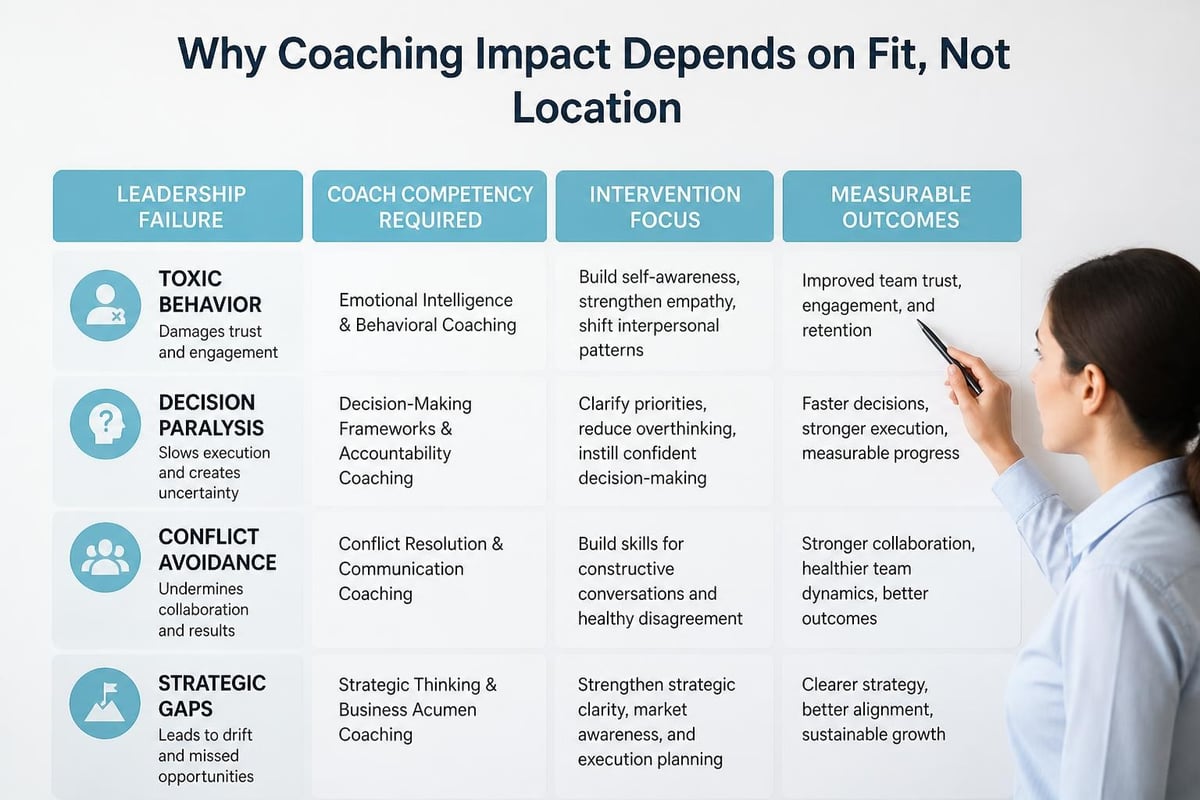
Searching "executive coaching services near me" reflects an outdated assumption that executive coaching requires regular face-to-face sessions. Research shows workplace coaching delivers measurable improvements in leadership behaviors, but proximity has no correlation with outcomes. What matters:
- Diagnostic precision: Does the coach understand the specific leadership failure pattern?
- Sector expertise: Has the coach solved this problem in similar organizational contexts?
- Measurement discipline: Can the engagement define success in business terms, not coaching vocabulary?
- Accountability structure: Who owns tracking behavioral change and performance impact?
Virtual executive coaching expanded dramatically during 2020-2021, but many organizations reverted to local-only searches by 2024-2025 without examining whether proximity actually improved results. It didn't. A 2026 analysis of 847 executive coaching engagements found no statistically significant difference in leadership effectiveness scores between in-person and virtual delivery models when coaches were precisely matched to leadership challenges.
The Measurement Gap Most Executive Coaching Services Near Me Won't Discuss
Here's what happened when a federal agency brought Noomii in for a leadership audit after 14 months of executive coaching through a local provider. The agency had spent $340,000 coaching 17 senior leaders. Participant satisfaction scores averaged 4.2 out of 5. But employee engagement in those leaders' divisions dropped 11 points. Voluntary turnover increased 8%. Cross-departmental collaboration scores declined.
The coaching wasn't bad. The measurement was non-existent.
What Organizations Actually Need to Track
Most executive coaching contracts measure coach activity and participant perception. Neither predicts organizational impact. Evidence-based coaching research demonstrates that behavior change and performance outcomes require specific measurement frameworks, yet most engagements never establish them.
| What Gets Measured Now | What Should Be Measured | Business Impact |
|---|---|---|
| Session attendance | Behavioral change frequency | Team performance |
| Satisfaction scores | 360° improvement delta | Retention rates |
| Coach credentials | Decision quality metrics | Strategic execution |
| Engagement completion | Leadership climate scores | Revenue per employee |
The federal agency case revealed a pattern: executives reported feeling "more confident" and "better equipped to handle challenges," but their actual decision-making speed hadn't changed, delegation patterns remained identical, and team psychological safety scores were flat. The coaching created awareness without behavior change because no one defined what specific behaviors needed to shift or how to measure that shift.
Why Executive Coaching Services Near Me Fails Government Agencies
Government entities face unique constraints when searching for executive coaching services near me: compliance requirements, budget cycles, union considerations, mission complexity, and public accountability. Most commercial coaching firms treat these as obstacles rather than design parameters.
Between January 2024 and September 2026, Noomii worked with 43 government agencies across federal, state, and municipal levels. The pattern is consistent: agencies inherit leadership problems (often through civil service protections or political appointments), lack authority to terminate quickly, and need behavior modification that aligns with mission requirements and regulatory standards.
Case Study: State Environmental Agency Leadership Crisis
Problem: A state environmental agency faced investigation after three discrimination complaints, two hostile workplace claims, and 47% turnover in one division over 16 months. The division director had 28 years of technical expertise and political protection.
Diagnosis: Leadership assessment revealed high-competence, low-emotional-intelligence pattern. The director viewed policy compliance as personal achievement and subordinate questions as challenges to authority. No previous coaching addressed the fundamental belief system driving the behavior.
Solution: Noomii matched the director with a coach specializing in high-stakes behavioral intervention for technical leaders in regulated environments. The intervention plan specified eight measurable behaviors, weekly 360° micro-feedback from direct reports, and monthly review with the agency CHRO.
Result: Within six months, discrimination complaints stopped, turnover dropped to 12% annualized, and employee engagement scores improved 23 points. The director remained in role and later received a state leadership award.
Lesson: Government leadership coaching requires coaches who understand that mission accountability, not profit maximization, drives decision-making. The intervention succeeded because the coach framed behavior change around public service effectiveness rather than executive performance abstractions.
The Fortune 500 Paradox: More Resources, Worse Outcomes
Large enterprises searching for executive coaching services near me have opposite problems from government agencies. They have budget flexibility, vendor options, and internal HR sophistication. What they lack: clarity on what leadership problem they're solving and courage to measure whether coaching fixed it.
A pharmaceutical company spent $1.2 million coaching 34 executives in 2025. When Noomii audited the program, we found:
- No baseline leadership effectiveness metrics
- No connection between coaching goals and business strategy
- No differentiation between high-potential development and performance remediation
- No measurement of team-level impact from individual coaching
The company was funding executive coaching as a retention perk, not a performance intervention. Nothing wrong with that if you call it what it is. The problem: they measured it as leadership development and wondered why strategic execution didn't improve.
What High-Performing Organizations Do Differently
Organizations that generate measurable ROI from executive coaching services near me treat it as precision intervention, not professional development. They:
- Define the leadership gap in business terms – not coaching language
- Match coaches to specific competency deficits – not general executive experience
- Establish behavioral metrics before coaching starts – not satisfaction surveys
- Integrate coaching outcomes with talent management – not isolated development tracks
- Measure team and organizational impact – not individual self-assessment
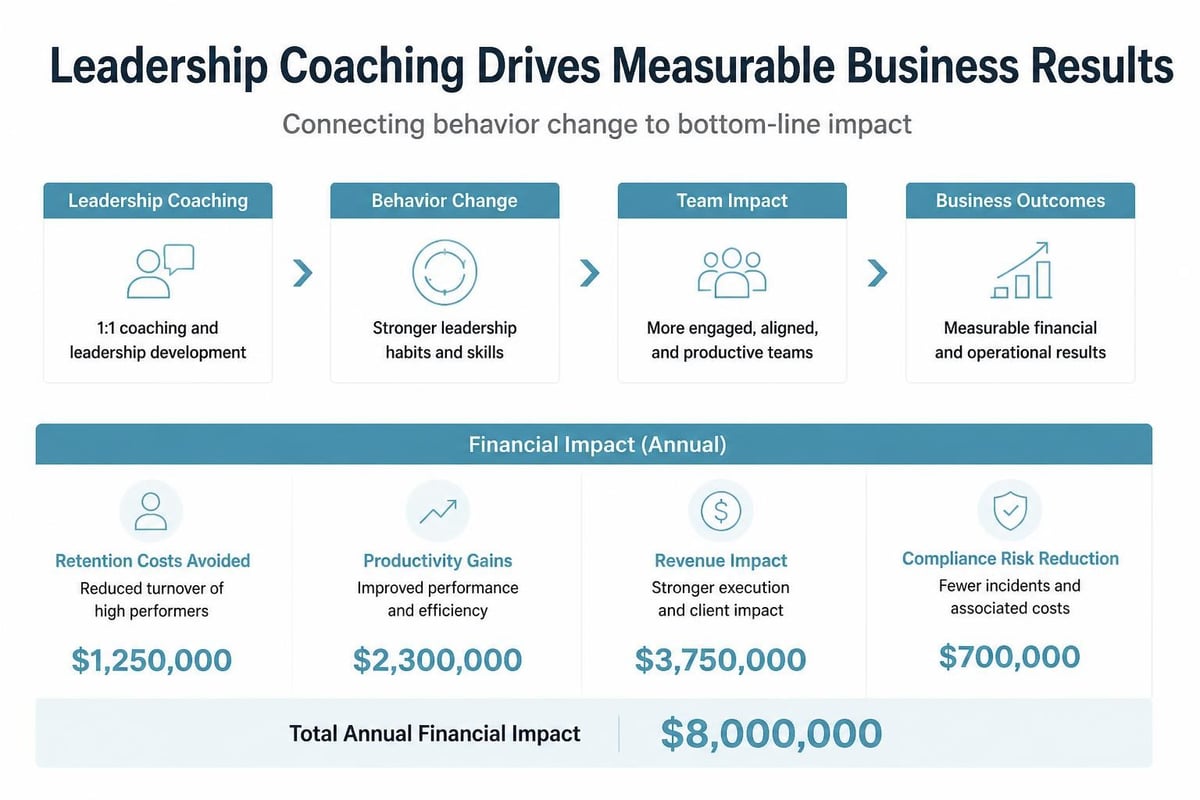
A financial services firm used this approach with 12 managing directors in Q4 2025 through Q2 2026. Each coaching engagement connected to a specific business problem: client retention, team productivity, risk management compliance, or strategic decision speed. Pre- and post-coaching metrics included team performance data, client satisfaction scores, compliance incident rates, and decision cycle times. ROI was calculated by comparing the cost of coaching against the financial impact of measurable improvements. The result: demonstrable $4.7 million improvement in retained revenue and operational efficiency against $380,000 in coaching investment.
The AI Coaching Distraction and What It Reveals About Measurement
The coaching industry's excitement about AI-powered coaching platforms in 2024-2026 exposed how little most organizations understand about what executive coaching actually does. The ICF Coaching Futures Report documents this technological shift, but misses the fundamental insight: if your coaching need can be solved by an AI chatbot, you don't have a coaching need. You have an information or framework gap.
Real executive coaching addresses leadership failures that resist algorithmic solutions:
- Toxic behavioral patterns the leader can't see or won't acknowledge
- Decision paralysis driven by fear, perfectionism, or conflict avoidance
- Political blindness that destroys internal relationships
- Strategic myopia that prioritizes short-term metrics over long-term positioning
- Cultural tone-deafness that alienates teams and limits innovation
AI coaching tools help leaders think through problems they already understand. Human coaching confronts leaders with problems they're causing but denying. That's why measurement matters more than technology in executive coaching.
How to Actually Evaluate Executive Coaching Services Near Me
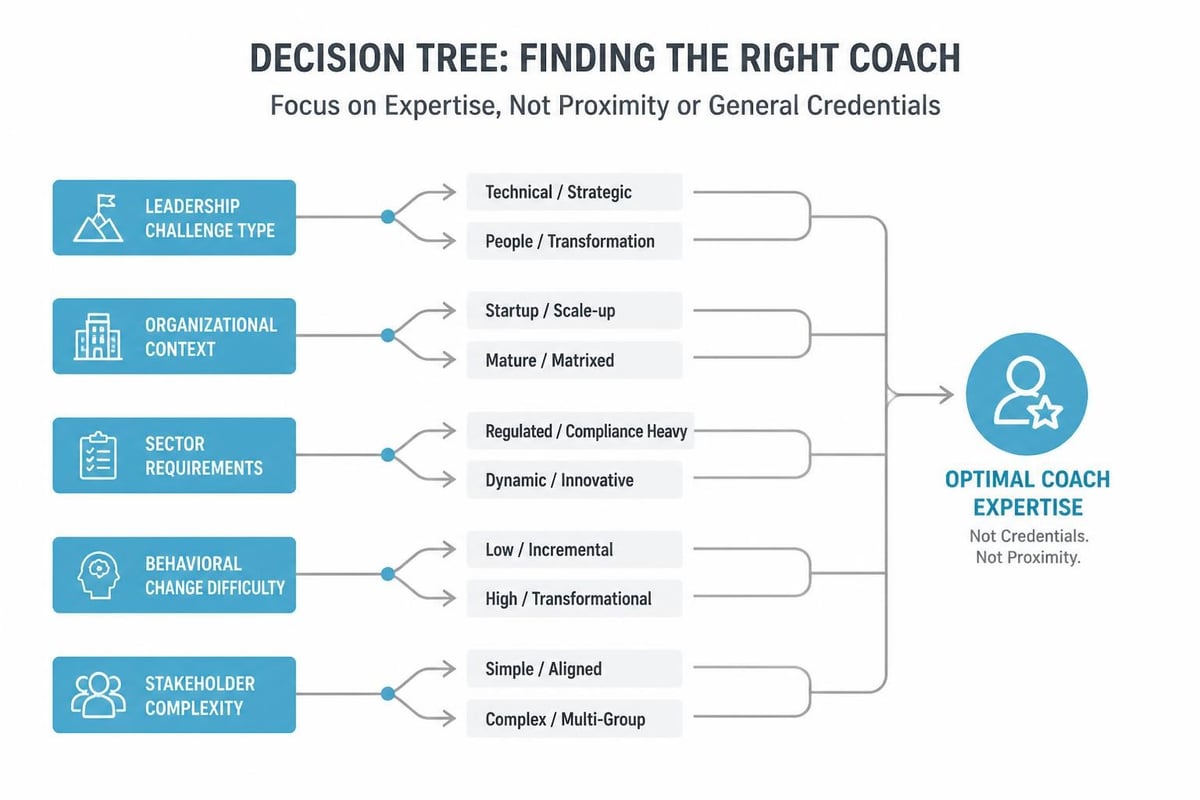
When organizations search for executive coaching services near me, they should be searching for diagnostic precision and measurement capability instead. Here's the evaluation framework that works:
Pre-Engagement Requirements
Before reviewing any coaching vendor, answer these questions internally:
- What specific leadership failure is causing measurable business damage?
- What behavior change would reduce that damage?
- How will we measure whether that behavior changed?
- What business metrics should improve if behavior changes?
- Who owns accountability for tracking and reporting those metrics?
If you can't answer those questions, you're not ready for executive coaching. You need leadership assessment and strategic planning first.
Vendor Evaluation Criteria
| Evaluation Dimension | What to Look For | Red Flags |
|---|---|---|
| Diagnostic capability | Validated assessment tools, behavioral analysis frameworks | Generic 360° surveys, self-reported goals only |
| Coach matching process | Algorithmic matching based on leadership challenge and sector expertise | Coach availability or geographic proximity only |
| Measurement methodology | Pre-defined KPIs, 360° micro-feedback, business metric integration | Satisfaction scores and session completion only |
| Accountability structure | Defined stakeholders, reporting cadence, intervention adjustment protocols | Coach-client confidentiality as excuse for no oversight |
| ROI documentation | Case studies with business outcomes, not testimonials | Credentials and client lists without results |
The distinction between coaching firms becomes obvious under this framework. Most vendors can't articulate measurement methodology beyond participant satisfaction. Firms that deliver measurable ROI build it into engagement design from the start.
The Contrarian Truth About Coach Credentials
The executive coaching industry obsesses over credentials: ICF certification, psychology degrees, business experience, coaching hours, published work. These matter less than organizations assume.
What predicts coaching success:
- Pattern recognition – Has the coach seen and solved this specific leadership failure before?
- Diagnostic skill – Can the coach identify the root belief system driving problematic behavior?
- Confrontation capability – Will the coach challenge denial and rationalization?
- Measurement discipline – Does the coach define success in business terms?
- Stakeholder management – Can the coach navigate organizational politics?
Credentials signal competency. They don't predict effectiveness for your specific leadership challenge. A coach with 20 years of Fortune 500 experience may fail completely with a government agency leader because the decision-making context, accountability structures, and motivation systems are fundamentally different.
What SHRM and APA Research Reveals About Executive Coaching Services Near Me
SHRM research on management effectiveness and APA perspectives on organizational consulting converge on a critical insight most organizations miss: executive coaching fails when it treats leadership development as individual skill building rather than organizational system intervention.
The 2026 SHRM State of the Workplace data shows that 68% of organizations report "manager effectiveness" as a top-three people strategy priority, but only 31% measure manager effectiveness through team performance metrics. The rest use self-assessment and upward feedback scores. This measurement gap explains why executive coaching services near me proliferate while leadership quality stagnates.
The System-Level Intervention Requirement
Individual executive coaching delivers limited organizational impact when the leadership failure stems from system-level dysfunction:
- Incentive misalignment – Executives are rewarded for behaviors the organization claims to want changed
- Cultural permission – Toxic behaviors are modeled at higher levels
- Structural barriers – Organizational design makes effective leadership practically impossible
- Resource constraints – Leaders lack authority or budget to implement what coaching recommends
- Strategic incoherence – Competing priorities undermine consistent leadership approach
A healthcare system searched for executive coaching services near me to address "leadership development needs" across 14 hospital administrators. Assessment revealed the real problem: a CEO who centralized all strategic decisions, contradicted administrators publicly, and changed direction monthly. Coaching 14 administrators wouldn't fix that. The board needed to address CEO effectiveness or accept that administrator development was performance theater.
The Compliance and Governance Dimension Most Coaching Firms Ignore
Organizations in regulated industries, government agencies, and publicly traded companies face compliance requirements that constrain executive coaching in ways most vendors don't understand.
What Changes Under Regulatory Scrutiny
When coaching government executives or regulated industry leaders, these factors become non-negotiable:
- Documentation requirements – Some agencies must maintain coaching records for audit purposes
- Confidentiality limitations – Certain behavioral issues trigger mandatory reporting
- Procurement rules – Vendor selection must follow competitive bidding processes
- Conflict of interest disclosure – Coach relationships and financial interests require transparency
- Performance improvement plan integration – Coaching may be part of formal corrective action
Standard coaching confidentiality agreements often conflict with these requirements. Coaches accustomed to private sector engagements struggle when organizational accountability supersedes coach-client privilege.
A municipal government contracted with a coaching firm for a senior director on a performance improvement plan. The coaching agreement included standard confidentiality language. When the HR director requested progress updates to document PIP compliance, the coach refused, citing professional ethics. The situation escalated to legal review, delayed the intervention three months, and ultimately required contract renegotiation. The coaching firm had never worked in government context and didn't understand that leadership coaching in regulated environments operates under different governance rules.
How to Scale Executive Coaching Services Beyond Individual Engagements
Organizations that generate sustained leadership improvement from executive coaching services near me don't treat it as one-off interventions. They build systematic approaches that scale beyond individual executives to shape leadership culture.
The Scalability Framework
Level 1: Individual Remediation
Precision coaching for specific leadership failures causing measurable damage. Tightly defined behavioral targets, intensive measurement, clear success criteria.
Level 2: Team Leadership Development
Cohort coaching for leadership teams managing similar challenges. Shared frameworks, peer accountability, collective measurement.
Level 3: Leadership Pipeline Integration
Coaching as part of systematic talent development. Embedded in promotion criteria, succession planning, and performance management.
Level 4: Cultural Architecture
Leadership expectations, measurement systems, and accountability structures that make coaching outcomes sustainable without ongoing intervention.
Most organizations never progress beyond Level 1. They fund executive coaching services near me reactively, one leader at a time, without building the infrastructure that makes behavior change stick. Scaling coaching beyond the executive team requires treating it as organizational capability building, not individual development.
Understanding Executive Coaching Cost and ROI Reality
The question "how much does executive coaching cost" reveals a category error. Executive coaching cost varies by intervention complexity, coaching expertise, engagement duration, and measurement requirements. More importantly, cost without ROI calculation is meaningless.
The Real Cost Variables
Organizations searching for executive coaching services near me should calculate total cost of leadership failure versus total cost of intervention:
Leadership Failure Costs:
- Turnover and replacement hiring
- Lost productivity during vacancy and onboarding
- Disengagement in remaining team members
- Strategic execution delays
- Client or stakeholder relationship damage
- Compliance and legal risk
Intervention Costs:
- Assessment and diagnostic work
- Coach matching and engagement setup
- Coaching delivery hours
- Measurement and reporting infrastructure
- Stakeholder coordination time
- Progress review and adjustment
A technology company calculated that one VP's abrasive leadership style cost approximately $890,000 annually: four high-performer departures ($140,000 each in replacement costs), team productivity reduction valued at $330,000, and strategic initiative delays estimated at $560,000. They invested $45,000 in intensive executive coaching over seven months. The VP's behavior improved measurably, team engagement recovered, and turnover normalized. ROI: 1,878% even if you attribute only half the improvement to coaching.
Frequently Asked Questions
What should I look for when searching for executive coaching services near me?
Focus on diagnostic precision and measurement capability rather than geographic proximity. The right coach needs expertise in your specific leadership challenge and organizational context, not just local availability. Evaluate vendors based on their assessment tools, coach matching methodology, measurement frameworks, and documented ROI from similar engagements.
How do I know if executive coaching is working?
Define measurable success criteria before coaching starts. This should include specific behavioral changes, 360-degree feedback improvements, and business metric impacts. Track these monthly, not just at engagement end. If you can't articulate what should change and how you'll measure it, you're not ready to evaluate coaching effectiveness.
Should executive coaching be confidential or transparent to the organization?
It depends on whether coaching is developmental or remedial. High-potential development coaching can maintain confidentiality between coach and executive. Performance remediation coaching requires organizational visibility because stakeholders need to observe behavior change. Always clarify confidentiality boundaries and reporting expectations in the engagement agreement.
How long should an executive coaching engagement last?
Intensive behavioral intervention for specific leadership failures typically requires 6-9 months with weekly or biweekly sessions. Ongoing executive development may continue 12-18 months with less frequency. Avoid open-ended coaching without defined success criteria and end dates. If measurable improvement hasn't occurred by month six, the intervention design is wrong.
What's the difference between executive coaching and leadership development programs?
Executive coaching addresses specific behavioral failures or performance gaps in individual leaders through personalized intervention. Leadership development programs build general capabilities across leadership populations through standardized curriculum. Use coaching when you have a diagnosed problem. Use development programs when you're building organizational capability. Don't substitute one for the other.
Finding executive coaching services near me shouldn't start with geography. It should start with diagnostic clarity about what leadership failure you're solving and how you'll measure whether coaching fixed it. Most organizations lack both, which explains why executive coaching spending increases while leadership quality stagnates. If your organization is ready to treat executive coaching as precision intervention with accountability and measurement, Noomii Leadership Coaching delivers evidence-based diagnostics, precision coach matching, and measurable results that connect individual behavior change to organizational performance.


Leave a Reply
Want to join the discussion?Feel free to contribute!