
Executive Coaching for Hotel and Hospitality Groups
Hotel and hospitality groups operate with razor-thin margins, high turnover, and relentless operational pressure. When a general manager misreads market signals, a regional director fails to retain talent, or a C-suite team struggles with strategic execution, the consequences compound quickly. Executive coaching for hotel and hospitality groups should address these sector-specific stakes, yet most programs default to generic leadership frameworks that ignore the operational realities of running hotels. The difference between effective coaching and wasted investment comes down to three factors: sector expertise, measurable intervention design, and alignment with commercial outcomes. This article unpacks what works, what fails, and how to build coaching programs that deliver tangible results for hotel groups navigating talent shortages, evolving guest expectations, and economic volatility in 2026.
Why Generic Leadership Coaching Fails in Hospitality
Most executive coaching engagements default to self-awareness exercises, personality assessments, and broad leadership philosophies. These approaches collapse when applied to hospitality executives who manage 24/7 operations, navigate labor constraints, and balance brand standards with local market dynamics.
The failure pattern is predictable. A hotel group hires a well-credentialed coach with Fortune 500 experience but no hospitality context. The coach introduces frameworks from tech or finance, missing the operational nuances that define success in hotels: revenue management decisions made under time pressure, guest service recovery in real time, and team leadership across hourly and salaried staff with vastly different motivations.
The Sector Expertise Gap
Hospitality leaders face challenges that don't translate to other industries. A regional vice president overseeing 15 properties across three markets needs coaching on how to diagnose underperformance when RevPAR drops, not abstract discussions about values alignment. A food and beverage director managing a $12 million annual budget needs help building accountability with kitchen staff and front-of-house teams, not theories about psychological safety.
According to research from the Cornell Center for Hospitality Research, leadership effectiveness in hotels correlates directly with operational knowledge and the ability to make real-time decisions under resource constraints. Coaches without sector grounding can't distinguish between a training issue, a systems issue, and a leadership issue when examining the same operational breakdown.
The consequences of mismatched coaching:
- Wasted executive time on irrelevant frameworks
- Leadership behaviors that sound good in theory but fail operationally
- No measurable change in key performance indicators
- Erosion of trust between HR and business unit leaders

What Effective Executive Coaching for Hotel and Hospitality Groups Actually Looks Like
Effective coaching starts with diagnostic precision. Before any intervention, you need to know what's actually broken and what's at stake. For a hotel group, this means understanding whether the issue is strategic (misreading market positioning), operational (ineffective systems or processes), relational (team dysfunction or toxic patterns), or developmental (skill gaps that can be closed through targeted growth).
In 2024, we worked with a boutique hotel group facing retention issues across their general manager tier. Exit interviews pointed to "lack of support" and "unclear expectations," but those are symptoms, not diagnoses. The real issue emerged through leadership assessments and stakeholder interviews: the ownership group made capital allocation decisions without consulting property leaders, then held GMs accountable for outcomes they couldn't influence. The coaching intervention wasn't about helping GMs communicate better. It was about restructuring decision rights and building a governance model where operational leaders had appropriate authority.
Precision Matching and Sector-Specific Expertise
The coach match matters more than most HR leaders acknowledge. A hospitality executive dealing with franchise compliance, brand standard tensions, or multi-property P&L oversight needs a coach who has lived those challenges, not someone reading about them for the first time.
When evaluating top executive coaching firms, hotel groups should assess sector expertise as rigorously as coaching credentials. The right questions:
- Has the coach worked with hotel operators, not just hospitality brands or corporate functions?
- Can they speak credibly about ADR optimization, labor cost management, and guest satisfaction metrics?
- Do they understand the leadership dynamics between ownership, management companies, and on-property teams?
| Coaching Attribute | Generic Leadership Coach | Hospitality-Expert Coach |
|---|---|---|
| Operational context | Relies on client explanation | Brings firsthand knowledge |
| Diagnosis speed | Requires extensive discovery | Recognizes patterns quickly |
| Intervention relevance | Adapts general frameworks | Applies sector-specific models |
| Stakeholder credibility | Builds slowly through results | Immediate from shared language |
| ROI measurement | Generic engagement metrics | Tied to RevPAR, retention, NPS |
Programs offered by EHL Executive Education demonstrate how applied leadership development in hospitality integrates operational context, case-based learning, and peer exchange from other hotel leaders facing similar challenges. Executive coaching for hotel and hospitality groups should meet the same standard.
Building Targeted Interventions for Common Hospitality Leadership Challenges
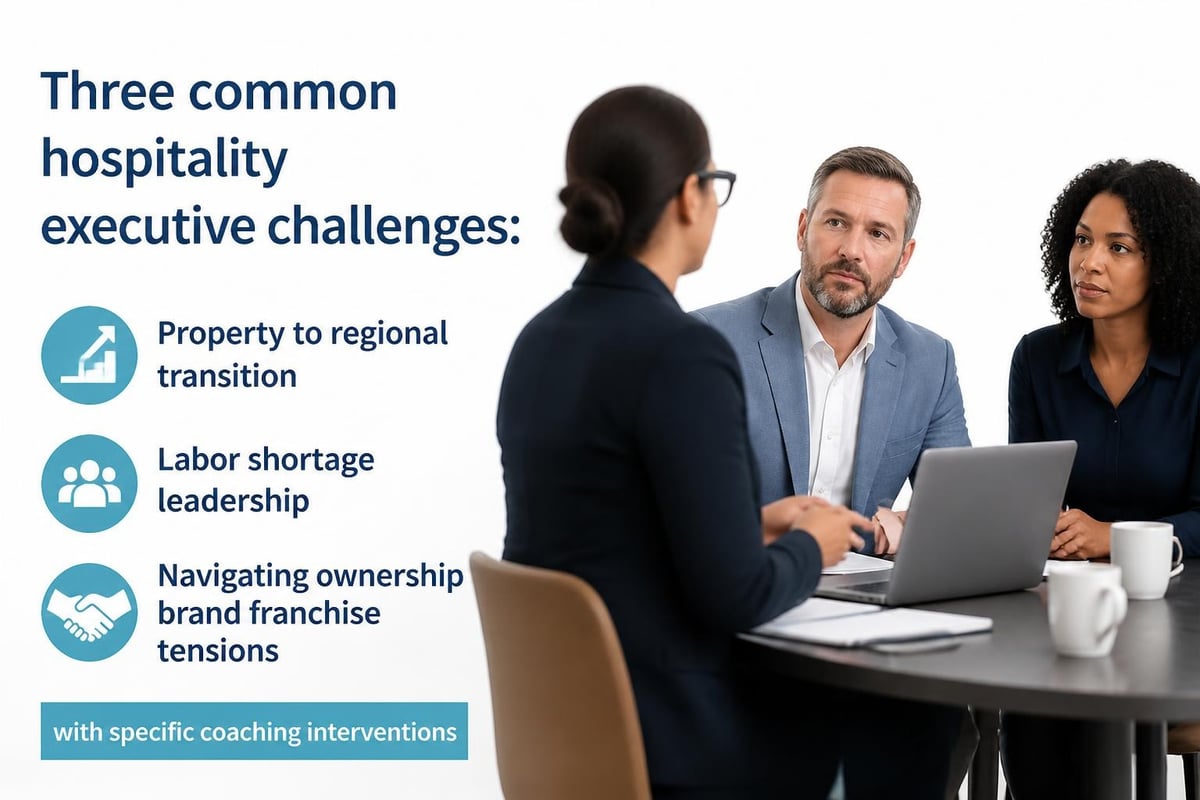
Hospitality executives face recurring leadership challenges that demand specific interventions, not broad development plans. Three patterns appear consistently across hotel groups:
Challenge 1: Transitioning from Property to Regional Leadership
A strong general manager doesn't automatically become an effective regional director. The skill shift from running one property to overseeing multiple sites requires different capabilities: diagnostic ability across varied contexts, delegation without micromanagement, and influence without direct operational control.
The intervention that works: structured transition coaching that includes stakeholder mapping, decision-rights clarification, and a 90-day plan with explicit milestones. Coaches should help new regional leaders identify early wins, build credibility with property teams, and establish governance rhythms (weekly property calls, monthly business reviews, quarterly strategy sessions) that create accountability without creating bureaucracy.
Challenge 2: Leading Through Labor Shortages and Turnover
Hotel groups in 2026 face persistent staffing challenges, particularly for hourly roles. Executives who default to "work harder" messaging or short-term financial incentives miss the underlying driver: employees leave managers, not companies, and hourly staff in hospitality have abundant alternatives.
According to WTTC research on workforce trends, the hospitality sector's talent challenges stem from poor onboarding, inconsistent management practices, and lack of career visibility. Coaching interventions should focus on building managers' capability to create psychological safety, deliver consistent feedback, and connect daily work to career progression.
Practical coaching outcomes we've measured:
- Reduced 90-day turnover from 47% to 31% after coaching department heads on structured onboarding
- Improved employee engagement scores (measured via pulse surveys) by 23 points after coaching front-line managers on recognition practices
- Increased internal promotion rates from 12% to 28% after coaching property leaders on talent pipeline conversations
Challenge 3: Navigating Ownership and Brand Tensions
Hotel executives at managed properties or franchise operations face unique governance complexity. They answer to brand standards, ownership's financial expectations, and guest experience imperatives that sometimes conflict. Leaders who can't navigate these tensions burn out or get replaced.
The coaching intervention: teaching executives how to frame trade-off conversations, build business cases that address each stakeholder's priorities, and negotiate decision rights when standards and financial realities collide. This isn't soft-skills coaching. It's applied strategy and influence work that directly affects property performance.
Measuring ROI and Organizational Impact
Most coaching programs fail at measurement. They track participation rates and satisfaction scores, which tell you nothing about whether leadership improved or business outcomes changed. For hotel groups investing in executive coaching, the measurement framework should connect individual development to organizational performance.
The metrics that matter:
Individual level: behavioral change observed by direct reports and peers (360 assessments pre- and post-coaching), specific skill acquisition (ability to deliver difficult feedback, make faster decisions, delegate effectively), and self-reported confidence in handling key challenges.
Team level: engagement scores from pulse surveys, retention rates for direct reports, team performance on operational metrics (guest satisfaction, labor cost per occupied room, revenue per available room).
Organizational level: promotion rates from coaching cohorts, time to fill critical roles, leadership pipeline strength (number of ready-now successors for key positions).
When Deloitte analyzed human capital trends, they found that organizations with mature coaching cultures demonstrate 23% higher revenue growth and 28% better talent retention than peers. But those outcomes require disciplined measurement and explicit linkage between coaching interventions and business strategy.
A regional hotel group we worked with in 2025 implemented executive coaching for 12 property leaders facing underperformance. The intervention was surgical: six months of monthly coaching sessions focused on revenue optimization and team accountability. The measured outcomes: average RevPAR improvement of 8.3% (controlling for market factors), employee turnover reduction of 19%, and guest satisfaction scores up an average of 12 points. Total coaching investment: $84,000. Incremental EBITDA from the 12 properties over six months: $1.7 million.
Integrating Coaching with Leadership Development Systems
Executive coaching for hotel and hospitality groups delivers maximum impact when integrated with broader leadership development infrastructure, not deployed as a standalone intervention.
Smart hotel groups connect coaching to succession planning. They identify high-potential directors and VPs who could move into C-suite roles within 24 months, then deploy coaching to close specific gaps preventing that progression. The coaching focuses on board-level communication, strategic thinking, and enterprise decision-making rather than operational management.
The HR Leader's Role
CHROs and talent leaders in hospitality often struggle with coaching program design because they inherit generic frameworks from other industries. The better approach: start with business strategy and work backward to leadership requirements.
If the hotel group's strategy depends on market share growth through aggressive pricing and marketing, what leadership capabilities enable that? Revenue management sophistication, cross-functional collaboration between sales and operations, and disciplined financial forecasting. Coach to those capabilities, not to abstract leadership competencies.
SHRM guidance on executive coaching emphasizes the shift from coaching as perk to coaching as performance intervention. For hospitality groups, this means HR leaders should approve coaching based on business cases that specify the gap being addressed, the expected behavioral change, and how that change connects to organizational outcomes.
| Integration Point | Weak Approach | Strong Approach |
|---|---|---|
| Succession planning | Coach high performers generally | Target coaching to close specific gaps preventing next-level readiness |
| Performance management | Offer coaching to struggling leaders | Deploy coaching proactively before performance deteriorates |
| Onboarding | Standard orientation programs | Add executive coaching for first 90 days in role transitions |
| Strategic initiatives | Launch initiatives, hope for adoption | Coach leaders responsible for execution on change management and influence |
Avoiding Common Implementation Failures
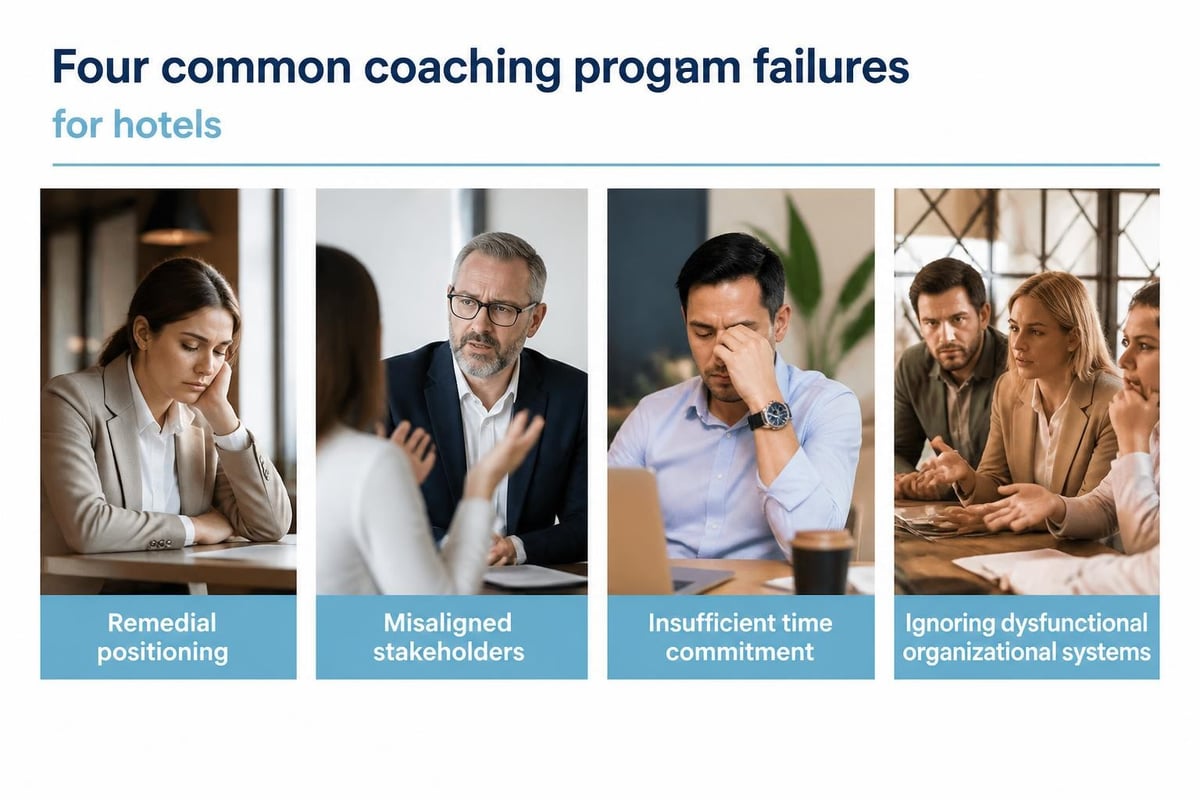
Hotel groups waste coaching investments through predictable failure modes. Recognizing these patterns helps HR and business leaders design better programs.
Failure 1: Treating coaching as a remedial intervention. When coaching is positioned as "help for struggling leaders," high performers avoid it and struggling leaders resist it. Position coaching as a development accelerator for leaders with high potential or high-stakes responsibilities.
Failure 2: No stakeholder alignment. If the coach, the leader being coached, their manager, and HR all have different expectations for what the coaching should accomplish, the engagement produces frustration, not results. Establish explicit success criteria before the first session.
Failure 3: Insufficient time commitment. One-off coaching conversations or monthly 30-minute check-ins don't create behavior change. Effective executive coaching requires at least 60-90 minutes per session, every two weeks, for a minimum of four months. Anything less is performance theater.
Failure 4: Ignoring organizational context. Individual coaching that ignores dysfunctional systems, misaligned incentives, or toxic cultural patterns sets leaders up to fail. Sometimes the right intervention is fixing the system, not coaching the leader to cope with it.
Research from hospitality leadership studies shows that competency development programs succeed when they combine experiential learning, real-time feedback, and organizational support. Executive coaching follows the same principle. The coach works with the individual, but the organizational environment determines whether new behaviors stick.
The Economics of Coaching Investment for Multi-Property Groups
Hotel groups evaluating coaching investments should calculate cost per improved outcome, not cost per coaching hour. A $15,000 coaching engagement that prevents one GM departure saves the organization $75,000 to $150,000 in replacement costs (recruiting, lost productivity, new hire onboarding). A coaching program that helps a regional leader improve portfolio performance by 3% ROI generates returns that dwarf the coaching investment.
The economics change dramatically based on scale. A 50-property group investing in executive coaching for 20 senior leaders (corporate and regional roles) might spend $250,000 annually. If that coaching improves retention by 10%, accelerates internal promotions, and drives modest performance gains across the portfolio, the financial return reaches seven figures.
For perspective on coaching economics across industries, reviewing enterprise corporate coaching providers reveals cost structures and ROI frameworks that hotel groups can adapt to hospitality contexts.
Build or buy considerations:
- Internal coaching capability: Some large hotel groups train senior HR business partners or learning and development leaders as coaches. This works for developmental coaching but rarely delivers the sector expertise and objectivity needed for executive-level interventions.
- Coach networks: Working with platforms that provide vetted, sector-expert coaches offers flexibility and quality control without building internal infrastructure. The trade-off is less cultural integration but faster deployment and broader expertise access.
- Hybrid models: Deploy internal coaching for mid-level managers and high-volume needs, reserve external executive coaches for C-suite, regional leaders, and high-stakes transitions.
Adapting Coaching to Hotel Segment and Operating Model
Executive coaching for hotel and hospitality groups requires adaptation based on segment (luxury, upscale, midscale, economy) and operating model (managed, franchised, owned).
Luxury hotel executives face different leadership challenges than select-service operators. A GM at a 400-room luxury resort managing 500 employees, multiple F&B outlets, spa operations, and high-touch guest experiences needs coaching on orchestrating complexity, developing department heads, and maintaining brand standards while allowing creative service recovery. A GM running a 90-room select-service property with 15 employees needs coaching on efficiency, multi-tasking, and driving performance with minimal resources.
Operating model matters equally. Executives at managed properties (where a management company operates hotels owned by third parties) navigate constant tension between brand standards and ownership economics. Coaching should address stakeholder management, business case development, and influence without authority. Executives at franchised properties face brand compliance requirements while maintaining operational autonomy. Coaching should focus on balancing standardization and local adaptation.
According to HSMAI talent research, commercial leadership roles (revenue management, sales, marketing) present distinct development needs in hospitality. Leaders in these functions need coaching on data-driven decision-making, cross-functional collaboration with operations, and navigating the tension between short-term bookings and long-term brand positioning.
Frequently Asked Questions
What qualifications should I look for in an executive coach for hotel leadership?
Prioritize sector experience over coaching credentials alone. Look for coaches who have held operational or commercial leadership roles in hospitality (hotel operations, revenue management, multi-property oversight) combined with recognized coaching certification (ICF, EMCC). The coach should understand hotel P&L statements, labor models, and revenue optimization as fluently as they understand adult development theory and behavior change models.
How long does executive coaching take to show measurable results?
Behavior change becomes visible within 60 to 90 days of consistent coaching (bi-weekly sessions minimum). Measurable business outcomes (improved team performance, better financial results, reduced turnover) typically emerge within four to six months. Coaching engagements shorter than three months rarely produce lasting change. Expect six to twelve months for senior executives addressing complex challenges like cultural transformation or major role transitions.
Should we use the same coach for all our hotel executives?
No. Different leaders face different challenges and respond to different coaching styles. A coach effective with analytical, data-driven revenue leaders may struggle with relationship-focused operations leaders. Use matching algorithms and trial sessions to ensure coach-leader fit. For large hotel groups, building a panel of 3 to 5 vetted coaches with different specializations (operations, commercial leadership, succession preparation) provides flexibility while maintaining quality.
How do we measure coaching ROI in hospitality?
Track three levels: individual (360 assessments, specific skill acquisition, behavioral change observed by stakeholders), team (engagement scores, retention of direct reports, team performance on operational metrics), and organizational (promotion rates, leadership pipeline strength, business performance of coached leaders' units). Compare performance of coached leaders against control groups when possible. Calculate financial impact of outcomes like reduced turnover, improved RevPAR, and faster time-to-productivity in new roles.
What's the difference between leadership development programs and executive coaching?
Leadership development programs (cohort-based training, simulations, workshops) build foundational capabilities and create peer networks. Executive coaching provides individualized, context-specific support for high-stakes challenges, behavior change, and role transitions. Both have value. Use development programs for emerging leaders and core competency building. Deploy executive coaching for senior leaders, succession candidates, and leaders facing complex performance or transition challenges. The highest-performing hotel groups integrate both approaches.
Executive coaching for hotel and hospitality groups succeeds when it combines sector expertise, diagnostic precision, and measurable intervention design tailored to operational realities. Generic leadership frameworks fail because they ignore the unique pressures facing hotel executives: 24/7 operations, labor constraints, stakeholder complexity, and performance accountability measured in real-time guest satisfaction and financial metrics. When HR and business leaders demand coaching that addresses these realities and measure outcomes that matter, they transform leadership capability and drive organizational performance. Noomii Leadership Coaching helps hotel and hospitality groups solve complex leadership challenges through precision coach matching, evidence-based diagnostics, and targeted interventions aligned with organizational goals and measurable business outcomes.



Leave a Reply
Want to join the discussion?Feel free to contribute!