

Executive Coaching Cost in the UAE: 2026 Pricing Guide
The executive coaching cost in the United Arab Emirates reflects a market shaped by multinational demand, regulatory considerations, and high-stakes leadership transitions. Organizations deploying coaching in Dubai, Abu Dhabi, and across the Emirates face pricing that ranges from AED 1,500 to AED 8,000 per session depending on coach credentials, engagement scope, and whether the work addresses C-suite performance, cultural integration, or governance issues. The difference between a failed coaching engagement and one that drives measurable leadership transformation often hinges on understanding what you're actually buying and how to structure the investment for accountability.
What Drives Executive Coaching Cost in the United Arab Emirates
The executive coaching cost in the United Arab Emirates is not set by a single market force. It's determined by credential rigor, demand concentration in key sectors, VAT treatment, and the scarcity of coaches who understand both Western leadership frameworks and Gulf business culture.
Credential and Certification Premiums
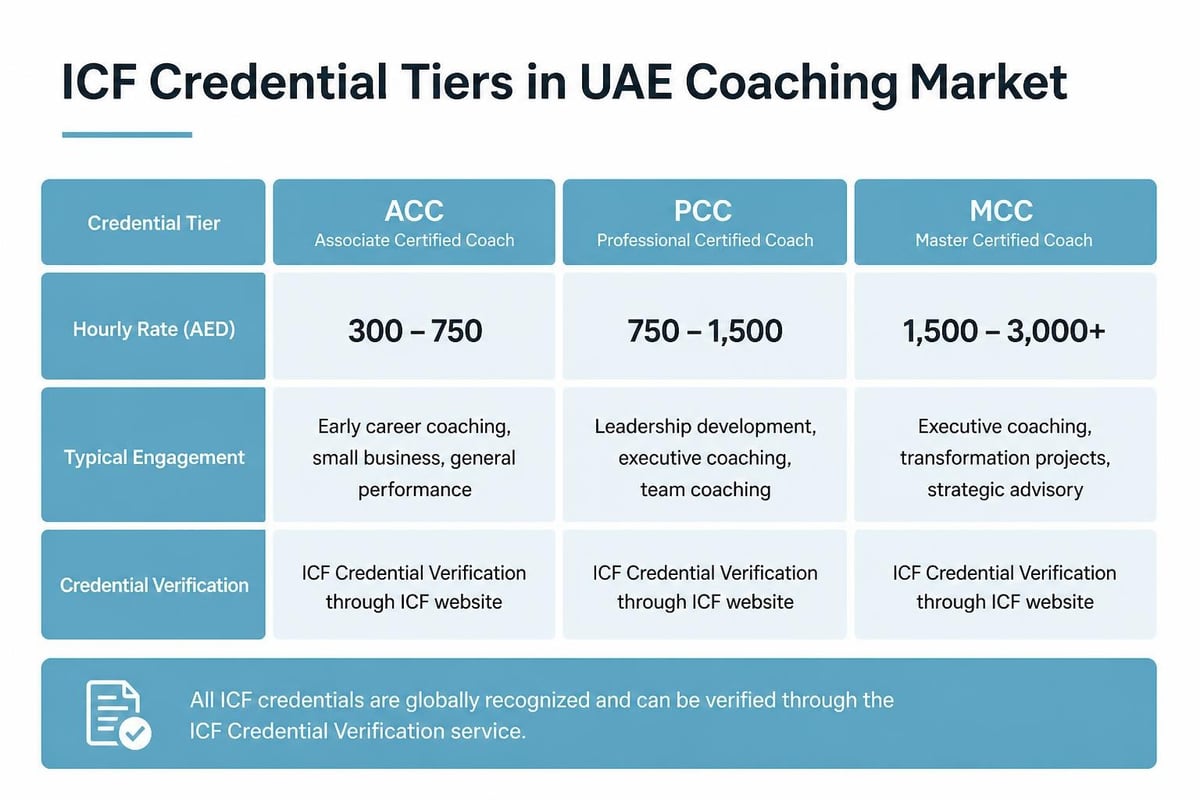
Coaches holding ICF Master Certified Coach (MCC) credentials command 40-60% higher fees than those with Associate Certified Coach (ACC) designations. This gap reflects experience hours, supervision requirements, and competency assessments required by the International Coach Federation.
According to the 2023 ICF Global Coaching Study, regional coaching fee medians in the Middle East sit at USD 250-350 per hour, but UAE rates skew higher due to demand from financial services, government entities, and family-owned conglomerates navigating succession planning.
Key credential tiers and typical hourly rates in AED:
| Credential Level | Hourly Rate (AED) | Typical Client Profile |
|---|---|---|
| ACC (100+ hours) | 1,500 – 2,500 | Mid-level managers, new directors |
| PCC (500+ hours) | 2,800 – 4,500 | Senior leaders, VP-level transitions |
| MCC (2,500+ hours) | 5,000 – 8,000 | C-suite, board members, succession cases |
Organizations that engage coaches without verifying credentials face higher failure rates because the coach lacks the supervised practice hours to manage high-stakes executive dynamics.
Sector-Specific Expertise and Language Competency
Coaches with deep sector knowledge in oil and gas, sovereign wealth management, or government transformation charge premiums because they reduce ramp-up time and understand regulatory constraints. A coach who has worked with ADNOC leadership or Dubai government entities brings context that generic executive coaches cannot replicate.
Bilingual coaches (Arabic and English) who can navigate family business governance or public sector protocols add 20-30% to baseline rates. This reflects market scarcity, not arbitrary pricing.
Pricing Models and Engagement Structures
The executive coaching cost in the United Arab Emirates is structured in three primary models: hourly rates, fixed-term packages, and retainer agreements. Each carries different risk profiles and cost-per-outcome implications.
Hourly Rate Agreements
Hourly engagements offer flexibility but create misaligned incentives. Coaches bill for time, not outcomes. For organizations testing coaching or addressing one-off transitions, this model provides an entry point. The risk is scope creep without accountability.
Typical hourly engagement costs:
- Initial assessment and contracting: 2-3 hours at standard rate
- Ongoing sessions: 1.5 hours per session (including prep and follow-up)
- Monthly cost for bi-weekly sessions: AED 9,000 – 24,000
Add 5% VAT on most coaching services per UAE tax regulations, which increases total engagement cost. Organizations often underestimate this when comparing proposals.
Fixed-Term Packages (6-12 Month Programs)
Package pricing aligns incentives around defined outcomes. A six-month C-suite coaching engagement typically includes 12-18 sessions, 360-degree assessments, stakeholder interviews, and progress reviews. Total package cost ranges from AED 75,000 to AED 180,000 depending on coach tier and assessment tools.
This model works when the organization has clarity on the leadership gap being addressed-whether that's a newly promoted CFO struggling with board dynamics, a divisional leader creating team dysfunction, or an expatriate executive failing to adapt to local business culture.
Our work with a UAE-based government entity in 2025 illustrates the value of structured packages. The client engaged coaching for a senior director exhibiting abrasive leadership behaviors that drove talent attrition. The six-month engagement cost AED 95,000 and included:
- Behavioral assessment and stakeholder feedback collection
- Bi-weekly coaching sessions with defined behavioral targets
- Monthly progress reviews with the CHRO
- Post-engagement impact measurement
Result: The leader's team engagement scores improved by 34 points, voluntary turnover in the division dropped from 28% to 11%, and the organization avoided a replacement search that would have cost AED 400,000+ in recruitment and lost productivity.
The lesson: Fixed packages create accountability structures that hourly models cannot deliver. But only if the contract specifies measurable outcomes and defines what happens when progress stalls.
Retainer and Multi-Executive Programs
Organizations deploying coaching across multiple executives negotiate retainers that reduce per-session costs by 15-25%. A retainer covering five C-suite leaders for 12 months might cost AED 450,000 – 850,000 depending on session frequency and assessment depth.
This model makes sense for:
- Succession planning cohorts preparing for C-suite transitions
- Post-merger integration where cultural alignment is mission-critical
- Government entities building leadership capability across departments
The CRF report on Gulf leadership development notes that organizations in the region increasingly favor cohort-based approaches that build peer learning alongside individual coaching.
Hidden Costs and Total Investment Calculation
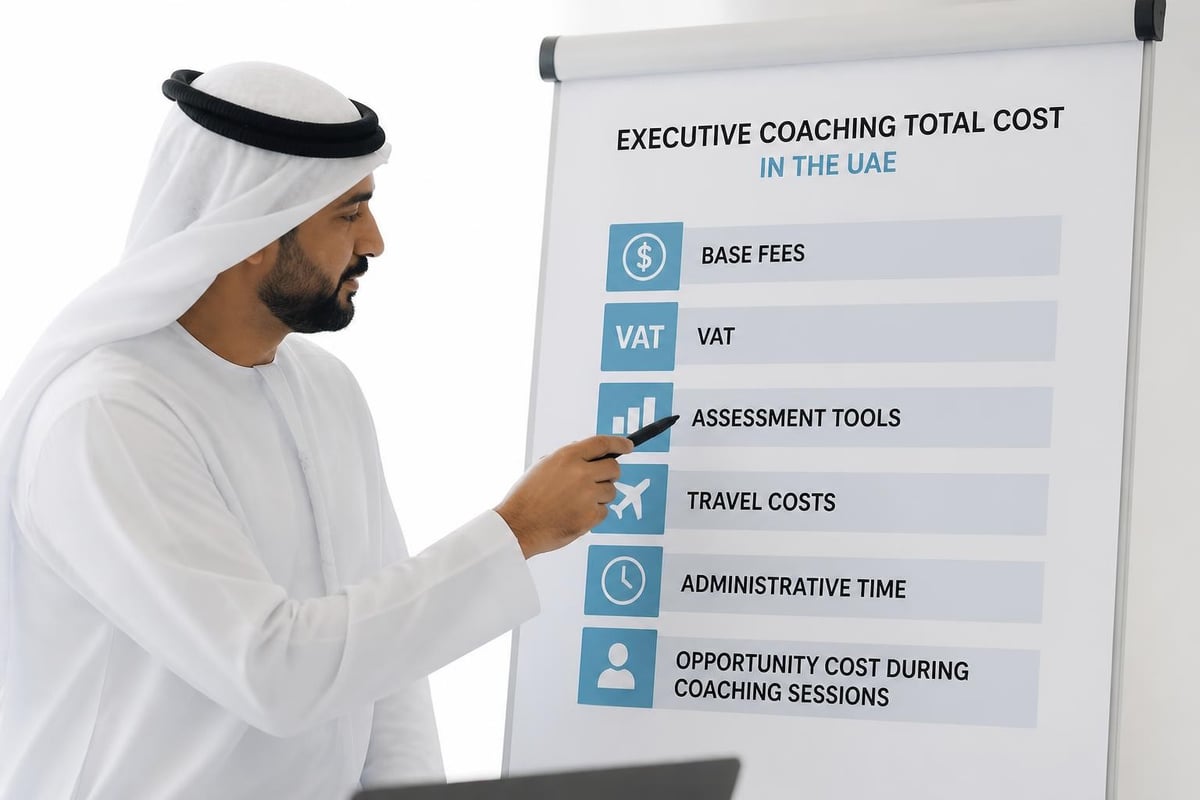
The stated executive coaching cost in the United Arab Emirates rarely reflects the total investment. Organizations that fail to account for assessment tools, travel, administrative burden, and opportunity cost during coaching sessions underestimate actual spend by 20-35%.
Assessment and Diagnostic Tools
Validated leadership assessments (Hogan, EQ-i 2.0, 360-degree instruments) add AED 3,500 – 12,000 per executive. These are not optional extras. They provide baseline data that separates effective coaching from expensive conversations.
Coaches who skip formal assessments rely on subjective impressions. That increases the risk of misdiagnosis-addressing confidence issues when the actual problem is poor strategic judgment, or focusing on communication style when the real issue is a leader's inability to delegate.
Geographic and Travel Considerations
Coaches based outside the UAE but serving local clients add travel and accommodation costs that can increase engagement expenses by 30-40%. A London-based coach flying to Dubai for quarterly on-site sessions generates costs that hourly rate comparisons don't capture.
Local coaches eliminate this variable but may lack exposure to global best practices. The optimal structure pairs a UAE-based coach for regular sessions with periodic input from international specialists for specific competencies.
Administrative and Coordination Burden
HR and L&D teams underestimate the internal labor cost of managing coaching engagements. Scheduling, progress tracking, stakeholder communication, and contract administration consume 8-15 hours per month for a single executive coaching relationship. Scale that across ten leaders, and you've created a part-time role.
Organizations working with top executive coaching firms that provide coordination and progress dashboards reduce this burden, but often pay 10-15% more in base fees.
ROI Benchmarks and Justification Framework
Finance and HR leaders deploying coaching in the UAE must quantify return on investment to justify budget allocation. The executive coaching cost in the United Arab Emirates only makes sense when measurable outcomes exceed investment.
Quantifiable Impact Categories
Research on executive coaching ROI in the MENA region identifies four categories where organizations track value:
- Retention of high-potential leaders: Replacement cost for a C-suite executive in the UAE averages 2-3x annual compensation
- Time to full productivity in new roles: Coached executives reach performance benchmarks 3-5 months faster than uncoached peers
- Team performance improvements: Measured through engagement scores, project delivery metrics, or revenue per team member
- Reduced governance risk: Fewer HR complaints, lower legal exposure, improved board confidence
A 2025 audit of coaching deployments across UAE-based organizations found that engagements with defined KPIs and quarterly reviews delivered 4.2x ROI on average, while those without measurement frameworks showed inconsistent or unquantifiable returns.
Cost Per Problem Solved vs. Cost Per Hour
The framing error most organizations make is comparing executive coaching cost in the United Arab Emirates on a per-hour basis rather than cost per problem solved.
Example: An AED 120,000 coaching package for a senior leader creating team dysfunction looks expensive compared to an AED 45,000 package from a less experienced coach. But if the higher-cost engagement resolves the issue in six months while the lower-cost option drags on for 18 months with minimal progress, the premium option delivers superior ROI and eliminates ongoing organizational damage.
The same logic applies to understanding business coaching costs more broadly-the cheapest option rarely delivers the lowest total cost of ownership.
Market Dynamics and Pricing Trends
The executive coaching cost in the United Arab Emirates has shifted significantly since 2023 due to increased professionalization, growing demand from government entities, and economic diversification efforts across the Emirates.
Supply-Demand Imbalance in Specialized Niches
Demand for coaches who understand UAE labor law, governance requirements for government-linked entities, and cultural integration for expatriate executives outstrips supply. This creates pricing power for coaches with these capabilities.
Deloitte’s 2025 Middle East Human Capital Trends report shows that 73% of UAE organizations cite leadership development as a top priority, with executive coaching as the preferred intervention for C-suite and direct reports.
This demand concentration drives pricing in three specific areas:
- Family business succession and governance: AED 6,500 – 9,500 per session for coaches with proven succession planning experience
- Government transformation leadership: AED 5,000 – 8,000 per session for coaches cleared to work with public sector entities
- Cross-cultural integration for expatriate C-suite: AED 4,500 – 7,500 per session for coaches who understand both Western management frameworks and Gulf business protocol
Price Compression in Generic Executive Coaching
Simultaneously, pricing for general executive coaching without sector specialization or cultural expertise has compressed due to increased coach supply, including practitioners who completed certification programs available in the UAE market but lack the supervised hours to handle complex cases.
This creates a dangerous middle market where coaches charge AED 2,500 – 3,500 per session but deliver inconsistent results because they're working at the edge of their competency.
Vendor Selection and Contract Negotiation
Organizations that treat executive coaching cost in the United Arab Emirates as a simple procurement exercise-selecting the lowest qualified bidder-get what they pay for. The contracting process determines outcome quality as much as coach selection.
Non-Negotiable Contract Elements
Every coaching agreement should specify:
- Defined success metrics: What behaviors, outcomes, or competencies will improve? By how much? Measured how?
- Progress review cadence: Monthly stakeholder check-ins prevent drift and create course-correction opportunities
- Termination clauses: What happens if the coach-client relationship breaks down or progress stalls after 90 days?
- Confidentiality boundaries: What information stays between coach and client vs. what gets shared with HR or leadership?
- Credential verification: Require proof of claimed certifications and references from similar engagements
Organizations that skip these elements create coaching relationships with no accountability structure. That's how a six-month engagement becomes an 18-month relationship with no measurable improvement.
Contrarian Insight: Higher Fees Often Signal Lower Risk
The conventional wisdom in procurement is to negotiate maximum discounts. In executive coaching, that's backwards. Coaches who discount heavily often lack sufficient demand for their services. That's a market signal.
The best coaches maintain pricing discipline because they understand the value they deliver and can afford to decline engagements that don't fit. A coach who immediately offers 25% off their stated rate is either desperate for work or hasn't developed the expertise to command premium pricing.

Integration with Broader Leadership Development
The executive coaching cost in the United Arab Emirates makes strategic sense only when integrated with broader leadership development infrastructure, not deployed as a standalone intervention.
Coaching as Part of a Leadership System
Organizations that achieve sustainable impact combine coaching with:
- Leadership assessments that identify developmental priorities across the executive population
- Succession planning frameworks that define the capabilities required for future roles
- Performance management systems that reinforce behaviors developed through coaching
- Culture initiatives that align individual leadership growth with organizational priorities
A 2026 case study from our work with a UAE-based financial services firm illustrates this integration. The organization deployed coaching for twelve senior leaders (total investment: AED 680,000 over 12 months) as part of a broader culture transformation addressing risk management and ethical decision-making.
The coaching was structured around:
- Pre-engagement assessment measuring current leadership behaviors against desired culture attributes
- Individual coaching plans targeting specific behavior gaps
- Monthly cohort learning sessions where coached leaders shared challenges and progress
- Quarterly reviews measuring individual progress and collective cultural shift
Result: The organization measured a 41-point improvement in culture health scores, reduced compliance incidents by 67%, and promoted eight of the twelve coached leaders into expanded roles within 18 months. The engagement paid for itself through reduced compliance costs and improved talent retention.
The lesson: Coaching delivers ROI when treated as a targeted intervention within a leadership system, not as a generic development perk.
Frequently Asked Questions
What is the average executive coaching cost in the United Arab Emirates for a C-suite leader?
C-suite executive coaching in the UAE typically costs AED 75,000 to AED 180,000 for a six-month engagement including 12-18 sessions, assessments, and stakeholder reviews. Hourly rates range from AED 5,000 to AED 8,000 for coaches with MCC credentials and sector expertise.
How do UAE coaching costs compare to other global markets?
Executive coaching cost in the United Arab Emirates is 15-25% higher than US and UK averages due to supply scarcity in specialized niches, demand concentration in high-stakes sectors, and the premium for bilingual coaches who understand Gulf business culture and Western leadership frameworks.
What credentials should organizations verify before hiring an executive coach in the UAE?
Verify ICF certification level (ACC, PCC, or MCC), supervised practice hours, sector-specific experience, and references from similar engagements. Require proof of claimed certifications and confirm the coach maintains active credential status through the International Coach Federation UAE chapter.
Does VAT apply to executive coaching services in the UAE?
Yes, executive coaching services in the UAE are subject to 5% VAT in most cases. Organizations should confirm VAT treatment with their tax advisors and account for this additional cost when budgeting coaching engagements, as it increases total investment by 5%.
How long should an executive coaching engagement last to deliver measurable results?
Effective executive coaching engagements in the UAE typically run 6-12 months with bi-weekly or monthly sessions. Shorter engagements (under four months) rarely produce sustainable behavioral change, while engagements longer than 14 months without clear progress may indicate mismatched coach-client fit.
What ROI should organizations expect from executive coaching in the UAE?
Organizations with defined success metrics and quarterly progress reviews typically achieve 3-5x ROI through improved retention, faster time to productivity, enhanced team performance, and reduced governance risk. Engagements without measurement frameworks show inconsistent or unquantifiable returns.
Matching Precision and Market Realities
The challenge in the UAE market isn't finding coaches-it's finding the right coach for a specific leadership challenge while managing cost within budget constraints. This requires matching precision that accounts for sector expertise, cultural competency, credential rigor, and proven track record with similar cases.
Organizations that treat coach selection as a strategic decision deploy leadership executive coaching as a targeted intervention. Those that treat it as a commodity procurement exercise waste money and fail to move the needle on leadership capability.
The executive coaching cost in the United Arab Emirates reflects market realities: high demand, limited supply of specialized expertise, and high-stakes leadership environments where failure carries organizational consequences. The question isn't whether coaching costs too much, but whether the engagement structure, coach capabilities, and accountability framework justify the investment through measurable outcomes.
Understanding the full scope of executive coaching cost in the United Arab Emirates requires looking beyond hourly rates to total investment, outcome probability, and integration with broader leadership priorities. Organizations that structure engagements around defined metrics, verify credentials rigorously, and treat coaching as part of a leadership system achieve returns that justify premium pricing. Noomii Leadership Coaching provides precision matching between UAE-based organizations and certified coaches with proven expertise in your sector, complete with assessment-driven engagement design and measurable outcome frameworks that eliminate the guesswork from coaching investments.



Leave a Reply
Want to join the discussion?Feel free to contribute!