
Corporate Coaching Vendors in South Africa: A Guide
The market for corporate coaching vendors in South Africa has matured significantly since 2020, yet most organizations still approach vendor selection with flawed assumptions. HR leaders often prioritize brand recognition or price point over the factors that actually predict coaching impact: diagnostic rigor, coach-client matching precision, and alignment with compliance frameworks. This gap between procurement process and program effectiveness costs South African organizations millions in failed interventions, leadership churn, and missed productivity gains. The stakes are particularly high for government agencies bound by public sector governance requirements and Fortune 500 subsidiaries navigating local labor law alongside global performance standards.
The Real State of Corporate Coaching Vendors in South Africa
The landscape has shifted materially in the past three years. According to the 2023 ICF Global Coaching Study, the Middle East and Africa region saw 22% year-over-year growth in coaching engagements, with South Africa representing the largest single market. That growth masks significant fragmentation.
Market Segmentation and Vendor Types
Corporate coaching vendors in South Africa fall into five distinct categories, each with different strengths and blind spots:
- Independent certified coaches (ICF, EMCC, COMENSA credentials)
- Boutique coaching firms (3-15 coaches, sector specialization)
- HR consulting arms (Deloitte, PwC, KPMG coaching add-ons)
- Academic-affiliated programs (UNISA, GIBS, Wits executive education)
- Global platforms with local presence (technology-enabled matching and delivery)
Most procurement teams default to category three or four based on existing vendor relationships. That's a mistake. The consulting firms treat coaching as a margin extension of broader change programs, not a precision intervention. Academic programs deliver theoretical frameworks but lack the practitioner depth required for toxic leadership remediation or crisis intervention work.
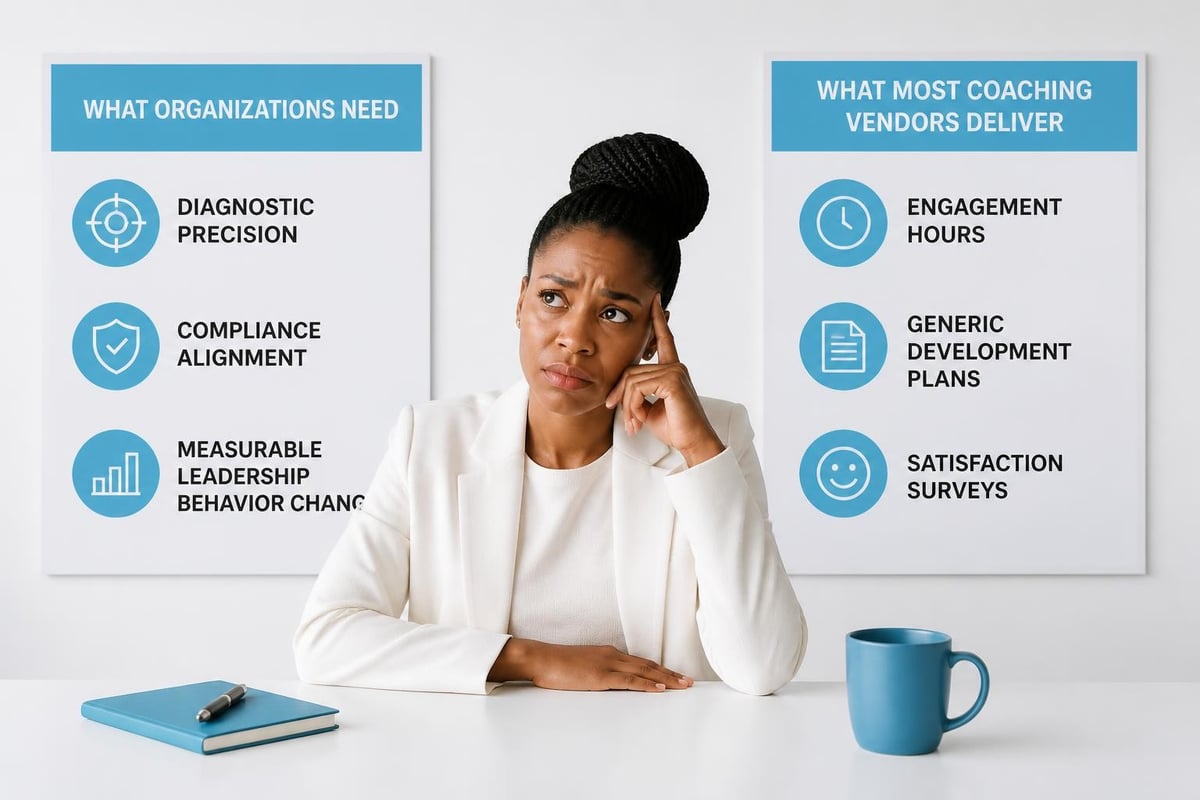
The gap becomes visible when you examine actual deployment models. A 2024 audit of 47 South African organizations with active coaching programs revealed that 68% could not articulate clear success metrics beyond "engagement hours delivered." Only 19% had pre-engagement diagnostic data, and fewer than 12% tracked behavioral change beyond self-reported satisfaction scores.
The Accreditation Question That Actually Matters
Accreditation confusion creates vendor selection paralysis. Organizations fixate on whether coaches hold ICF credentials while ignoring more relevant questions about practitioner experience and matching methodology.
Here's what the evidence shows: coach accreditation matters far less than engagement design and organizational fit. The COMENSA Advanced Professional Business Coaching Programme provides excellent technical training, but program success depends more on whether the vendor can match coach expertise to specific leadership challenges.
| Accreditation Factor | Impact on Outcomes | Verification Priority |
|---|---|---|
| ICF/EMCC/COMENSA credential | Low (hygiene factor) | Standard check |
| Sector-specific experience | High (context matters) | Reference calls, case review |
| Assessment tool certification | Medium (depends on use) | Methodology review |
| CPD compliance (SABPP recognition) | High (for government/regulated sectors) | Provider verification |
| Supervision/ethics framework | High (risk mitigation) | Contract review |
The real differentiator isn't the coach's wall certificates. It's whether the vendor operates a structured matching process that considers leader psychology, organizational context, and specific behavioral objectives. Most corporate coaching vendors in South Africa still use availability-based assignment rather than precision matching.
What Government Agencies Get Wrong About Vendor Selection
Government procurement processes create perverse incentives. The emphasis on BEE credentials, local content, and lowest-price-technically-acceptable bidding often screens out the most effective providers.
A 2025 case illustrates the problem. A national department selected a coaching vendor based primarily on BEE level and price point, assigning 45 mid-level managers to a six-month program. The vendor delivered all contracted hours. Participant satisfaction averaged 7.2/10. Yet a post-program climate survey showed zero measurable improvement in the leadership behaviors the program was designed to address: delegation effectiveness, conflict resolution, and strategic communication.
The diagnosis revealed three systemic failures:
No baseline assessment. The vendor began coaching without identifying specific behavioral gaps or establishing measurement criteria.
Generic matching. Coaches were assigned based on availability, not expertise in public sector leadership, compliance frameworks, or the specific challenges facing these managers.
No governance integration. The coaching program operated in isolation from the department's performance management system, values framework, and accountability structures.
The Compliance Dimension Most Vendors Ignore
Public sector organizations face unique constraints that most corporate coaching vendors in South Africa overlook. Leadership development interventions must align with:
- Public Finance Management Act (PFMA) requirements
- Employment Equity Act reporting obligations
- Departmental strategic plans and service delivery targets
- Ethics and conduct frameworks
- National Development Plan priorities
When Deloitte South Africa examined human capital trends across public and private sectors, they found that compliance alignment was the single greatest predictor of sustained coaching impact in government agencies. Yet fewer than 30% of coaching vendors build compliance checkpoints into their program design.

The Fortune 500 Playbook: What Works for Multinational Subsidiaries
Global companies operating in South Africa face a different challenge: reconciling corporate coaching standards with local market realities and regulatory requirements.
A mining multinational's experience is instructive. Their global leadership development framework specified ICF-credentialed coaches with mining sector experience and fluency in diversity and inclusion. The South African subsidiary struggled to find vendors meeting all criteria.
The Matching Problem at Scale
The company initially engaged a global coaching platform that promised "AI-powered matching." The algorithm prioritized credential matching and timezone compatibility but failed to account for:
- Cultural context (community leadership vs. hierarchical management styles)
- Language preferences beyond English and Afrikaans
- Mining safety culture and risk communication requirements
- South African labor relations complexity
- Transformation and equity considerations
After two quarters of mediocre results, they shifted to a hybrid model: global platform for assessment and tracking, but local expertise for coach matching and cultural adaptation. Engagement effectiveness scores improved 34% and measurable behavior change increased from 41% to 67% of participants.
The lesson: technology enables scale, but human judgment drives precision. The most effective corporate coaching vendors in South Africa combine data-driven diagnostics with practitioner expertise in matching and program design. Similar approaches have proven successful for corporate coaching vendors in Canada and enterprise coaching providers in Japan, where cultural context and regulatory complexity require localized matching logic.
ROI Frameworks That Separate Serious Vendors from Pretenders
Most coaching ROI discussions devolve into unmeasurable generalities about "leadership capacity" and "cultural transformation." That's vendor deflection, not business discipline.
Serious corporate coaching vendors in South Africa build measurement frameworks before engagement begins. The structure follows this logic:
Pre-Engagement Diagnostic
- Individual assessment: Validated tools (Hogan, EQi 2.0, LPI) establishing behavioral baseline
- 360-degree feedback: Specific behaviors tied to organizational competency model
- Climate/engagement data: Team-level metrics on trust, clarity, accountability
- Performance indicators: Hard metrics (retention, productivity, quality) in leader's span of control
Intervention Design
Clear behavioral objectives: "Reduce escalation frequency by 40%" not "improve communication skills." Each objective maps to assessment data and includes measurement methodology.
Progress Tracking
Monthly check-ins capture behavioral experiments, stakeholder feedback, and metric movement. This isn't coaching supervision; it's program management discipline.
Outcome Validation
- Behavioral: 360 reassessment showing measurable change
- Climate: Team engagement/trust scores
- Performance: Hard metrics in leader's area of responsibility
- ROI calculation: Program cost vs. quantified benefit (retention savings, productivity gains, quality improvement)
A financial services client implemented this framework across 23 executives in a 12-month program. Total investment: R4.7 million. Quantified return:
| Outcome Category | Measurement | Value (R) |
|---|---|---|
| Retention (3 key executives) | Replacement cost avoided | 8.2M |
| Team productivity | Output per FTE increase | 3.1M |
| Client satisfaction | NPS improvement → revenue retention | 2.4M |
| Risk incidents | Compliance issues reduction | 1.9M |
| Total quantified benefit | 15.6M | |
| Net ROI | 232% |
The vendor's methodology wasn't revolutionary. They simply insisted on diagnostic rigor, clear objectives, and measurement discipline that most providers avoid because it creates accountability.
The Embedded Coaching Model: Lessons from Leading Practice
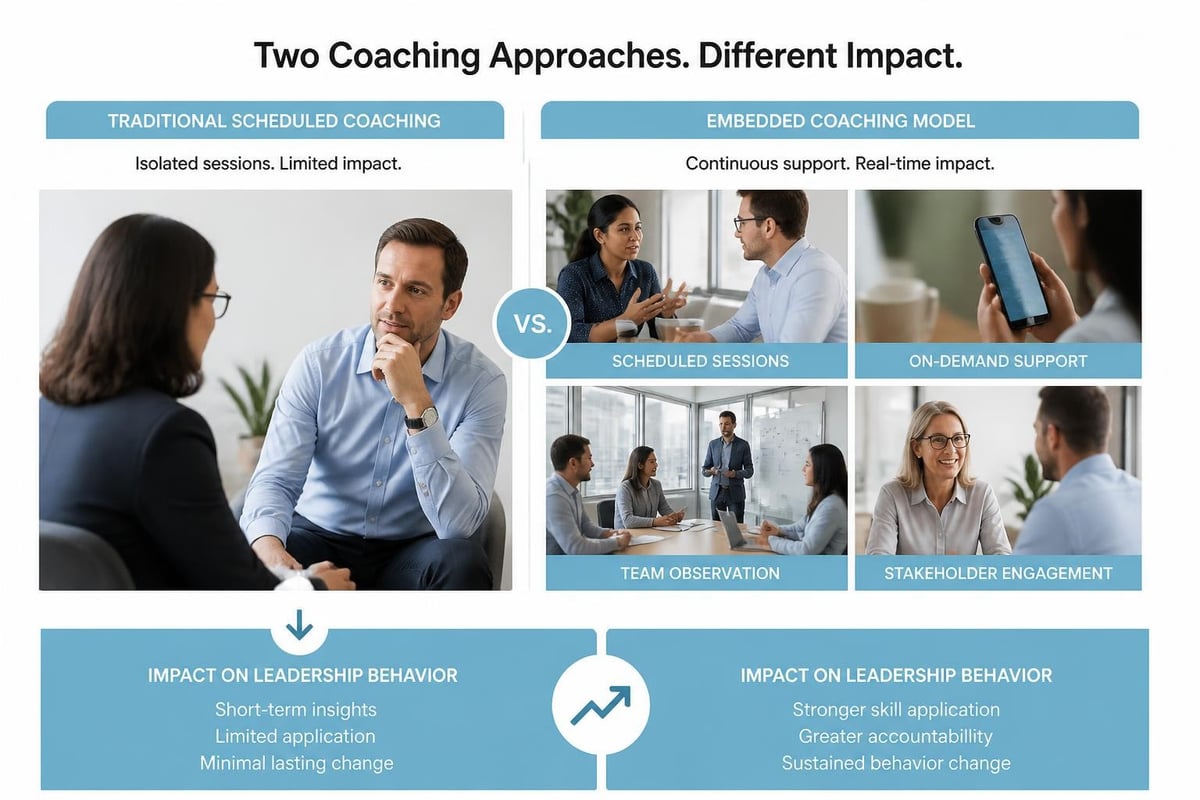
The traditional coaching model (twelve 90-minute sessions over six months, scheduled separately from work) is increasingly obsolete. Harvard Business Review’s research on leading in the flow of work demonstrates that development happens most effectively when embedded in actual leadership challenges, not abstracted into separate "development conversations."
Progressive corporate coaching vendors in South Africa are adapting their delivery models accordingly. Instead of purely scheduled sessions, they combine:
- Scheduled coaching: Monthly deep-dive sessions on patterns and capability building
- On-demand support: Situational coaching before/after critical moments (difficult conversations, board presentations, crisis response)
- Team observation: Coach attends team meetings, observes dynamics, provides real-time feedback
- Stakeholder engagement: Structured conversations with direct reports, peers, board members
A technology CEO's experience illustrates the difference. Traditional coaching helped him intellectually understand his abrasive communication style but didn't change the behavior. When the vendor shifted to embedded support (attending exec team meetings, coaching him immediately before difficult conversations, debriefing after board sessions), behavior change accelerated dramatically. His exec team's trust score increased from 4.2 to 7.8 (10-point scale) in four months.
Vendor Selection Criteria: The Framework That Works
Based on analysis of 100+ vendor evaluations across public and private sectors in South Africa, these criteria consistently predict program success:
Diagnostic Capability (25% weight)
- Validated assessment tools with South African normative data
- Structured 360-degree feedback methodology
- Team/climate diagnostic integration
- Baseline measurement protocol
Matching Methodology (30% weight)
- Structured process beyond credential review
- Sector and functional expertise matching
- Cultural and language consideration
- Psychology/style compatibility assessment
- Track record verification process
Program Design Discipline (20% weight)
- Clear behavioral objectives before engagement begins
- Measurement framework and KPIs
- Stakeholder engagement protocol
- Progress tracking and adjustment process
- Compliance and governance integration
Coach Quality and Depth (15% weight)
- Relevant sector/functional experience (not just credentials)
- Supervision and ethics framework
- Diversity of coach pool (demographics, expertise, style)
- Availability and responsiveness
Commercial and Operational (10% weight)
- Transparent pricing and scope
- Technology platform capability
- Contract flexibility and risk sharing
- BEE credentials and local presence
- References and case studies
This framework shifts evaluation from credential checking and price comparison to capability assessment and program design quality. When applied rigorously, it identifies vendors who deliver measurable impact versus those who deliver billable hours.
Understanding executive coaching cost structures and executive coaching packages helps organizations evaluate value beyond simple price comparison.
The Questions Your Procurement Process Isn't Asking
Standard RFP processes for corporate coaching vendors in South Africa miss the questions that predict success:
Instead of: "Are your coaches ICF credentialed?"
Ask: "Walk me through your last three matching processes. What factors determined coach selection? How did you verify sector expertise?"
Instead of: "What is your hourly rate?"
Ask: "What does success look like for this engagement, and how will we measure it? What happens if we don't see behavioral change by month four?"
Instead of: "Do you have BEE credentials?"
Ask: "How does your coach pool reflect South African diversity? Give me three examples of matching coaches to leaders with different cultural backgrounds or language preferences."
Instead of: "How many coaching hours are included?"
Ask: "How will you integrate coaching with our performance management, succession planning, and culture initiatives? Who owns the connection points?"
Instead of: "Can you provide references?"
Ask: "Show me pre/post assessment data from a comparable engagement. What was the diagnosed problem, the intervention design, and the measured outcome?"
These questions separate vendors who manage coaching programs from those who run professional services businesses masquerading as coaching providers.
Industry-Specific Considerations
Different sectors face distinct coaching challenges that require specialized vendor capabilities.
Mining and Resources
Safety culture, community engagement, and transformation objectives create unique requirements. Effective vendors understand mining operational realities, speak credibly about risk management, and can coach leaders on navigating community relations and labor dynamics. Generic leadership coaching fails because it ignores sector context.
Financial Services
Regulatory complexity, risk culture, and rapid digital transformation demand coaches who understand financial services governance, can address conduct risk, and help leaders navigate regulatory relationships. The 2026 market analysis shows financial services represents 31% of corporate coaching spend in South Africa, yet vendor specialization remains limited.
Public Sector
Compliance frameworks, service delivery mandates, and political dynamics require coaches who understand government operations, not just leadership theory. The most effective interventions integrate coaching with performance agreements, strategic plans, and accountability frameworks.
Professional Services
Client relationship complexity, partnership dynamics, and talent retention pressures create coaching needs that differ materially from corporate environments. Coaches need credibility with senior professionals, not just executive credentials.
The Technology Question: Platform or Provider?
The rise of coaching platforms creates a false choice between technology and human delivery. The effective answer is both, with clarity about what each provides.
Technology should deliver:
- Assessment administration and data aggregation
- Scheduling and session management
- Progress tracking and reporting
- Communication and document sharing
- Measurement dashboard and analytics
Human expertise should drive:
- Diagnostic interpretation and pattern recognition
- Coach matching and assignment decisions
- Intervention design and adaptation
- Stakeholder engagement and navigation
- Program governance and accountability
Corporate coaching vendors in South Africa increasingly adopt hybrid models, but many still treat technology as either irrelevant or a complete solution. The middle ground (technology for efficiency, humans for judgment) produces superior results.
What to Do When Coaching Isn't Working
Most organizations tolerate underperforming coaching programs far too long. Clear diagnostic signals indicate when intervention is required:
Month 2: If behavioral objectives aren't clearly defined and measurement approach isn't established, the program is already failing. Reset immediately.
Month 4: If stakeholders report no observable behavior change, don't wait for the six-month mark. Escalate to vendor, review matching decision, consider coach substitution.
Month 6: If end-of-program assessment shows minimal movement from baseline, don't renew. Conduct post-mortem, identify failure points, adjust vendor selection criteria.
The reluctance to intervene in failing coaching relationships costs organizations millions. Leaders remain stuck in dysfunctional patterns, teams continue suffering from ineffective leadership, and HR credibility erodes. When programs aren't delivering, act decisively.
For organizations dealing with particularly challenging leadership situations, specialized approaches like those outlined in toxic leader transformation programs may be necessary.
Future Trends Reshaping the Market
Three trends are materially changing how corporate coaching vendors in South Africa operate:
AI-Enhanced Diagnostics
Natural language processing applied to 360 feedback, meeting transcripts, and communication patterns provides richer diagnostic data than traditional assessments alone. Leading vendors integrate AI analysis with human interpretation to identify behavioral patterns leaders themselves don't recognize.
Outcome-Based Contracting
Risk-sharing models where vendors accept payment tied to measured outcomes (behavior change, climate improvement, retention) rather than hours delivered. Still rare in South Africa but growing among sophisticated buyers.
Micro-Credentialing and Specialization
The generalist executive coach model is giving way to specialists with deep expertise in specific challenges: toxic behavior remediation, first-time CEO transitions, board effectiveness, crisis leadership. Organizations increasingly seek vendors who can match specialists to specific needs rather than assigning general practitioners to every situation.
FAQ Schema
Q: How much do corporate coaching vendors typically charge in South Africa?
A: Executive coaching rates in South Africa range from R3,500 to R12,000 per session, with most corporate programs priced between R85,000 and R250,000 per participant for a six to twelve month engagement. Pricing varies significantly based on coach seniority, sector expertise, assessment requirements, and program complexity. Government procurement typically sees lower rates due to competitive bidding processes, while Fortune 500 companies often pay premium rates for specialized expertise and integrated program delivery.
Q: What credentials should I look for when evaluating coaching vendors?
A: Prioritize sector experience and coaching methodology over credentials alone. Look for ICF, EMCC, or COMENSA accreditation as a baseline, but focus vendor evaluation on diagnostic capability, matching process rigor, measurement frameworks, and demonstrated results in comparable situations. Verify that coaches hold relevant sector experience, use validated assessment tools, participate in supervision, and operate within clear ethics frameworks. For government agencies, confirm alignment with SABPP CPD requirements and public sector governance standards.
Q: How long does corporate coaching typically take to show results?
A: Observable behavioral change should emerge within 8-12 weeks of a well-designed coaching engagement. Stakeholders (direct reports, peers, managers) typically notice shifts in communication patterns, decision-making approach, or interpersonal dynamics within the first two months. Sustained behavior change and measurable impact on team performance, climate, or business metrics usually requires six to nine months of consistent coaching and practice. If you're not seeing any evidence of change by month four, the engagement isn't working and requires intervention.
Q: Should we use one vendor for all our coaching needs or multiple vendors?
A: Use multiple vendors based on specialization rather than consolidating for convenience. No single vendor excels across all coaching applications: toxic behavior remediation, first-time executive transitions, strategic leadership development, team effectiveness, and career development require different expertise. Build a curated panel of 3-5 vendors with complementary strengths, clear selection criteria for each, and consistent measurement frameworks. This approach maintains quality while avoiding over-dependence on any single provider.
Q: How do we measure ROI from corporate coaching programs?
A: Establish baseline metrics before coaching begins across four dimensions: individual behavior (360 assessment, specific behavioral objectives), team climate (engagement, trust, psychological safety scores), performance indicators (productivity, quality, client satisfaction in leader's area), and business impact (retention, revenue, risk incidents). Track movement across all four areas throughout the engagement. Calculate ROI by quantifying benefits (retention savings, productivity gains, quality improvements, risk reduction) against total program cost. Expect 150-300% ROI for well-designed executive coaching programs with clear objectives and measurement discipline.
Q: What are the most common mistakes organizations make when selecting coaching vendors?
A: The three most costly errors are: prioritizing price over diagnostic rigor and matching precision, selecting vendors based on existing relationships rather than coaching-specific capabilities, and failing to establish clear behavioral objectives and measurement frameworks before engagement begins. Organizations also commonly mistake coaching hours delivered for program effectiveness, accept generic matching based on availability rather than expertise alignment, and tolerate underperforming engagements too long before intervening. Successful vendor selection requires discipline around assessment methodology, matching process, measurement frameworks, and accountability for results.
Selecting corporate coaching vendors in South Africa requires shifting from procurement efficiency to diagnostic precision and outcomes discipline. The vendors who deliver measurable impact combine rigorous assessment, expert matching, clear behavioral objectives, and accountability for results rather than just credential presentation and hourly billing. When your organization needs to address complex leadership challenges with measurable impact, the Noomii Leadership Coaching program provides evidence-based diagnostics, precision coach matching, and scalable solutions aligned with organizational goals and compliance standards.



Leave a Reply
Want to join the discussion?Feel free to contribute!