

Corporate Coaching Vendors in Mexico: 2026 Buying Guide
Mexican organizations spent an estimated 2.4 billion pesos on coaching services in 2025, yet most HR leaders cannot articulate what differentiates one provider from another beyond price and availability. This gap between investment and understanding creates significant risk. When enterprises evaluate corporate coaching vendors in Mexico, they frequently overlook the signals that predict program failure: misaligned coach expertise, absent measurement frameworks, and vendor models that prioritize volume over outcome. The consequences show up six months later in stalled leadership development, unchanged behaviors, and skeptical executives who declare coaching ineffective.
The Mexican Coaching Market: What Procurement Teams Miss
The coaching industry in Mexico operates without mandatory licensing or standardized credentials. According to the International Coaching Federation’s market study, approximately 68% of practitioners offering coaching services lack recognized certification. This creates a buyer's challenge: distinguishing between credentialed professionals and individuals who adopted the "coach" title after a weekend workshop.
Corporate procurement teams frequently evaluate coaching vendors using criteria designed for commodity services. They request proposals, compare hourly rates, and select based on cost per engagement. This approach fails because coaching outcomes depend on precision matching between coach expertise and leader development needs, not transactional efficiency.
What actually predicts coaching success:
- Coach certification level and continued professional development
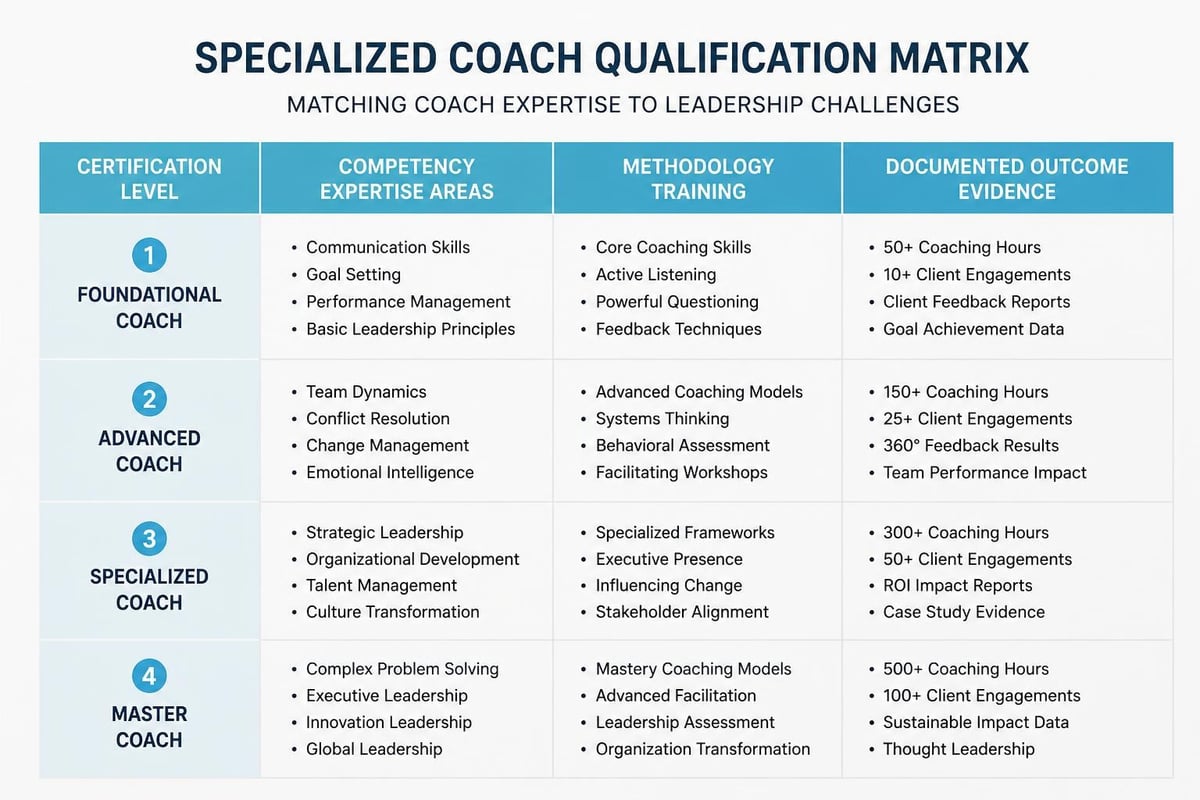
- Documented specialization in the target competency (strategic thinking, conflict resolution, executive presence)
- Assessment methodology used to diagnose development needs
- Measurement framework tied to organizational KPIs
- Compliance with Mexican labor and professional standards
Organizations that treat vendor selection as a strategic decision rather than a purchasing exercise report 3x higher satisfaction rates and measurably better leadership outcomes. The difference lies in asking the right diagnostic questions before signing contracts.
Regulatory and Compliance Considerations
Mexico's official competency standards for coaching provide a framework that few vendors reference in their proposals. Yet alignment with these standards matters significantly for government agencies, regulated industries, and multinational corporations operating under compliance obligations.
The standard defines coaching as a structured professional service requiring demonstrated competency in methodology, ethics, and confidentiality. Vendors who cannot articulate how their programs align with these published standards raise immediate red flags. This becomes especially critical when coaching addresses sensitive leadership issues like abrasive behavior, ethical violations, or performance deficiencies that carry legal implications.

Vendor Models: Comparing Approaches Used in Mexico
Corporate coaching vendors in Mexico typically operate under one of four business models, each with distinct advantages and limitations. Understanding these structures helps procurement teams evaluate proposals accurately.
| Vendor Model | Structure | Strength | Limitation | Best For |
|---|---|---|---|---|
| Boutique Consultancies | 2-5 certified coaches, personalized service | Deep client knowledge, cultural fit | Limited scalability, succession risk | Small to mid-size leadership teams |
| Training Firms with Coaching Add-On | Workshops plus coaching package | Integrated learning experience | Coaches may lack specialized expertise | Broad skills development |
| Coach Networks/Platforms | Directory of independent practitioners | Geographic coverage, specialist access | Quality variance, coordination overhead | Distributed organizations |
| Full-Service Leadership Firms | End-to-end talent development | Comprehensive diagnostics, measurement | Higher investment, longer implementation | Enterprise transformation initiatives |
The fifth model, which combines precision matching technology with vetted coach networks, addresses the quality variance problem while maintaining scalability. This approach uses validated assessments to diagnose leadership gaps, then matches leaders with coaches who have documented success addressing those specific competencies.
The Matching Methodology Gap
Most corporate coaching vendors in Mexico assign coaches based on availability and general industry experience. A financial services executive receives a coach who has "worked with finance leaders." A manufacturing plant director gets paired with someone who "understands operations."
This surface-level matching misses what actually drives coaching outcomes: alignment between the leader's specific development need and the coach's proven methodology for addressing that challenge.
Example from a 2025 client engagement:
Problem: A technology company's VP of Engineering displayed dismissive communication patterns that caused three senior developers to resign within four months.
Standard Vendor Approach: Assigned an executive coach with technology sector experience to work on "communication skills."
Precision Approach: Conducted validated assessment identifying specific patterns (interrupting, dismissing concerns, imposing solutions). Matched with a coach certified in abrasive leader transformation who had documented success changing these exact behaviors in technical leaders.
Result: Within 90 days, observable behavior changes measured through 360-degree feedback. Within six months, team retention stabilized and innovation metrics improved as psychological safety increased.
The difference between generic matching and precision alignment determines whether organizations invest in coaching or in verifiable leadership transformation. Vendors who cannot articulate their matching methodology beyond industry fit or chemistry meetings lack the sophistication required for complex leadership challenges.
What Procurement RFPs Should Actually Measure
Standard requests for proposal ask vendors to describe their coaching process, share coach credentials, and provide pricing. These elements matter, but they reveal little about whether a vendor can deliver measurable results aligned with organizational priorities.
Sophisticated buyers evaluate vendors against criteria that predict outcome quality:
Assessment and Diagnostic Rigor
Does the vendor use validated instruments to identify specific leadership gaps? Can they explain the psychometric properties of their assessments? Do they differentiate between symptoms (low team engagement) and root causes (leader's conflict avoidance pattern)?
Vendors who skip assessment and begin with "discovery conversations" lack the diagnostic precision needed for targeted intervention. According to Randstad’s 2024 talent trends data, 61% of Mexican enterprises cite leadership capability gaps as a top talent concern, yet most cannot specify which capabilities require development.
Coach Specialization Depth
General business coaching differs fundamentally from specialized interventions addressing toxic leadership, strategic decision-making under uncertainty, or cultural transformation. Vendors should demonstrate how they match coach specialization to development priorities, not just industry familiarity.
Questions that reveal vendor sophistication:
- How do you assess whether a coach has successfully addressed this specific leadership challenge before?
- What evidence would you provide that your matching process selects the optimal coach rather than an available one?
- How do you handle situations where initial coach assignment proves misaligned?
Vendors who provide vague answers about "chemistry" and "iterative refinement" lack systematic matching processes. This increases the risk of wasted time, leader frustration, and failed interventions.
Measurement and ROI Framework
The World Economic Forum’s 2024 talent report emphasizes measurement rigor in leadership development investments. Yet most coaching engagements in Mexico begin without defined success metrics beyond participant satisfaction.
Effective vendors establish measurement frameworks before coaching begins:
- Behavioral indicators tied to specific leadership competencies
- Team impact metrics like engagement scores, retention, productivity
- Organizational outcomes aligned with strategic priorities
- ROI calculation methodology comparing investment to tangible results
When evaluating leadership coaching solutions, organizations should require vendors to propose specific KPIs with baseline measurement, interim checkpoints, and outcome validation. Resistance to quantitative accountability signals a vendor accustomed to activity-based rather than results-based contracting.
Implementation Models and Cultural Fit
Corporate coaching vendors in Mexico must navigate cultural dimensions that influence engagement effectiveness. The concept of leading like a coach has gained traction among Mexican enterprises, yet implementation varies significantly based on organizational hierarchy norms and feedback culture maturity.
A multinational manufacturer discovered this cultural complexity when rolling out coaching across Mexican operations in 2025. Their global vendor used a direct-confrontation methodology effective in North American contexts but misaligned with Mexican communication norms around respect and relationship preservation. Engagement stalled as leaders perceived the approach as culturally insensitive.
The manufacturer switched to a vendor with Mexico-specific expertise who maintained accountability while adapting methodology to cultural context. Coaching adoption accelerated and behavioral outcomes improved measurably.
Scalability Without Quality Dilution
Organizations expanding coaching beyond executive levels face the scalability challenge: maintaining intervention quality while increasing participant volume. Corporate coaching vendors in Mexico use three scaling approaches:
- Cohort Models: Group coaching combined with individual sessions, reducing cost per participant while maintaining personalized support
- Technology-Enabled Delivery: Virtual coaching platforms expanding geographic reach without travel overhead
- Internal Coach Development: Training organizational leaders in coaching methodologies to supplement external expertise
Each approach introduces quality risks. Cohort models work when participants share similar development needs but fail when customization requirements diverge. Virtual delivery increases access but may reduce relationship depth for leaders preferring face-to-face engagement. Internal coach programs create sustainability but require significant upfront investment in training and certification.
Vendors who have scaled successfully can demonstrate specific quality controls: standardized coach training, ongoing supervision protocols, outcome monitoring systems, and intervention adjustment processes when results lag expectations.
Pricing Models and Contract Structures
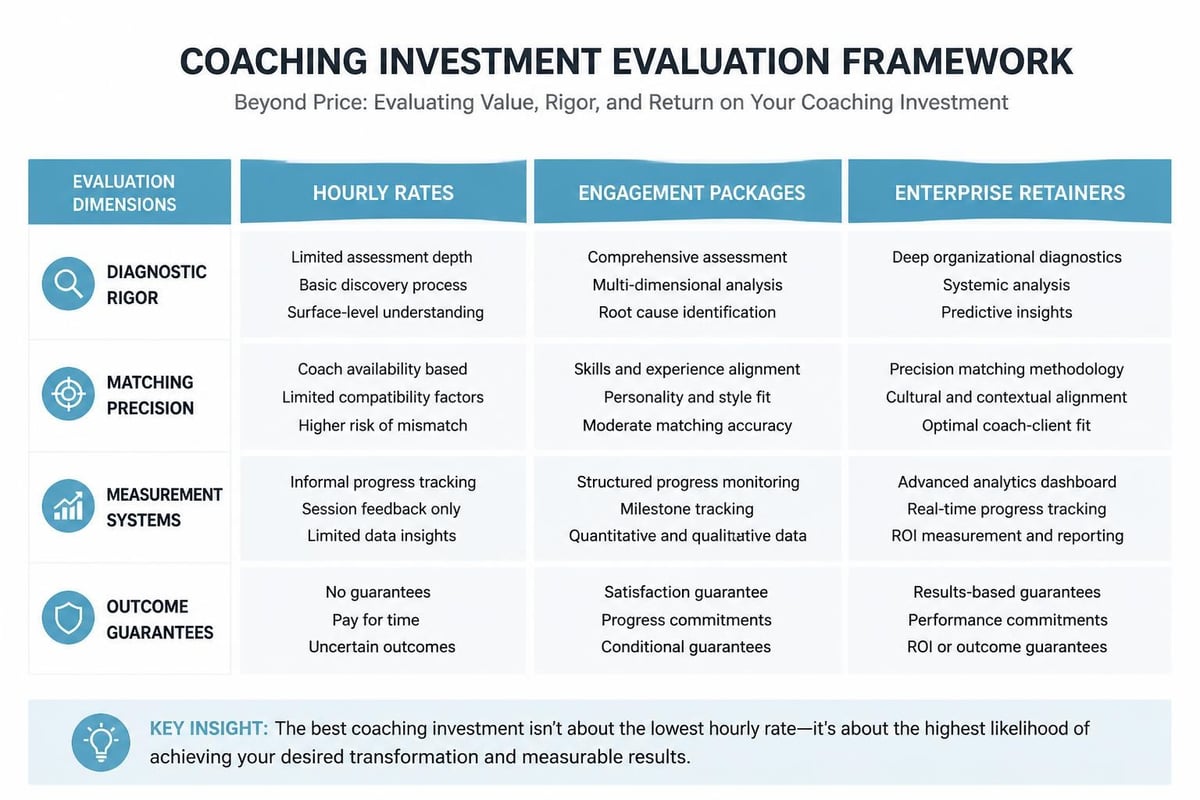
Pricing opacity remains a persistent challenge when evaluating corporate coaching vendors in Mexico. Vendors quote hourly rates, monthly retainers, per-engagement packages, or outcome-based fees, making apples-to-apples comparisons difficult.
Common pricing structures observed in 2026:
- Hourly rates: MXN 2,500 to MXN 8,500 per coaching hour depending on coach seniority and specialization
- Engagement packages: MXN 45,000 to MXN 180,000 for six-month individual coaching (12-20 sessions)
- Cohort programs: MXN 25,000 to MXN 60,000 per participant for group plus individual coaching
- Enterprise retainers: Custom pricing based on participant volume, assessment requirements, and support services
These ranges reflect significant quality variance. A MXN 3,000 per hour coach may deliver exceptional value if precisely matched to the leader's development need and skilled in that specific intervention. An MXN 7,000 per hour generalist may produce minimal impact despite higher cost.
Organizations evaluating executive coaching costs should focus less on rate comparison and more on value architecture: what diagnostics inform the engagement, how coaching aligns with organizational priorities, what measurement validates progress, and how outcomes connect to business results.
Contract Red Flags
Certain contract terms signal vendor inexperience or misaligned incentives:
- Pre-committed session volumes without outcome gates (vendor gets paid regardless of progress)
- No-refund policies when coaching proves ineffective
- Vague deliverable descriptions ("ongoing support" rather than specific outcomes)
- Exclusive coach assignment preventing changes when fit issues emerge
- Minimal measurement requirements beyond attendance tracking
Sophisticated vendors structure contracts around outcomes, build in adjustment mechanisms when initial approaches prove ineffective, and align their economic incentives with client success rather than session consumption.
The Vendor Selection Process: A Staged Approach
Organizations that consistently select high-performing corporate coaching vendors in Mexico follow a structured evaluation process rather than issuing generic RFPs and comparing proposals.
Stage One: Internal Clarity (Before Vendor Contact)
Define the specific leadership challenge requiring coaching intervention. "Improve leadership effectiveness" lacks the precision needed for vendor evaluation. "Address conflict avoidance patterns causing team dysfunction and delayed decision-making" provides actionable direction.
Establish success criteria and measurement approach. What observable changes would indicate coaching effectiveness? How will those changes be tracked? Who validates progress?
Determine budget parameters based on expected ROI. If addressing a toxic leader's behavior could retain three high-performers (saving MXN 900,000 in replacement costs), a MXN 120,000 coaching investment represents strong ROI even at premium rates.
Organizations that skip internal clarity work inevitably select vendors based on superficial criteria and express disappointment when results fail to materialize.
Stage Two: Vendor Qualification
Request evidence of specialized expertise in the target development area. Ask for case examples, methodology descriptions, and outcome data specific to the challenge being addressed.
Evaluate assessment and diagnostic approach. How does the vendor identify root causes versus symptoms? What validated instruments do they use? How do assessment findings inform coaching design?
Examine matching methodology. What criteria determine coach selection? How does the vendor ensure alignment between coach expertise and leader development needs? What happens if initial matching proves suboptimal?
Review measurement frameworks. What KPIs does the vendor propose? How do they establish baselines, track progress, and validate outcomes? What ROI calculation methodology do they use?
Assess cultural competency and Mexico-specific experience. Can the vendor demonstrate understanding of Mexican organizational culture, communication norms, and regulatory context?
This qualification stage should narrow the field to 2-3 vendors who demonstrate genuine capability rather than proceeding with all respondents.
Stage Three: Pilot and Evaluation
Rather than committing to enterprise-wide programs immediately, sophisticated buyers structure pilot engagements with built-in evaluation gates.
Pilot structure example:
- Participants: 3-5 leaders representing the target population and development challenges
- Duration: 90-120 days with defined milestones
- Measurement: Baseline assessment, interim progress check (60 days), outcome validation
- Decision criteria: Minimum threshold improvements required to proceed with broader rollout
This approach reduces risk, provides real performance data, and establishes vendor accountability before major investment.
Organizations comparing top executive coaching firms should recognize that vendor reputation matters less than demonstrated capability addressing their specific challenges with their unique culture and constraints.
What High-Performing Vendors Do Differently
After evaluating vendor performance across 140+ coaching engagements in Mexico between 2024 and 2026, clear patterns distinguish vendors who consistently deliver measurable results from those producing sporadic outcomes.
They Lead with Diagnosis, Not Solution
Effective corporate coaching vendors in Mexico invest significant time understanding the leadership challenge before proposing intervention approaches. They conduct comprehensive assessments, interview stakeholders, review organizational context, and analyze how current leadership patterns impact business outcomes.
Weak vendors pitch their standard coaching package regardless of the specific challenge. They emphasize coach credentials and methodology without demonstrating how those elements address the particular development need.
They Match Coaches to Challenges, Not Just Industries
The shift from industry matching to competency matching represents the single largest predictor of coaching success. A manufacturing executive developing strategic thinking skills benefits more from a coach expert in strategic decision-making (regardless of industry background) than from a manufacturing-industry generalist.
Leading vendors maintain detailed coach profiles documenting specific competency expertise, intervention methodologies, and documented outcomes. They can explain why Coach A rather than Coach B represents the optimal match for a given leader's development priority.
They Measure What Matters
Sophisticated vendors establish measurement frameworks tied to organizational impact rather than coaching activity. They track behavioral changes, team outcomes, and business results connected to the leadership competencies being developed.
They provide regular progress reports with quantitative data, adjust interventions when results lag expectations, and calculate ROI using methodology their clients can defend to finance teams and boards.
They Integrate with Organizational Systems
Coaching doesn't exist in isolation. Effective vendors connect their interventions to performance management processes, succession planning initiatives, and strategic priorities. They coordinate with HR teams, communicate appropriately with leaders' managers, and ensure coaching supports rather than contradicts organizational direction.
Vendors who treat coaching as a standalone service delivered independently of organizational context miss opportunities to amplify impact and sustainability.
Frequently Asked Questions
How long does corporate coaching typically last in Mexican organizations?
Individual executive coaching engagements typically run 4-8 months with sessions every 2-3 weeks. However, duration should match development objectives rather than arbitrary timeframes. Simple skill development may require 3-4 months while transforming entrenched leadership patterns often needs 6-12 months of sustained intervention and reinforcement.
What credentials should we require from coaching vendors operating in Mexico?
At minimum, coaches should hold recognized certification from bodies like the International Coaching Federation (PCC or MCC level preferred for executive work). Additionally, look for specialized training in the specific competency area (conflict resolution, strategic thinking, cultural transformation) and demonstrated compliance with Mexican professional standards. Avoid vendors who cannot provide verification of coach credentials and continuing education.
How can we measure ROI from corporate coaching investments?
Effective ROI measurement connects coaching to business outcomes through a multi-level approach: behavioral changes measured via 360-degree assessments, team impact tracked through engagement and productivity metrics, organizational outcomes tied to retention and performance indicators, and financial impact calculated from retention savings, productivity gains, or revenue effects. Require vendors to propose specific KPIs with baseline and outcome measurement before engagement begins.
Should we use Mexican coaching vendors or international firms?
The critical factors are cultural competency and Mexico-specific expertise rather than vendor origin. International firms with deep Mexican experience and local coach networks can be highly effective. Similarly, Mexican boutique firms may lack the specialized expertise needed for complex interventions. Evaluate based on demonstrated capability addressing your specific challenges within Mexican organizational culture rather than vendor nationality.
How do we handle confidentiality concerns with corporate coaching?
Establish clear confidentiality protocols in vendor contracts that specify what information coaches may share with the organization (typically progress toward agreed objectives without revealing session content) and what remains confidential (specific discussions, personal disclosures, sensitive topics). Ensure vendors understand Mexican privacy standards and have documented processes for handling confidential information, especially when coaching addresses performance issues or sensitive leadership challenges.
The Real Cost of Vendor Selection Mistakes
Poor vendor selection creates costs beyond wasted coaching fees. When enterprises invest in ineffective programs, leaders conclude that "coaching doesn't work for us" and resist future development initiatives. This skepticism persists even when subsequent vendors might deliver better results.
A government agency spent MXN 840,000 on leadership coaching in 2024 that produced minimal observable change. The vendor used a generic approach with newly-certified coaches lacking public sector expertise. Eighteen months later, the agency still resists coaching despite persistent leadership challenges, citing the previous failed investment as evidence of coaching's ineffectiveness.
The actual problem wasn't coaching methodology but vendor selection based on lowest bid rather than capability to address specific leadership gaps in a government context. The true cost includes not just the wasted investment but the ongoing impact of unaddressed leadership dysfunction and missed opportunity for meaningful development.
Organizations evaluating corporate coaching vendors in Mexico should recognize that vendor selection represents a strategic decision with long-term implications for leadership culture, development credibility, and organizational capability. Treating it as a procurement transaction rather than strategic partnership creates predictable failure patterns.
Selecting corporate coaching vendors in Mexico requires moving beyond rate comparison and credential checking to evaluate diagnostic rigor, matching precision, and measurement sophistication. Organizations that approach vendor selection strategically, define success criteria clearly, and structure pilot evaluations create the foundation for meaningful leadership transformation. Noomii Leadership Coaching combines validated assessment methodology, precision coach matching, and outcome-focused measurement to deliver scalable coaching solutions aligned with organizational priorities and Mexican regulatory standards, helping enterprises transform leadership challenges into measurable competitive advantages.



Leave a Reply
Want to join the discussion?Feel free to contribute!