

Corporate Coaching Vendors in Australia: A 2026 Guide
The Australian corporate coaching market has matured rapidly, yet most organizations still select vendors based on incomplete criteria. After analyzing procurement decisions across government agencies and ASX-listed companies, a pattern emerges: senior leaders focus heavily on credentials and pricing while overlooking the capability gaps that determine whether coaching delivers measurable ROI or becomes another forgotten HR initiative. Understanding how corporate coaching vendors in Australia actually operate, not just how they market themselves, separates strategic investments from expensive disappointments.
The Vendor Landscape Has Changed Fundamentally
Australia's executive education and coaching market reached $487 million in 2025, according to recent market research tracking the sector’s growth. Yet this expansion has created complexity rather than clarity for buyers.
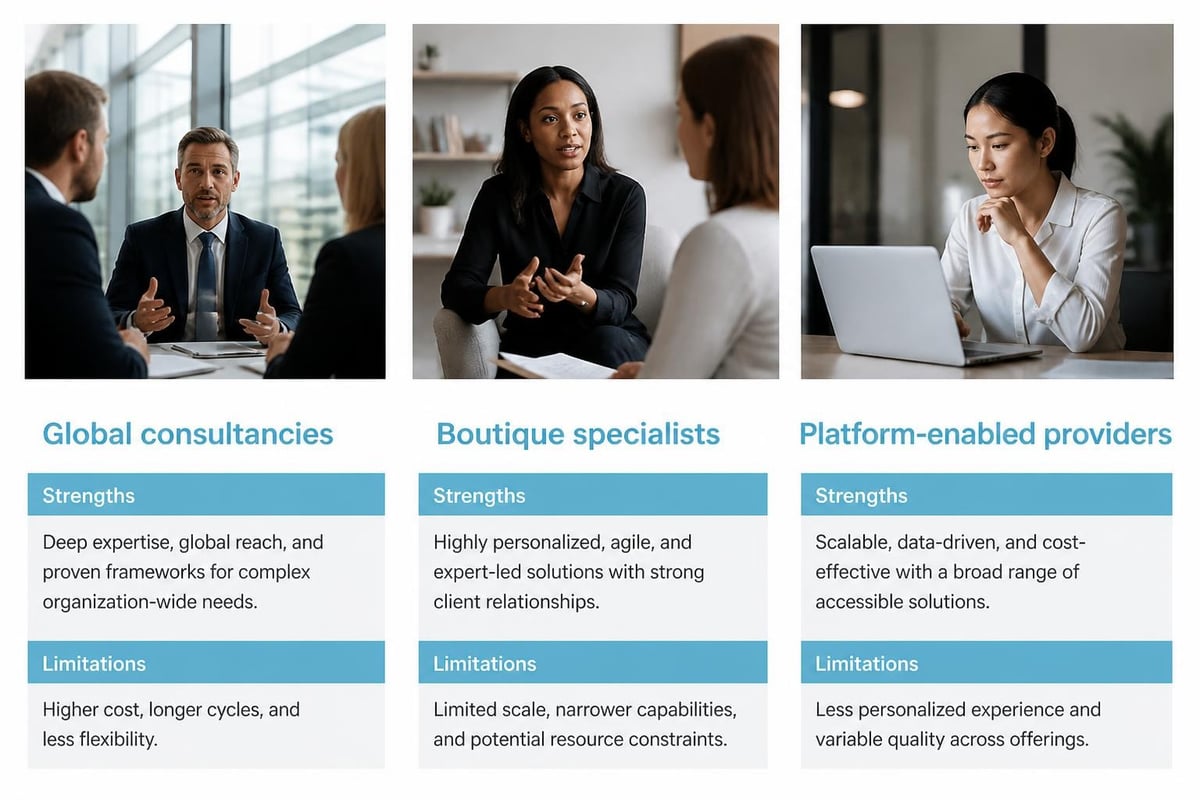
Three distinct vendor categories now compete for enterprise budgets:
Global consultancies offer coaching as part of broader transformation engagements. These providers bring sophisticated frameworks and established relationships with C-suite executives. Their weakness: coaching often becomes subordinate to consulting deliverables, with coaches selected for availability rather than precise skill matching.
Boutique specialist firms focus exclusively on executive and leadership development. They typically maintain small networks of 20-50 coaches and emphasize deep client relationships. The limitation: scaling across multiple divisions or geographies creates bottlenecks, and expertise gaps emerge when specific challenges fall outside the core team's experience.
Platform-enabled providers use technology to match coaches with leaders based on industry expertise, leadership challenges, and organizational context. This category includes corporate coaching vendors in Australia that prioritize precision matching and measurable outcomes over relationship selling.
What Most Procurement Processes Miss
A federal agency recently shared their RFP evaluation for a leadership coaching program targeting 40 senior executives. The selection criteria weighted pricing at 30%, vendor experience at 40%, and methodology at 30%. Missing entirely: how coaches would be matched to specific leaders, what assessment tools would diagnose individual development needs, and how outcomes would be measured beyond participant satisfaction surveys.
This approach assumes all certified coaches deliver equivalent results. Field observations prove otherwise. A coach with deep expertise in manufacturing operations won't effectively address strategic communication challenges facing a CFO navigating stakeholder relations. Yet many corporate coaching vendors in Australia assign coaches based primarily on calendar availability.
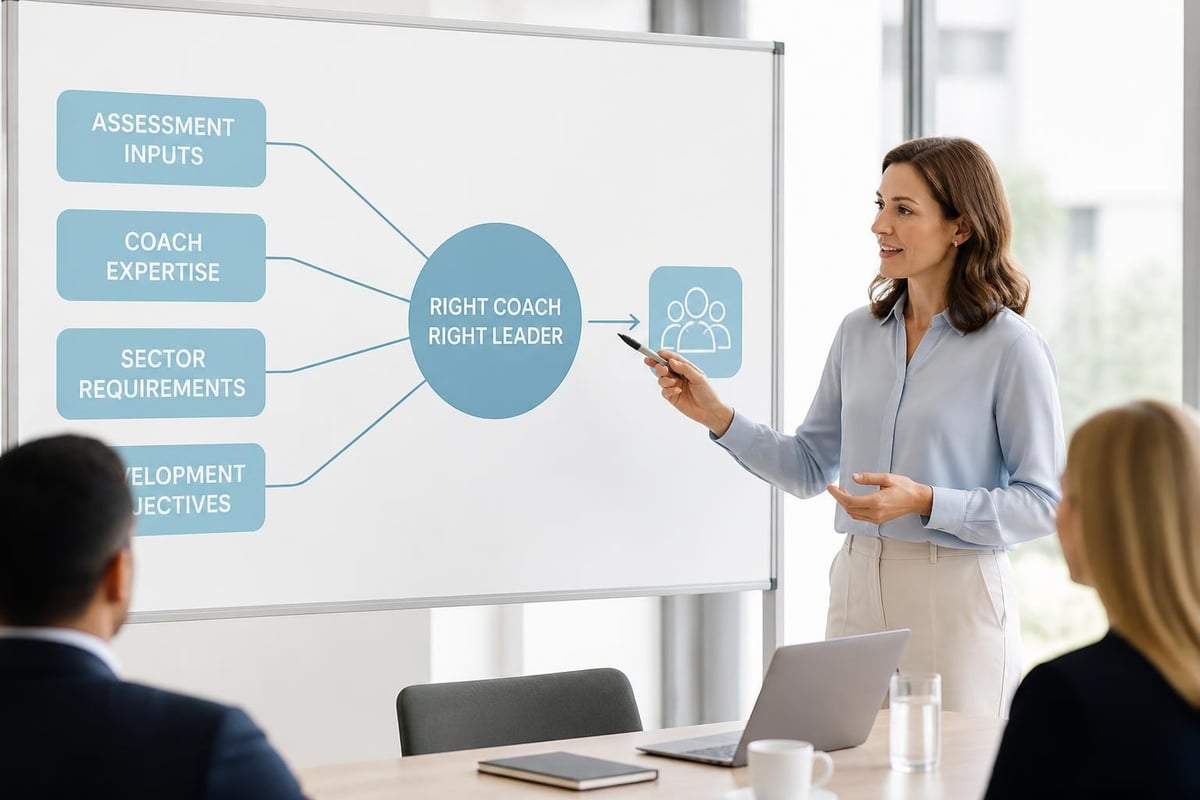
The most consequential vendor selection criterion gets the least attention: the methodology for diagnosing leadership gaps and matching the right coach to the right challenge.
Assessment Rigor Separates Effective Programs From Theater
Generic 360-degree feedback and personality assessments dominate intake processes. These tools provide useful data points but rarely diagnose the specific behavioral patterns driving performance issues or cultural friction.
One public sector organization implemented coaching for ten senior managers following an engagement survey that revealed trust deficits and low psychological safety. The vendor administered standard leadership assessments, then assigned coaches based on geographic proximity. Six months later, participant feedback was positive, but team-level metrics showed minimal improvement in trust or collaboration.
The diagnosis was too shallow. The real issue: several leaders lacked the skills to navigate conflict constructively, defaulting instead to avoidance or escalation. Standard assessments identified these leaders as "conflict-averse" but didn't surface the underlying patterns driving the behavior or the specific interventions needed.
Evidence-Based Diagnostics Require Specific Capabilities
Effective vendors use validated assessment instruments that go beyond self-reported preferences to identify:
- Behavioral patterns under stress or ambiguity
- Gaps between self-perception and stakeholder experience
- Specific triggers for unproductive reactions
- Strengths that can be leveraged for growth
Understanding workplace coaching competencies according to national training standards provides a baseline, but truly effective diagnostics require coaches who can interpret results in organizational context.
A mining company used multi-rater assessments that measured not just leadership style but specific behaviors linked to safety culture, operational decision-making, and team performance. The vendor then matched each leader with a coach who had both mining sector experience and expertise in the precise development area identified, whether conflict resolution, strategic thinking, or stakeholder engagement.
The result: measurable improvements in safety incident reporting (up 34%) and team effectiveness scores (up 27%) within nine months. These weren't satisfaction metrics but operational outcomes tied directly to business priorities.
Coach Matching Methodology Determines Program Success
Most corporate coaching vendors in Australia describe their matching process as "comprehensive" and "customized." In practice, this often means a brief intake call followed by assignment to whoever has availability in the right city.
A more rigorous approach treats matching as a diagnostic and strategic decision, not an administrative task.
| Matching Approach | Typical Process | Outcome Quality |
|---|---|---|
| Availability-based | Coach assigned based on calendar and location | 40-50% success rate |
| Credentials-based | Coach selected for certifications and experience level | 55-65% success rate |
| Precision-based | Coach matched using sector expertise, development need, leadership context, and interpersonal fit | 75-85% success rate |
These success rates come from analyzing completion rates, stakeholder-reported improvements, and achievement of defined development objectives across 200+ corporate coaching engagements in Australia and comparable markets like Canada’s corporate coaching sector.
The Cost of Mismatched Coaching Relationships
An ASX-listed retailer invested $180,000 in executive coaching for six C-suite leaders. Three engagements produced meaningful growth in strategic decision-making and stakeholder influence. Two yielded modest improvements in self-awareness but limited behavioral change. One failed completely, with the executive discontinuing after four sessions.
Post-program analysis revealed the pattern: successful engagements paired leaders with coaches who had direct experience in their industry and the specific challenge they faced. The failed engagement matched a first-time CFO navigating board dynamics with a coach whose background was entirely in operational leadership.
The vendor's matching process asked about career level and general development goals but didn't assess the nuanced requirements of board-level financial leadership during organizational transition. The $30,000 invested in that engagement delivered zero return.
Compliance and Governance Requirements Are Non-Negotiable
Government agencies and regulated industries face coaching requirements that extend beyond effectiveness to include probity, privacy, and ethical standards. Many vendors treat these as checkbox exercises rather than fundamental program design elements.
A state government department recently terminated a coaching contract mid-program after discovering the vendor's coaches weren't consistently documenting conflicts of interest or maintaining proper confidentiality protocols. The vendor met credential requirements but lacked systematic governance processes.
What Compliance Actually Requires
Corporate coaching vendors in Australia serving government or regulated sectors must demonstrate:
- Documented coach selection criteria that align with public sector probity standards
- Privacy frameworks that protect sensitive information discussed in coaching sessions
- Conflict of interest protocols that prevent coaches from serving multiple clients with competing interests
- Ethical guidelines consistent with professional coaching psychology standards
- Data security measures for assessment results and progress documentation
These aren't administrative burdens but essential safeguards. A coaching program that improves leadership effectiveness while creating compliance risk or reputational exposure hasn't delivered value.
Measurement Systems Reveal Vendor Sophistication
Satisfaction surveys remain the most common evaluation method for leadership coaching. They measure whether participants enjoyed the experience, not whether the organization achieved its objectives.
Research on coaching-as-leadership emphasizes outcomes over process: improved team performance, better decision-making under pressure, enhanced stakeholder relationships, and measurable cultural shifts.
A healthcare organization implemented coaching for 15 clinical leaders struggling with conflict between patient care priorities and operational efficiency demands. The vendor proposed measuring success through participant satisfaction and coach session completion rates. The organization insisted on different metrics:
- Reduction in staff turnover within coached leaders' teams
- Improvement in patient experience scores
- Decrease in escalated conflicts requiring executive intervention
- Increased cross-functional collaboration on process improvements
Six months post-program, turnover in participating teams dropped by 22%, patient experience scores improved by 11%, and documented conflicts requiring escalation fell by 43%. These metrics demonstrated ROI in concrete business terms, not coaching process compliance.
The KPI Framework That Actually Works
| Category | Weak Metrics | Strong Metrics |
|---|---|---|
| Individual growth | Satisfaction scores | 360-degree behavioral change ratings |
| Team impact | Session attendance | Team effectiveness and psychological safety measures |
| Organizational outcomes | Completion rates | Performance KPIs linked to coached behaviors |
| Cultural health | Program participation | Engagement, retention, and collaboration indices |
Vendors who resist outcome-based measurement typically lack confidence in their matching methodology or coach quality. The best corporate coaching vendors in Australia build measurement frameworks collaboratively, linking coaching objectives directly to organizational priorities.
The Hidden Cost Structures That Inflate Budgets
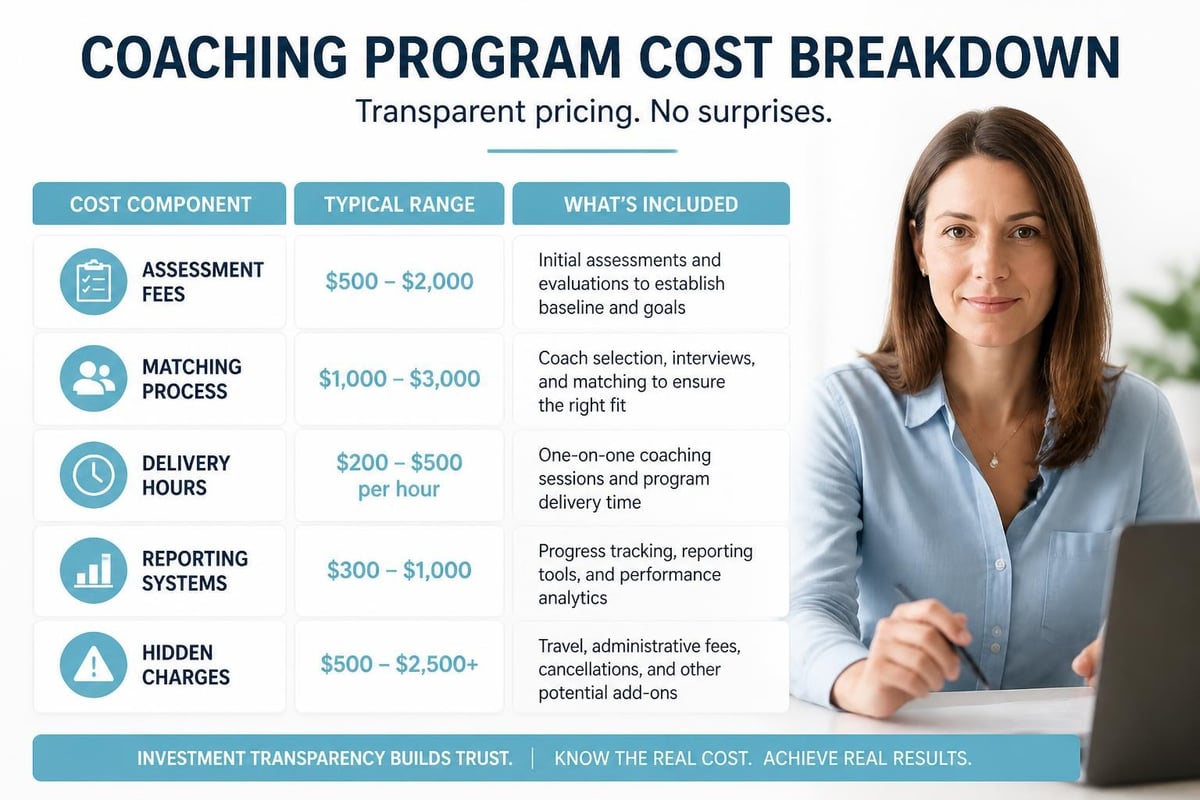
Quoted per-coach pricing rarely reflects total program costs. A vendor proposal showing $8,000 per executive for a six-month engagement might exclude:
- Assessment administration and interpretation fees
- Program management and reporting time
- Platform or technology access charges
- Travel costs for in-person sessions
- Additional stakeholder interviews or 360 reviews
A manufacturing company accepted a coaching proposal at $120,000 for 15 participants. Final invoices totaled $167,000 after add-ons and scope adjustments. The vendor hadn't misrepresented pricing but structured the proposal to appear competitive while monetizing standard program elements separately.
More transparent vendors bundle assessment, matching, coaching delivery, progress reporting, and stakeholder communication into fixed per-participant pricing. This approach eliminates surprise costs and allows accurate budget planning. Understanding executive coaching packages and pricing models helps buyers evaluate proposals accurately.
Volume Pricing and Multi-Year Commitments
Large enterprises often negotiate volume discounts or multi-year arrangements. These can deliver cost savings but create risks if the vendor relationship underperforms.
One professional services firm committed to a three-year coaching partnership for 50 leaders annually. Year one results were mixed: some engagements succeeded, others failed to move key metrics. The contract structure made it difficult to exit or renegotiate terms, trapping the organization in a mediocre vendor relationship.
A better approach: pilot programs with 10-15 participants before scaling. Measure outcomes rigorously. Expand only after confirming the vendor's methodology delivers measurable results in your specific organizational context.
Sector Expertise Matters More Than Generic Credentials
A coach with 20 years of experience and prestigious certifications may still be the wrong choice for a specific leadership challenge in a particular industry.
A financial services executive needed coaching to strengthen strategic influence with the board while managing regulatory pressure and stakeholder scrutiny. The assigned coach had deep expertise in operational leadership and team development but limited exposure to board dynamics in regulated industries. The coaching helped with self-awareness but didn't address the core challenge.
When Industry Experience Is Essential
Certain contexts require coaches with direct sector knowledge:
- Regulated industries (financial services, healthcare, energy) where compliance complexity shapes leadership decisions
- Government and public sector where political dynamics and public accountability create unique pressures
- Professional services where up-or-out cultures and client relationships define success
- Manufacturing and operations where safety, quality, and process discipline dominate
Generic leadership principles apply across contexts, but effective coaching addresses the specific challenges leaders face in their environment. Corporate coaching vendors in Australia with diverse coach networks can match sector expertise to participant needs. Those with narrow networks default to whoever is available regardless of fit.
What CHROs Should Demand From Vendor Partners
HR leaders bear responsibility for selecting vendors who will deliver organizational value, not just complete contracted sessions. This requires asking questions most RFPs skip:
How do you diagnose specific leadership development needs before assigning coaches? Generic assessments aren't sufficient. Look for vendors using validated instruments that identify behavioral patterns and development priorities.
What is your coach selection and vetting process? Credentials matter less than demonstrated expertise in relevant challenges and industries. Ask for examples of how coaches have been matched to similar leadership situations.
How will you measure success beyond participant satisfaction? Push vendors to propose metrics linked to team performance, cultural health, and business outcomes.
What happens when a coaching relationship isn't working? The best vendors proactively monitor engagement quality and will reassign coaches when fit isn't optimal, without additional charges.
How do you ensure compliance and ethical standards? Particularly important for government agencies and regulated industries requiring documented governance processes.
These questions separate vendors who prioritize delivery from those focused primarily on sales. Organizations looking to expand their understanding of leadership coaching program design benefit from examining how different vendors answer these fundamental questions.
The Platform Advantage in Scalable Programs
Enterprise-scale coaching programs face challenges boutique vendors can't solve: matching 50+ leaders with appropriate coaches across multiple geographies, maintaining consistent quality and methodology, tracking progress systematically, and demonstrating ROI through data rather than anecdotes.
Platform-enabled providers use technology not to replace human judgment but to enhance matching precision and program management. A global retailer used a platform approach to deliver coaching to 120 store managers across Australia, matching each leader with coaches who had retail operations experience and expertise in the specific development area identified through diagnostic assessments.
The platform managed scheduling, progress tracking, and outcome measurement while human specialists oversaw matching decisions and stakeholder communication. This hybrid model delivered consistency at scale while preserving the customization that makes coaching effective.
Technology's Role in Quality Assurance
Platforms enable capabilities that manual processes can't sustain at scale:
- Systematic tracking of session completion and engagement quality
- Real-time identification of struggling relationships requiring intervention
- Aggregated analytics showing patterns across coaching engagements
- Centralized documentation ensuring compliance and privacy standards
A government department used platform analytics to identify that three of 25 coaching relationships were underperforming based on session frequency and stakeholder feedback. Early intervention and coach reassignment salvaged two of the three engagements, demonstrating how data-driven oversight improves outcomes.
Vendor Selection as Strategic Decision, Not Procurement Exercise
Treating coaching vendor selection as a compliance-focused procurement process produces mediocre results. The organization checks a development box, participants complete sessions, and minimal organizational change occurs.
Strategic vendor selection starts with clarity about what leadership gaps actually constrain organizational performance. Is the issue toxic leadership patterns damaging culture and driving turnover? Executive decision-making that's too slow or risk-averse? Leadership teams that can't collaborate effectively across functional boundaries?
Different challenges require different diagnostic approaches, matching methodologies, and measurement frameworks. Vendors who claim their model works equally well for all leadership situations either don't understand the nuances or aren't being honest about their limitations.
The best corporate coaching vendors in Australia help organizations diagnose what's actually broken before proposing solutions. They acknowledge when a challenge falls outside their expertise rather than forcing every problem into their standard methodology. They measure success by organizational outcomes, not program completion.
Understanding whether coaching can actually work in your specific context requires examining these vendor capabilities systematically, not just comparing credential summaries and pricing proposals.
Frequently Asked Questions
What qualifications should corporate coaching vendors in Australia have?
Look beyond basic coaching certifications (ICF, EMCC) to assess diagnostic capability, matching methodology, sector expertise, compliance frameworks, and measurement systems. Vendors should demonstrate how they've delivered measurable outcomes in contexts similar to yours, with coaches matched to specific leadership challenges rather than assigned based on availability.
How much should organizations budget for executive coaching programs?
Enterprise coaching typically ranges from $6,000 to $15,000 per participant for six-month engagements, depending on coach experience, program scope, and assessment rigor. Total program costs include diagnostics, matching, delivery, and measurement. Volume arrangements and multi-year commitments can reduce per-participant costs but should only follow successful pilot programs.
What's the difference between coaching vendors and internal coaching programs?
External vendors provide access to specialized expertise, objective perspectives, and scalable infrastructure that internal programs can't replicate. Internal coaches understand organizational culture deeply but may lack the sector diversity, fresh insights, or perceived neutrality needed for senior executive development. Hybrid approaches often work best: internal coaching for emerging leaders, external vendors for executives and specialized challenges.
How long does it take to see results from corporate coaching?
Behavioral awareness typically emerges within 6-8 weeks. Sustained behavior change requires 4-6 months of consistent practice and feedback. Organizational impact (improved team performance, cultural shifts, measurable KPI improvements) generally becomes visible at 6-9 months. Vendors promising immediate results or measuring success only through participant satisfaction aren't serious about outcomes.
Should coaching be confidential or transparent to stakeholders?
Coaching conversations must remain confidential to build trust and psychological safety. However, progress toward agreed-upon development objectives should be visible to relevant stakeholders (managers, HR, program sponsors) through structured check-ins and measurement systems. The best vendors establish clear protocols distinguishing confidential process from transparent outcomes before engagements begin.
Selecting corporate coaching vendors in Australia requires rigor most procurement processes lack: precision diagnostics, evidence-based matching, sector expertise, and measurement frameworks tied to business outcomes rather than satisfaction surveys. Organizations that treat vendor selection as a strategic decision rather than an administrative task achieve measurable leadership transformation. Noomii Leadership Coaching delivers the diagnostic precision, matching methodology, and outcome accountability that separates meaningful leadership development from expensive theater, helping organizations transform leadership challenges into competitive advantages through evidence-based coaching solutions.



Leave a Reply
Want to join the discussion?Feel free to contribute!