
Corporate Coaching for SaaS Companies: What Works in 2026
SaaS companies are scaling faster than their leadership capabilities can keep pace. You see the pattern everywhere: brilliant technical founders managing fifty-person teams with zero leadership training, product managers drowning in stakeholder chaos, and engineering directors who can build distributed systems but cannot run effective one-on-ones. The result is predictable: burnt-out teams, missed delivery commitments, and expensive attrition. Corporate coaching for SaaS companies exists to close this gap, but most implementations fail because they treat software organizations like traditional enterprises. The coaching that works for manufacturing executives or retail managers does not translate to environments where deployment velocity, incident response culture, and async communication define success.
Why Traditional Corporate Coaching Fails SaaS Leaders
The problem starts with mismatched diagnostics. Most corporate coaching programs begin with personality assessments designed in the 1980s for hierarchical organizations. They measure traits like "decisiveness" and "strategic thinking" without accounting for the unique pressures SaaS leaders face: continuous deployment cycles, remote-first teams across twelve time zones, customer-driven product roadmaps that change weekly, and venture capital boards demanding impossible growth trajectories.
The SaaS Leadership Context Is Different
Consider what a typical SaaS VP of Engineering manages compared to a manufacturing plant director:
| Traditional Enterprise Leader | SaaS Engineering Leader |
|---|---|
| Annual product cycles | Daily or weekly deployments |
| Co-located teams | Distributed across continents |
| Stable requirements | Constant pivots based on usage data |
| Predictable resource planning | Rapid headcount swings tied to funding |
| Clear chain of command | Matrix reporting with product, design, data |
The leadership competencies required are fundamentally different. SaaS leaders need to excel at asynchronous decision-making, manage high-ambiguity environments, build psychological safety in remote settings, and translate technical constraints into business language for non-technical stakeholders. Traditional coaching frameworks miss this entirely.
What we observe in SaaS organizations: Leaders coached using generic frameworks report the sessions feel disconnected from their daily reality. They learn conflict resolution techniques designed for in-person disputes, not Slack thread escalations. They practice presentation skills for boardrooms, not async Loom videos. The coaching does not stick because the context is wrong.

The Real Leadership Gaps in High-Growth SaaS
After working with dozens of SaaS companies from series A to post-IPO, we have identified the leadership failures that actually cause damage. These are not personality deficits. They are skill gaps that emerge from rapid scaling without proper leadership infrastructure.
Technical Founders Managing People
The transition from individual contributor to people manager destroys more SaaS companies than competitive threats. A brilliant engineer promoted to engineering manager typically has no training in performance management, career development, or team dynamics. They default to what they know: solving technical problems. When a team member struggles, they jump in to fix the code instead of coaching the person.
The consequence is twofold: the manager becomes a bottleneck, and the team never develops problem-solving capacity. We see engineering managers working eighty-hour weeks while their teams wait for decisions. Corporate coaching for SaaS companies must address this directly by teaching managers to diagnose people problems with the same rigor they apply to system architecture.
Framework: The People System Diagnostic
We developed this approach after watching too many SaaS managers treat team performance issues as black boxes:
- Define the observable behavior (not the person's attitude or motivation)
- Map dependencies (what systems, processes, or other people does this person rely on?)
- Identify the constraint (is this a skill gap, a process gap, or a misalignment?)
- Design the minimum intervention (what is the smallest change that removes the constraint?)
- Measure the outcome (what specific behavior or metric will confirm improvement?)
This framework translates system thinking into people management. SaaS leaders understand it immediately because it mirrors how they debug production issues.
Cross-Functional Alignment Chaos
SaaS organizations operate as matrix structures whether they intend to or not. Product managers need engineering capacity. Engineering needs design resources. Customer success escalates bugs that derail sprint commitments. Sales promises features that do not exist on the roadmap.
Most corporate coaching programs teach stakeholder management as if it is primarily about influence and persuasion. That is inadequate for SaaS. The real skill is designing lightweight alignment mechanisms that work asynchronously across teams.
- Weekly async updates in a shared document that all functions contribute to
- Dependency mapping that makes cross-team blockers visible in real time
- Escalation protocols that route decisions to the right level without manager bottlenecks
- Capacity visibility so product and sales know what engineering can actually deliver
These are operational disciplines, not soft skills. Research from Deloitte on employee engagement confirms that structural clarity matters more than interpersonal dynamics for team performance in knowledge work environments.
Scaling Decision-Making Without Becoming a Bottleneck
Early-stage SaaS founders make every important decision. At fifty people, that breaks. At two hundred people, it is catastrophic. Yet most technical leaders resist delegating because they believe no one else has sufficient context or judgment.
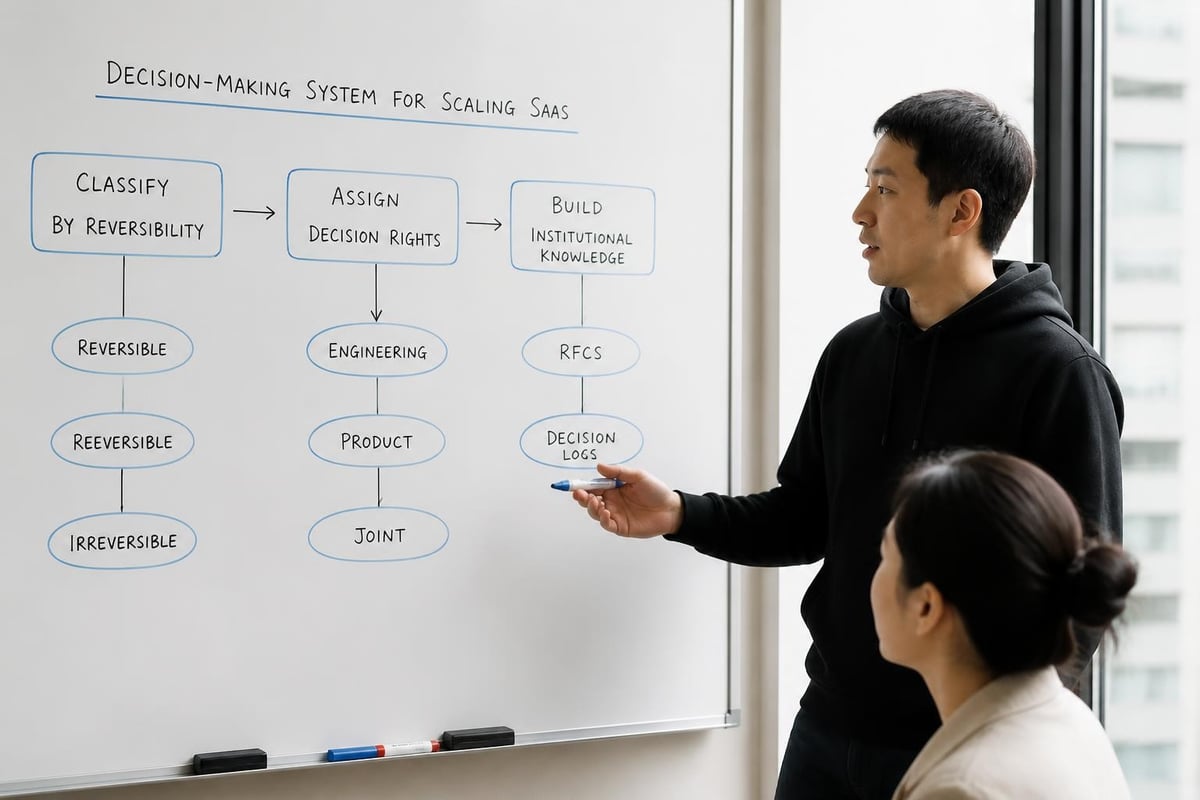
The coaching intervention that works is not "trust your team more." It is teaching leaders to build decision-making systems:
- Document decision criteria explicitly (what factors matter, how are tradeoffs weighted?)
- Classify decisions by reversibility (one-way doors require more scrutiny than two-way doors)
- Assign decision rights clearly (who owns which categories of decisions at what threshold?)
- Create decision artifacts (templates, RFCs, decision logs that capture reasoning)
When a SaaS leader implements this, they stop being the bottleneck. Equally important, the organization builds institutional memory instead of relying on heroic individuals.
What Effective Corporate Coaching for SaaS Companies Looks Like
The coaching that produces measurable results in SaaS environments has three characteristics: it is context-specific, outcome-focused, and integrated with how the organization already works.
Context-Specific Coach Matching
Assigning a retired manufacturing executive to coach a SaaS product leader is malpractice. The coach needs to understand SaaS business models, the dynamics of product-market fit, the technical constraints of software development, and the growth-stage pressures the organization faces.
When we work with SaaS clients, the matching criteria include:
- Prior experience in SaaS or high-growth technology companies (preferably as an operator, not just a coach)
- Familiarity with modern development practices (agile, continuous deployment, DevOps culture)
- Understanding of remote and distributed team dynamics
- Track record coaching technical leaders (engineers, product managers, data scientists)
This specificity matters. Harvard Business Review's analysis of how to lead like a coach emphasizes that effective coaching requires domain credibility. SaaS leaders will not accept guidance from someone who has never navigated their challenges.
Outcome-Focused Interventions
Corporate coaching for SaaS companies fails when it becomes open-ended personal development. The most effective programs define success criteria before the first session:
| Vague Goal | Measurable Outcome |
|---|---|
| "Improve leadership presence" | "Reduce escalations to CEO by 40% within 90 days" |
| "Be more strategic" | "Deliver quarterly business reviews that inform board decisions" |
| "Build a stronger team" | "Increase internal promotion rate from 15% to 35% annually" |
| "Better cross-functional collaboration" | "Ship features on roadmap commitments 85%+ of the time" |
Outcomes drive accountability. They also ensure coaching addresses business problems, not just individual growth. Understanding executive coaching cost helps organizations align investment with expected returns.
Integration With Existing Systems
SaaS companies already have performance review cycles, OKR processes, sprint planning rituals, and all-hands meetings. Effective coaching integrates with these systems rather than adding parallel infrastructure.
Example from a Series C SaaS client: Their VP of Product was struggling to align engineering and go-to-market. Instead of weekly hour-long coaching sessions disconnected from work, we embedded the coaching into existing meetings. The coach joined sprint planning as an observer, reviewed roadmap documents async, and conducted fifteen-minute debriefs after key stakeholder interactions. The intervention was invisible to the broader organization but dramatically improved the VP's effectiveness in the meetings that mattered.
This approach also addresses a practical constraint: SaaS leaders are time-starved. They will not sustain coaching that feels like another obligation. But they will engage if it directly improves outcomes in the work they are already doing.
Diagnostic Frameworks That Work for SaaS Leadership
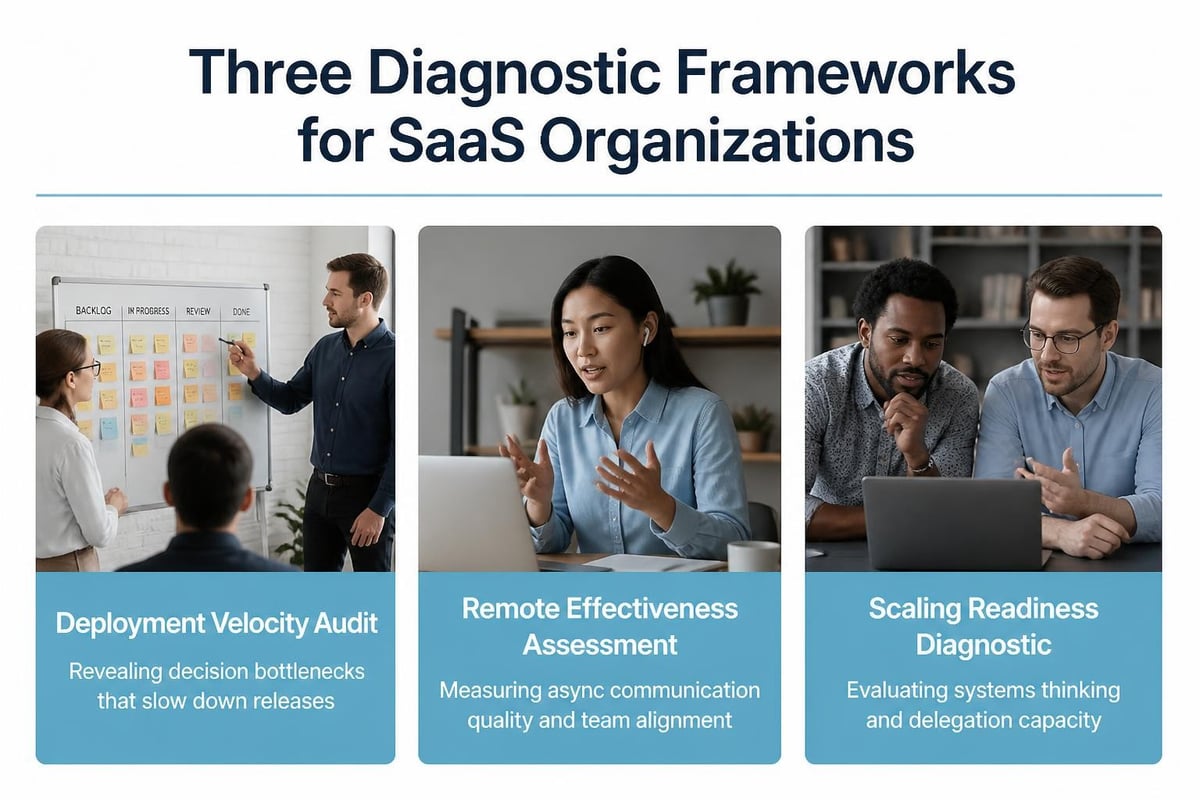
Generic 360 feedback and personality tests do not surface the specific dysfunction in SaaS organizations. We use three diagnostic tools designed for high-growth technology companies.
The Deployment Velocity Audit
Leadership problems in SaaS often manifest as slowing deployment velocity. When a company that shipped daily starts shipping weekly, something broke. Usually it is a leadership issue, not a technical one.
The audit examines:
- Decision latency: How long do deployments wait for approval or prioritization decisions?
- Rework rate: What percentage of work gets rolled back or significantly revised?
- Cross-team dependencies: How often do deploys block on other teams?
- Incident response patterns: Who gets involved in production issues and how quickly?
These metrics reveal leadership gaps. High decision latency points to unclear ownership. Elevated rework rates suggest insufficient upfront alignment. Frequent cross-team blocks indicate poor dependency management. Slow incident response reflects weak operational discipline.
The Remote Effectiveness Assessment
Most SaaS companies operate with distributed teams, but few leaders are trained to manage remotely. This assessment measures:
- Async communication quality (are decisions documented, is context shared proactively?)
- Time zone respect (are meetings scheduled fairly, is synchronous time used wisely?)
- Visibility practices (can team members see progress and blockers without asking?)
- Inclusion patterns (do remote team members have equal influence and advancement?)
Leaders who score poorly on these dimensions create invisible dysfunction. Remote employees feel disconnected, decisions happen in private Slack channels, and institutional knowledge lives in people's heads instead of in shared systems.
The Scaling Readiness Diagnostic
This framework predicts whether a SaaS leader can scale with the organization or will become a constraint. It evaluates:
- Systems thinking: Does the leader design processes or just solve individual problems?
- Delegation capability: Can they transfer ownership with clarity and accountability?
- Teaching orientation: Do they build capability in others or hoard knowledge?
- Execution rhythm: Do they maintain consistent operational cadence under pressure?
Leaders who fail this diagnostic need targeted intervention before the company scales past them. The cost of replacing a senior leader mid-growth is enormous, not just in recruiting expense but in lost momentum and team disruption.
Building a Coaching Culture That Sticks in SaaS
Individual executive coaching delivers value, but organizational transformation requires embedding coaching capability throughout the company. SHRM's toolkit for building a business-driven coaching culture provides enterprise-focused implementation guidance, though it needs adaptation for SaaS velocity.
Manager-as-Coach Training
The highest-leverage intervention is teaching managers to coach their direct reports. This scales leadership development beyond what external coaches can deliver alone. But it requires changing how managers spend their time.
Implementation that works: We train SaaS managers using real scenarios from their environment, not role-play exercises. They bring actual performance issues, roadmap conflicts, or team dynamics problems to the training. They practice coaching conversations on real stakes, get feedback, and refine their approach. Then they apply it immediately with their teams.
The failure mode is making this training generic. Managers need to practice coaching conversations about sprint planning conflicts, on-call rotation fairness, technical debt prioritization, and career growth in flat organizations. These are the conversations they have daily.
Embedding Coaching in Performance Cycles
SaaS companies typically run quarterly performance reviews tied to OKR cycles. These reviews often focus on evaluation (did you hit your goals?) rather than development (what capability do you need to build?).
Effective corporate coaching for SaaS companies integrates coaching directly into this cycle:
- Pre-quarter coaching: What skills or relationships do you need to develop to achieve next quarter's OKRs?
- Mid-quarter check-in: What obstacles have emerged and how are you adapting?
- Post-quarter reflection: What did you learn about your leadership that you can apply next cycle?
This rhythm ensures coaching stays connected to business outcomes and builds leadership capability incrementally rather than through disconnected interventions.
Measuring Coaching Impact on Business Metrics
SaaS organizations are metric-driven. They track MAU, NRR, CAC payback, and deployment frequency obsessively. Leadership development should use the same rigor.
| Leadership Investment | Leading Indicator | Lagging Indicator |
|---|---|---|
| Engineering manager coaching | Pull request review latency | Deployment frequency |
| Product leader coaching | Roadmap commitment accuracy | Feature adoption rate |
| Cross-functional coaching | Meeting decision rate | Time to ship |
| Executive coaching | Strategic clarity score | Board confidence rating |
When coaching moves these metrics, CFOs and boards pay attention. When it does not, the program gets cut during the next downturn.
The Hidden Cost of Bad Leadership in SaaS
The case for corporate coaching for SaaS companies becomes obvious when you calculate what poor leadership actually costs. Most organizations underestimate this dramatically.
Attrition Math
A mid-level engineer at a SaaS company earning one hundred twenty thousand dollars costs approximately one hundred eighty thousand dollars when you include benefits, equity, and overhead. Replacing that person costs another sixty thousand dollars in recruiting and lost productivity during ramp-up. If poor management drives twenty percent annual attrition in a fifty-person engineering team, that is over two million dollars in direct costs.
The indirect costs are worse. Lost institutional knowledge, disrupted team dynamics, delayed product shipments, and damaged morale compound over time. Forrester’s research on revenue enablement demonstrates that leadership quality directly impacts both retention and performance in high-growth companies.
Opportunity Cost of Slow Execution
When leadership dysfunction slows down shipping velocity, the market cost can be existential. SaaS companies compete on execution speed. A competitor that ships twice as fast learns twice as fast, iterates to product-market fit faster, and captures market share while you are still in planning meetings.
Real example: A series B SaaS company we audited was shipping major features quarterly instead of monthly. The root cause was not technical. It was a product leader who could not make decisions without perfect information and an engineering leader who could not push back on scope creep. Six months of coaching for these two leaders increased shipping velocity by three times. The company hit their growth targets and raised their next round. Without that intervention, they would have missed their metrics and faced a difficult down round.
The Compounding Effect of Weak Middle Management
SaaS companies often promote strong individual contributors into management without training. These new managers then train the next generation of managers. Weak leadership compounds geometrically.
A poorly trained manager who develops five direct reports creates five managers with bad habits. Those five create twenty-five. Within three promotion cycles, seventy-five percent of your management team operates with dysfunctional patterns. Fixing this retroactively is nearly impossible. Preventing it through systematic leadership development is straightforward.
Contrarian Take: Stop Coaching Executives, Start Coaching Managers
Most corporate coaching for SaaS companies targets executives and senior leaders. This is backwards. The highest ROI comes from coaching frontline managers who directly impact the largest number of people.
Why Manager Coaching Delivers More Value
A VP of Engineering at a two hundred-person company manages eight directors. Those directors manage forty managers. Those managers manage one hundred fifty individual contributors. Coaching the VP improves decisions affecting eight people. Coaching the forty managers improves daily reality for one hundred fifty people.
The counter-argument is that executive decisions have larger impact. True, but executives in well-run SaaS companies make relatively few decisions. They set direction, allocate resources, and resolve escalations. The bulk of daily leadership happens at the manager level: one-on-ones, performance feedback, prioritization, conflict resolution, career development.
Implementation: Allocate sixty percent of coaching budget to frontline managers, thirty percent to directors and senior managers, ten percent to executives. Measure impact through team health scores, retention rates, and delivery predictability at the team level. Adjust based on data.
Procurement and Implementation Realities
Buying corporate coaching for SaaS companies is complex. Most vendors sell generic programs poorly suited to software organizations. Here is what actually matters in vendor selection.
Red Flags in Coaching Vendors
- No SaaS-specific experience: If their case studies are all from manufacturing, retail, or finance, walk away
- Cookie-cutter programs: If they cannot customize for your tech stack, development methodology, or growth stage, they will not deliver value
- Vague success metrics: If they resist defining measurable outcomes, they are not accountable for results
- Coach assignment without matching: If they assign whoever is available rather than matching expertise to need, quality will be inconsistent
- No integration plan: If they cannot explain how coaching integrates with your existing performance management, OKRs, and development practices, implementation will fail
What Good Looks Like
Effective programs start with diagnosis, not coaching. They assess your specific leadership gaps using SaaS-relevant frameworks. They match coaches with proven experience in your domain. They define success metrics tied to business outcomes. They integrate coaching into existing systems rather than creating parallel infrastructure.
Organizations seeking structured approaches to corporate leadership coaching should prioritize vendors who demonstrate this level of rigor and customization.
Frequently Asked Questions
What makes SaaS leadership coaching different from general executive coaching?
SaaS leaders face unique challenges: managing distributed teams, maintaining deployment velocity, navigating technical constraints, and scaling rapidly under venture capital pressure. Effective coaching addresses these specific contexts rather than applying generic leadership frameworks designed for traditional industries.
How long does it take to see results from corporate coaching in a SaaS environment?
Leading indicators (decision quality, meeting effectiveness, team feedback) typically improve within four to six weeks. Lagging indicators (retention, deployment frequency, revenue metrics) show measurable change within one quarter. Programs that do not demonstrate progress by ninety days are likely poorly designed.
Should we coach executives or frontline managers first?
Frontline managers deliver higher ROI because they directly impact more people and handle daily leadership responsibilities. Allocate the majority of coaching resources to managers and directors, with targeted executive coaching for strategic challenges or crisis situations.
How do we measure coaching effectiveness in a SaaS organization?
Track business metrics tied to leadership quality: deployment frequency, pull request review latency, employee retention by manager, roadmap commitment accuracy, cross-functional project cycle time, and promotion rates. Avoid relying solely on satisfaction surveys or self-reported growth.
What should we expect to pay for SaaS-specific corporate coaching?
Pricing varies based on coach experience, program scope, and engagement model. Individual executive coaching ranges from five hundred to one thousand five hundred dollars per session. Manager development programs cost between five thousand and fifteen thousand dollars per participant annually. Enterprise-wide culture change initiatives run from one hundred thousand to five hundred thousand dollars depending on company size.
Can internal HR teams deliver coaching or do we need external partners?
Internal HR can facilitate coaching culture and train managers, but external coaches bring domain expertise, objectivity, and dedicated focus that internal teams rarely match. Hybrid models work well: external coaches for executives and specialized situations, internal capability building for manager development.
SaaS leadership is a learnable skill set, not an innate trait, but it requires coaching designed for the specific pressures of high-growth software organizations. Generic programs fail because they ignore the context in which SaaS leaders operate: continuous deployment, distributed teams, rapid scaling, and existential competitive velocity. The organizations that build systematic leadership capability rather than relying on heroic individuals win in the long run. Noomii Leadership Coaching delivers precision-matched coaching solutions tailored to SaaS environments, with measurable outcomes tied to business metrics that matter: deployment velocity, team retention, cross-functional execution, and scalable decision-making systems.



Leave a Reply
Want to join the discussion?Feel free to contribute!