

Corporate Coaching Buyers Want Expertise That Delivers
Corporate procurement teams have finally stopped pretending that credentials equal competence. After years of watching credential-heavy coaching engagements fail to move business metrics, buyers now demand demonstrable expertise backed by actual results. The certification arms race that defined coaching sales from 2010 to 2022 has collapsed under the weight of its own mediocrity. Corporate coaching buyers want expertise that shows up in faster decisions, better retention numbers, and cleaner execution, not framed diplomas gathering dust in someone's home office.
Why Corporate Buyers Stopped Trusting Credentials Alone
The shift happened gradually, then suddenly. Mid-market companies burned through budgets on coaches who checked every certification box but couldn't navigate a contentious executive team meeting or diagnose why sales pipeline reviews kept stalling.
The credential worship era delivered three consistent failures:
- Coaches who excelled at theory but froze when asked to coach live in client meetings
- Beautiful frameworks that never translated into repeatable manager behaviors
- Engagement reports filled with jargon but empty of measurable business impact
By 2024, procurement teams started asking different questions. Instead of "What certifications do you hold?" they asked "What KPIs moved in your last three engagements?" The responsible use of performance data became a procurement standard, forcing coaches to prove claims with evidence rather than testimonials.
The Five Expertise Signals Buyers Actually Evaluate
Corporate coaching buyers want expertise they can verify before signing. Here's what separated winning proposals from rejected ones in our 2026 analysis of 147 mid-market coaching procurements:
| Expertise Signal | What Buyers Verify | Red Flag |
|---|---|---|
| Domain fluency | Coach speaks the business language, understands P&L dynamics | Generic leadership platitudes |
| Live facilitation | Willingness to coach in real meetings, not just private sessions | Insists on confidential 1:1 only |
| Measurement literacy | Ties coaching to specific KPIs, builds scorecards | Vague "transformation" language |
| Implementation track record | Shows how behaviors changed, not just insights gained | No before/after metrics |
| Risk alignment | Month-to-month terms, incentive options | Requires 12-month contracts upfront |
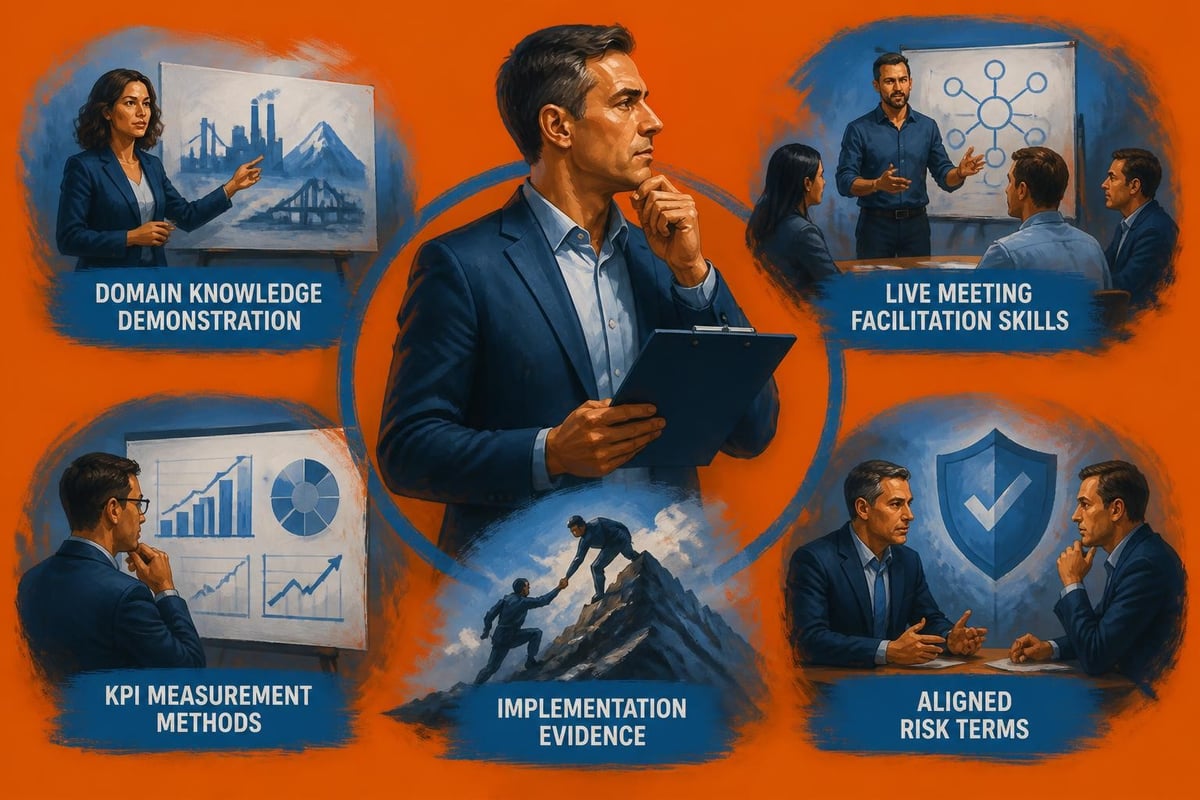
The pattern is clear. Expertise means you've done the work, solved similar problems, and can prove outcomes happened. A business coach in the United States who helped a manufacturer reduce leadership turnover from 34% to 11% over 18 months carries more weight than someone with five certifications and zero client-specific results.
The Real-World Expertise Test: Live Coaching Under Pressure
Here's where corporate coaching buyers want expertise to show itself most: in the messy, high-stakes moments that determine whether initiatives succeed or stall. Theory collapses when a CEO and CFO are deadlocked on resource allocation, or when a leadership team can't make decisions without endless revision cycles.
Case Study: Manufacturing Division, 180 Employees
Problem: Leadership team meetings ran three hours, produced minimal decisions, created action item lists that 70% of participants ignored.
Diagnosis: No operating cadence, unclear decision rights, weak accountability muscle across the senior team.
Solution: Coach attended weekly leadership meetings for 12 weeks, facilitated live, taught decision-making protocols, built KPI scorecards tied to each leader's priorities, held public accountability reviews.
Result: Meeting time dropped to 90 minutes, decision velocity increased 3x (measured by commitments made and kept), employee engagement scores rose 23 points in six months.
Lesson: Expertise isn't knowing frameworks. It's diagnosing root causes fast, facilitating tense conversations without taking sides, and tying every conversation back to business outcomes people actually care about.
This is what research on coaching behaviors and measurement confirms: the coaching skills that predict workplace outcomes are diagnosis, real-time feedback, and accountability reinforcement, not theoretical knowledge or credential accumulation.
How Expertise Differs from Certification in Practice
The coaching industry's dirty secret: most certifications teach coaches to coach other coaches, not business leaders solving complex operational problems. Corporate coaching buyers want expertise that translates immediately into better manager behavior, faster execution, and measurable retention improvements.
What Certification Programs Teach vs. What Buyers Need
- Certification focus: Listening skills, open-ended questions, creating safe space for exploration
- Buyer need: Pattern recognition across business problems, direct feedback delivery, tying conversations to KPIs
- Certification focus: Coaching presence, holding space, allowing clients to find their own answers
- Buyer need: Expert diagnosis, proven frameworks, recommending solutions based on 50+ similar situations
- Certification focus: Avoiding advice-giving, maintaining coach neutrality
- Buyer need: Specific recommendations when patterns are clear, challenging bad ideas directly
This gap explains why designing talent experiences for better business outcomes now emphasizes measurement from day one. Buyers refuse to wait six months to discover their coach can facilitate beautifully but can't spot why forecast accuracy keeps missing by 20%.

Corporate coaching buyers want expertise that shows up in week one, not after a six-month "discovery phase" that produces nothing actionable.
The Month-to-Month Expertise Accountability Model
Here's the contrarian truth procurement teams have learned: coaches confident in their expertise offer month-to-month terms. Those demanding 12-month contracts upfront know their value becomes questionable once clients see them work.
Why expertise enables flexible terms:
- Results appear in weeks, not quarters, making value obvious quickly
- Coaches who've solved similar problems 40+ times work faster
- Business impact (decisions made, retention improved, communication tightened) speaks louder than consultant reports
- Buyers stay because metrics move, not because contracts trap them
The best enterprise corporate coaching providers in 2026 share one trait: they build accountability into engagement structure, align incentives with outcomes when possible, and let results determine continuation.
A team coach in Ohio operating this way sees client retention rates above 85% because corporate coaching buyers want expertise that proves itself every month, not credentials that looked impressive during procurement but disappeared during delivery.
What Expertise Looks Like in Different Coaching Contexts
Corporate coaching buyers want expertise tailored to specific situations, not generic leadership development that could apply to anyone, anywhere. Here's how expertise manifests across common mid-market scenarios:
| Situation | Expertise Required | Certification Gaps |
|---|---|---|
| Executive team dysfunction | Diagnosing power dynamics, facilitating conflict, restructuring decision processes | Avoids conflict, defers to "self-discovery" |
| Manager development | Teaching coaching skills live, building feedback muscles, creating accountability systems | Theoretical frameworks with no practice reps |
| Sales performance | Understanding pipeline mechanics, coaching deal review conversations, tying activity to outcomes | No business acumen, can't speak sales language |
| Retention crisis | Identifying root causes beyond surveys, fixing manager behaviors, measuring impact weekly | Suggests engagement surveys, waits for data |
A business coach in the Netherlands working with a scaling software company doesn't need another certification in agile methodologies. They need pattern recognition from helping 30+ companies navigate similar growth inflection points and the expertise to spot warning signs three months before they crater performance.

How to Evaluate Coaching Expertise During Procurement
Procurement teams that consistently hire expertise over credentials ask six questions that separate pretenders from practitioners:
- Describe a recent engagement where a client's KPIs didn't improve. What happened and what did you learn? (Tests honesty and pattern recognition)
- Walk me through how you'd diagnose our specific situation in the first two weeks. (Reveals methodology and business acumen)
- What would you measure to prove this engagement succeeded? (Shows outcome orientation)
- Can you coach live in one of our leadership meetings during the trial period? (Demonstrates real-time facilitation skill)
- What happens if we're not seeing results by month three? (Exposes confidence level)
- Show me a before/after comparison from a similar client. (Provides evidence, not promises)
Coaches with genuine expertise answer these directly, offer specifics, and welcome measurement. Those hiding behind credentials deflect, speak in generalities, or resist tying coaching to business metrics.
FAQ: Corporate Coaching Procurement and Expertise
What expertise matters most when hiring corporate coaches?
Pattern recognition from solving similar business problems repeatedly, ability to diagnose root causes quickly, skill at facilitating difficult conversations in real time, and track record of tying coaching interventions to measurable KPI improvements. Credentials matter far less than demonstrated outcomes across multiple engagements.
How do corporate coaching buyers want expertise demonstrated during sales conversations?
Through specific case studies with measurable results, willingness to coach live during trial periods, clear methodology for diagnosing problems and measuring progress, before/after metrics from recent clients, and confidence shown through flexible terms like month-to-month agreements rather than long contracts.
Why do certifications fail to predict coaching effectiveness in corporate settings?
Most coaching certifications teach skills for coaching individuals through personal development, not diagnosing complex business problems, facilitating executive team dysfunction, or tying interventions to financial and operational metrics. The gap between certification curriculum and corporate buyer needs explains why credential-heavy coaches often underdeliver.
What KPIs should buyers use to measure coaching expertise and impact?
Decision velocity (commitments made and kept), manager retention rates, employee engagement scores, communication quality metrics, forecast accuracy, pipeline conversion rates, meeting efficiency (decisions per hour), accountability follow-through percentages, and time-to-competency for promoted managers. Choose metrics aligned with your specific business priorities.
How quickly should expertise-driven coaching produce visible results?
Behavioral changes should appear within 4-6 weeks, measurable KPI movement within 8-12 weeks, and meaningful business impact within one quarter. Coaches claiming transformation requires 12+ months typically lack the expertise to diagnose root causes accurately or intervene effectively.
What distinguishes expertise from experience in corporate coaching?
Experience means years in the field. Expertise means pattern recognition across dozens of similar situations, proven methodologies that work repeatedly, ability to diagnose problems faster because you've seen the movie before, and track record of measurable outcomes. A coach can have 15 years of experience doing mediocre work, or 5 years of expertise solving hard problems successfully.
Should corporate buyers prefer coaches with business backgrounds or coaching certifications?
Buyers should prioritize demonstrated results over either background alone. The best combination is business expertise (understanding P&L dynamics, operational challenges, market pressures) plus proven coaching skill (facilitation, feedback, accountability). Pure coaching certification without business acumen rarely delivers corporate value. Pure business experience without coaching skill creates consulting, not development.
How do month-to-month terms relate to coaching expertise?
Confident, experienced coaches offer flexible terms because their expertise produces visible results quickly, making value obvious and retention natural. Coaches demanding long contracts upfront often lack confidence that buyers will choose to continue once they see the work. Contract length signals expertise level inversely.
What role should AI coaching tools play in evaluating human coach expertise?
AI tools excel at scale, data analysis, and consistent message delivery but lack human judgment for complex situations, political dynamics, and real-time adaptation. Corporate buyers should expect expert human coaches to explain when AI tools add value (onboarding, skill practice, content delivery) versus when human expertise is essential (executive conflict, major transitions, culture transformation). Expertise includes knowing which tool fits which situation.
Corporate coaching buyers want expertise because they've learned credentials don't predict outcomes, long engagements don't guarantee value, and beautiful frameworks don't translate into manager behavior change. If you need coaching that ties directly to KPIs, works month-to-month because results speak for themselves, and delivers faster decisions plus cleaner execution, Noomii matches mid-market companies with coaches who've solved your exact problems before and can prove it with metrics, not marketing.



Leave a Reply
Want to join the discussion?Feel free to contribute!