

AI Is Changing Leadership Expectations in 2026
The real story of AI in organizations isn't about productivity gains or automation wins. It's about exposure. Every executive behavior, decision-making delay, and leadership gap that could hide behind complexity and busyness is now visible. AI is changing leadership expectations by accelerating work to the point where poor judgment, weak accountability, and absent emotional intelligence become organizational liabilities boards can no longer ignore. The leaders who thrived in slower cycles are struggling. The ones who believed technical fluency would carry them forward are discovering they misread the mandate entirely.
The Acceleration Paradox Exposing Leadership Deficiencies
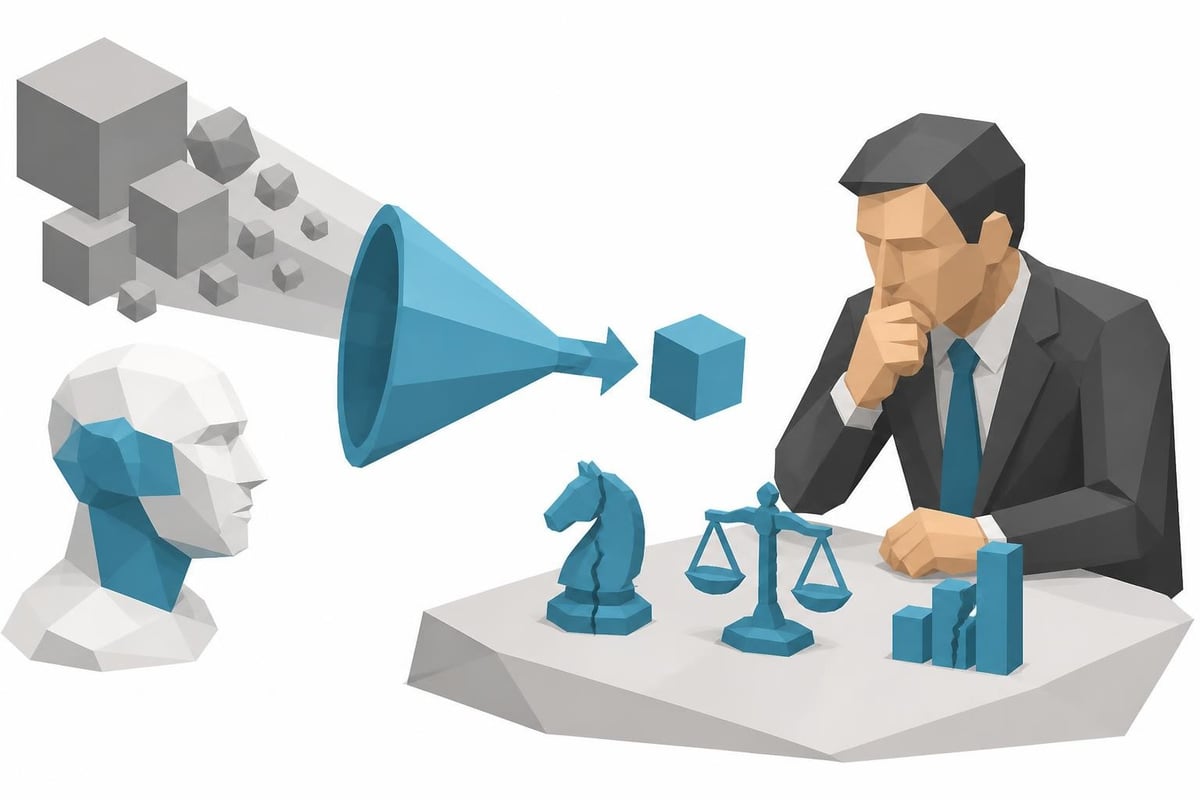
When AI compresses a three-week analysis into three hours, the bottleneck shifts from data to decision-making. This reveals something uncomfortable: many senior leaders weren't slow because the work was hard. They were slow because they lacked clarity, conviction, or the courage to make calls with incomplete information.
Organizations using AI-driven financial modeling, customer analytics, or operational forecasting are discovering their C-suite can't keep pace with the insights being generated. As AI speeds up work, leadership gaps are becoming harder to ignore, particularly around decisiveness and strategic interpretation. The tools deliver answers faster than executives can process implications, prioritize actions, or communicate direction.
What We're Seeing in Leadership Assessments
In diagnostic work with Fortune 500 executives over the past 18 months, three patterns dominate:
- Interpretation paralysis: Leaders receive AI-generated insights but lack frameworks to translate data into strategic action
- Delegation confusion: Executives unsure which decisions require human judgment versus algorithmic recommendation
- Accountability gaps: Unclear ownership when AI influences or contradicts leadership intuition
The consequence isn't just slower execution. It's erosion of confidence from boards, direct reports, and peers who watch leaders falter at precisely the moment they should be demonstrating judgment.
The Myth of Technical Fluency as Leadership Competency
The most damaging assumption in 2026 leadership development is that understanding AI tools equals effective AI leadership. It doesn't. AI leadership is about leading in environments where intelligence is no longer exclusively human, not becoming more technical.
CHROs are funding the wrong training. Boards are asking the wrong questions. Executives are building the wrong capabilities.
Technical fluency matters for practitioners. For leaders, what matters is:
- Judgment calibration: Knowing when AI recommendations require override based on context, culture, or consequences the algorithm can't weight
- Ethical boundaries: Setting clear limits on AI application before pressure, convenience, or competitive dynamics erode them
- Human connection: Strengthening relationships and trust as AI handles transactional interactions
- Accountability ownership: Accepting full responsibility for outcomes influenced by AI, not hiding behind "the system decided"
| Leadership Competency | Pre-AI Priority | 2026 Priority | Gap Consequence |
|---|---|---|---|
| Strategic Judgment | High | Critical | Misaligned AI deployment |
| Technical Skill | Low | Medium | Over-indexed in training |
| Emotional Intelligence | Medium | Critical | Team disengagement |
| Ethical Reasoning | Medium | Critical | Compliance failures |
| Decisiveness | High | Critical | Bottleneck despite speed |
The executives struggling most aren't those who can't use AI tools. They're the ones who can't lead people who are anxious about AI, make judgment calls AI can't make, or set boundaries AI will respect.
Organizational Problems Disguised as AI Problems
Most organizations blaming "AI adoption challenges" are actually confronting leadership and governance failures they've ignored for years. AI adoption problems are usually organizational problems in disguise, revealing fragmented ownership, unclear decision rights, and weak cross-functional collaboration.
Case Study: Government Agency Implementation Failure
A federal agency invested $8M in AI-powered case management expecting 40% efficiency gains. After 14 months, adoption sat at 23% and efficiency improved 6%.
Problem: Leadership assumed technology would solve workflow issues.
Diagnosis: The real barriers were territorial division directors, undefined escalation protocols, and zero trust between field operations and headquarters.
Solution: Leadership coaching focused on building cross-functional accountability, establishing decision frameworks, and developing directors' capability to lead through ambiguity.
Result: Within six months, adoption reached 67%, efficiency improved 31%, and employee satisfaction scores increased 18 points.
Lesson: AI reveals structural dysfunction. It doesn't fix it. That requires leadership transformation.
The agency's executive team learned that ai is changing leadership expectations by making organizational health non-negotiable. When systems are fast, politics and silos become expensive.
The Fatigue-Expectation Collision CHROs Must Navigate
CIOs are caught between contradictory pressures. Boards demand faster AI deployment. Employees report exhaustion from constant change. CIOs face tension between employee AI fatigue and leadership expectations, creating impossible conditions without executive alignment.
This isn't a technology problem. It's a leadership coordination failure.
The Real Dynamic
Board perspective: Competitors are moving faster. We need AI advantage now. Why is adoption slow?
Employee reality: We're learning the fourth new system this year. No one explained why the third one failed. We don't trust this will be different.
CIO position: Caught between mandate and capacity, blamed for culture problems they didn't create.
The solution isn't better change management communications. It's CHROs and CEOs acknowledging that ai is changing leadership expectations around change capacity, psychological safety, and transparent decision-making. Leaders who push AI without addressing trust, clarity, and workload are creating the conditions for failure.
Organizations working with Noomii’s leadership coaching practice implement a framework that addresses this directly:
- Assess current change fatigue and capacity across teams
- Align executive team on deployment pace and success metrics
- Develop leaders' skills in explaining AI decisions and addressing fear
- Build feedback loops that surface adoption barriers early
- Create accountability for protecting team wellbeing during transformation

The Human Skills AI Cannot Replace Just Got More Valuable
The counterintuitive reality: as AI handles more cognitive work, the premium on distinctly human capabilities is rising faster than most development programs recognize. The human skills AI cannot replace are precisely the ones separating effective leaders from those being exposed by acceleration.
What's Appreciating in Value
Contextual judgment: AI optimizes for patterns. Leaders must account for culture, timing, relationships, and second-order consequences algorithms miss.
Ethical reasoning: When efficiency conflicts with values, someone must choose. That's leadership, not automation.
Conflict resolution: AI can flag team dysfunction. It can't rebuild trust, facilitate difficult conversations, or heal damaged relationships.
Ambiguity tolerance: Leaders who need certainty before acting are liabilities in AI-accelerated environments where perfect information never arrives.
Presence and connection: As interactions become more transactional, the ability to make people feel seen, heard, and valued is differentiating.
The mistake is treating these as soft skills. They're core competencies determining whether organizations extract value from AI or get crushed by it. Psychological safety in the workplace becomes non-negotiable when AI creates anxiety about job security, decision authority, and organizational direction.
The Overdependence Risk Leaders Underestimate
The most dangerous leadership failure isn't resisting AI. It's surrendering judgment to it. Five major risks of AI overdependence include diminished critical thinking, compounded errors, deskilling, and accountability erosion.
Framework: The Judgment Calibration Model
Leaders need a systematic approach to AI reliance:
| Decision Type | AI Role | Human Role | Override Trigger |
|---|---|---|---|
| Operational routine | Primary decision maker | Exception monitor | Pattern break or anomaly |
| Tactical execution | Recommendation provider | Final decision maker | Strategic misalignment |
| Strategic direction | Analysis provider | Primary decision maker | Always human-led |
| Ethical boundary | Not consulted | Sole decision maker | No AI involvement |
| People decisions | Data input only | Primary decision maker | Cultural/relational factors |
The leaders getting this wrong make one of two errors: treating all decisions as algorithmic or rejecting AI input on ego. Both are expensive.
What's required is disciplined discernment about when human judgment adds value and when it introduces bias, delay, or inconsistency that AI eliminates. This isn't intuitive. It requires coaching, practice, and feedback.
What Boards Should Demand From Leadership Now
Board oversight of AI deployment is mostly focused on risk, compliance, and ROI. That's necessary but insufficient. The question boards should be pressing: "How is our leadership team developing the judgment, accountability, and human connection capabilities this technology demands?"
The Board-Level Questions That Matter
On judgment: How are we assessing and developing executives' ability to override or validate AI recommendations based on context?
On accountability: When AI influences a decision that goes wrong, how do we assign responsibility? Is the answer clear to everyone?
On culture: What evidence do we have that employees trust leadership's AI deployment decisions? What are we hearing about fatigue, fear, or cynicism?
On development: Are we investing in the human capabilities AI makes more valuable, or just technical training?
On governance: Who owns the decision framework for AI use across functions? Is that person empowered?
Directors who accept reassuring answers without evidence are failing their oversight responsibility. AI is changing leadership expectations at the board level too. Comfort with ambiguity, willingness to challenge executives, and insistence on culture metrics alongside financial ones are now baseline competencies.

The Stanford Perspective on Disciplined AI Leadership
Stanford Graduate School of Business research emphasizes that AI is reshaping leadership by accelerating decision-making while requiring disciplined approaches to maintain ethical awareness and accountability. The acceleration without discipline creates exactly the leadership failures we're observing.
The implication for development programs: speed alone isn't the goal. Speed with judgment, ethics, and accountability is. Many executives conflate the two, optimizing for velocity while degrading the guardrails that protect organizations from catastrophic decisions.
This requires what Stanford calls "disciplined decision architecture" where leaders:
- Establish clear decision rights before AI provides recommendations
- Define non-negotiable boundaries AI cannot cross
- Build review processes that surface errors early
- Create feedback loops that improve both AI and human judgment
- Maintain accountability for outcomes regardless of AI involvement
Organizations implementing this approach report higher AI adoption, fewer implementation failures, and stronger employee trust. The difference isn't the technology. It's leadership clarity and discipline.
The Social Process of AI Leadership Transformation
The Center for Creative Leadership notes that navigating AI’s impact requires emphasis on human connection and collaboration as technological disruption accelerates. Leadership in AI environments is fundamentally social, not technical.
This contradicts how most organizations are approaching development. The focus is on tool training, not relationship building. On efficiency, not connection. On individual capability, not collective trust.
What's Missing in Most Programs
- Facilitated dialogue about AI anxiety and job security fears
- Team-based learning where leaders practice judgment calibration together
- Cross-functional alignment on decision frameworks and boundaries
- Coaching support for managing personal resistance and leading through uncertainty
- Structured reflection on leadership identity as AI changes the nature of work
The executives adapting successfully are those investing in peer learning, coach-supported development, and team-level trust building. They recognize that ai is changing leadership expectations in ways that make isolation and independence liabilities. Connection and collaboration are competitive advantages.
How Global Leadership Patterns Are Shifting
The World Economic Forum observes that AI is transforming leadership worldwide, presenting new opportunities for competitiveness while demanding adaptation. The patterns are consistent across regions, sectors, and organizational sizes.
What varies is response speed and effectiveness. Organizations that acknowledge ai is changing leadership expectations and invest accordingly are pulling ahead. Those treating AI as a technology implementation while ignoring leadership transformation are falling behind.
The gap isn't access to tools. It's willingness to confront uncomfortable truths about current leadership capability, make hard decisions about development investment, and hold executives accountable for growth.
Cross-Industry Observations
Financial services: Executives strong in risk management struggling with speed and ambiguity tolerance
Healthcare: Clinical leaders excelling at ethical reasoning but weak on strategic AI deployment
Technology: Engineering-focused leaders missing the human connection and culture components
Government: Strong process discipline but insufficient decisiveness and change leadership
Manufacturing: Operational excellence not translating to AI-era judgment and adaptation
No sector has this figured out. Every industry is confronting similar gaps. The advantage goes to organizations acknowledging reality and addressing it systematically, not those pretending current leadership is adequate.
Implementation: What Actually Works
Based on direct observation across government agencies and Fortune 500 implementations, the programs producing measurable leadership transformation share common elements:
Individual assessment: Using validated tools to identify specific gaps in judgment, decisiveness, ethical reasoning, and emotional intelligence.
Precision matching: Pairing leaders with coaches who have sector expertise and experience developing the exact capabilities needed.
Structured practice: Creating safe environments where executives can test AI-related decisions, receive feedback, and refine judgment.
Team alignment: Ensuring leadership teams develop shared frameworks, language, and accountability mechanisms.
Measurement discipline: Tracking growth through behavioral change, team feedback, and organizational outcomes, not just completion metrics.
The organizations getting ROI from AI are those investing in leadership transformation with the same rigor they apply to technology implementation. The ones struggling are those treating leadership as a soft afterthought to hard technical deployment.
For organizations serious about leadership coaching that drives measurable results, the requirement is evidence-based diagnostics, targeted intervention, and accountability for growth. Anything less is expense without impact.
Frequently Asked Questions
What specific leadership skills does AI demand that weren't critical before?
Judgment calibration (knowing when to override AI), ethical boundary setting, ambiguity tolerance, and the ability to build trust during rapid change. Technical fluency is secondary to these human capabilities.
How should boards evaluate if their executives are ready for AI-era leadership?
Look for evidence of decisiveness under ambiguity, willingness to challenge AI recommendations, capability to address employee fears transparently, and track record of maintaining culture during technology change.
What's the biggest mistake organizations make in AI leadership development?
Focusing on technical training instead of judgment, ethics, and human connection. Most programs teach tool use when the real need is developing capabilities AI cannot replace.
How long does it take to develop effective AI-era leadership capabilities?
With targeted coaching and structured practice, meaningful progress appears in 3-4 months. Full transformation typically requires 12-18 months of sustained development and accountability.
Should AI leadership development be different for senior executives versus mid-level managers?
Yes. Executives need strategic judgment and ethical frameworks. Mid-level managers need skills in explaining AI decisions, managing team anxiety, and maintaining psychological safety during change.
AI is changing leadership expectations by making behavioral gaps expensive and judgment quality visible. The leaders and organizations that acknowledge this reality and invest in systematic development will pull ahead. Those treating AI as purely technical will discover their leadership wasn't as strong as slower cycles allowed them to believe. The Noomii Corporate Leadership Program helps organizations develop the judgment, accountability, and human capabilities AI environments demand through evidence-based assessment, precision coach matching, and measurable transformation.



Leave a Reply
Want to join the discussion?Feel free to contribute!