Employee Engagement Courses Worth Your Team’s Time
The best employee engagement courses teach HR teams and managers how to measure engagement and act on what they find, but a course only pays off if someone applies it on Monday morning. Six options stand out, ranging from about $239 to $3,000, and the right one depends on whether you need analytics skills, strategy, or manager behavior change.
Engagement is a real problem, not a soft one. In 2024, 31% of U.S. employees were engaged, the lowest level in a decade, while 17% were actively disengaged, based on surveys of 79,087 workers.
What the Gallup numbers say about what a course must fix
A useful course targets the specific gaps in those numbers, not engagement in general. Gallup's same report found only 46% of employees clearly knew what was expected of them, 39% strongly felt someone cared about them as a person, and just 30% strongly agreed someone encouraged their development.
Notice what those three have in common. Each one is a manager behavior: setting expectations, showing care, encouraging growth. A course aimed at HR dashboards will not move them. Gallup also reports that employees who get meaningful feedback weekly are four times more likely to be engaged, which is a habit, not a knowledge gap.
1. Reigniting Employee Engagement (University of Michigan via Coursera)
This is a practical entry point for managers and HR practitioners who need to rebuild engagement after it has slipped. Coursera lists it as intermediate, 1 to 4 weeks, rated 4.7 from 29 reviews. Skills covered include driving engagement and leadership. It is included in Coursera Plus, which costs $239 per year.
Best for: a manager group on a tight budget. Verdict: the cheapest credible way to give managers shared vocabulary.
2. GenAI for Employee Engagement: Driving Real-Time Insights (Coursera)
This course teaches HR professionals to use AI for survey analysis and real-time engagement data. It is intermediate, runs 1 to 4 weeks, and is rated 4.8 from 8 reviews, a small sample. Topics include responsible AI, HR technology, employee surveys, and data-driven decisions. It is included in Coursera Plus at about $239 per year.
Best for: an HR team that already runs surveys and wants faster analysis. Verdict: valuable for insight, silent on what managers should do with it.
3. Strategic Engagement (eCornell)
A two-week, instructor-led, fully online program that asks for 3 to 5 hours of study per week, priced at $999. It frames engagement as a business strategy rather than an HR program.
Best for: HR leaders who must build the business case for an engagement budget. Verdict: the strongest mid-priced option for strategy.
4. Creating an Engaging Workplace for Engagement Champions (Gallup)
A virtual, two-day course in English (USA), priced at $3,000. It trains designated champions to support engagement work inside their organizations.
Best for: a company with a named engagement owner and budget for a small cohort. Verdict: the priciest here, and built around internal champions.
5. Creating an Environment for Talent to Thrive (AIHR)
A short module of about 4 hours (2 modules, 6 lessons, 12 months of access), but it is not sold on its own. It comes inside the Talent Management & Succession Planning Certificate Program, which costs $1,125.
Best for: HR professionals who want talent and engagement practices alongside succession planning. Verdict: good content, awkward packaging if engagement is your only need.
6. Design Thinking & Employee Experience (AIHR)
About 5 hours (3 modules, 11 lessons, 12 months of access), sold only within the Digital HR 2.0 Certificate Program, which costs $1,125.
Best for: people-experience practitioners redesigning onboarding, feedback, or workflows. Verdict: a design-oriented option that rewards HR teams with room to experiment.
Comparison at a glance
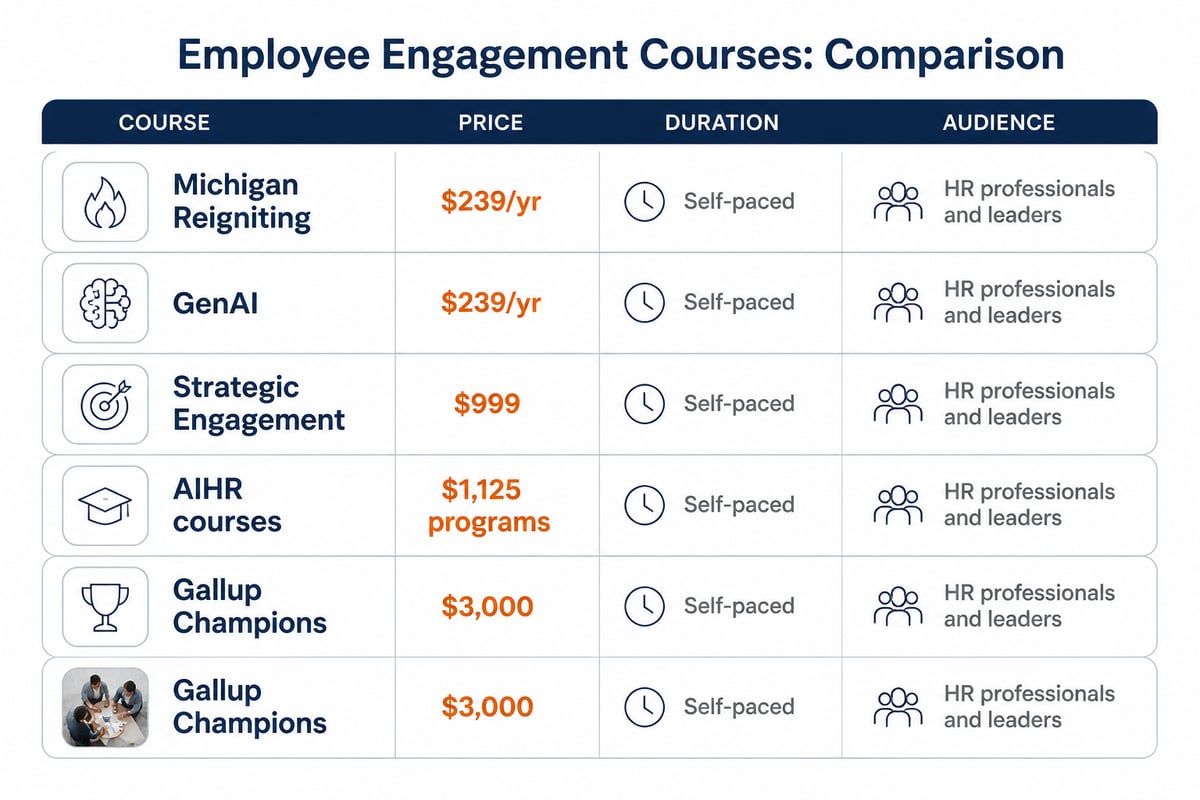
| Course | Provider | Price | Length | Fit |
|---|---|---|---|---|
| Reigniting Employee Engagement | Univ. of Michigan / Coursera | $239/yr (Coursera Plus) | 1-4 weeks | Managers, HR |
| GenAI for Employee Engagement | Coursera | $239/yr (Coursera Plus) | 1-4 weeks | HR analytics |
| Strategic Engagement | eCornell | $999 | 2 weeks | Leaders, HR |
| Engagement Champions | Gallup | $3,000 | 2 days | Champions |
| Talent to Thrive | AIHR | $1,125 (program) | 4 hours | HR |
| Design Thinking & EX | AIHR | $1,125 (program) | 5 hours | HR, people experience |

Where employee engagement courses fall short
Courses transfer knowledge; engagement changes only when behavior does. A manager can finish a module, nod at every slide, and still hold the same one-on-ones the next week. A course completion certificate often gets filed while the survey score stays flat weeks later.
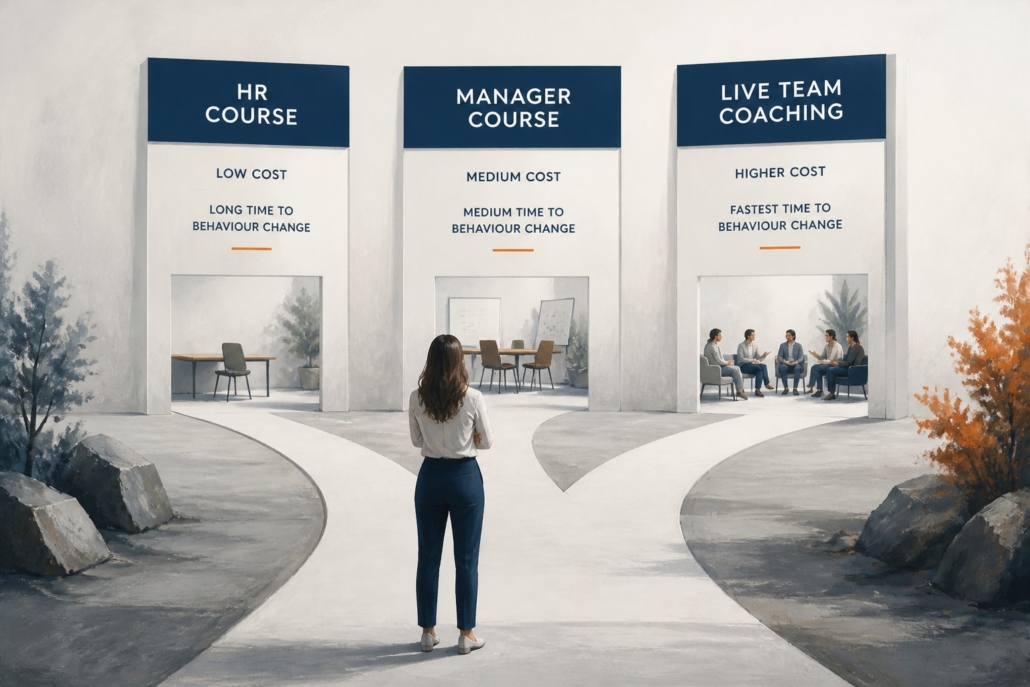
Here is a simple scenario that shows the gap. Problem: a services firm had engagement scores sliding and sent six managers to a course. Diagnosis: the scores traced back to unclear priorities and almost no developmental feedback, both manager habits. Solution: the firm added live coaching in team meetings and a weekly one-on-one structure with a scorecard. Result: managers were practicing the behaviors within weeks, because someone watched them do it. Lesson: training supplies the idea, and coaching with accountability supplies the repetition. Credentials matter less than whether anyone observes the manager doing the work.
If your gap is manager behavior, leadership coaching usually starts from a 360 assessment and builds from the specific habits it exposes. If engagement is tied to business results and priorities, business coaching centers on goals and profitability. Both can sit alongside a course rather than replace it.
How to choose among employee engagement courses
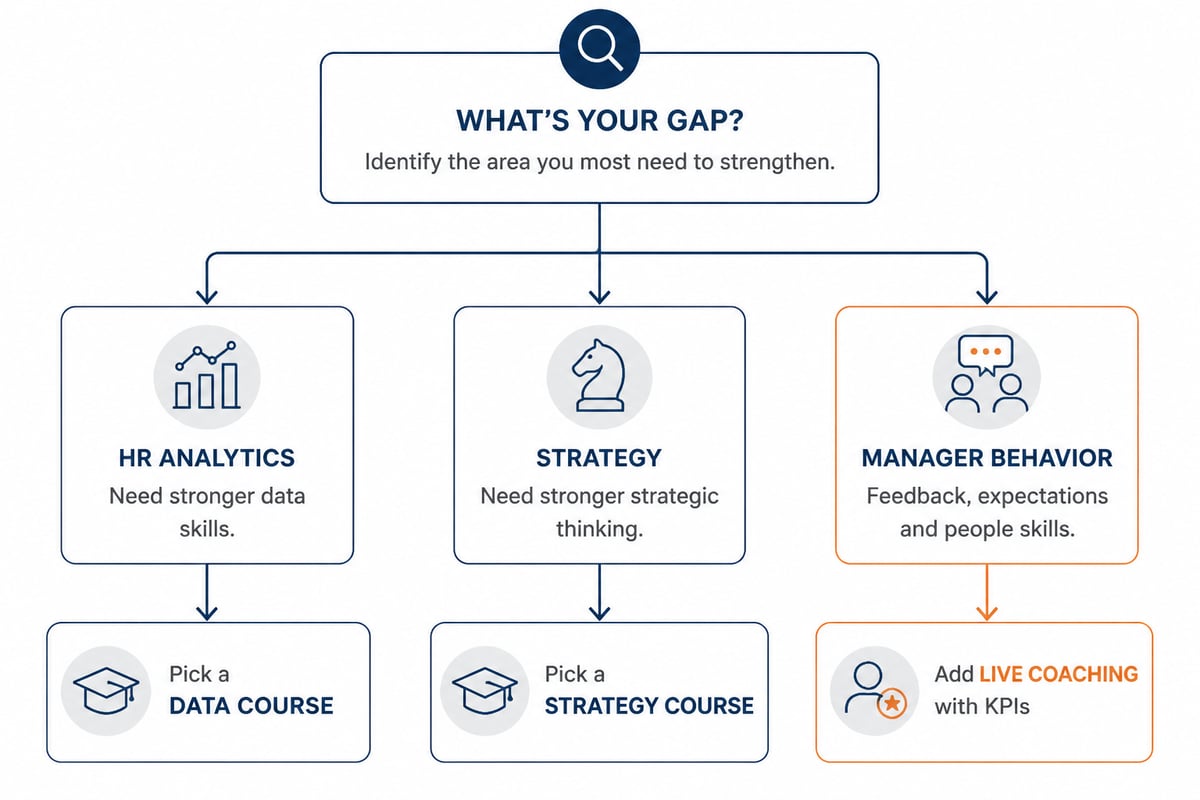
Match the course to the gap you can name, using this four-part check:
- Gap: which Gallup-style gap is yours: expectations, care, development, or feedback?
- Owner: who changes behavior, HR or line managers?
- Proof: what metric moves in 90 days, such as pulse score, regretted attrition, or one-on-one completion?
- Follow-through: what happens after the final lesson?
Measurement also matters. CIPD’s employee engagement resources cover measurement and employee voice, and Gallup’s engagement indicator offers historical benchmarks. Tools such as Hatchproof go further, reading actual work output so you can test whether engagement efforts show up in performance.
One caution on AI: GenAI courses sharpen your reading of survey data, but a faster dashboard of a problem is not a fix for it. Insight without manager action is just a quicker way to know you are stuck.
Questions people ask about employee engagement courses
1. Are employee engagement courses worth it? Yes, when matched to a specific gap and followed by applied practice.
2. How much do they cost? From $239 per year on Coursera Plus to $3,000 for Gallup's two-day course.
3. Which is best for managers? The University of Michigan course is a practical, low-cost start.
4. Which is best for HR analytics? The Coursera GenAI course.
5. Do certificates improve engagement? Not on their own. Behavior change does.
6. How long until results show? Results depend on how consistently managers apply the habits, so track pulse surveys over several quarters.
7. Can coaching replace a course? For behavior gaps, often yes; for HR technical skills, no.
8. Should small companies buy a course or coaching? For a company of 25 to 500 employees, a course plus targeted team coaching can give a practical return.
9. Is coaching a substitute for therapy? No. Coaching and therapy serve different needs, and mental health concerns belong with a licensed professional.
Start this week by naming your single biggest engagement gap and the one manager habit tied to it, then pick the course above that targets it. If you want a coach to turn that habit into a visible, measured result, Noomii can match you with independent coaches based on your goals, personality and budget, and Get My Free Match is the way to see up to five recommendations at no cost. You can also explore leadership coaching for managers who need live accountability.



Leave a Reply
Want to join the discussion?Feel free to contribute!