
Leadership Development Providers in Ireland: How to Choose
The best leadership development providers in Ireland fall into four groups: university and business school programs, public sector and professional institutes, network-funded training schemes, and specialist coaching firms. The right choice depends less on brand than on whether the provider can show observable behavior change in your leaders and report it in numbers your board will accept.
Most selection processes get this backwards. HR teams compare curricula, trainer biographies and per-head fees, then discover twelve months later that a well-reviewed classroom program left the same manager behaviors in place. A defensible shortlist starts with what you need to change, then works back to the delivery model.
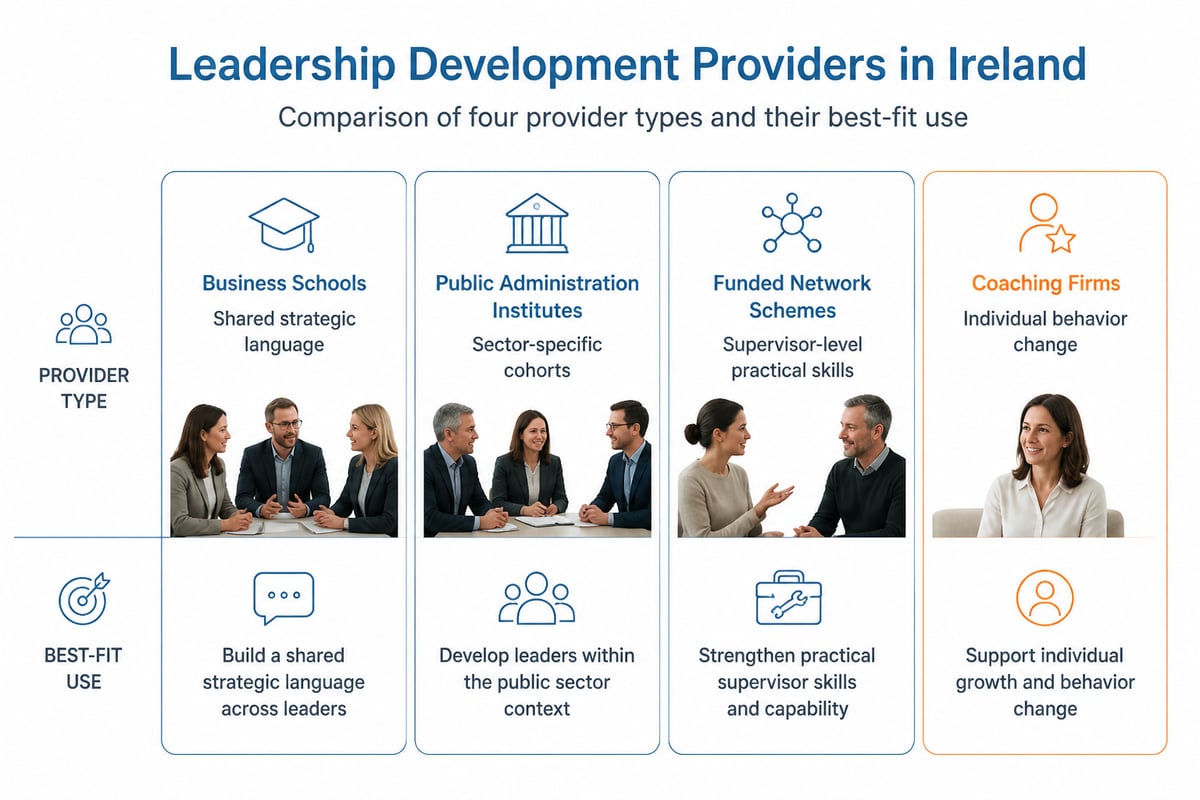
What types of leadership development providers operate in Ireland?
Four provider types dominate the Irish market, and each solves a different problem.
- Business schools and universities. Strong on strategy, finance and general management frameworks. Cohort-based, credentialed, and best for building a shared language across a leadership layer. Weaker at fixing the individual behaviors that block a specific leader.
- Professional and public administration institutes. Typically strongest where the audience is homogeneous, such as senior civil servants or healthcare managers, and where program design can reflect sector rules and accountability structures.
- Network and funded schemes. Subsidized, practical and often aimed at supervisors and first-line managers. Network schemes like Skillnet Ireland support large numbers of businesses and trainees, which shows how much capability-building runs through this channel.
- Coaching firms. One-to-one and small-group delivery, built around the individual leader's context. Best for senior leaders, high-potential successors and anyone whose problem is behavioral rather than informational.
The mistake is treating these as substitutes. A cohort program builds common standards. Coaching changes what a specific leader does on Monday morning. Mature organizations buy both and sequence them.
What is leadership development consulting, and when do you need it?
Leadership development consulting is outside advisory work that diagnoses leadership gaps and designs the interventions to close them, rather than delivering a fixed course. You need it when the problem is organization-specific: a succession bench that is too thin, a culture issue traced to a handful of managers, or a restructure that changed what leaders are accountable for.
A consultant's first deliverable should be a diagnosis, not a catalog. If a provider proposes a program before they have seen assessment data on your leaders, you are buying their product, not solving your problem.
This matters more as capability expectations rise. CIPD Ireland reported that most surveyed organizations planned to increase investment in reskilling and upskilling existing employees to work alongside AI, with Irish organizations more likely to do so than organizations globally. More money is chasing development, and that increases the cost of choosing a provider who cannot demonstrate transfer to the job.
How should leadership development providers in Ireland be compared?
Compare providers on evidence of behavior change, not on content, because content is the one thing every provider can match. Curricula converge. What separates providers is diagnostics, delivery design and measurement.
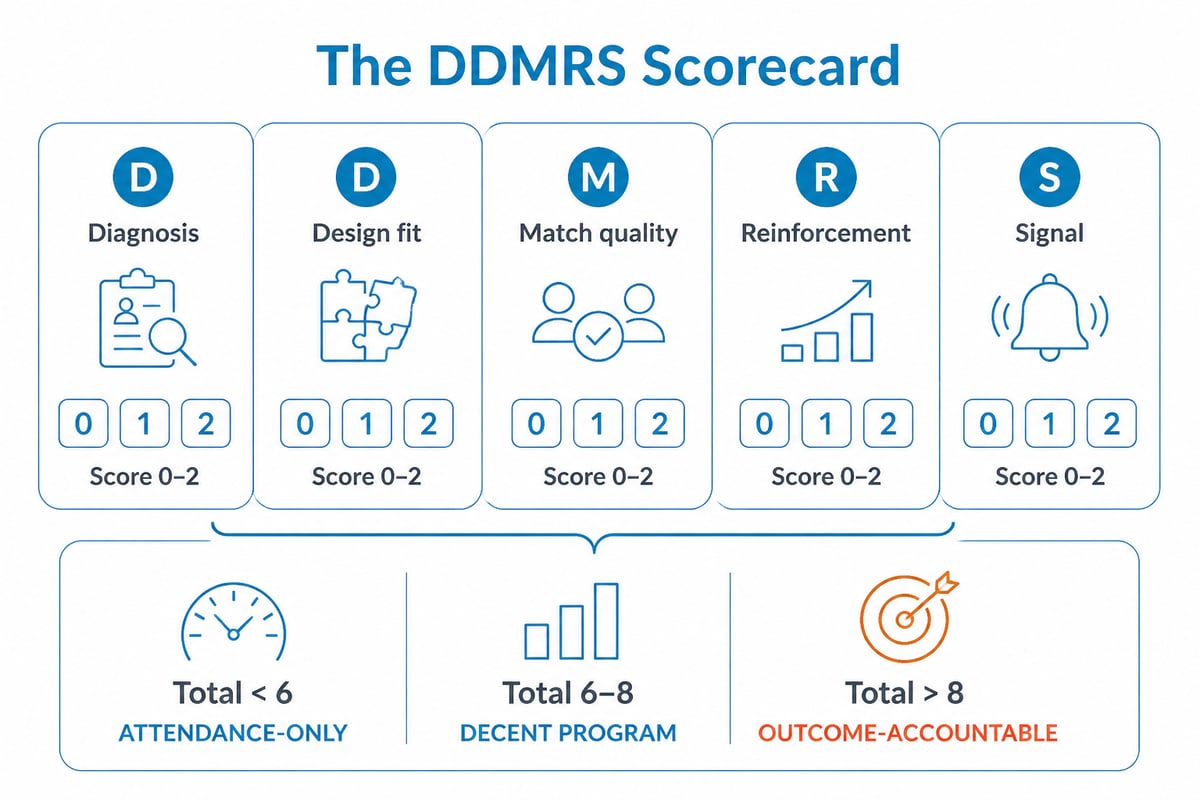
I use a five-test scorecard, which I call the DDMRS test, and score each provider from 0 to 2 on every line:
- Diagnosis. Does the provider assess leaders with validated tools before proposing anything, including 360 feedback?
- Design fit. Is the plan built around named business outcomes, or is it a standard program with your logo on it?
- Match quality. Who delivers? Are facilitators or coaches selected for your sector, level and goals, or assigned from whoever is available?
- Reinforcement. What happens between sessions? Behavior change needs practice and accountability over months, not a two-day event.
- Signal. Will you receive reporting tied to retention, performance and leadership KPIs, on a fixed cadence?
A provider scoring below 6 out of 10 is selling attendance. Between 6 and 8, you are buying a decent program that will need your internal team to carry the transfer. Above 8, the provider is carrying accountability for outcomes alongside you.
Case study: what a strong public sector design looks like
The Irish government's own flagship program is a useful benchmark. The 2024 Senior Public Service Strategic Leadership Programme ran for nine months and combined a 360-degree psychometric exercise, action learning, coaching and masterclasses. It began with 96 participants and was delivered by the Institute of Public Administration with Roffey Park Institute.
Read the structure rather than the brand. Nine months is long enough for behavior to shift. Diagnosis comes first. Coaching and action learning sit alongside the masterclasses instead of being replaced by them. That mix, not any single module, is what you should expect from any provider asking for senior leaders' time.
Which provider type fits which leadership problem?
Match the provider to the problem, because a mismatched format is the most common source of wasted development spend.
| Leadership problem | Best-fit provider type | Why |
|---|---|---|
| New managers promoted without preparation | Funded network program or institute course | Standard skills, scale, lower cost per head |
| Executive team misaligned on strategy | Business school or consulting-led cohort | Shared frameworks and facilitated debate |
| Senior leader with a derailing behavior | Individual coaching | Needs private, specific, repeated practice |
| Thin succession bench for critical roles | Assessment plus coaching, sequenced | Diagnose readiness, then close individual gaps |
| Toxic or low-trust team culture | Coaching with team-level intervention | Pattern sits with specific leaders, not a skills gap |
The pattern worth noticing is that training solves knowledge gaps and coaching solves behavior gaps. Most boardroom complaints about leadership are behavior gaps: avoiding hard conversations, not owning problems, tolerating poor conduct from high performers. Sending those leaders to a workshop produces polite agreement and no change. For a closer look at why programs stall at this point, see this piece on leadership development without behavior change.
Are there free leadership training courses in Ireland?
Yes, free and heavily subsidized leadership training exists in Ireland, mostly through network-funded schemes and public programs, but it is built for breadth rather than depth. These suit supervisors and emerging managers, and they are a sensible use of budget for the first rung of the ladder.
Be clear about what free buys. Subsidized courses typically deliver standard content to mixed cohorts. They rarely include individual diagnostics, matched delivery or ROI reporting. That is fine for foundational skills. It is the wrong tool for a director whose behavior is costing you retention.
The Expert Group on Future Skills Needs report on management skills recommends that firms identify their skills needs and make use of available supports. Follow that sequence. Define the need first, then see which funded options cover it, and spend your own budget on the gap that remains.
Why a course catalog is the wrong starting point
A catalog tells you what a provider sells, not whether it will work for your leaders. Starting there is the conventional approach, and it is the reason so many programs end with strong feedback scores and no measurable change.
Participant satisfaction is the metric providers find easiest to deliver and least useful to you. A leader can rate a workshop 9 out of 10 and return to the same habits. The question for any provider is what changed in observable behavior and who verified it. Ask for the method, not the testimonial.
Two practical consequences follow:
- Insist on pre- and post-measurement. A 360 survey at the start and a repeat at the end gives you a before-and-after picture from the people who work with the leader.
- Pay for outcomes you can inspect. Prefer structures where you approve the delivery plan before committing, and where reporting arrives quarterly rather than at the end.
Where coaching-led providers fit, and what the evidence looks like
Coaching-led providers fit best where the goal is individual behavior change at senior or high-potential level, and where you need proof of impact. Noomii Leadership Coaching works this way for organizations with a leadership quality or succession problem to solve, and its reported results are worth testing against your own scorecard.
Its model hand-matches human coaches by function, level, industry and goals. Coaches are matched to each leader's needs, and organizations can approve the coach selection and development plan before committing. Participants receive a 360 leadership survey, and organizations can receive reporting tied to retention, performance and leadership KPIs.
What it has reported from engagements:
- Problem: A Fortune 1000 international therapeutics company had leaders who stayed in task execution instead of owning problems.
- Diagnosis and solution: Matched coaching built around that shift in accountability.
- Result: Leaders moved from task execution to problem ownership.
- Lesson: Behavior change was framed as a defined target, not a general aspiration to grow.
A second example comes from a Fortune 500 global electronics manufacturer, which re-commissioned coaching engagements because of documented impact. Reported outcomes include observable behavior change in leaders, strong effectiveness ratings for goal alignment, support and accountability, and coordinated delivery across multiple coaches in several countries, which matters if your leadership population in Ireland reports into a wider European or global structure.
For HR and L&D teams that want a structured plan rather than a standalone engagement, Noomii’s Leadership Development Programs are designed with your People team and aligned to business strategy, with pilot programs available. A pilot is a sensible way to test any provider's claims against your own scorecard before scaling. For a view of how this fits wider approaches, the overview of corporate leadership development is a useful companion.
Questions to put to every provider before you sign
Ask these in the first meeting. A provider's answers will tell you more than the proposal does.
- What diagnostic data will you collect from our leaders before you design anything?
- Who exactly will deliver, and how were they selected for our sector and level?
- What happens between sessions to drive practice and accountability?
- How will you report progress, how often, and against which of our KPIs?
- Can you show a client who re-commissioned your work, and why?
- How do you handle conduct issues, such as leaders whose results come at the expense of their teams?
The last question deserves weight. Tolerance of high performers who damage teams is a leadership failure that development spend cannot paper over. Providers should be able to discuss how they address it, and how their work aligns with your governance and compliance expectations. The topic of toxic leadership is worth understanding before you brief anyone.
What are the 7 C's of leadership?
The 7 C's of leadership are a popular teaching framework: competence, confidence, commitment, communication, character, charisma and creativity. Versions vary by author, and none is an Irish or academic standard. Treat it as a conversation starter, not a selection criterion. When assessing a provider, the useful question is not which acronym they teach but how they measure whether a leader's communication or accountability actually changed.
FAQ
What is leadership development consulting?
Leadership development consulting is advisory work that diagnoses an organization's leadership gaps and designs a tailored plan to close them, instead of selling a fixed course. It usually combines assessment, coaching or facilitated programs and measurement against business outcomes.
Are there free leadership training courses in Ireland?
Yes. Subsidized and free options exist through network-funded schemes and public programs, mainly aimed at supervisors and emerging managers. They suit foundational skills but rarely include individual diagnostics or outcome reporting.
What are the 7 C's of leadership?
They are competence, confidence, commitment, communication, character, charisma and creativity. The list is a teaching framework with no formal standard behind it, so use it for discussion rather than as a way to rank providers.

Before your next vendor meeting, score two or three shortlisted providers against the DDMRS test and drop any that cannot show how they will measure behavior change. If you want a second set of eyes on that shortlist, or a pilot that tests the approach on a small group of leaders first, Book a Free Strategy Call with Noomii Leadership Coaching and bring your succession and leadership-quality priorities to the conversation.


Leave a Reply
Want to join the discussion?Feel free to contribute!