
What Gen Z Expects From Managers in 2027: A Guide for Leaders
What Gen Z expects from managers in 2027 comes down to four things: active mentorship, honest and frequent feedback, psychological safety on mental health, and visible connection between daily work and purpose. Many Gen Z employees will not tolerate a manager who only assigns tasks and tracks output, and they are likely to quietly disengage or leave when development stalls.
The stakes are practical. Gen Z is a growing share of first-time managers' direct reports, and the managers they report to were often promoted for technical performance, not for coaching skill. That gap is where retention is won or lost. This guide lays out the expectations, the evidence behind them, and a diagnostic you can apply across your management population.
What Gen Z Wants From Their Manager, in Order of Priority
Gen Z wants a manager who develops them, communicates clearly, protects their well-being, and ties work to purpose. Those four expectations show up consistently in the research, and they rank differently than most leadership teams assume.
Deloitte’s 2025 Gen Z and Millennial Survey drew on 23,482 respondents across 44 countries. Its findings point to a generation that is constantly building skills: 70% of Gen Z respondents said they develop skills to advance their careers at least weekly. They are not waiting for an annual review cycle to learn.
Here is the priority order that the evidence supports:
- Development and mentorship. They expect the manager to be the primary source of career growth, not HR or an LMS.
- Frequent, specific feedback. Quarterly or annual reviews feel too slow to be useful to them.
- Mental health safety. They expect to raise strain without penalty.
- Purpose and meaning. They want to know why the work matters.
- Flexibility with accountability. They want autonomy over how and where, paired with clear outcomes.
Notice what is missing from the top: ping-pong tables, perks, and slogans. Compensation matters, but the manager relationship is what determines whether a Gen Z employee stays after the first eighteen months.
The Mentorship Gap Is the Biggest Risk Most Organizations Carry
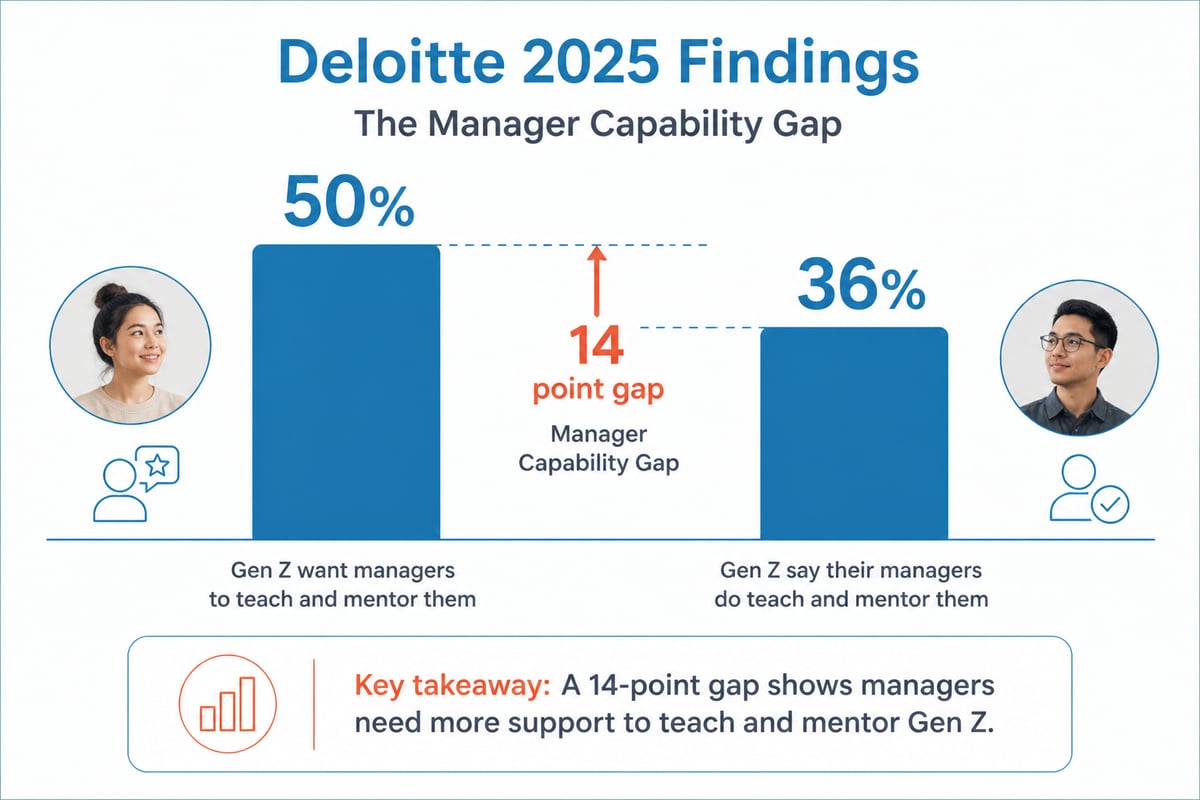
The mentorship gap is the distance between what Gen Z wants from managers and what they receive, and it is wide. According to Deloitte Global, 50% of Gen Z respondents want managers to teach and mentor them, while only 36% said their managers actually do so.
That 14-point gap is not a Gen Z problem. It is a manager capability problem. Forbes’ summary of the Deloitte findings reinforces the point: Gen Z wants practical, applied learning and sees managers as central to it.
Here is the contrarian read most boards need to hear. Organizations keep responding to this gap by buying more learning content. But Gen Z already consumes learning weekly. What they lack is a human who watches them work, names what they did well, and tells them what to do differently on Monday. Content cannot fill that role. Manager behavior can.
Why the gap persists
Three patterns explain it. First, most managers were promoted for individual performance and never trained to coach. Second, span of control has widened, so managers have less time per direct report. Third, many managers learned their craft in an era when mentoring was informal and tenure-based, so they do not know how to do it deliberately.
Companies that treat this as a training-hours problem tend to stall. Those that treat it as a behavior-change problem, with observable standards and follow-up, tend to move the number.
What Gen Z Expects From Managers in 2027 on Feedback and Career Paths
In 2027, Gen Z expects feedback weekly or in real time and a career path that is explicit, not implied. They have little patience for ambiguity about what "good" looks like or what comes next.
Two nuances matter here, and both challenge conventional assumptions.
Gen Z is not uniformly chasing the corner office. Deloitte's research found that only 6% of Gen Z respondents named reaching a senior leadership position as a primary career goal, per Deloitte New Zealand. If your succession model assumes every high performer wants to climb the management ladder, you are building plans around a motivation that most of them do not share. Offer expert tracks, project leadership roles, and lateral moves with real status attached.
Feedback needs to be bidirectional. Gen Z expects to ask questions of their manager's decisions and to be heard when they push back. A manager who treats questions as insubordination will lose them. A manager who explains the reasoning, even when the decision stands, keeps them.
For HR leaders, this has a direct implication for performance management design. The shift toward continuous feedback, and the role AI will play in review processes, is covered in AI and performance reviews: what changes in 2027. The short version: tools can surface data, but the conversation still has to be human and skilled.
Mental Health Is a Manager Competency, Not a Benefit
Gen Z expects their manager to be a safe first point of contact on mental health, and the data shows it is a retention lever. SHRM reports that 61% of Gen Z workers said they would strongly consider leaving their current job for a new one with significantly better mental-health benefits.
Yet benefits alone do not solve the problem. The same SHRM report cites Deloitte's 2024 survey finding that 56% of Gen Z workers feel comfortable discussing mental-health challenges with their managers. That leaves a large minority who do not.
Most organizations respond with an EAP and a wellness app. Those are necessary, but they sit downstream of the real determinant: whether the person's manager makes it safe to say "I am overloaded" before it becomes a resignation letter.
What managers actually need to do is narrow and learnable:
- Ask about workload and energy in one-on-ones, not only status.
- Respond to disclosure with curiosity and adjustment, not judgment or visible discomfort.
- Know the boundary between supportive manager and untrained therapist, and refer appropriately.
- Model sustainable behavior, including taking leave and not sending messages at midnight.
A manager who is abrasive, volatile, or dismissive cancels every wellness investment you make. Addressing those patterns directly matters, and the lessons in insights from reformed toxic leaders are a useful read for people leaders dealing with exactly this.
Purpose Has to Show Up in the Work, Not the Mission Statement
Gen Z expects managers to connect assigned work to a purpose they can see, and 89% of Gen Z respondents told Deloitte Global that a sense of purpose is important to their job satisfaction and well-being.
The mistake leaders make is treating purpose as a brand exercise owned by communications. Purpose for a 24-year-old analyst is local. It is the answer to "who uses what I produce, and what changes because of it?" Only the direct manager can answer that credibly.
This is especially acute in government and regulated sectors, where mission is real but often invisible at the task level. Managers there need to translate public service outcomes into daily relevance. For agencies working through this, executive coaching for government agencies addresses how leadership development can align with mission objectives.
AI fluency is now part of the purpose conversation
Gen Z also expects their managers to be credible on AI. They are using generative tools daily and will notice quickly if their manager cannot discuss how AI changes the work, which tasks are worth automating, and where human judgment still matters. A manager who is defensive or vague about AI loses authority with this cohort. A manager who experiments openly and sets clear norms gains it.

A Diagnostic Framework: The Five-Signal Manager Readiness Check
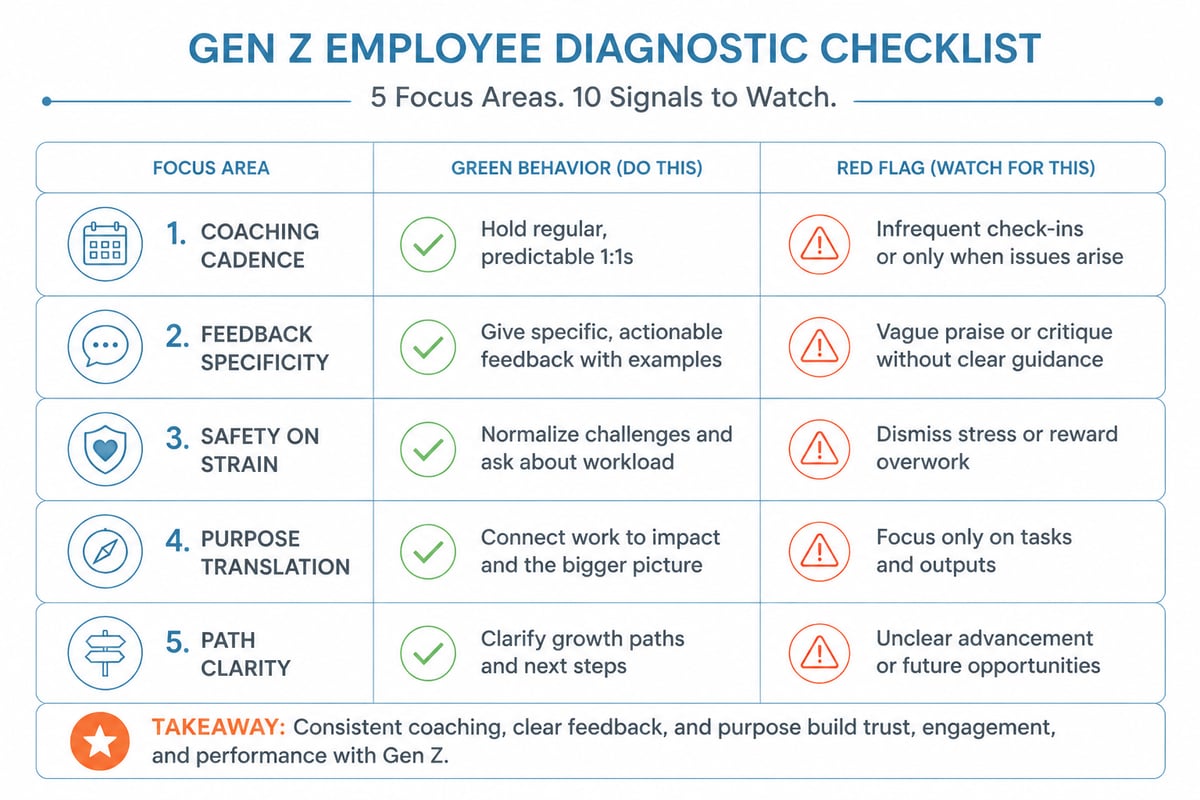
Most organizations measure manager quality through engagement scores that arrive too late. A more useful approach is to check observable behaviors against the expectations above. The following five-signal check is a practical way to audit a manager population before you invest in development.
| Signal | What to observe | Red flag |
|---|---|---|
| Coaching cadence | Frequency and quality of one-on-ones focused on growth | One-on-ones used only for status updates |
| Feedback specificity | Whether direct reports can describe what to repeat and what to change | Feedback arrives only at review time |
| Safety on strain | Whether reports raise workload or well-being issues early | Issues surface only at resignation |
| Purpose translation | Whether reports can state who benefits from their work | Work described only as tasks and deadlines |
| Path clarity | Whether reports know their next two steps, including non-management options | Promotion described as the only path |
Run this through a mix of skip-level conversations, pulse questions, and a structured 360. A 360 is the most direct way to see the gap between how a manager believes they lead and how their reports experience them. Noomii's coaching engagements can begin with a 360 leadership survey, which gives HR a baseline before any development plan is written.
A Pattern From Practice: When Task Managers Become Problem Owners
A recurring pattern in leadership development is that managers who execute tasks well struggle when their reports need coaching rather than direction. The documented outcomes in Noomii's client work illustrate the shift.
Problem: At a Fortune 1000 international therapeutics company, leaders were operating in task-execution mode, handing work down and reviewing output.
Diagnosis: The leaders' skills were technical and they lacked a deliberate habit of owning problems end to end and developing the people around them.
Solution: Hand-matched coaching with development plans tied to leadership KPIs.
Result: Leaders moved from task execution to problem ownership.
Lesson: The behavior Gen Z wants, a manager who owns problems and develops people, is a trainable shift when coaching is matched to the leader's function and level. It does not require replacing the manager.
Across Noomii engagements, leaders have shown observable behavior change, and a Fortune 500 global electronics manufacturer re-commissioned coaching because of documented impact. The point for HR is that behavior change is measurable. If you cannot show movement within two quarters, the program design is wrong.
How to Close the Gap Without Rebuilding Your Whole Leadership Model
Closing the gap means prioritizing, not boiling the ocean. Focus on the managers who supervise the most Gen Z talent in your highest-attrition or highest-value roles first.
A practical sequence:
- Baseline. Run a 360 and pulse survey on the five signals for your target manager group.
- Segment. Separate managers who need skill building from those who need behavior change or role reassessment.
- Match. Pair each leader with development that fits their function, level, and specific gap. Generic workshops rarely change daily behavior.
- Measure. Track retention, internal mobility, and leadership KPIs quarterly, not annually.
- Reinforce. Build the new standards into promotion criteria so that coaching skill is rewarded, not just output.
Customized, measurable leadership development programs designed with your HR or L&D team and aligned to business strategy are one way to run this sequence, and pilots let you test impact before committing broadly. For a view of how the performance bar itself is moving, see what high performance looks like in 2027. And if you need to justify the spend, measuring return on investment from executive coaching covers the metrics that hold up under CFO scrutiny.
One caution: do not frame this as a generational accommodation project. The expectations Gen Z voices, clear feedback, real development, a safe place to flag strain, are the same things that improve performance for every age group. Gen Z simply refuses to tolerate their absence.
FAQ
What is Gen Z's attitude towards work?
Gen Z treats work as a place to build skills and find meaning, not just earn a paycheck. Deloitte's 2025 survey found 70% develop skills at least weekly and 89% say purpose matters to their job satisfaction. They are loyal to managers and environments that invest in them, and quick to leave ones that do not.
What is Gen Z's biggest issue at work?
The most consistent issue is the gap between the mentorship they want and the mentorship they receive. Deloitte found 50% want managers to teach and mentor them while 36% say managers do. Mental health pressure is a close second, with 61% saying they would strongly consider leaving for significantly better mental-health benefits, per SHRM.
Do all Gen Z employees want to become senior leaders?
No. Deloitte New Zealand reports that only 6% of Gen Z respondents named reaching a senior leadership position as a primary career goal. Succession plans should include specialist tracks and project leadership roles, not only the management ladder.
Your next step this week is to pick one high-attrition team and run a short 360 plus skip-level check against the five signals above, so you know which managers need support first. If you want a partner to turn those findings into a measurable plan, Noomii matches human coaches to each leader and can report on ROI tied to retention and performance KPIs, and its Leadership Development Programs can be piloted before you scale. You can Book a Free Strategy Call with Noomii Leadership Coaching to map out the right starting point for your managers.


Leave a Reply
Want to join the discussion?Feel free to contribute!