

Coaching Budget Benchmarks for 2027: Real Allocations
Most organizations approach coaching budget benchmarks for 2027 with outdated assumptions carried over from pre-pandemic allocations. The reality is that executive coaching spend has fundamentally shifted in both scale and distribution since 2024, driven by leadership failures that boards can no longer tolerate and compliance pressures that make reactive fixes prohibitively expensive. If you are still sizing your coaching budget as a simple percentage of headcount or a fixed per-leader allocation, you are missing the structural changes reshaping how sophisticated organizations fund, deploy, and measure leadership development investments.
The New Baseline: What Organizations Actually Spend
Recent SHRM benchmarking data on L&D spend shows enterprise organizations allocating between $1,450 and $2,100 per employee annually on total learning and development in 2026, with coaching representing 12% to 18% of that total. That translates to approximately $174 to $378 per employee specifically for coaching interventions.
But aggregate averages obscure the decisive question: how much are you allocating by leadership tier?
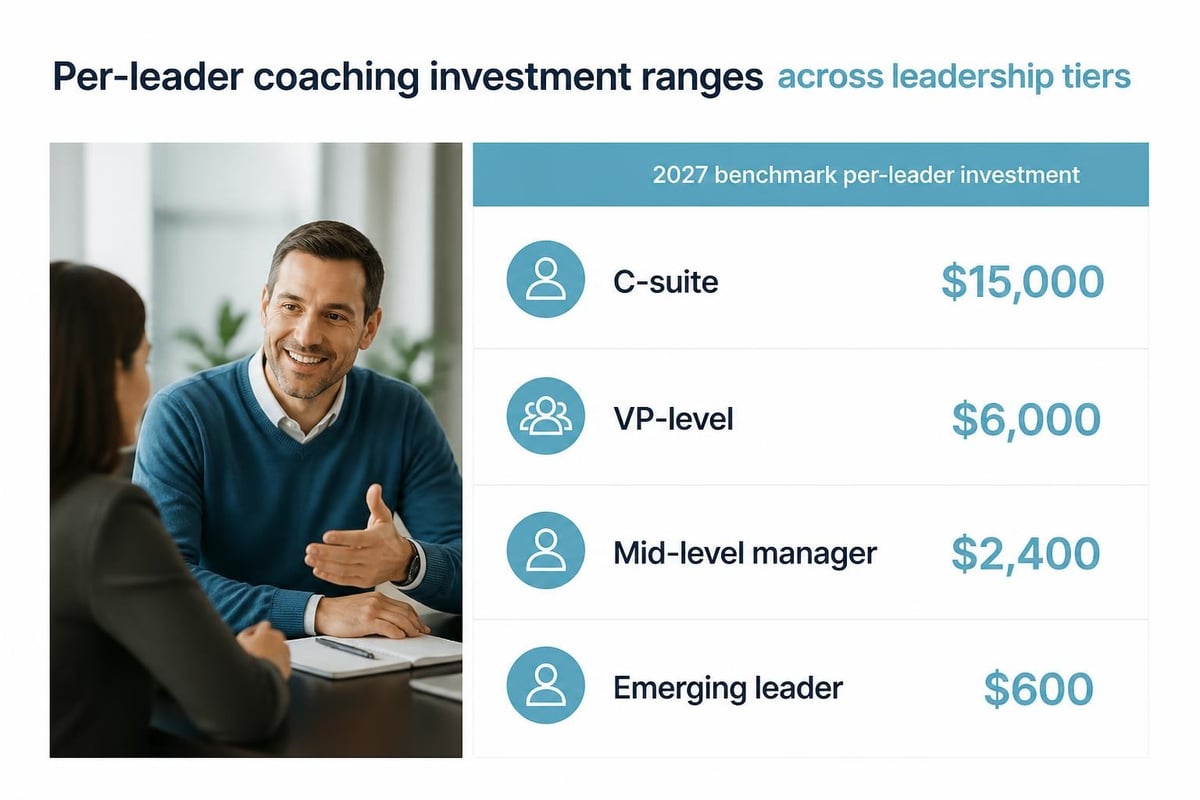
Organizations that treat coaching as strategic rather than remedial allocate differently:
- C-suite and direct reports: $8,000 to $15,000 per executive annually
- Vice presidents and senior directors: $4,500 to $7,500 per leader
- Mid-level managers: $1,200 to $2,800 per manager
- Emerging leaders: $600 to $1,500 per participant
These figures reflect blended rates combining internal coaching resources, external executive coaches, and digital coaching platforms. The distributions matter more than the totals because they reveal organizational priorities and risk tolerance.
Industry and Sector Variances
Coaching budget benchmarks for 2027 diverge significantly by sector, reflecting different risk profiles, regulatory environments, and leadership complexity.
| Sector | Per-Employee Coaching Investment | Coaching as % of L&D Budget |
|---|---|---|
| Financial services | $420 – $580 | 16% – 19% |
| Healthcare | $310 – $490 | 14% – 17% |
| Technology | $380 – $550 | 15% – 18% |
| Manufacturing | $240 – $390 | 11% – 14% |
| Government | $280 – $410 | 12% – 15% |
| Non-profit | $180 – $310 | 10% – 13% |
Financial services organizations allocate more aggressively because regulatory scrutiny and fiduciary accountability make leadership failures catastrophically expensive. Healthcare systems face similar pressures from patient safety standards and clinical governance requirements.
The 2026 failure of a regional health system's executive team to address toxic leadership cost the organization $14 million in turnover, legal settlements, and remediation, a figure that would have funded comprehensive coaching for their entire leadership cohort for seven years. That calculus is reshaping budget conversations.
Internal Versus External Coaching Mix
The most consequential benchmarking decision is not total budget size but the ratio between internal coaching capacity and external expertise. The Conference Board’s executive coaching dashboard reveals that high-performing organizations maintain a 60:40 to 70:30 external-to-internal coaching split, contrary to the conventional wisdom that internal programs deliver better ROI.
Why external coaching dominates strategic allocations:
Internal coaches excel at organizational context and cultural fluency but face inherent conflicts when coaching leaders on sensitive issues: board relations, peer conflicts, succession positioning, and performance concerns about other internal stakeholders. External coaches provide the psychological safety and confidentiality required for authentic executive development.
Organizations running lean internal teams supplement with external coaches for specialized needs:
- Executive transitions (new C-suite hires, promotions to VP)
- Crisis interventions (toxic behavior remediation, team dysfunction)
- Strategic capability building (M&A integration leadership, transformation)
- Regulatory and compliance (governance, ethics, risk management)
The internal team handles high-volume, lower-complexity coaching at the manager tier while external resources address high-stakes, high-complexity executive needs.
Staffing Ratios That Work
Benchmarking internal coaching capacity requires understanding realistic coach-to-leader ratios. Best-practice organizations staff one full-time internal coach per 180 to 220 leaders (director level and above), supplemented by HR business partners providing coaching-light support to frontline managers.
A 5,000-employee organization with 400 director-plus leaders typically maintains:
- 2-3 full-time internal coaches (handling 60-80 engagements annually)
- External coach panel of 8-12 coaches (handling 40-60 engagements annually)
- Digital coaching platform (supporting 100-150 mid-level managers)
This architecture balances coverage, cost, and capability while allowing the internal team to focus on organizational knowledge transfer and the external panel to deliver specialized expertise.
How Leading Organizations Size 2027 Budgets
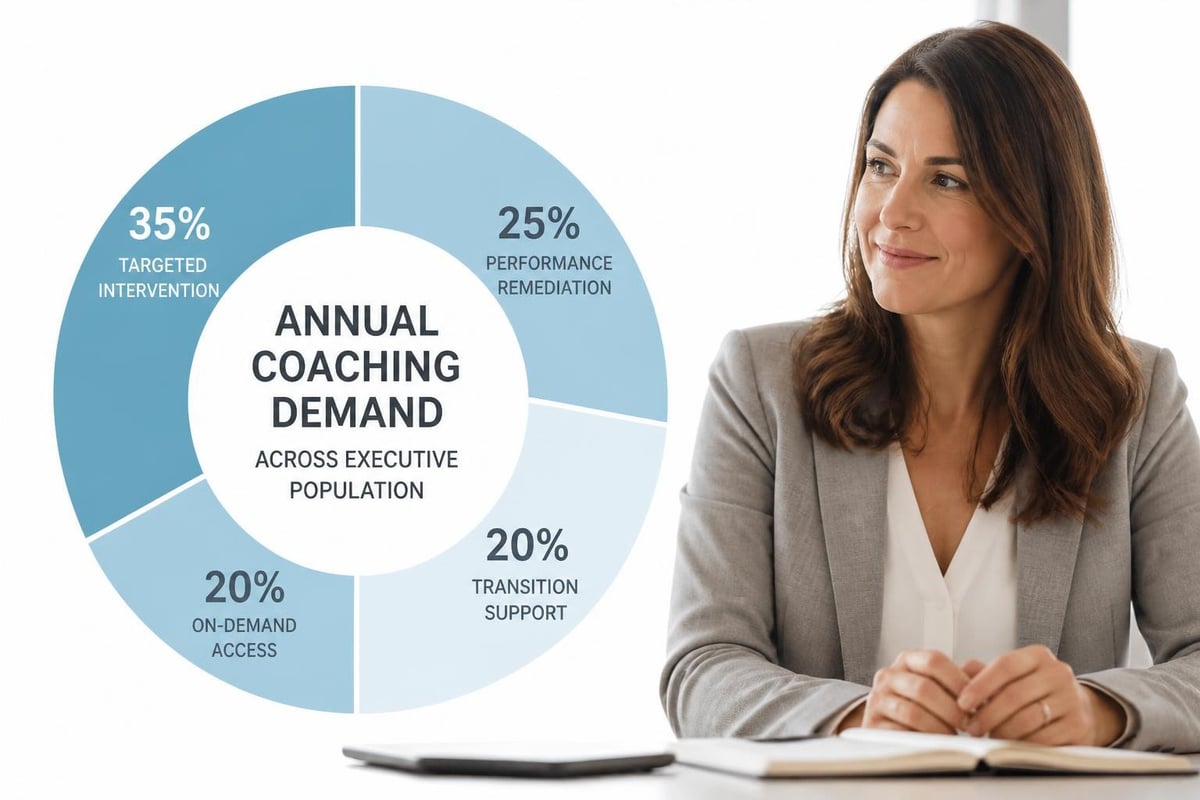
The most rigorous approach to coaching budget benchmarks for 2027 builds from leadership population analysis, not top-down percentage allocations. Start with a diagnostic question: What percentage of your leadership population requires coaching intervention annually?
Data from government and Fortune 500 deployments shows:
- 15% to 22% of executives need targeted coaching each year
- 8% to 12% face performance or behavioral issues requiring intervention
- 25% to 35% of newly promoted leaders benefit from transition coaching
- 40% to 60% of manager-tier leaders value access to on-demand coaching
Calculating Your Baseline Allocation
A practical budgeting framework for a 3,000-employee organization with 240 director-plus leaders:
Executive Tier (40 leaders)
- 18 targeted engagements × $10,000 average = $180,000
- 6 crisis interventions × $15,000 average = $90,000
- Subtotal: $270,000
Director/Senior Manager Tier (200 leaders)
- 35 targeted engagements × $5,500 average = $192,500
- 50 transition coaching engagements × $3,200 average = $160,000
- Subtotal: $352,500
Mid-Manager Tier (digital platform access)
- 350 managers × $800 annual platform fee = $280,000
- Subtotal: $280,000
Total Coaching Budget: $902,500
Per-employee investment: $301
Coaching as % of $1,800 L&D budget: 16.7%
This bottom-up calculation aligns with LEADx benchmarking research on leadership development budgets while reflecting actual deployment patterns rather than aspirational percentages.
Red Flags in Coaching Budget Allocation
After analyzing coaching deployments across technology firms, manufacturing operations, and government agencies, certain budget patterns reliably predict poor outcomes:
Underfunding executive coaching while overfunding classroom training. Organizations spending less than 10% of their L&D budget on coaching while allocating 40%+ to instructor-led programs consistently struggle with leadership effectiveness. Classroom training builds knowledge; coaching changes behavior.
Uniform per-leader allocations regardless of role complexity. Allocating identical coaching budgets to frontline supervisors and C-suite executives signals a fundamental misunderstanding of leadership development economics. A $2,000 coaching engagement may transform a manager; it barely moves the needle for an executive whose decisions affect hundreds of millions in enterprise value.
Reactive-only budgeting with no prevention allocation. If your entire coaching budget activates only when performance issues surface or crises emerge, you are paying premium rates for remediation while missing the opportunity to prevent problems. High-performing organizations allocate 60% to 70% of coaching budgets to proactive development and 30% to 40% to intervention.
No measurement framework tied to budget allocation. Coaching budget benchmarks for 2027 mean nothing without ROI visibility. Organizations that cannot articulate expected returns, key performance indicators, or success metrics for their coaching investments are essentially operating on faith rather than evidence.
Benchmarking ROI and Impact Metrics
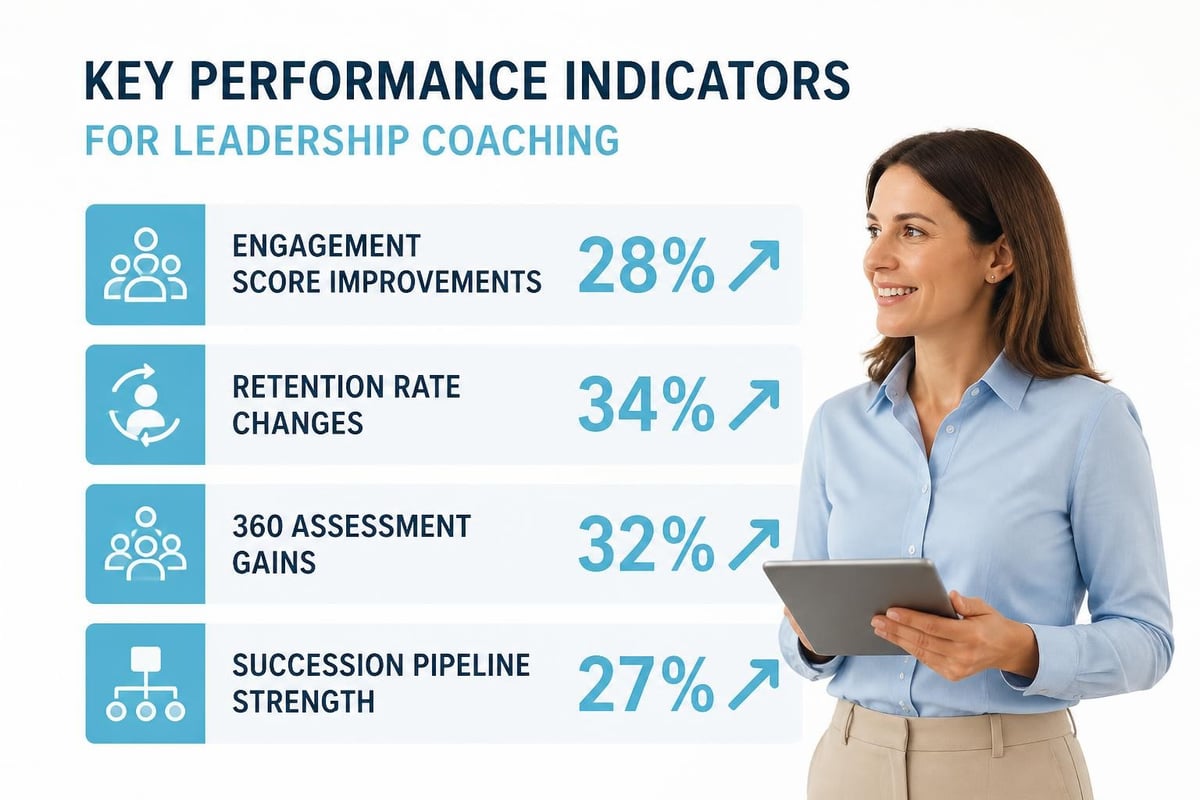
Heidrick & Struggles research on measuring leadership development impact confirms what sophisticated CHROs already know: coaching ROI exceeds training ROI by a factor of 3x to 6x when properly measured. But measurement requires defining success before deployment, not after.
Leading indicators tracked by high-performing programs:
- Engagement scores for coached leaders' direct reports (target: +12 to +18 points)
- Retention rates for coached executives (target: 15% to 25% improvement vs. non-coached peers)
- 360 assessment improvement in targeted competencies (target: +0.8 to +1.2 points on 5-point scale)
- Time to productivity for newly promoted leaders (target: 25% to 40% reduction)
Lagging indicators that justify continued investment:
- Succession pipeline strength (percentage of critical roles with ready-now successors)
- Leadership-driven turnover reduction (separations attributed to poor leadership)
- Regulatory and compliance incidents (governance failures, ethics violations)
The most rigorous programs tie coaching outcomes to financial metrics: revenue per leader, cost of leadership turnover, and value created or protected through better executive decision-making.
What Boards Actually Want to See
Board-level scrutiny of leadership development spend has intensified since 2024. Audit committees and governance committees now regularly review coaching investments, particularly for CEO and C-suite development. They ask sharp questions:
- What percentage of executive coaching addresses performance deficits versus strategic capability building?
- How does coaching investment correlate with succession readiness?
- What is our cost per avoided leadership failure?
Organizations that cannot answer these questions face budget pressure. Those that can answer with data often receive increased allocations because boards recognize coaching as risk mitigation, not just development spend.
Building Your 2027 Budget: A Contrarian Approach
Conventional guidance tells you to benchmark against industry averages and size your coaching budget as a percentage of total L&D spend. That approach produces mediocre results because it anchors to what other organizations do rather than what your organization needs.
Start with leadership risk assessment instead. Identify your ten highest-risk leadership scenarios:
- Key executive departure
- Toxic leader damaging team performance
- Failed executive hire
- Leadership team dysfunction blocking strategy execution
- Compliance or governance failure
- Critical succession gap
- M&A integration leadership breakdown
- Transformation initiative stalling due to leadership capability gaps
- High-potential leader derailment
- Board-CEO relationship deterioration
Assign probability and impact to each scenario. Calculate the financial consequence of occurrence. Then ask: What coaching investment would reduce probability or mitigate impact?
This risk-based approach typically produces coaching budgets 30% to 50% larger than industry-average benchmarks, but the investment makes sense when framed against the cost of leadership failure. A $1.2 million coaching budget looks expensive until you compare it to the $8 million cost of a failed C-suite hire or the $15 million impact of a toxic executive destroying a business unit.
Structural Trends Reshaping 2027 Allocations
Several macro trends are forcing organizations to reconsider coaching budget benchmarks for 2027 beyond traditional benchmarking:
AI augmentation of coaching delivery. Digital coaching platforms now incorporate generative AI for practice conversations, scenario planning, and developmental feedback between live coaching sessions. This technology reduces the cost of mid-tier coaching by 40% to 60% while maintaining effectiveness, allowing organizations to extend coaching access deeper into the management ranks without proportional budget increases.
Compliance-driven coaching mandates. Financial services, healthcare, and government organizations increasingly face regulatory expectations around leadership accountability and conduct. Proactive coaching on governance, ethics, and risk management is shifting from optional to required, forcing budget reallocations.
Leadership durability crisis. Average executive tenure continues declining, from 5.3 years in 2020 to 4.6 years in 2026. Organizations are responding with intensive onboarding coaching for new executives, typically $12,000 to $18,000 per hire during the first six months. This specialized need was barely budgeted three years ago; it now represents 15% to 20% of executive coaching spend.
Hybrid work complexity. Leading distributed teams requires different capabilities than leading co-located teams. Deloitte’s human capital trends research shows that 68% of organizations increased coaching budgets specifically to address hybrid leadership challenges, a category that did not exist in pre-2023 budgets.
These structural shifts mean that simple year-over-year percentage increases miss the underlying changes in how coaching budgets must be allocated to address current organizational reality.
Industry-Specific Benchmarking Considerations
Generic coaching budget benchmarks for 2027 fail to account for the distinct leadership challenges and risk profiles across sectors. Real-world deployment experience reveals what actually matters by industry:
Financial Services and Fintech: Regulatory complexity and fiduciary responsibility drive premium allocations. Expect to invest 18% to 22% of L&D budgets on coaching, with heavy emphasis on executive transitions, governance, and ethical decision-making. Crisis intervention budgets must be larger because the cost of leadership failure includes regulatory penalties and reputational damage that dwarfs typical business consequences.
Healthcare Systems: Clinical leadership requires coaches who understand both healthcare operations and people leadership. Budget for specialized expertise, which costs 20% to 30% more than generalist executive coaching. Physician leader development represents a distinct budget category because physicians require different coaching approaches than administrative leaders.
Technology Companies: High-growth tech firms face leadership scalability challenges. Budget for intensive manager development because your management population expands faster than your executive population. Allocate 25% to 35% of coaching budgets to first-time manager transitions.
Manufacturing and Industrial: Operational leadership coaching must connect to safety, quality, and efficiency metrics. Budget for coaches with operational backgrounds, not just leadership development credentials. Front-line supervisor coaching often delivers higher ROI than executive coaching in manufacturing contexts.
Government Agencies: Mission complexity and stakeholder accountability require coaches who understand public sector leadership challenges. Budget cycles and procurement processes add 15% to 25% to effective costs through administrative overhead. Plan for longer vendor selection and contracting timelines.
Practical Budget Architecture for 2027
The most effective coaching budgets separate funding into distinct categories rather than treating all coaching as fungible:
| Budget Category | % of Total | Purpose | Deployment Model |
|---|---|---|---|
| Executive Development | 35-40% | Proactive C-suite and VP coaching | External coaches, 6-12 month engagements |
| Performance Intervention | 20-25% | Remediation and crisis response | External specialists, variable duration |
| Transition Support | 15-20% | Onboarding and promotion coaching | Blended internal/external, 3-6 months |
| Manager Development | 15-20% | Frontline and mid-manager capacity | Digital platforms, internal coaches |
| Reserve/Contingency | 10-15% | Unplanned needs and pilots | Flexible deployment |
This architecture prevents the common problem of performance crises consuming the entire coaching budget and crowding out proactive development. It also creates flexibility for emerging needs while maintaining strategic focus.
Vendor and Platform Economics
Understanding rate structures prevents budget surprises. Current market rates for 2026-2027:
- Elite executive coaches (Fortune 500 CEO-level): $800-$1,200 per hour
- Senior executive coaches (C-suite, VP): $400-$650 per hour
- Experienced business coaches (Director, Senior Manager): $250-$400 per hour
- Internal coach fully-loaded cost: $145,000-$185,000 annually
- Digital coaching platforms: $600-$1,200 per user annually
Engagement models matter as much as hourly rates. A six-month executive coaching engagement typically includes:
- 12-15 coaching sessions
- Pre-engagement assessment
- Stakeholder interviews
- Development planning
- Progress reviews
- Closeout assessment
Total investment ranges from $9,000 to $15,000 depending on coach seniority and organizational complexity.
Future-Proofing Your Coaching Investment
Organizations building coaching budget benchmarks for 2027 must account for accelerating change in leadership requirements. The capabilities executives needed in 2024 inadequately prepare them for 2027 challenges: AI integration, workforce transformation, stakeholder capitalism, and geopolitical complexity.
Budget for capability building, not just remediation. High-performing organizations allocate at least 65% of coaching budgets to developing future capabilities rather than fixing current performance gaps. This forward-looking investment prevents the expensive cycle of reactive coaching when new challenges inevitably surface.
Build coaching into your talent architecture, not your training catalog. The most sophisticated organizations integrate coaching into succession planning, high-potential development, and executive onboarding as standard components rather than optional add-ons. This structural integration typically increases coaching budgets by 40% to 60% but delivers proportionally higher returns through systematic rather than sporadic deployment.
Measure what matters, not what is easy. Completion rates and satisfaction scores tell you almost nothing about coaching effectiveness. Track behavior change, business impact, and organizational outcomes. Budget 3% to 5% of your total coaching investment for measurement infrastructure, assessment tools, and analytics capability. Organizations that measure rigorously can defend and grow their coaching budgets; those that cannot face perpetual skepticism.
Frequently Asked Questions
What should coaching represent as a percentage of total L&D budget in 2027?
For organizations serious about leadership effectiveness, coaching should represent 12% to 18% of total learning and development spend, with financial services and healthcare sectors trending toward the higher end due to regulatory complexity and leadership risk. However, percentage allocations matter less than whether your coaching investment aligns with your leadership risk profile and strategic priorities.
How much should we budget per executive for coaching?
C-suite and senior VP coaching typically requires $8,000 to $15,000 per executive annually for meaningful impact. VP and senior director level coaching ranges from $4,500 to $7,500 per leader. Mid-level managers can be effectively supported with $1,200 to $2,800 per person through a combination of external coaching and digital platforms. Organizations spending significantly less than these ranges should question whether they are actually funding coaching or just checking a box.
Should we build internal coaching capacity or rely on external coaches?
Maintain a 60:40 to 70:30 external-to-internal coaching split for executive tiers. External coaches provide the confidentiality and specialized expertise required for sensitive executive issues, while internal coaches deliver organizational context and cost efficiency for manager-level development. The internal coaching team should focus on high-volume, lower-complexity work while external resources handle high-stakes executive needs.
How do we calculate ROI on coaching investments?
Track leading indicators like engagement scores for coached leaders' direct reports, retention rates for coached executives, and 360 assessment improvements in targeted competencies. Connect these to lagging indicators including succession pipeline strength, leadership-driven turnover reduction, and avoided costs of leadership failures. Organizations that quantify the cost of a failed executive hire or toxic leader can easily demonstrate positive ROI when coaching prevents these outcomes.
What are the biggest mistakes in coaching budget allocation?
Underfunding executive coaching while overfunding classroom training, treating all leadership tiers identically in per-leader allocations, operating with reactive-only budgets that have no prevention allocation, and failing to establish measurement frameworks before deployment. These patterns reliably predict poor outcomes and make budget defense difficult when scrutiny increases.
Coaching budget benchmarks for 2027 require moving beyond simplistic percentage allocations to risk-based investment frameworks that align coaching deployment with your specific leadership challenges and organizational priorities. Organizations that benchmark rigorously while budgeting strategically create sustainable competitive advantage through superior leadership capability. Noomii Leadership Coaching helps organizations design evidence-based coaching strategies that deliver measurable results through precision coach matching, leadership diagnostics, and scalable deployment models aligned with your budget realities and business objectives.


Leave a Reply
Want to join the discussion?Feel free to contribute!