
The Corporate Coaching Industry Myth Exposed
The corporate coaching industry myth persists across boardrooms and HR departments: hire a certified coach, schedule weekly sessions, and watch transformation unfold. Companies invest tens of thousands expecting measurable business outcomes, only to discover six months later that nothing fundamentally changed. The myth survives because it conflates credentials with capability, conversation with implementation, and theory with results.
The Certification Delusion
The corporate coaching industry myth begins with credential worship. Organizations assume ICF or EMCC badges guarantee quality, but professional regulation remains voluntary and inconsistent across the coaching marketplace.
Here's what certification actually proves:
- Completion of specific training hours
- Familiarity with theoretical models
- Ability to pass supervised assessments
- Adherence to ethical frameworks
What certification doesn't prove: ability to diagnose organizational dysfunction, implement change in real business environments, or tie coaching to revenue, retention, or efficiency metrics.
I've watched dozens of highly credentialed coaches run abstract exercises while operations teams miss quarterly targets. The certification told the buyer nothing about whether the coach could diagnose why deals stalled in pipeline stage three or why manager turnover spiked in the Dallas office.
The Gap Between Talking and Doing
Traditional coaching operates at a safe distance from actual business operations. Coaches meet executives in conference rooms, explore leadership philosophies, and assign reflection exercises. Meanwhile, the executive returns to dysfunctional meetings, unclear KPIs, and teams that can't execute priorities.
The corporate coaching industry myth assumes this separation works. It doesn't.

Real transformation happens when coaches work inside your operations, not adjacent to them. That means sitting in your leadership meetings, observing how decisions stall, diagnosing communication breakdowns in real time, and building accountability structures that survive after the coach leaves.
Evidence Versus Marketing Claims
A comprehensive meta-analysis of workplace coaching reveals methodological problems across coaching effectiveness research. Studies often lack control groups, rely on self-reported satisfaction rather than business metrics, and conflate correlation with causation.
The myth thrives because buyers don't demand proof. They accept testimonials, case studies without verifiable metrics, and vague promises of "leadership development" without defining what developed leadership actually produces.
| Myth Claim | Reality Check |
|---|---|
| Coaching guarantees ROI | ROI depends on implementation quality, organizational readiness, and measurement rigor |
| All coaches deliver similar value | Effectiveness varies wildly based on business experience, diagnostic skill, and accountability structure |
| Longer engagements mean better results | Duration matters less than intensity, integration, and measurement cadence |
| Certifications predict outcomes | No evidence links credential type to measurable business performance improvement |
When we work with mid-market companies, we establish clear KPIs before engagement begins. Revenue per sales rep. Manager retention rates. Decision cycle time. Customer acquisition cost. If coaching doesn't move these numbers, it failed regardless of how many insights emerged in private sessions.
The Technology Distraction
The corporate coaching industry myth now includes a technology chapter: AI will either destroy coaching or scale it infinitely. Both claims miss the point.
AI and digital tools are reshaping learning operations, but they don't replace diagnostic expertise in complex organizational systems. A global survey on digital and AI coaching trends shows practitioners remain skeptical about AI handling nuanced leadership challenges.
The real question isn't human versus machine. It's whether the coaching, regardless of delivery method, integrates with actual business operations and produces measurable outcomes.
We've seen companies buy expensive AI coaching platforms that employees ignore because the content doesn't connect to their specific operational challenges. We've also seen simple weekly accountability check-ins drive 30% improvement in priority completion because they forced real behavioral change.
What Buyers Miss
The corporate coaching industry myth survives because buyers focus on the wrong signals during vendor selection:
- Credentials over track record in similar organizational contexts
- Coaching philosophy over implementation methodology
- Session volume over outcome metrics
- Theoretical frameworks over diagnostic processes
- Personality fit over business acumen
Smart buyers ask different questions. Show me three clients where you improved specific KPIs. Walk me through how you diagnose why our managers can't coach their teams. Explain your process for embedding accountability that survives your departure. What happens if we don't see measurable progress in 90 days?
Executive coaches who can't answer these questions clearly rely on the myth to close business.

The One-Size-Fits-All Fallacy
SHRM’s critical perspective on executive coaching argues the field must evolve beyond universal solutions. The corporate coaching industry myth assumes every executive, team, and organization needs roughly the same intervention.
This ignores obvious reality. A VP struggling with strategic thinking needs different support than a director who can't delegate. A team with trust issues requires different facilitation than a team that can't prioritize. Leadership training doesn’t automatically create leaders when the training ignores specific organizational context.
Effective coaching starts with accurate diagnosis:
- What's actually broken versus what leadership thinks is broken
- Which problems coaching can solve versus which need operational or structural fixes
- Whether the organization can implement recommended changes
- How to measure progress using existing business metrics
We lost a deal last quarter because the prospect wanted feel-good leadership development workshops. They didn't want to hear that their real problem was an unclear operating cadence and conflicting KPIs across departments. Six months later, they called back after burning budget on workshops that changed nothing.
The ROI Reality
Understanding the ROI of coaching requires honest measurement and clear attribution. The corporate coaching industry myth suggests ROI is either automatic or impossible to measure. Neither is true.
ROI becomes measurable when coaching ties directly to business metrics you already track. Reduce manager turnover from 25% to 15%. Increase sales team quota attainment from 60% to 75%. Cut decision cycle time from six weeks to three. Improve employee engagement scores from 3.2 to 4.1.
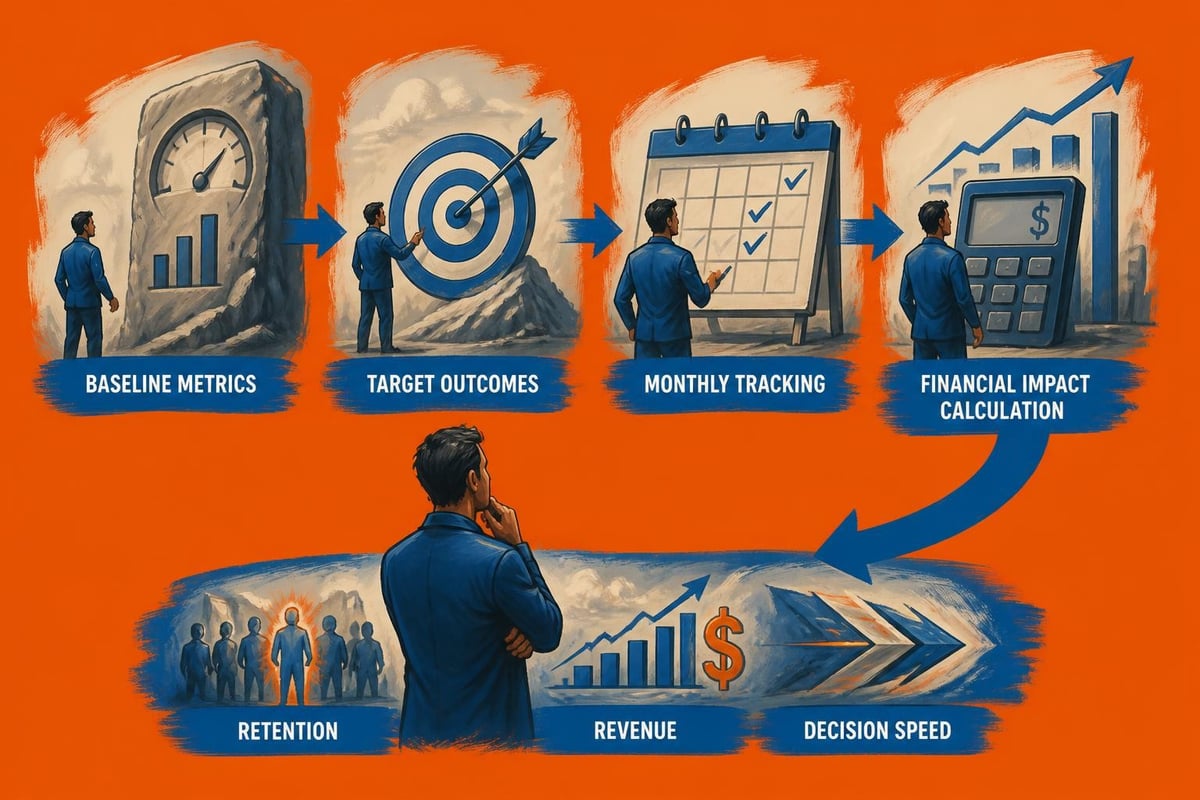
The formula is straightforward:
- Identify the business metric coaching should improve
- Establish baseline performance
- Define target improvement
- Measure progress monthly
- Calculate financial impact of the improvement
If your coach can't help you complete this process, you're buying the myth instead of results.
Moving Beyond the Myth
The corporate coaching industry myth collapses when organizations demand what they should have required from the beginning: coaches who understand business operations, diagnose root causes accurately, implement solutions inside real workflows, and prove results through clear metrics.
This doesn't mean coaching lacks value. It means most coaching as currently delivered fails to capture available value because it operates outside business reality. Understanding distinctions between mentors, sponsors, and coaches helps organizations match intervention type to actual need.
Month-to-month terms force accountability that multi-year contracts obscure. When coaches share risk through performance incentives, everyone focuses on outcomes instead of activity. When sessions happen inside leadership meetings instead of private offices, implementation becomes immediate instead of theoretical.
The myth persists because it's comfortable for everyone. Coaches avoid accountability for business results. Buyers avoid the hard work of defining clear success metrics. HR avoids challenging executives about real performance gaps.
Breaking the myth requires uncomfortable honesty about what's actually broken, what fixing it requires, and how you'll know when it's working. Most organizations aren't ready for that conversation, which explains why the corporate coaching industry myth will likely survive another decade despite mounting evidence of its limitations.
The corporate coaching industry myth crumbles when organizations demand measurable business outcomes instead of accepting credentials and theory as proxies for results. Noomii Corporate Coaching works month-to-month inside your actual operations, coaching live in meetings, establishing clear KPIs, and tying every engagement to visible ROI. If you're ready to move beyond the myth and build accountable leaders who deliver measurable business results, explore how Noomii can help your organization execute priorities with clarity and speed.
Frequently Asked Questions
What is the corporate coaching industry myth?
The corporate coaching industry myth is the belief that hiring certified coaches for regular sessions automatically delivers business transformation. In reality, results depend on accurate diagnosis, live implementation inside operations, clear KPI tracking, and rigorous measurement of business outcomes rather than credentials or conversation volume.
Why do coaching credentials fail to predict results?
Coaching credentials verify training completion and theoretical knowledge but don't prove ability to diagnose organizational dysfunction, implement change in complex business environments, or tie coaching to measurable metrics like revenue, retention, or efficiency. Business acumen and implementation skill matter more than certification type.
How can companies measure coaching ROI accurately?
Measure coaching ROI by identifying specific business metrics the coaching should improve, establishing baseline performance, defining target outcomes, tracking progress monthly, and calculating the financial impact of improvements. Effective metrics include manager retention rates, sales quota attainment, decision cycle time, and employee engagement scores.
What's the difference between traditional coaching and implementation-focused coaching?
Traditional coaching operates through private sessions separate from business operations, focusing on reflection and theory. Implementation-focused coaching embeds inside actual meetings, decision processes, and team operations, diagnosing problems in real time and building accountability structures that drive measurable business outcomes.
Should companies use AI coaching tools or human coaches?
The choice between AI tools and human coaches matters less than whether the coaching integrates with actual business operations and produces measurable outcomes. AI tools work for scalable content delivery but struggle with complex organizational diagnosis. Human coaches add value when they bring business acumen and can implement solutions inside real workflows.
What questions should buyers ask when selecting corporate coaches?
Ask coaches to show measurable KPI improvements in similar organizational contexts, explain their diagnostic methodology for specific business problems, describe their process for embedding accountability after engagement ends, and clarify what happens if measurable progress doesn't appear within 90 days.
Why do long-term coaching contracts often fail?
Long-term contracts reduce accountability by guaranteeing payment regardless of results. Month-to-month terms force continuous demonstration of value and keep focus on measurable outcomes. Duration matters less than implementation quality, measurement rigor, and whether the coaching addresses actual business priorities.
How does coaching differ from mentorship and sponsorship?
Coaching focuses on building specific capabilities through structured intervention and accountability. Mentorship provides guidance based on shared experience. Sponsorship actively advocates for career advancement. Organizations often need all three but should match the intervention type to the actual developmental need rather than defaulting to coaching.
What makes coaching fail in corporate environments?
Coaching fails when it operates separately from business operations, focuses on abstract development instead of specific performance gaps, lacks clear measurement tied to business KPIs, relies on credentials instead of diagnostic skill, or continues indefinitely without demonstrating measurable improvement in priority outcomes.



Leave a Reply
Want to join the discussion?Feel free to contribute!