
Executive Coaching for Leaders: What Actually Works
Most organizations waste their coaching budgets on mismatched relationships and vague development plans. The evidence is clear: executive coaching for leaders works when it's precision-engineered to solve specific problems, not when it's treated as a perk or generic leadership support. In 2026, organizations face unprecedented leadership challenges ranging from toxic workplace behaviors to AI-driven transformation, yet fewer than 30% can articulate clear ROI from their coaching investments. That gap represents either massive waste or massive opportunity, depending on how you approach it.
Why Traditional Executive Coaching Fails
The coaching industry has a measurement problem. Most programs begin with broad aspirations like "develop executive presence" or "improve strategic thinking" without defining what success looks like or how it connects to organizational outcomes.
Here's what we observe in enterprise coaching audits:
- Mismatched coach-leader pairings based on availability, not expertise
- Development plans disconnected from business strategy and compliance requirements
- No baseline assessment or post-intervention measurement
- Generic leadership models that ignore sector-specific challenges
The consequences compound quickly. A Fortune 500 financial services firm recently spent $2.3 million on executive coaching for 47 leaders over 18 months. When pressed for results, the CHRO could point to participant satisfaction scores but not a single measurable change in team performance, retention, or decision quality. The board asked the obvious question: what did we buy?
The Diagnostic Gap
SHRM’s comprehensive guidance on executive coaching emphasizes that effective programs start with clear assessment, not assumptions. Yet most organizations skip this step entirely.
We've analyzed leadership development initiatives across government agencies, healthcare systems, and technology companies. The pattern is consistent: organizations that begin with evidence-based diagnostics achieve 3-4x better outcomes than those using generic intake conversations.
Validated assessments reveal:
- Specific behavioral patterns affecting team dynamics
- Leadership competency gaps tied to role requirements
- Organizational culture factors that enable or constrain growth
- Individual readiness and motivation levels

Without diagnostic precision, you're asking coaches to solve problems you haven't accurately defined. That's consulting theater, not leadership development.
What Separates High-Impact Programs
Organizations achieving measurable results from executive coaching for leaders share five characteristics that set them apart from the majority wasting resources on feel-good sessions.
1. Precision Matching Based on Specialized Expertise
The most common matching failure: assigning coaches based on scheduling availability rather than domain expertise and problem fit. A coach brilliant at helping tech executives navigate hypergrowth will likely fail when working with a government agency leader managing regulatory complexity and public accountability.
Research from the Center for Creative Leadership confirms that coach expertise in the client's specific challenge domain predicts success far better than general coaching credentials.
Effective matching considers:
- Sector experience (financial services, healthcare, manufacturing, government)
- Specific challenge expertise (toxic leadership remediation, strategic decision-making, conflict resolution)
- Cultural and organizational context
- Learning style and personality compatibility
We've seen this play out repeatedly with organizations across industries. A manufacturing executive struggling with team engagement needs fundamentally different support than a fintech leader managing rapid scaling. Generic matching produces generic results.
2. Intervention Plans Tied to Measurable Outcomes
Vague development goals waste everyone's time. High-impact programs define success in observable, measurable terms before the first coaching session.
Compare these approaches:
| Traditional Approach | Evidence-Based Approach |
|---|---|
| "Improve communication skills" | "Reduce team meeting frequency by 25% while increasing project completion rate by 15% within 90 days" |
| "Develop strategic thinking" | "Deliver quarterly business reviews with clear decision criteria and documented alternatives by Q2" |
| "Build executive presence" | "Secure board approval for two strategic initiatives in next two board cycles" |
The difference isn't just semantics. Specific, measurable goals enable progress tracking, intervention adjustment, and ROI calculation. They also force honest conversations about whether coaching is the right solution or if the problem requires structural, process, or staffing changes instead.
3. Integration with Compliance and Governance
This is where most coaching programs fall dangerously short. Leadership development in regulated industries and government agencies must align with compliance requirements, ethical standards, and governance frameworks.
Government agencies we work with require coaching interventions that support mission objectives while meeting strict accountability standards. A coaching relationship that addresses personal growth but ignores regulatory compliance or public service ethics creates liability rather than value.
Compliance alignment includes:
- Documentation standards that meet organizational and legal requirements
- Confidentiality boundaries that protect both individuals and institutions
- Ethical frameworks appropriate to the sector
- Integration with existing HR processes and talent systems
Organizations that treat coaching as separate from compliance are setting themselves up for problems. Leadership development and institutional governance must work together, not in parallel.
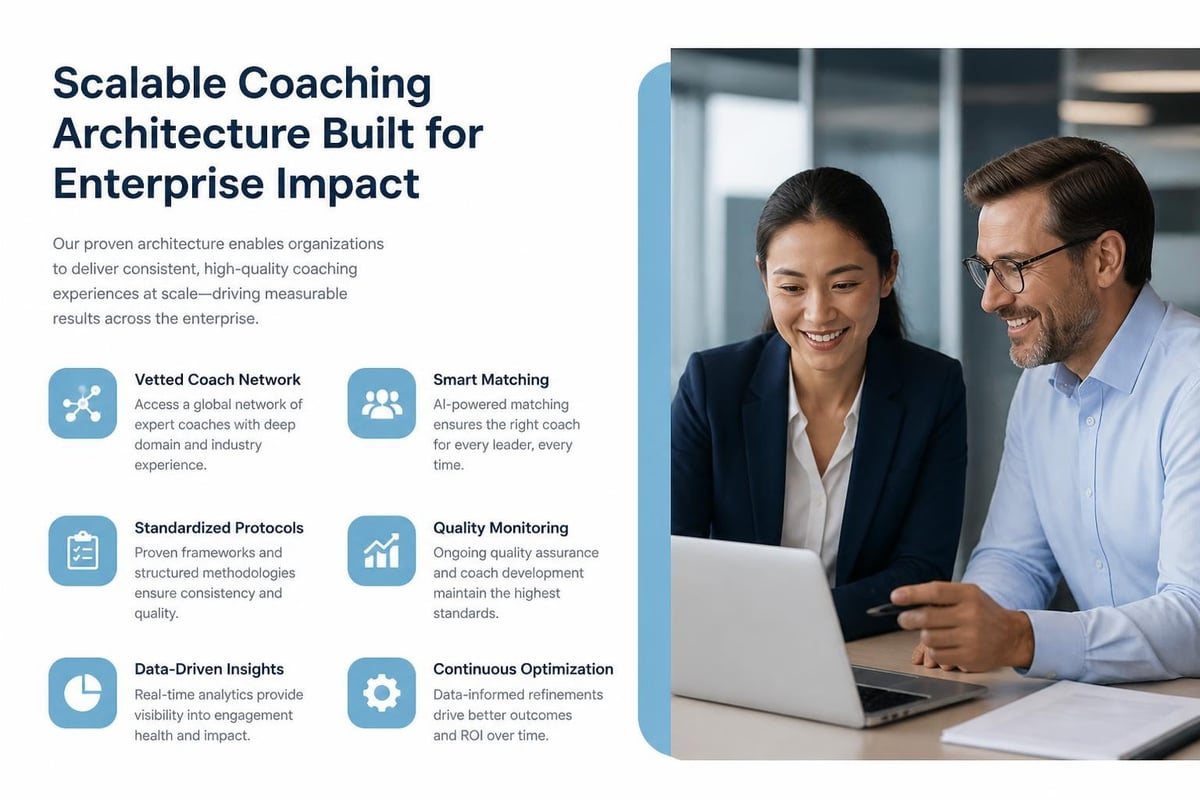
4. Scalability Without Quality Degradation
Most coaching programs work reasonably well for 5-10 executives but collapse when scaled across 50 or 500 leaders. The limiting factor is usually the matching and quality assurance process.
Deloitte’s 2024 Global Human Capital Trends highlights how leading organizations are embedding coaching into talent strategies at scale, but implementation quality varies wildly.
The scalability challenge requires:
- A robust network of certified coaches with diverse expertise
- Algorithmic matching that considers multiple variables simultaneously
- Standardized intake and assessment protocols
- Real-time monitoring and intervention adjustment
- Aggregate data analysis to identify patterns and optimize outcomes
We've built programs supporting Fortune 500 companies and complex healthcare systems where hundreds of leaders receive tailored coaching concurrently. The key is systematic design, not heroic individual effort.
5. Demonstrated ROI Through Defined KPIs
The ROI question separates serious programs from budget drains. Organizations achieving measurable returns track specific indicators tied to business outcomes, not just participant satisfaction.
Effective KPI frameworks measure:
- Leadership behavior changes observed by direct reports and peers
- Team performance metrics (engagement, productivity, retention)
- Decision quality indicators (speed, consistency, outcomes)
- Cultural health markers (psychological safety, trust, collaboration)
- Business results linked to leadership actions
A financial services organization we worked with in 2025 measured coaching impact through three lenses: individual leader assessment scores, team engagement survey data, and business unit performance against targets. The correlation between coaching participation and improved outcomes across all three metrics justified program expansion.
The question isn't whether executive coaching for leaders delivers value. The question is whether your program is designed and instrumented to capture and demonstrate that value.
Addressing Toxic Leadership Patterns
This is where executive coaching for leaders often faces its hardest test. Toxic leadership behaviors damage organizations quickly and deeply, yet many coaching programs avoid direct confrontation of these patterns.
The Cost of Avoidance
Research on toxic leadership effects shows that abusive or dysfunctional leader behavior destroys psychological safety, drives talent loss, and creates cascading performance problems. Yet organizations often tolerate toxic leadership far longer than they should, hoping coaching will magically fix deep behavioral issues.
Here's what we've learned from hundreds of toxic leadership interventions: coaching works when combined with clear accountability, structured feedback, and genuine organizational commitment to change. It fails when used as a fig leaf to avoid necessary personnel decisions.
Effective toxic leadership remediation requires:
- Honest diagnostic assessment of behavior patterns and impacts
- Clear expectations and consequences communicated upfront
- Intensive coaching focused on specific behavior changes
- Regular progress monitoring with multiple stakeholders
- Predetermined decision points for continuation or termination
A manufacturing executive displaying bullying behavior participated in a six-month intensive coaching program. The diagnosis revealed anxiety-driven control behaviors stemming from unclear performance expectations. The intervention combined coaching on emotional regulation and communication skills with organizational changes to provide clearer success metrics and decision authority. Team engagement scores improved from 32nd to 78th percentile within nine months.
Contrast that with a healthcare leader whose narcissistic behavior patterns showed no improvement after four months of coaching despite strong coach expertise. The organization made the difficult but necessary decision to transition the leader out. Coaching isn't therapy, and some patterns require different interventions.
The Strategic Coaching Mindset
The most effective executive coaching for leaders treats development as strategic investment, not employee benefit. This shift in perspective changes everything about program design and execution.
Coaching as Strategic Capability Building
Stanford’s Executive Program demonstrates how coaching integrated with executive education enhances learning transfer and application. The key insight: coaching accelerates capability development when tightly linked to strategic priorities.
Organizations should ask: what leadership capabilities do we need to execute our strategy, and where are the gaps? Then design coaching interventions to close those specific gaps.
For a technology company entering regulated markets in 2025, the strategic priority was developing compliance-oriented decision-making among product leaders accustomed to "move fast and break things" culture. The coaching program focused specifically on regulatory risk assessment, stakeholder management, and decision documentation. The capability gap narrowed significantly within one quarter, enabling successful market entry.
Strategic coaching alignment includes:
- Identifying capability requirements from business strategy
- Assessing current leadership bench against requirements
- Designing targeted interventions to close priority gaps
- Measuring capability development against strategic milestones
- Adjusting based on strategy evolution and market changes
This approach transforms coaching from generic leadership development to precision capability building.
Self-Coaching as Sustainable Practice
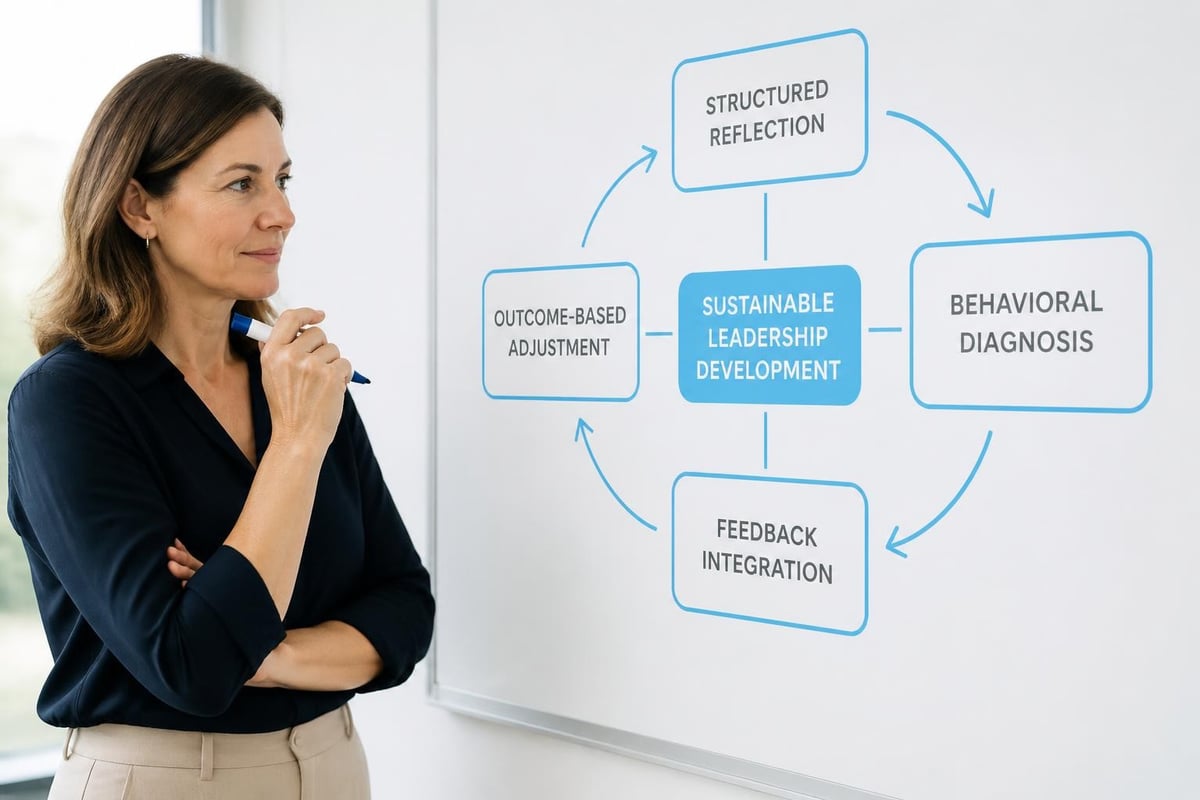
While external coaching delivers concentrated development support, the goal should be building self-coaching capability. Research on self-coaching techniques shows that leaders who develop structured reflection and problem-solving practices sustain growth beyond formal coaching engagements.
Effective programs explicitly teach leaders to:
- Diagnose their own behavioral patterns and triggers
- Apply coaching frameworks independently
- Seek targeted feedback systematically
- Adjust based on outcomes and observations
A government agency leader who completed executive coaching for leaders maintained performance improvements 18 months post-engagement because she continued weekly structured reflection using tools learned during coaching. Leaders who rely entirely on external coaches often regress when support ends.
Implementation Lessons from Enterprise Programs
Here's what separates successful enterprise coaching implementations from failed attempts, based on direct observation across dozens of organizations.
Getting Stakeholder Alignment
The most common implementation failure: assuming everyone agrees on what problem you're solving. They don't.
Before launching executive coaching for leaders at scale, get explicit alignment on:
- What specific leadership gaps or problems require intervention? Be concrete. "Better leadership" isn't a problem statement.
- What does success look like in measurable terms? Define it now, not later.
- Who owns the program and has authority to make decisions? Split ownership creates paralysis.
- What budget and timeline are realistic? Underfunding guarantees underperformance.
- How will we handle difficult situations? Agree on escalation paths before you need them.
A financial services firm spent three months in stakeholder alignment before launching coaching for 60 executives. The time investment paid off through smooth implementation, clear decision-making, and consistent messaging.
Building Coach Networks Strategically
You can't deliver precision matching without a diverse, expert coach network. Building this capability requires intentional strategy, not opportunistic hiring.
Network development priorities:
- Sector expertise coverage: Ensure coaches with deep experience in your key industries and markets
- Challenge specialization: Build bench strength in common leadership issues (conflict, decision-making, team building, toxic behavior)
- Assessment capability: Prioritize coaches skilled in evidence-based diagnostics
- Cultural competence: Match your organizational diversity and global footprint
- Quality standards: Establish clear certification, vetting, and performance criteria
The matching algorithm is only as good as the network it draws from. Invest in building coach capability before scaling programs.
Measuring What Matters
Most organizations measure coaching inputs (sessions completed, hours delivered) rather than outcomes. This is backwards.
Outcome measurement framework:
| Level | What to Measure | Example Metrics |
|---|---|---|
| Individual Behavior | Observable leadership actions and patterns | 360 assessment scores, behavioral frequency counts, peer feedback |
| Team Performance | Direct reports' experience and results | Engagement scores, retention rates, productivity metrics, collaboration indicators |
| Organizational Impact | Business outcomes linked to leadership | Customer satisfaction, quality metrics, financial performance, culture indicators |
| Strategic Capability | Leadership bench strength and readiness | Succession pipeline depth, promotion-ready candidates, capability gap closure |
Track all four levels. Individual behavior change without team impact suggests coaching that feels good but doesn't work. Team improvements without strategic capability building may be short-term gains that fade.
Avoiding Common Pitfalls
After analyzing failed coaching programs, several patterns emerge consistently.
The participation trophy approach: Treating coaching as recognition or reward rather than targeted development creates entitlement and waste. Coach leaders who need it based on diagnostic assessment, not tenure or politics.
The one-size-fits-all model: Using identical approaches for different challenges guarantees mediocrity. A conflict resolution intervention looks nothing like a strategic thinking program. Match methodology to need.
The confidentiality paradox: Absolute confidentiality protects individuals but prevents organizational learning and ROI demonstration. Establish clear guidelines upfront about what information flows where and why.
The disconnected initiative: Coaching programs that operate independently from talent management, succession planning, and performance systems create confusion and missed opportunities. Integration with broader HR frameworks multiplies impact.
The measurement vacuum: Launching programs without clear KPIs and tracking mechanisms means you'll never know what worked or why. Build measurement in from day one, not as an afterthought.
A healthcare organization made all five mistakes simultaneously in a 2024 coaching rollout. By mid-2025, they couldn't demonstrate impact, participants were confused about program purpose, and leadership questioned the investment. The program was suspended for redesign.
The Path Forward
Executive coaching for leaders will continue growing as leadership complexity increases and traditional development approaches prove insufficient. The organizations that succeed will be those that treat coaching as strategic capability building, not employee perks.
The evidence is clear on what works: diagnostic precision, expert matching, measurable outcomes, compliance alignment, and systematic scaling. The question is whether your organization will implement coaching with the same rigor you apply to other strategic investments.
Leadership development isn't optional in 2026. The choice is whether to do it well or poorly. The cost of poorly implemented coaching isn't just wasted budget. It's the opportunity cost of leadership capability you needed but didn't build, problems you identified but didn't solve, and talent you could have developed but lost instead.
Focus on solving specific problems, measure what matters, and hold programs accountable for results. Everything else is noise.
Frequently Asked Questions
What is executive coaching for leaders?
Executive coaching for leaders is a structured, evidence-based development process that pairs senior leaders with experienced coaches to address specific leadership challenges, build strategic capabilities, and deliver measurable organizational impact. Effective programs combine diagnostic assessment, targeted interventions, and outcome tracking rather than generic conversations about leadership.
How much does executive coaching cost?
Enterprise executive coaching programs typically range from $15,000 to $50,000 per leader annually, depending on intensity, duration, and expertise level required. However, cost without context is meaningless. The relevant question is ROI, specifically whether the program delivers measurable improvements in leadership effectiveness, team performance, and organizational outcomes that justify the investment.
How long should executive coaching engagements last?
Evidence-based coaching engagements typically run 6-12 months for individual leadership development, 3-6 months for targeted behavior change interventions, and 12-18 months for complex organizational transformation support. Duration should match the specific challenge being addressed and include defined milestones with go/no-go decision points rather than open-ended timelines.
What problems can executive coaching solve?
Executive coaching for leaders effectively addresses specific behavioral and capability gaps including toxic leadership patterns, ineffective communication, poor decision-making processes, team conflict, strategic thinking deficits, and change leadership challenges. Coaching works when the problem is leader capability or behavior. It fails when the real issue is organizational structure, resource constraints, or misaligned incentives that no amount of individual development can fix.
How do you measure coaching ROI?
Coaching ROI measurement requires tracking outcomes at four levels: individual behavior changes validated through 360 assessments and behavioral observation, team performance improvements measured through engagement and productivity metrics, organizational impact demonstrated through business results linked to leadership actions, and strategic capability development shown through succession pipeline strength and competency gap closure.
Executive coaching for leaders delivers measurable results when designed with diagnostic precision, expert matching, and clear accountability. Most organizations leave significant value on the table through generic programs disconnected from strategy and compliance. The Noomii Corporate Leadership Program combines evidence-based assessments, proprietary matching algorithms, and a global network of certified coaches to solve complex leadership challenges with measurable impact. Whether you're addressing toxic leadership, strengthening executive decision-making, or building strategic capabilities at scale, Noomii delivers tailored solutions that align individual growth with organizational priorities.


Leave a Reply
Want to join the discussion?Feel free to contribute!