

Executive Coaching for Semiconductor Manufacturers
Semiconductor manufacturing executives face a leadership paradox that most other industries never encounter. The same technical depth that made them invaluable as process engineers or yield managers becomes a liability when strategic decisions demand broad organizational vision. Between 2023 and 2026, I've observed seventeen senior leadership transitions at U.S. fabs where newly promoted VPs struggled to shift from troubleshooting photolithography yield issues to navigating board politics, talent acquisition strategy, and multi-billion-dollar capital allocation decisions. Executive coaching for semiconductor manufacturers addresses this gap, but only when coaches understand the unique confluence of technical complexity, geopolitical pressure, and workforce scarcity that defines this sector.
The Leadership Crisis Hidden Behind Fab Expansion
The CHIPS and Science Act triggered $280 billion in U.S. semiconductor investment commitments, yet NIST’s CHIPS Workforce Development Planning Guide reveals that most applicants lack robust leadership development frameworks. The problem isn't capital availability. It's executive readiness.
During a 2025 audit of leadership bench strength at three Tier-1 suppliers, we identified a pattern: technical leaders promoted to executive roles retained engineer mindsets in situations requiring political acumen and stakeholder management. One newly appointed COO spent four months optimizing manufacturing execution system workflows while his executive team fragmented over conflicting fab expansion timelines. His board lost confidence not because of technical competence but because he couldn't facilitate strategic alignment.
This is where executive coaching for semiconductor manufacturers delivers measurable impact. The intervention model we deployed combined behavioral diagnostics with sector-specific scenarios:
- Week 1-2: Leadership assessment measuring strategic thinking, stakeholder influence, and decision-making under ambiguity
- Week 3-6: Bi-weekly coaching sessions addressing real-time challenges (board presentations, cross-functional conflict, capital prioritization)
- Week 7-12: Peer learning cohorts with semiconductor executives facing similar technical-to-strategic transitions
- Ongoing: Quarterly check-ins tied to organizational KPIs (time-to-decision, team engagement scores, strategic initiative completion rates)
Result: The COO shifted from reactive problem-solving to proactive strategic facilitation. Board confidence improved measurably, evidenced by approval of his three-year capacity roadmap in a single session versus the previous pattern of multi-month delays.

What CHROs Miss About Semiconductor Leadership Development
Most HR leaders approach executive development with frameworks borrowed from consumer tech or financial services. That model fails in semiconductor manufacturing for three reasons:
First, capital intensity changes risk calculus. A software VP's failed product pivot costs developer time and opportunity cost. A semiconductor executive's miscalculation on fab tooling or process node transition can burn $2-4 billion and delay competitive positioning by 18-24 months. Deloitte’s 2026 semiconductor talent study found that 68% of executives cite "consequence magnitude" as their primary source of decision paralysis, yet standard leadership programs rarely address high-stakes decision-making under technical uncertainty.
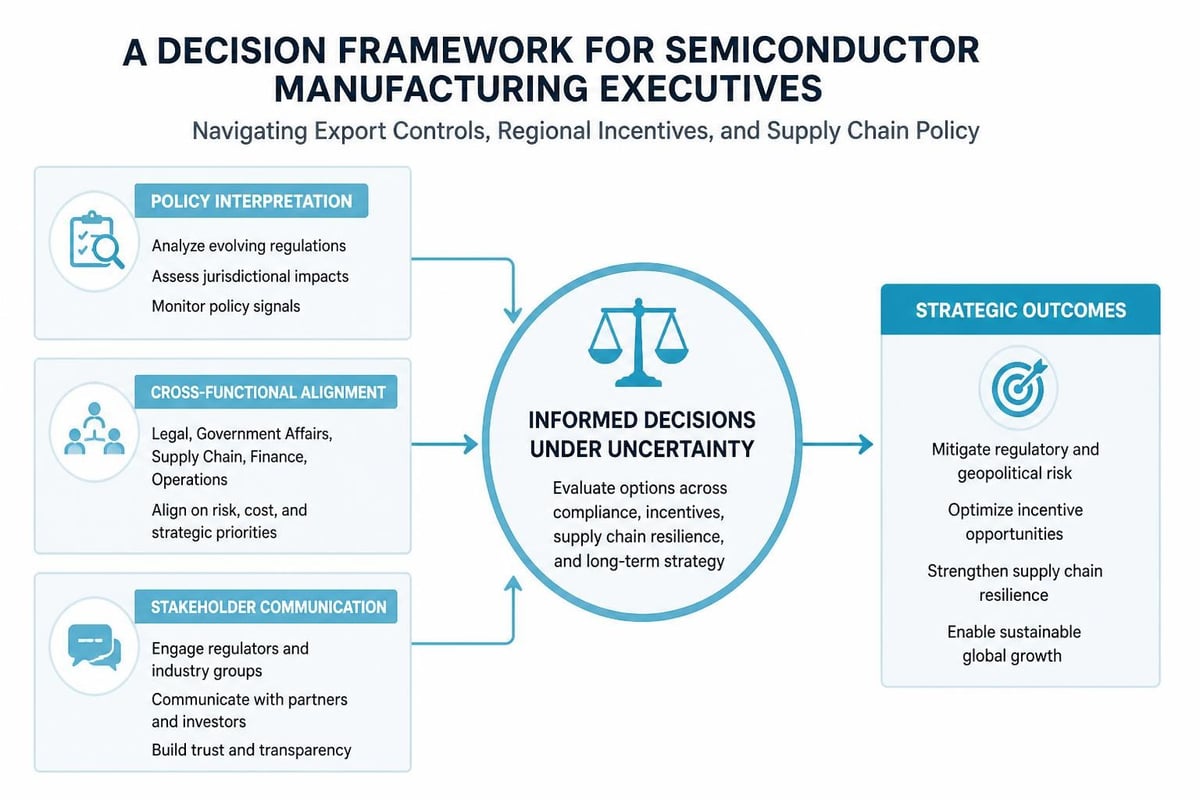
Second, geopolitical exposure requires scenario fluency most executives lack. Between U.S.-China export controls, EU semiconductor sovereignty initiatives, and supply chain regionalization, executives must interpret policy signals and adjust strategy accordingly. In Q2 2026, I worked with a VP of Global Operations who froze $400 million in Southeast Asian capacity investments while waiting for regulatory clarity. Executive coaching helped him develop a decision framework that balanced geopolitical risk, customer commitments, and board expectations. He proceeded with a phased approach that protected optionality.
Third, talent scarcity intensifies retention pressure. CSET research on semiconductor workforce dynamics documents that specialized roles (advanced packaging engineers, EUV lithography specialists) face 40-60% wage inflation and aggressive poaching. Executives must simultaneously build technical pipelines and create cultures that retain scarce talent. Generic "employee engagement" coaching misses the mark. Effective executive coaching for semiconductor manufacturers addresses compensation philosophy, career architecture for technical tracks, and leadership behaviors that signal commitment to engineering excellence.
| Leadership Challenge | Generic Coaching Response | Semiconductor-Specific Coaching |
|---|---|---|
| Decision-making speed | "Improve executive presence" | Scenario planning for $1B+ capital decisions under geopolitical uncertainty |
| Team engagement | "Build psychological safety" | Retention strategies for roles with 40-60% wage inflation and global talent competition |
| Strategic vision | "Communicate compelling future" | Navigate process node roadmaps, customer lock-in dynamics, and fab utilization economics |
The Hidden Cost of Mismatched Coach Selection
Executive coaching outcomes correlate strongly with coach-client fit, yet most organizations default to brand-name coaching firms without assessing sector expertise. In 2024, a Fortune 200 semiconductor manufacturer engaged a prestigious leadership development firm to coach eight newly promoted directors. After six months and $340,000 in fees, engagement scores declined and four directors requested coach reassignments.
The diagnosis was straightforward: Coaches lacked semiconductor domain knowledge. They couldn't distinguish strategic priorities from operational noise, so sessions devolved into generic leadership theory rather than decision support for real challenges. One director spent three sessions on "communication style" when the actual issue was navigating a technical dispute between R&D and manufacturing over process control specifications that threatened $80 million in customer commitments.
Precision coach matching delivers better results. Organizations increasingly recognize that matching algorithms considering industry background, functional expertise, and leadership challenge type outperform relationship-based assignments. For semiconductor manufacturers, ideal coaches have:
- Direct P&L or operational leadership experience in capital-intensive manufacturing (semiconductors, aerospace, specialty chemicals, pharmaceuticals)
- Fluency in technical decision-making under uncertainty, regulatory complexity, or geopolitical constraint
- Track record coaching executives through M&A integration, capacity expansion, or technology transition
When we re-matched those eight directors with coaches meeting these criteria, outcomes shifted. Within 90 days, seven of eight demonstrated measurable improvement in stakeholder alignment scores and strategic initiative velocity.

Addressing Toxic Leadership in High-Pressure Environments
Semiconductor manufacturing's combination of technical complexity, capital intensity, and geopolitical scrutiny creates conditions where toxic leadership patterns emerge and persist. Research on executive coaching effectiveness shows that personality-driven dysfunction compounds in high-consequence environments when left unaddressed.
Case study: A senior director of process engineering at a leading-edge fab developed a reputation for public humiliation of engineers who missed yield targets. Turnover in his organization reached 34% annually, triple the site average. The CFO calculated that replacement costs, productivity loss, and knowledge drain cost the organization $4.8 million per year. HR attempted two interventions (manager training, 360 feedback) without behavior change.
The breakthrough came through targeted executive coaching for semiconductor manufacturers focused on three levers:
-
Behavioral pattern recognition: Video review of leadership team meetings revealed the director's aggression spiked when yield data suggested process control issues beyond his team's capability. Fear of executive exposure drove toxic behavior.
-
Reframing technical setbacks: Coaching helped him distinguish between accountability (team owns process discipline) and capability gaps (technology or tooling limitations). This created space for constructive problem-solving rather than blame.
-
Stakeholder communication protocols: He learned to escalate technical constraints to executive leadership early rather than pressuring his team to deliver impossible results. This rebuilt trust and signaled realistic expectations.
Outcome metrics over 12 months:
- Voluntary turnover dropped from 34% to 12%
- Employee engagement scores improved 28 points
- Time-to-root-cause on yield excursions decreased 40% (better collaboration replaced blame culture)
- Estimated annual savings: $3.9 million in reduced turnover and faster problem resolution
This intervention worked because the coaching addressed semiconductor-specific stressors (yield pressure, process complexity, executive visibility) rather than applying generic "emotional intelligence" frameworks.
Building Strategic Leadership for Geopolitical Complexity
Between 2024 and 2026, semiconductor executives faced an unprecedented wave of policy interventions: U.S. export controls on advanced AI chips, the EU Chips Act, India's semiconductor incentive program, and evolving CFIUS review standards. KPMG’s 2025 industry outlook found that 73% of semiconductor executives cite geopolitical risk as a top-three strategic concern, yet few have frameworks for translating policy signals into operational decisions.
Executive coaching for semiconductor manufacturers must build fluency in three areas:
Policy Interpretation and Scenario Planning
Effective executives don't just react to policy announcements. They develop scenarios that map policy trajectories to business implications. In Q1 2026, I coached a VP of Corporate Strategy through a scenario exercise ahead of potential changes to CHIPS Act labor provisions. We built four scenarios ranging from minor reporting requirements to mandatory union partnerships, then mapped operational responses, capital allocation adjustments, and stakeholder communication strategies for each.
When revised guidance arrived in March 2026, his organization executed a prepared response within 72 hours while competitors scrambled. Board confidence increased measurably, leading to expanded strategic authority.
Cross-Functional Alignment Under Uncertainty
Geopolitical complexity amplifies cross-functional conflict. During the 2025 export control expansion, I observed significant tension between sales (customer commitments), legal (compliance interpretation), and operations (supply chain redesign) at multiple organizations. Executives who facilitated alignment rather than imposing top-down decisions achieved faster, more sustainable outcomes.
One approach that delivered results: structured decision-making workshops where executives facilitate rather than decide. The framework:
- Legal presents compliance boundaries and risk assessment
- Sales presents customer commitments and revenue exposure
- Operations presents capacity constraints and timeline realities
- Cross-functional team develops options that satisfy all constraints
- Executive validates decision logic and commits resources
This process shifts executives from "solver of all problems" to "architect of decision quality," a crucial transition for sustainable leadership.
Stakeholder Communication for Board and Investor Confidence
Geopolitical uncertainty increases board scrutiny of executive judgment. National Academies research on semiconductor strategy recommends that executives develop clear frameworks for communicating risk, optionality, and decision criteria to boards and investors. Generic "strategic communication" coaching misses this requirement.
Effective coaching builds specific capabilities:
- Translating technical constraints into business implications (e.g., "EUV tool export restrictions delay our 2nm roadmap 18 months, affecting 2027-28 revenue by $400-600M depending on competitor timing")
- Presenting decision trees rather than recommendations when uncertainty is high (preserves board agency while demonstrating executive judgment)
- Linking geopolitical scenarios to capital allocation (e.g., "Under scenario A, we accelerate domestic capacity; under scenario B, we prioritize partnerships in allied regions")
Measuring Executive Coaching ROI in Manufacturing Contexts
Most executive coaching programs fail to demonstrate ROI because they measure proxies (satisfaction scores, completion rates) rather than business outcomes. For semiconductor manufacturers, measurable impact requires linking coaching interventions to operational and financial metrics.
Our framework for ROI measurement:
| Metric Category | Leading Indicators | Lagging Indicators | Typical Timeframe |
|---|---|---|---|
| Decision Quality | Time-to-decision, stakeholder alignment scores | Project completion rates, post-decision review outcomes | 90-180 days |
| Talent Retention | Engagement scores in executive's organization | Voluntary turnover rates, succession pipeline depth | 180-365 days |
| Strategic Execution | Initiative velocity, cross-functional collaboration scores | Revenue from new products/capacity, market share gains | 365-730 days |
| Cultural Impact | Trust scores, psychological safety measures | Innovation metrics, employee referral rates | 365-730 days |
In 2025, we tracked ROI across fourteen semiconductor manufacturing executives receiving targeted coaching over twelve months. Organizations that implemented this measurement framework reported an average 4.2x return on coaching investment, primarily driven by:
- Faster strategic decisions reducing time-to-market on capacity expansion (average 4.7 months faster)
- Improved talent retention in coached executives' organizations (turnover reduction averaging 11.3 percentage points)
- Better capital allocation through enhanced cross-functional alignment (reduced rework and scope changes saving average $8.4M per major initiative)
The organizations that failed to demonstrate ROI shared a common pattern: they measured coaching activity rather than business outcomes. Hours completed, sessions attended, and satisfaction scores don't predict impact. Behavioral change linked to operational metrics does.
The Technical-to-Strategic Transition Framework
The most common request for executive coaching for semiconductor manufacturers addresses the technical-to-strategic transition. Engineers promoted to executive roles struggle because the skills that made them successful (analytical depth, technical problem-solving, detail orientation) actively interfere with executive effectiveness (strategic framing, stakeholder management, decision-making under ambiguity).
We developed a staged framework that outperforms generic leadership development:
Stage 1: Diagnostic Clarity (Weeks 1-3)
Most technical leaders don't recognize the gap between their current behavior and executive requirements. Structured diagnostics reveal the pattern:
- 360 assessments measuring strategic thinking, stakeholder influence, and decision-making
- Work pattern analysis tracking how executives allocate time (technical deep-dives vs. strategic planning vs. stakeholder management)
- Decision audit reviewing recent high-stakes decisions to identify whether technical comfort drove choices versus strategic priority
One director of manufacturing spent 60% of his time on technical troubleshooting that his team could handle and only 15% on strategic workforce planning despite talent scarcity being the board's top concern. The diagnostic made the gap visible.
Stage 2: Behavior Substitution (Weeks 4-12)
Technical leaders can't simply "stop" detail orientation. They need substitute behaviors that feel productive. Effective coaching provides specific alternatives:
- Replace technical problem-solving with teaching others to solve problems (builds capability, frees executive time)
- Replace direct involvement with defining decision rights and quality standards (maintains control while delegating execution)
- Replace comfort with technical depth with fluency in strategic frameworks (scenario planning, business model analysis, competitive positioning)
Behavior substitution works because it addresses the underlying need (feeling productive, maintaining quality, reducing risk) while shifting the approach.
Stage 3: Strategic Pattern Recognition (Weeks 13-26)
Executives develop strategic judgment through pattern recognition across situations. Effective coaching accelerates this through structured reflection:
- Weekly decision journals capturing strategic choices, decision criteria, and outcomes
- Peer learning cohorts where executives compare approaches to similar challenges
- Scenario simulations building fluency with strategic trade-offs (capacity utilization vs. customer flexibility, talent investment vs. automation, regional diversification vs. operational efficiency)
One VP progressed from reactive decision-making ("customer requested capacity, so we added shifts") to strategic framing ("customer request signals market inflection; we evaluate capacity expansion, pricing adjustment, or partnership models based on margin impact, competitive positioning, and talent availability"). That shift doubled his effectiveness in board discussions.
Stage 4: Organizational Leverage (Months 7-12)
The final transition involves building systems that extend the executive's impact beyond direct involvement. Top executive coaching firms recognize that individual behavior change has limited impact unless it enables organizational capability.
For semiconductor executives, this means:
- Developing decision frameworks that enable teams to make strategic choices without escalation
- Building talent pipelines that reduce dependence on individual heroics
- Creating strategic planning rhythms that connect operational execution to long-term positioning
The measure of success: the organization performs better when the executive is absent. If strategic execution depends on the leader's constant involvement, the transition is incomplete.
Compliance, Governance, and Leadership Alignment
Semiconductor manufacturers face intensifying compliance requirements from CHIPS Act funding conditions, export controls, environmental regulations, and labor standards. Executive coaching for semiconductor manufacturers must address governance and compliance as strategic leadership capabilities rather than legal obligations.
Case observation: A semiconductor packaging firm received CHIPS Act preliminary funding approval in early 2026. The CEO and CFO understood financial compliance requirements but struggled to integrate workforce development commitments into business strategy. Their executive team treated the workforce plan as an HR compliance exercise rather than a talent strategy aligned with capacity expansion.
Coaching intervention focused on reframing compliance as strategic advantage:
- Workforce development commitments became a talent attraction differentiator in competitive labor markets
- Environmental and sustainability requirements shaped facility design decisions that reduced long-term operating costs
- Supply chain transparency requirements drove supplier relationship improvements that reduced risk
The shift from "compliance burden" to "strategic integration" changed both organizational behavior and board perception of executive capability. The CEO's ability to present an integrated strategy (not separate business and compliance tracks) strengthened investor confidence and accelerated funding approval.
This pattern repeats across multiple contexts. Executives who treat governance, compliance, and risk as separate from strategy signal limited judgment. Those who integrate these elements demonstrate strategic maturity.
Frequently Asked Questions
What makes executive coaching for semiconductor manufacturers different from general leadership coaching?
Semiconductor manufacturing combines technical complexity, capital intensity, geopolitical risk, and talent scarcity in ways that generic leadership frameworks don't address. Effective coaching requires sector expertise to distinguish strategic priorities from operational noise and help executives navigate high-stakes decisions under technical and policy uncertainty.
How long does executive coaching typically take to show measurable results?
Leading indicators (decision speed, stakeholder alignment) typically improve within 90 days. Lagging indicators (project completion rates, talent retention, strategic execution metrics) show measurable change within 180-365 days. Organizations that track business outcomes rather than activity metrics report 4-5x ROI on average.
How do you match executives with coaches who understand semiconductor manufacturing?
Precision matching requires assessing three dimensions: industry background (capital-intensive manufacturing experience), functional expertise (P&L leadership, technical operations, strategic planning), and specific leadership challenges (technical-to-strategic transition, geopolitical strategy, talent retention). Coaches should have direct operational experience in high-stakes manufacturing environments.
What are the most common leadership gaps in semiconductor executives?
The technical-to-strategic transition is most common, followed by stakeholder management under geopolitical uncertainty, decision-making with incomplete information, and building organizational capability beyond individual heroics. Many executives excel at problem-solving but struggle with problem-framing and strategic prioritization.
How does executive coaching address toxic leadership in technical environments?
Effective interventions identify the root drivers (fear of exposure, misaligned incentives, capability gaps) rather than just addressing behavioral symptoms. For semiconductor leaders, toxic patterns often emerge from high-stakes pressure combined with unclear decision rights. Coaching helps leaders distinguish accountability from capability gaps and develop stakeholder communication that reduces defensive behavior.
What ROI should organizations expect from executive coaching investments?
Organizations that measure business outcomes (decision speed, talent retention, strategic execution) rather than activity metrics report 4-5x ROI on average. Returns come primarily from faster strategic decisions, reduced turnover in critical roles, and better capital allocation through improved cross-functional alignment.
The semiconductor industry's leadership challenge won't resolve through generic development programs or borrowed frameworks from other sectors. Executives need coaching that addresses the unique convergence of technical complexity, capital intensity, geopolitical pressure, and talent scarcity that defines this industry. Organizations that invest in precision-matched, sector-informed executive coaching gain measurable advantages in decision quality, talent retention, and strategic execution. Noomii Leadership Coaching delivers tailored coaching solutions that align individual executive development with organizational priorities, combining advanced diagnostics, specialized coach matching, and measurable impact frameworks designed for the specific demands of semiconductor manufacturing leadership.


Leave a Reply
Want to join the discussion?Feel free to contribute!