
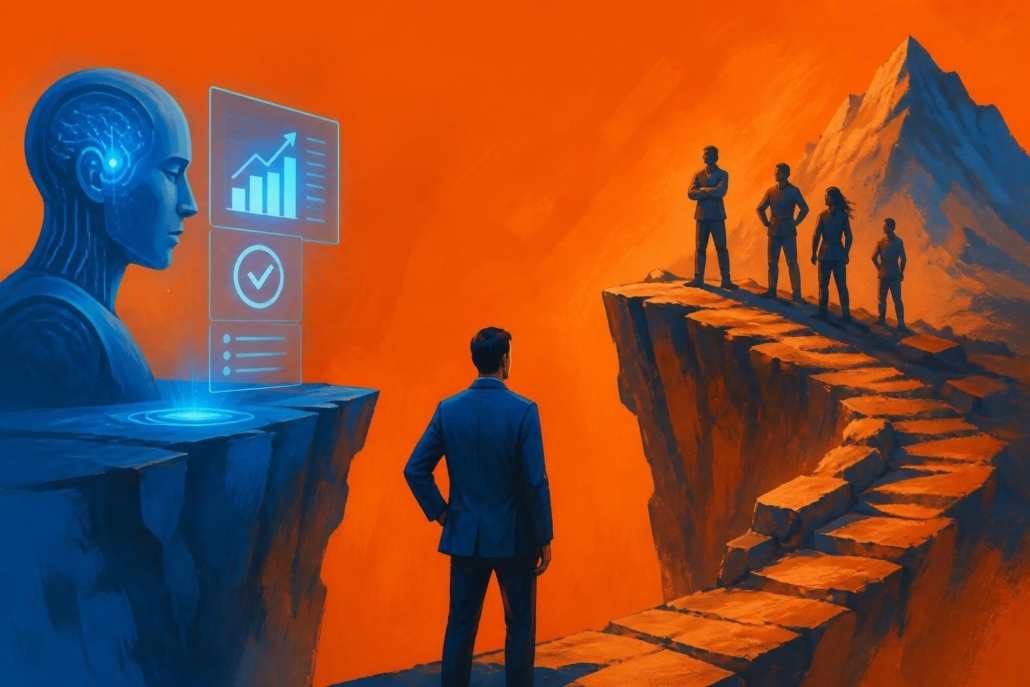
AI Advice Without Accountability Failed Me
I watched a VP of Sales follow AI-generated coaching advice for three months. The recommendations sounded impressive: reframe quarterly goals, restructure one-on-ones, deploy new accountability rituals. By month four, his team's pipeline had dropped 22%, two key account managers had resigned, and he couldn't explain what went wrong because the AI that gave the advice wasn't there to answer questions. That's when ai advice without accountability failed me became more than a cautionary tale. It became a pattern I've seen repeat across mid-market companies trying to scale leadership without investing in real coaching relationships.
The Confidence Problem in AI Coaching Recommendations
AI tools deliver advice with unwavering certainty. They don't hedge, second-guess, or admit uncertainty. Research on detecting hallucinations in large language models shows these systems confidently produce wrong answers in ways that fool even experienced users.
In corporate coaching contexts, this creates three specific failures:
- Leaders implement strategies without understanding the underlying assumptions
- Teams follow processes that don't fit their actual operating rhythm or culture
- Organizations lose months chasing metrics that weren't properly diagnosed in the first place
The VP I mentioned earlier had asked an AI tool how to improve team accountability. The system recommended daily stand-ups, public KPI dashboards, and weekly performance reviews. All textbook moves. None contextualized to a field sales team spread across four time zones selling complex enterprise software with 9-month cycles.
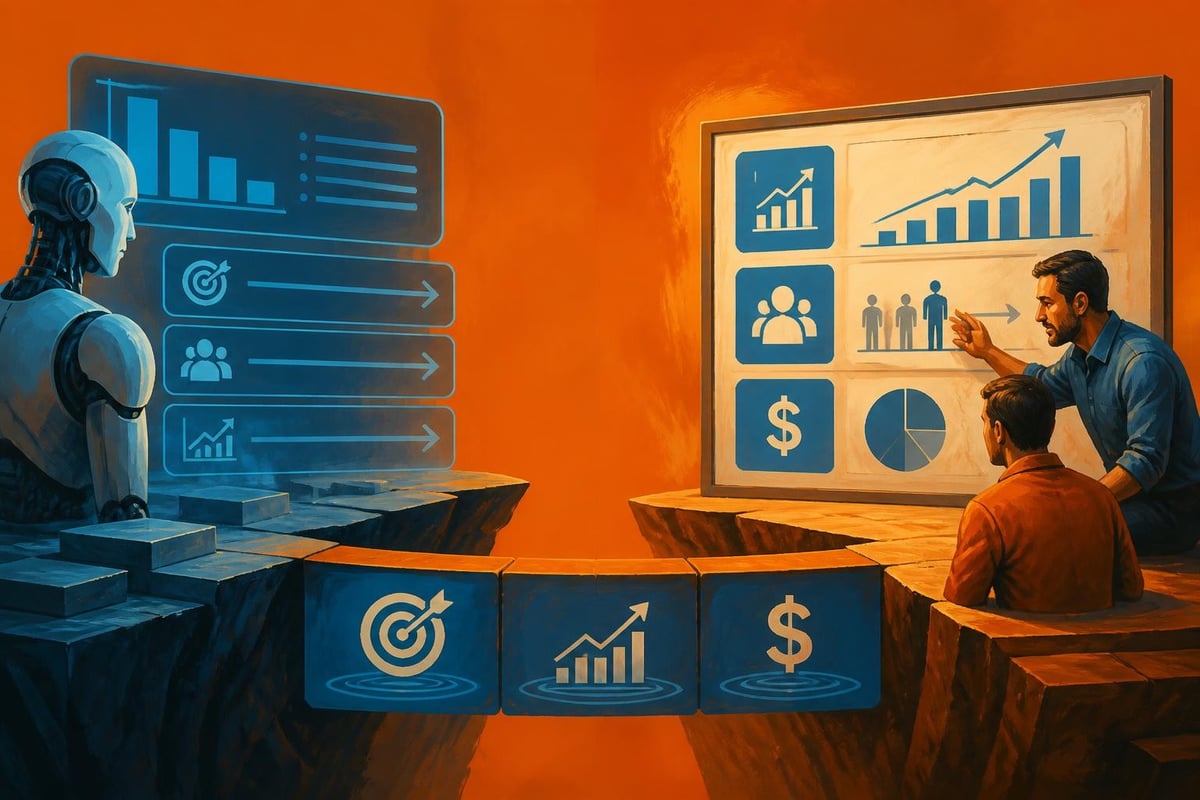
When I asked him why he chose those particular tactics, he said, "The AI seemed confident, and I didn't have anyone to push back." That sentence captures the core failure mode. AI advice without accountability failed me because there's no one in the loop to say, "That won't work here, and here's why."
What Accountability Actually Means in Leadership Development
Real coaching accountability has three components that AI fundamentally cannot provide: ownership of outcomes, adaptation based on real-time feedback, and consequence when advice fails.
| Accountability Element | Human Coach | AI Tool |
|---|---|---|
| Owns the outcome | Yes, reputation and relationship at stake | No, system generates output without consequence |
| Adapts in real-time | Yes, observes, questions, adjusts | No, produces static recommendations |
| Shares risk | Yes, can tie fees to results | No, subscription continues regardless |
Consider team coaching in practice. A coach sits in your leadership meetings, watches communication patterns break down, spots the two people who never speak up, notices when decisions stall because roles aren't clear. Then they intervene, right there, with context. An AI tool can't observe a Zoom call and detect that your CFO dismisses every idea from operations, or that your weekly reviews skip the hard conversations.
The NTIA’s AI Accountability Policy Report outlines why policy-level accountability matters for AI systems, but corporate leadership development requires personal accountability. Someone needs to care whether your managers actually improve, not just whether they consumed content.
The Documented Failures Add Up
The AIIncidentLaw database catalogs cases where AI advice led to measurable harm. While many focus on healthcare or finance, the accountability gap applies equally to business coaching. When AI recommends firing an underperformer without diagnosing whether they lack skill, clarity, or support, and that advice gets followed, who's responsible? Not the algorithm.
I've seen this play out in manager training scenarios. A director asked an AI how to handle a struggling team lead. The response: "Set clear expectations, document performance issues, prepare a performance improvement plan." Technically correct. Practically useless. The real problem was the team lead had never received any training, was managing people for the first time, and needed coaching on delegation, not documentation for termination. Ai advice without accountability failed me again because no one diagnosed the root cause.
Why Leaders Keep Falling for Confident Algorithms
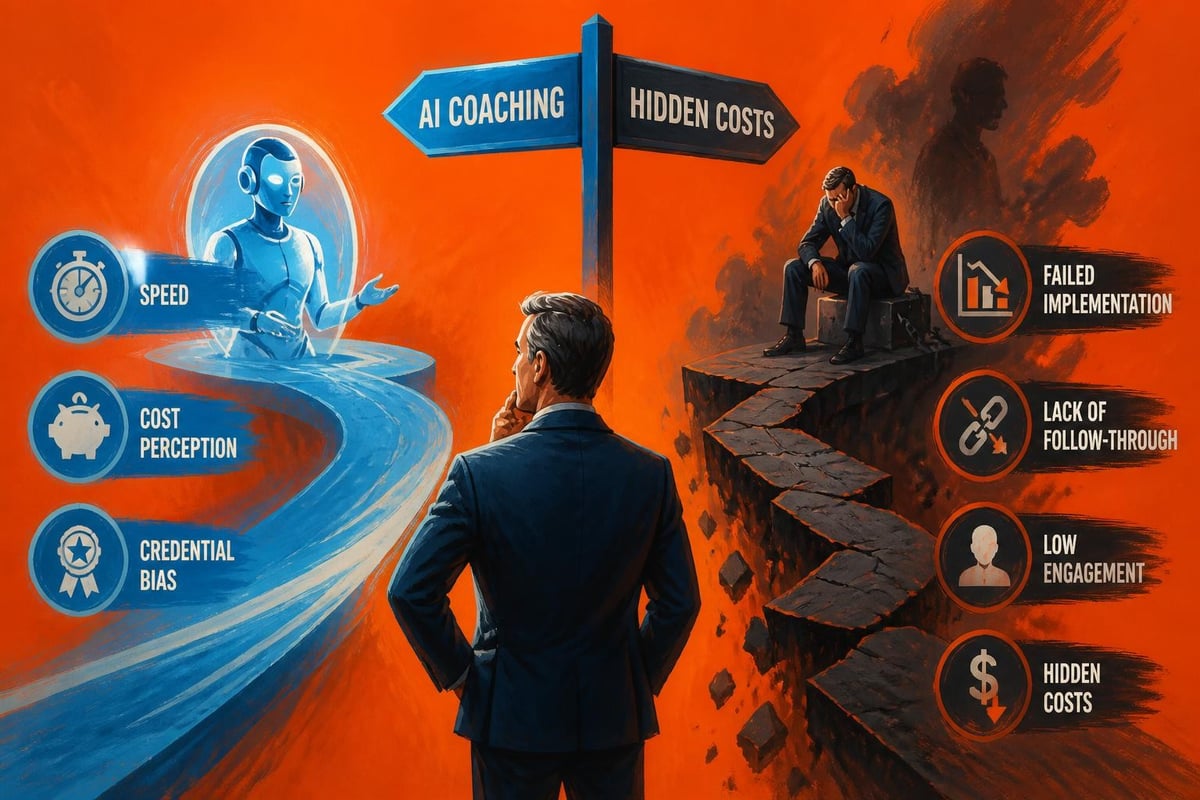
Three forces drive leaders toward AI advice despite the accountability gap:
- Speed bias: AI answers instantly; human coaches ask clarifying questions first
- Cost perception: Monthly subscriptions feel cheaper than coaching engagements (until you measure the cost of failed initiatives)
- Credential worship: If an AI was trained on thousands of leadership books, it must know more than a practitioner
Research on clinicians’ perspectives on AI decision support reveals similar patterns in healthcare. Professionals want the efficiency but struggle with liability when AI advice proves wrong. In corporate settings, the liability is softer but the damage is real: wasted quarters, burned-out teams, lost talent.
The alternative isn't to abandon AI tools entirely. It's to recognize what they can and cannot do. AI excels at pattern matching, content generation, and organizing information. It fails at diagnosing unique organizational dysfunction, reading room dynamics, and holding leaders accountable to commitments when it's uncomfortable.
The Accountability Architecture That Actually Works
After watching ai advice without accountability fail repeatedly, here's what I've seen work in mid-market companies:
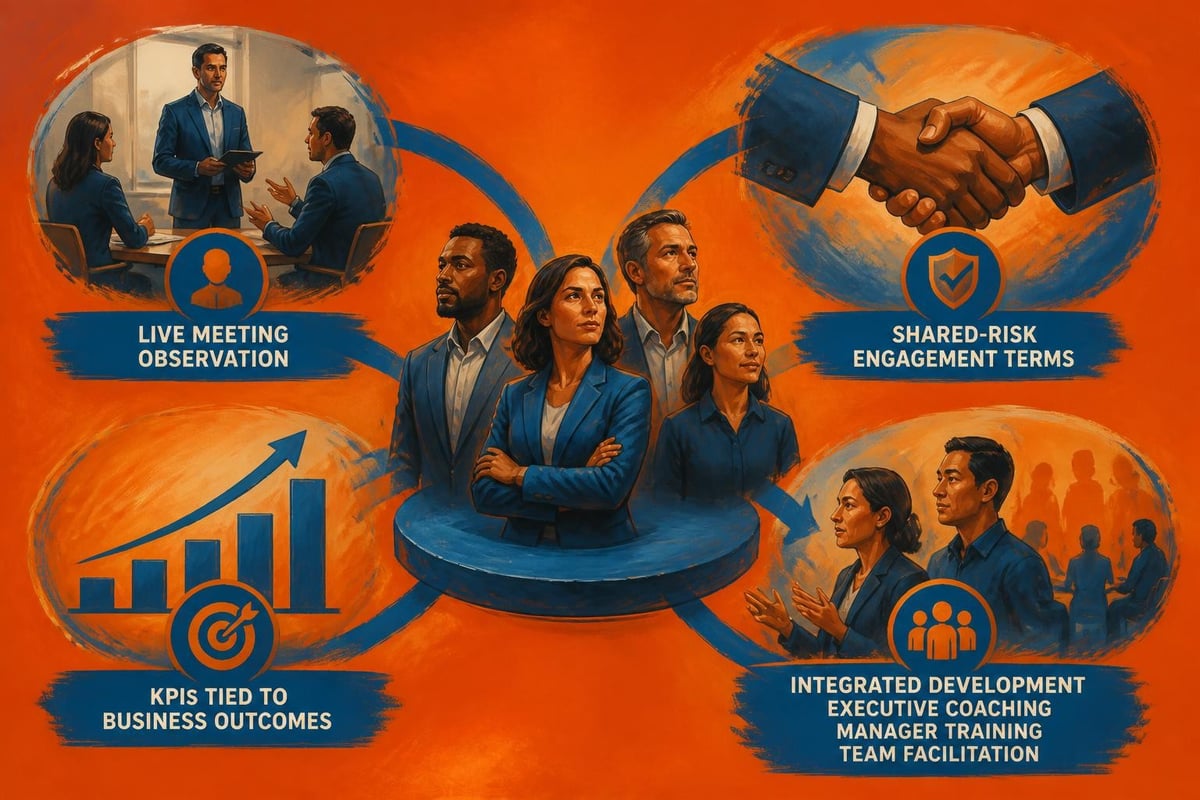
Direct Observation and Real-Time Coaching
Executive coaching that sits in your operating rhythm, not outside it. Coaches who join leadership meetings, listen to how decisions get made, and spot the patterns you can't see from inside.
Shared-Risk Structures
Month-to-month engagements where the coach's continued involvement depends on visible results. If pipeline metrics, retention numbers, or decision velocity don't improve, the relationship should end. This forces real accountability on both sides.
KPIs Tied to Business Outcomes
Not coaching satisfaction scores or session completion rates. Actual business metrics: time to decision, manager retention, internal promotion rates, revenue per team member, customer retention in key accounts. When coaching outcomes connect to P&L impact, accountability becomes measurable.
| Traditional Coaching Metric | Accountable Alternative |
|---|---|
| Sessions completed | Decisions made faster |
| Satisfaction surveys | Manager retention rate |
| 360 feedback scores | Revenue per employee growth |
| Action items logged | Strategic priorities executed on time |
Integrated Development Architecture
Coaching that doesn't stop at advice. It includes 360 assessments to diagnose gaps, operating cadence work to ensure decisions stick, and sales or retention coaching tied to actual pipeline movement. Business coaching that integrates across functions costs more upfront but wastes less time on strategies that sound good but don't execute.
The Transparency Standard You Should Demand
Microsoft’s Responsible AI Transparency Report shows what accountability looks like at the platform level. But coaching relationships need transparency at the engagement level: What's the diagnosis? What results are we targeting? How will we measure? What happens if we don't hit milestones?
I've audited dozens of coaching engagements that failed. The common pattern: vague goals ("improve leadership"), no measurement framework, and no checkpoints where either party could exit based on evidence. Contrast that with engagements structured around quarterly KPI reviews where both coach and client assess progress against defined outcomes. The second model forces real accountability. The first just burns budget.
What Buyers Miss When Evaluating Coaching Options
Most RFPs for leadership development focus on coach credentials, methodology, and content. Almost none ask: "How do you take ownership of outcomes? What happens if your approach doesn't work for our context? How do you measure whether leaders actually improve?"
The Ada Lovelace Institute’s work on algorithmic accountability in government shows that even well-intentioned policy mechanisms fail without practical enforcement. Corporate coaching needs the same scrutiny. Does your coaching partner show up in your business rhythm, or do they stay safely in scheduled sessions? Do they adapt based on what they observe, or deliver pre-built modules regardless of fit?
When ai advice without accountability failed me, it wasn't because the advice was always wrong. Sometimes it was directionally correct. But direction without diagnosis, context, and follow-through produces random motion, not progress. Leaders need partners who care whether the advice works, not just whether it sounds authoritative.
AI tools can support leadership development, but they can't replace the accountability that drives real change. When you need coaching that ties to business results, shares risk, and adapts based on what's actually happening in your organization, Noomii connects you with coaches who roll up their sleeves and own outcomes alongside you. We work month-to-month, measure what matters, and stay because progress is visible, not because you're locked into a contract.
FAQ
What makes AI coaching advice fail in corporate settings?
AI lacks the ability to diagnose organizational context, observe real-time team dynamics, or adapt recommendations based on implementation feedback. It produces confident-sounding generic strategies without accountability for whether they work in your specific environment.
How is accountable coaching different from traditional coaching?
Accountable coaching ties directly to measurable business outcomes like decision speed, manager retention, and revenue metrics. Coaches take ownership by working month-to-month with shared risk, participating in actual business operations, and adjusting based on KPI results rather than satisfaction scores.
Can AI tools be useful in leadership development at all?
Yes, for organizing information, drafting communication templates, or summarizing patterns in feedback data. But they should support human coaches who provide diagnosis, real-time adaptation, and accountability, not replace them.
What should I look for in a corporate coaching engagement?
Direct observation of your team in action, clear KPIs tied to business outcomes, month-to-month terms with exit options based on results, and coaches who integrate into your operating rhythm rather than staying in scheduled sessions only.
Why do leaders keep choosing AI advice despite accountability gaps?
Speed bias (instant answers feel efficient), cost perception (subscriptions seem cheaper than engagements), and credential worship (belief that AI trained on thousands of sources must be superior to practitioner experience).
What happened when companies implemented AI coaching recommendations without human oversight?
Common failures include teams following processes that don't fit their operating rhythm, leaders implementing strategies without understanding assumptions, and organizations losing months on initiatives that weren't properly diagnosed for their context.
How do you measure whether coaching actually works?
Track business metrics like time to decision, internal promotion rates, manager retention, revenue per employee, and strategic priority completion rates. Avoid relying solely on satisfaction surveys or session completion counts.
What does shared-risk coaching mean in practice?
Coaches work month-to-month where continued engagement depends on visible KPI improvement. If pipeline metrics, retention numbers, or decision velocity don't progress, the relationship ends naturally rather than continuing because of contract obligations.
Should companies abandon AI tools entirely for leadership development?
No, but recognize the limits. Use AI for support tasks while ensuring human coaches provide the diagnosis, contextual adaptation, and personal accountability that drives measurable business results and owns outcomes when strategies need adjustment.


Leave a Reply
Want to join the discussion?Feel free to contribute!